What SETI@home was Designed to Find
The core hypothesis behind SETI@home was precise: If an extraterrestrial civilization wanted to be detected, it might transmit a narrowband signal, a radio emission confined to an extremely small frequency range, that natural astrophysical processes are not known to produce.
Detecting such signals is computationally demanding. As Earth rotates and orbits the Sun, incoming transmissions experience the Doppler effect, meaning their observed frequency changes due to the relative motion between the source and the observer. Correcting for this drift across many possible motion scenarios requires substantial computational resources.
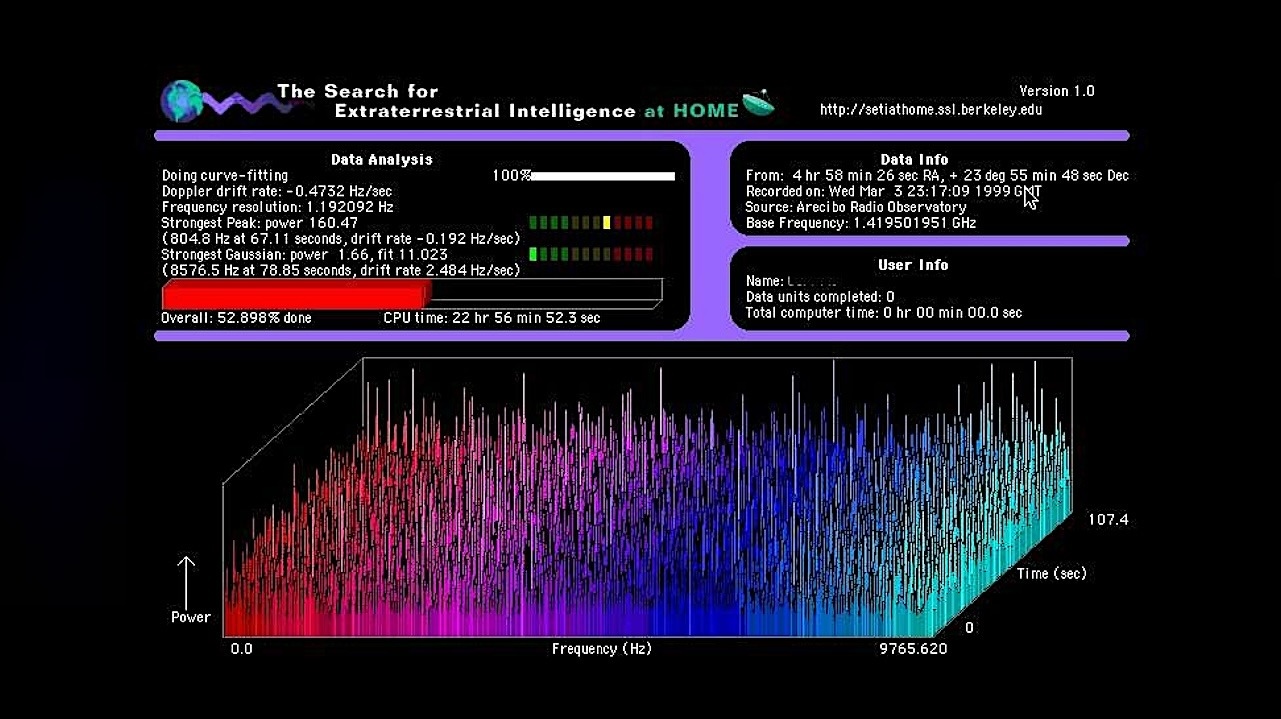
SETI@home’s key innovation was to distribute that workload. Rather than relying on on-site spectrometers, the project sent baseband data, raw streams of recorded voltages from radio telescopes, to volunteers’ computers. Each system applied Doppler corrections, generated spectra, and searched for features indicative of an artificial origin. This approach increased sensitivity by roughly an order of magnitude, allowing astronomers to probe significantly farther into the galaxy than conventional real-time systems.
From Fourteen Billion Candidates to One Hundred
Over its 20 years of operation, SETI@home generated a database of approximately 14 billion candidate signals. Most were quickly classified as either random thermal noise or radio frequency interference (RFI), contamination from human technology such as satellites, radar systems, or terrestrial transmitters.
To identify genuine astrophysical candidates, Korpela and his colleagues developed algorithms that rejected signals inconsistent with distant cosmic sources. Signals that appeared at the same frequency across widely separated points in the sky, for example, were strong indicators of nearby or Earth-orbiting interference.
The team also introduced synthetic “extraterrestrial” signals into the dataset. These blind insertions allowed researchers to verify that their filtering methods could still recover artificial patterns even when they did not know where or how the test signals were embedded. Only candidates that ranked alongside these synthetic benchmarks were retained.
That rigorous process reduced billions of detections to roughly 100 candidates. These are not detections. They are faint, intermittent statistical outliers – signals that appeared only two or three times across repeated observations of the same sky positions – worthy of further scrutiny rather than immediate claims of discovery.
Testing the Candidates with FAST
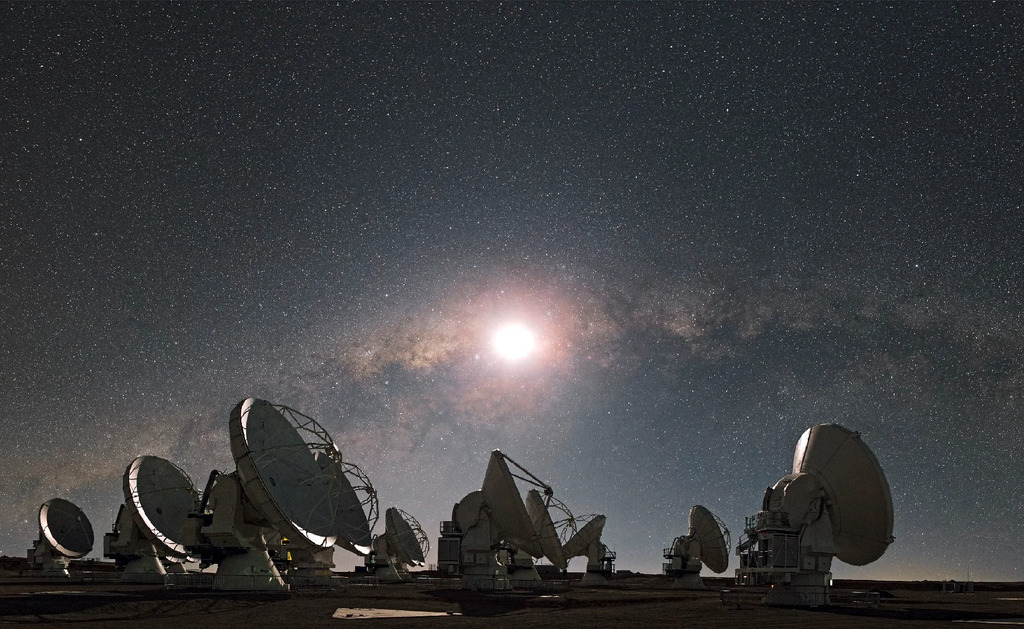
The next phase of the research relies on the Five-hundred-meter Aperture Spherical Telescope (FAST) in China, currently the world’s largest single-dish radio telescope. By revisiting the same regions of the sky, researchers can test whether candidate signals repeat under independent observations.
Repeatability is essential. A genuine extraterrestrial transmission should persist in both time and frequency when observed again. So far, none of the candidates have met that threshold. The results remain consistent with expectations from statistical chance and residual interference.
The Role of Machine Learning and Its Limits
Modern machine learning techniques have become powerful tools for recognizing patterns in large datasets. The SETI@home team tested these approaches but found that carefully designed, hand-coded algorithms performed just as effectively for this specific dataset.
Any filtering strategy carries risk. Signals that resemble human-made interference or fall within heavily used frequency bands may be discarded, even if they originate from an unexpected extraterrestrial source. To mitigate this, SETI@home employed multiple detection strategies, including pulse searches and autocorrelation, a mathematical method for identifying repeated waveforms hidden in noisy data.
Scientific Value Beyond SETI
The SETI@home archive has contributed more than technosignature signals. The same observations were used to produce detailed maps of galactic hydrogen, the universe's most abundant element, and a fundamental tracer of star formation. For several years, data derived from SETI@home supported the most comprehensive single-dish survey of hydrogen in the Milky Way.
This dual-use outcome reflects a broader principle of modern astronomy: carefully preserved data can address scientific questions far beyond their original purpose.
A Model for Future Exploration
Advances in computing and data storage continue to lower the barriers to planet-scale science. While any successor to SETI@home would require sustained institutional and public support, the scientific framework remains compelling. Distributed analysis can, in some cases, achieve sensitivity levels beyond real-time systems, offering a powerful complement to modern observatories.
Watch the full SETI Live conversation here.
)