)

From cis-lunar space, MARBLE will observe Earth the way we might see a planet like Earth orbiting a distant star: not as a world of oceans and continents, but as a tiny point of light. By measuring its color, brightness, and polarization, MARBLE will create the first real-world reference dataset for how an inhabited planet looks from afar, a guide for detecting life beyond our solar system.
Astronomers have discovered vast numbers of planets orbiting other stars (exoplanets). With hundreds of billions of stars in the galaxy, there could be as many, or even more, exoplanets. Like Earth, many of these planets are in the so-called “habitable zones” of their sunlike stars, where liquid water could exist, neither too hot nor too cold, warmed by the heat of their star.
Missions such as NASA’s Habitable Worlds Observatory (HWO) will directly detect such worlds nearby and assess their potential for life. But even the most advanced space- and ground-based telescopes will see these worlds only as faint, unresolved points of light.
Scientists will rely on these faint signals to characterize exoplanets. Measuring the brightness, color and spectra of these planets over time is key, enabling researchers to detect atmospheric gases, while small brightness and color fluctuations could reveal continents and oceans. Interpreting these measurements will be difficult and ambiguous unless we use all the information available in the single point of light which is the exoplanet.
That’s where MARBLE comes in.
Light contains more information than only brightness and color. Polarization, the orientation of the electromagnetic waves that comprise a light beam, can provide clues about a planet’s surface and atmosphere.
By observing Earth from the Moon, we see it at all its phases, from full to crescent, just as the Moon appears from Earth. As these different phases progress, the polarization of light reflected by Earth reveals the nature of Earth’s clouds, oceans and atmosphere, allowing us to characterize atmospheric molecules and aerosols, probe for water and, hence habitability, through ocean glint and rainbows. We can even search for the biomolecules of living organisms. We get the best of all worlds – spectra, brightness and color, coupled with the unique diagnostics afforded by measuring light polarization.
The Moon offers the perfect location to monitor these characteristics as the Earth moves through its sequence of phases, and observing the changes as it rotates and proceeds through its seasons yields deeper insights into our search for habitability and life.
MARBLE’s goal is to observe Earth as the archetype of a living exoplanet.
By understanding how our own inhabited Earth appears when reduced to a distant point of light, we can prepare to recognize habitability and even life around other stars.
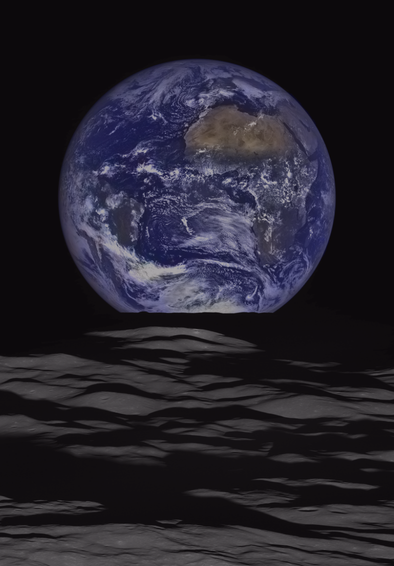
MARBLE represents a unique utilization of commercial lunar infrastructure to provide a valuable scientific research platform, an important expansion of the utility of cis-lunar space.
MARBLE aligns with the SETI Institute’s goal of finding life beyond Earth by observing Earth and validating search methods for life elsewhere. Seeing how Earth might appear to a distant observer provides tremendous material and opportunity for public engagement, both scientific and artistic, reflecting the significance of the search for life elsewhere. In extreme, can we see ourselves, evidence of humanity, our cities, agriculture, impacts to the environment, while appreciating the beauty and vulnerability of Earth?
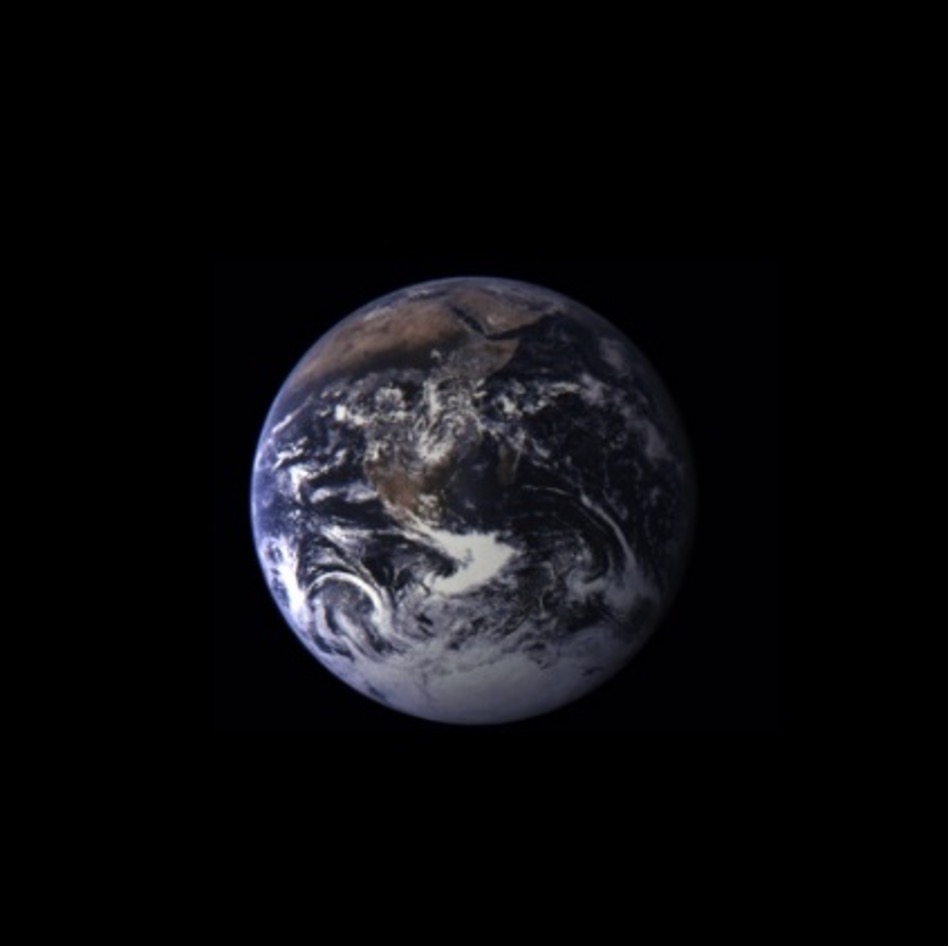
MARBLE simulated observation for the famous Blue Marble image.