)

Friday, Sep 12, 2025
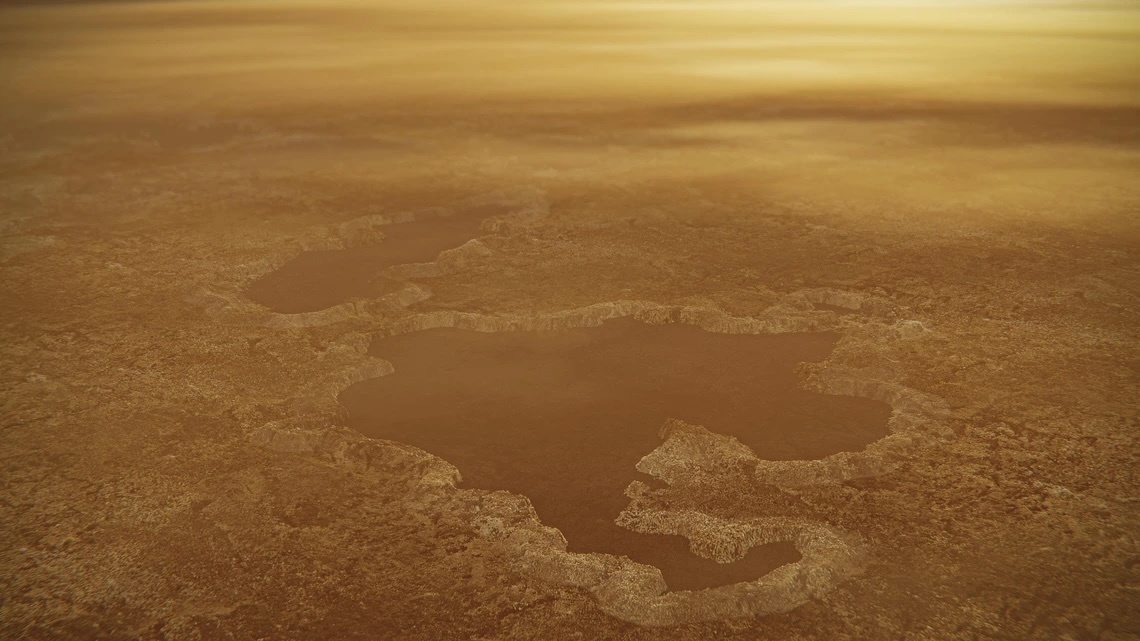
This artist's concept of a lake at the north pole of Saturn's moon Titan illustrates raised rims and rampart-like features as seen by NASA's Cassini spacecraft. Credit: NASA/JPL-Caltech.
At a Glance
|
Saturn’s largest moon, Titan, is a complex environment. It hosts rivers and lakes of liquid methane, fields of icy boulders, extensive sand dunes, and, beneath its frozen crust, a vast subsurface ocean. This unique combination makes Titan one of the most intriguing subjects in astrobiology.
A new study led by ETH Zurich fellow Dr. Antonin Affholder examines whether that subsurface ocean could support life. His findings, discussed in a recent SETI Live with SETI Institute communications specialist Beth Johnson, suggest that if life exists there, it may persist only in extremely small amounts, making detection a formidable challenge.
Why Titan Matters in Astrobiology
Titan is unusual among moons. It has a dense atmosphere rich in organic molecules—compounds built primarily from carbon and hydrogen. These molecules are considered precursors to life and resemble those thought to have existed in Earth’s early atmosphere.
In addition to its organic-rich surface and atmosphere, Titan contains a global ocean of liquid water beneath its ice shell. Because all known life on Earth depends on liquid water for metabolism, the discovery of this ocean significantly increases Titan’s relevance to astrobiology.
As Dr. Affholder explains, Titan’s habitability can be approached from two perspectives:
- Prebiotic chemistry: studying how complex molecules assemble before life emerges
- Extant life: assessing whether microbial-scale organisms could survive in Titan’s ocean
Testing a Simple Metabolism
To evaluate Titan’s potential for supporting life, Dr. Affholder and his team focused on fermentation. Fermentation is how some organisms make energy when there’s no oxygen around. The food they’re breaking down basically “recycles itself” in the process, doing the job that oxygen normally would. It’s the same trick yeast uses to make bread rise and to turn grape juice into wine. Scientifically speaking, fermentation is a redox reaction where the same molecule is both the donor of an electron (oxidation) and the recipient of an electron (reduction)
On Earth, fermentation is one of the simplest and oldest metabolisms. It predates the evolution of oxygen-based respiration and can occur under strict anaerobic conditions. These features make fermentation a conservative model for studying alien environments, as it does not require assuming the presence of oxygen or other electron acceptors, such as sulfur or iron.
The team modeled fermentation using glycine, one of the simplest amino acids, as a potential source of food. By comparing the energy available from glycine fermentation to the energy demands of microbial life, they evaluated whether Titan’s conditions could sustain cells.
Results: A Minimal Biosphere
The study concludes that fermentation on Titan could, in theory, sustain life, but only at an extremely low biomass. Dr. Affholder estimates that the total living material might amount to just a few kilograms spread across Titan’s entire ocean.
Such a small biosphere would be nearly undetectable by direct sampling. However, low biomass does not necessarily mean weak signatures. Over billions of years, even small populations of microorganisms can alter the chemical composition of an atmosphere or ocean. Early Earth likely hosted similarly sparse microbial ecosystems before the advent of photosynthesis transformed the biosphere.
Implications for Exploration
These results refine scientists' understanding of Titan’s astrobiological potential. The presence of organics and liquid water remains compelling, but the study suggests that scientists should search for localized environments where life could be concentrated. Hydrothermal vents on the seafloor or sites where the ocean interacts with Titan’s ice shell may provide more favorable conditions.
NASA’s upcoming Dragonfly mission, a rotorcraft lander set to launch in 2028, will be critical for advancing Titan science. Designed as a multipurpose platform, Dragonfly will analyze Titan’s atmospheric chemistry, surface organics, and geological processes. While not a dedicated life-detection mission, it will establish a foundation for understanding how surface and subsurface environments interact, a key factor for assessing habitability.
Titan, Enceladus, and Europa
But how does Titan compare with other icy moons? Dr. Affholder emphasizes that while Titan offers a broader range of chemical possibilities, Saturn’s smaller moon Enceladus may be a more strategic near-term target. Enceladus actively ejects plumes of ocean material into space, allowing spacecraft to sample subsurface chemistry directly. Europa, a moon of Jupiter, also hosts a deep ocean beneath its ice shell but presents greater challenges due to its radiation environment.
Together, these worlds provide complementary opportunities for exploring ocean worlds and testing hypotheses about the distribution of life in the Solar System.
What Comes Next
Dr. Affholder is continuing to study planetary habitability, shifting focus from Titan to early Earth. His current research investigates the long delay between the emergence of photosynthesis and the accumulation of oxygen in Earth’s atmosphere. Understanding this transition is essential for evaluating whether oxygen is a reliable biosignature (a measurable indicator of life) on exoplanets. As telescopes like JWST advance the study of exoplanet atmospheres, such insights will help scientists interpret whether detected molecules truly indicate the presence of life.
Watch the full SETI Live conversation with Dr. Antonin Affholder, and read the press release and published paper.







News
Related News
Jul 2, 2026
How Clouds Hide Alien Worlds—and How Astronomers See Through Them
#Blog #Lauren Sgro
Jun 29, 2026
Humanity's Plan for First Contact: Who Speaks for Earth?
#Blog #Lauren Sgro #Lucian Walkowicz #Chelsea Haramia #SETI #SETI Institute
Jun 26, 2026
What Juice Revealed About Interstellar Comet 3I/ATLAS
#Blog #3I/ATLAS #Franck Marchis #Juice
Jun 12, 2026
Not Planets, Not Stars: NASA Volunteers Doubled the Number of Known Brown Dwarfs
#Blog #Lauren Sgro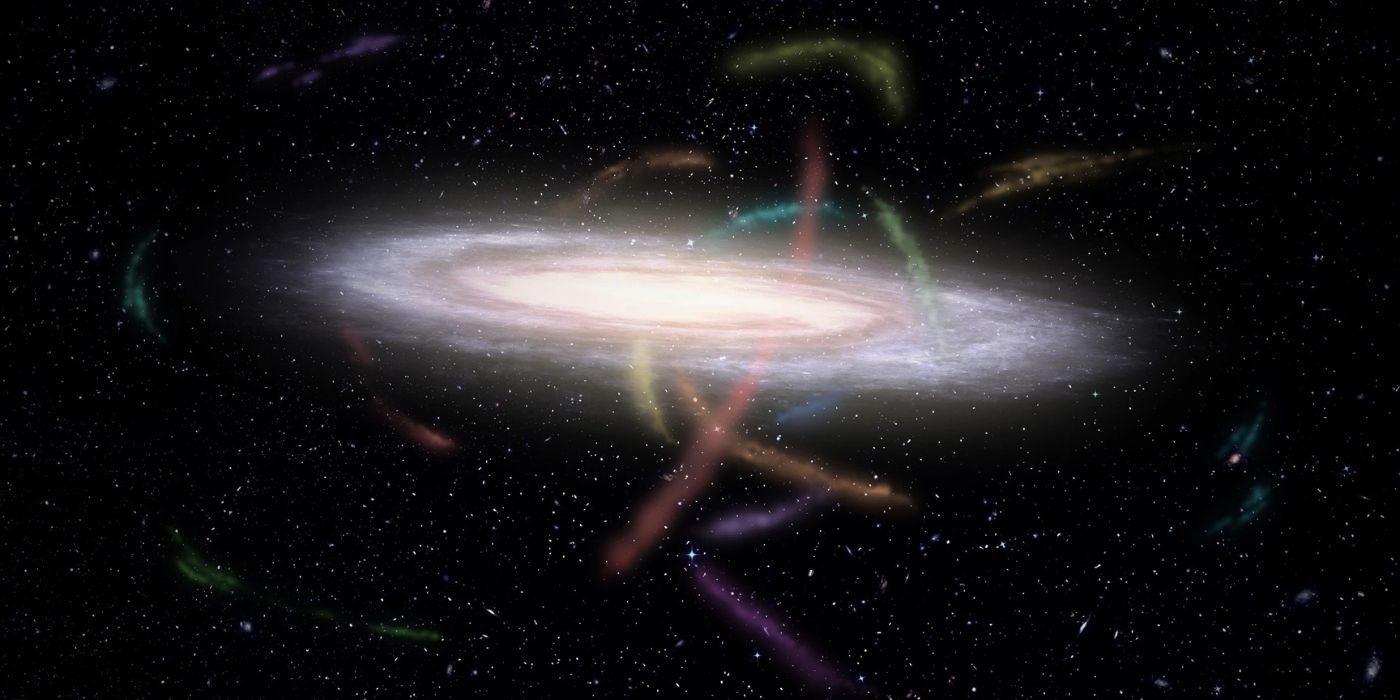
Jun 11, 2026
Life is But a Stream: Planetary Systems Along Stellar Streams
#Blog #Moiya McTier
Jun 8, 2026
The Sounds of Intelligence: A Conversation with 2026 Drake Award Recipient Lori Marino
#Blog #Drake Awards #Lori Marino #SETI
Jul 2, 2026
#Blog
#Lauren Sgro
Jun 29, 2026
#Blog
#Lauren Sgro
#Lucian Walkowicz
#Chelsea Haramia
#SETI
#SETI Institute
Humanity's Plan for First Contact: Who Speaks for Earth?
Jun 26, 2026
#Blog
#3I/ATLAS
#Franck Marchis
#Juice
What Juice Revealed About Interstellar Comet 3I/ATLAS
Jun 12, 2026
#Blog
#Lauren Sgro
Not Planets, Not Stars: NASA Volunteers Doubled the Number of Known Brown Dwarfs
Jun 11, 2026
#Blog
#Moiya McTier
Life is But a Stream: Planetary Systems Along Stellar Streams
Jun 8, 2026
#Blog
#Drake Awards
#Lori Marino
#SETI
The Sounds of Intelligence: A Conversation with 2026 Drake Award Recipient Lori Marino
Research
Related Projects

SkyMapper • SETI • Citizen Science • Astronomy
SkyMapper: Expanding Access to Real-time Astronomy Through a Global Astronomical Network
SkyMapper and the SETI Institute are connecting educators, students and the public to live astronomical observations through a distributed astronomical network. #SkyMapper #SETI #Citizen Science #Astronomy
VPL
Virtual Planetary Laboratory
How can we best assess whether an exoplanet supports life? #VPL
Discovery and Futures Lab
Discovery and Futures Lab
What happens if life beyond Earth is discovered? The Discovery and Futures Lab at the SETI Institute fosters novel and anticipatory research at the intersection of science, society, our planet, and the search for life beyond Earth. #Discovery and Futures Lab
May 17, 2026
SkyMapper: Expanding Access to Real-time Astronomy Through a Global Astronomical Network
SkyMapper and the SETI Institute are connecting educators, students and the public to live astronomical observations through a distributed astronomical network.
#SkyMapper
#SETI
#Citizen Science
#Astronomy
May 5, 2026
Virtual Planetary Laboratory
How can we best assess whether an exoplanet supports life?
#VPL
Apr 16, 2026
Discovery and Futures Lab
What happens if life beyond Earth is discovered? The Discovery and Futures Lab at the SETI Institute fosters novel and anticipatory research at the intersection of science, society, our planet, and the search for life beyond Earth.
#Discovery and Futures Lab
Support Us
Support the
SETI Institute
Scientists are getting closer in their search for life beyond earth. But with limited federal funding for the search for extraterrestrial intelligence, supporters are the reason cutting-edge scientists can keep their eyes on the sky.
