Tuesday, Sep 09, 2025

LaserSETI instruments at Isla Magueyes, Puerto Rico. From left to right: Dr. Abel Méndez, student Francisco Pacheco-Vellón, Dr. Franck Marchis, Dr. Lauren Sgro, and LaserSETI Principal Investigator Eliot Gillum.

At a Glance

  • LaserSETI expanded to Puerto Rico with three new instruments
  • Site chosen for its clearer southern skies and low light pollution
  • Dr. Abel Méndez’s team conducted the first modern reanalysis of the 1977 Wow! Signal using advanced signal-processing tools
  • Found similar narrowband emissions from compact hydrogen clouds, suggesting natural astrophysical origins
  • Recalibration placed the Wow! Signal’s sky position more precisely, and revealed its intensity was four times greater than earlier estimates
  • Even if natural, the signal may represent a previously unrecognized astrophysical process, advancing both SETI and radio astronomy
  • SETI Live: https://www.youtube.com/watch?v=NgIV41taoCU
  • https://www.seti.org/news/laserseti-live-puerto-rico-edition-a-new-observatory-revisiting-the-wow-signal/

This special edition of SETI Live featured SETI Institute postdoctoral researcher Dr. Lauren Sgro, outreach manager for the LaserSETI project, in conversation with professor Dr. Abel Méndez, a planetary astrobiologist and director of the Planetary Habitability Laboratory at the University of Puerto Rico (UPR) at Arecibo.

Broadcast from Isla Magueyes in Puerto Rico, the episode highlighted the installation of three new LaserSETI instruments at UPR at Mayaguez’s Department of Marine Sciences. The discussion also explored Dr. Méndez’s recent research on the historic Wow! Signal, one of the most iconic detections in the history of the search for extraterrestrial intelligence.

A Fourth Observatory Joins the Global Network

The SETI Institute’s LaserSETI project has reached its latest milestone with the installation of three new instruments in Puerto Rico. Hosted on the rooftop of UPR at Mayaguez’s Department of Marine Sciences on Isla Magueyes, this site became the fourth LaserSETI observatory worldwide.

LaserSETI is designed as an all-sky, all-the-time survey to detect brief optical laser pulses. Such pulses are not known to occur naturally. Detecting one would point to either an undiscovered astrophysical phenomenon or a potential signal from extraterrestrial intelligence.

The Puerto Rico installation joins observatories in California, Arizona, and Hawaiʻi, and will overlap with fields of view from Sedona and future sites such as the Canary Islands. With this network, LaserSETI is now able to survey an estimated 30–40% of the night sky.

Why Puerto Rico?

The choice of Isla Magueyes was a strategic one. Dr. Méndez, who helped facilitate the installation and whose team will monitor the new instruments, emphasized the importance of local conditions. Northern Puerto Rico experiences high cloud cover, making optical observations challenging. The south of the island, however, is drier with clearer skies.

While campuses in other towns were considered, issues such as light pollution ruled them out. Isla Magueyes, already a research hub for marine science, offered the right combination of low illumination and favorable weather. The installation was carried out with the assistance of the Astronomical Society of the Caribbean (Sociedad de Astronomía del Caribe) and students from the University of Puerto Rico, ensuring long-term collaboration and local expertise in instrument maintenance and data analysis.

Involving Students and Expanding Applications

LaserSETI’s arrival in Puerto Rico opens opportunities for student engagement in optical astronomy. Dr. Méndez and colleagues plan to involve undergraduates in instrument monitoring and data analysis. Beyond SETI, the instruments may also be used to investigate meteors, atmospheric events, and other transient optical phenomena.

This aligns with ongoing efforts in Puerto Rico to establish a complementary radio astronomy survey. Dr. Méndez described a project developing small, affordable radio telescopes that could operate as a global network. Coordinating between optical and radio observatories strengthens the ability to confirm transient events across different wavelengths, from supernovae to fast radio bursts.

Revisiting the Wow! Signal

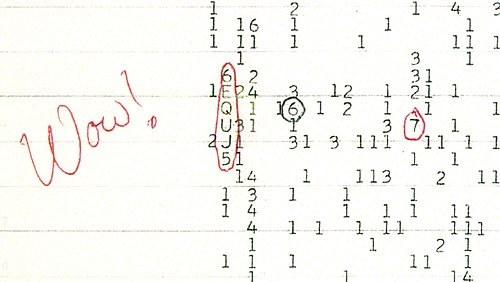
The Wow! Signal represented as "6EQUJ5". The Ohio History Connection preserves the original printout with Ehman's handwritten exclamation.

Detected in 1977 by the Big Ear radio telescope at Ohio State University, the Wow! Signal was a 72-second-long burst at the hydrogen line frequency (1.42 GHz). Its intensity and characteristics stood out, and SETI researcher Jerry Ehman famously circled the signal printout and wrote “Wow!”—a label that has endured for nearly five decades.

Dr. Méndez’s team reanalyzed archival Big Ear data with modern signal-processing techniques. Unlike the 1970s, when data were printed on paper and analyzed manually, today’s digital tools allow for large-scale comparisons across the entire dataset. This approach revealed similar but less intense signals consistent with natural emissions from compact hydrogen clouds.

Hydrogen clouds can emit narrowband radio signals, but the Wow! Signal was unusually strong and transient. To explain this, Méndez’s team has explored astrophysical processes such as maser flares and superradiance—mechanisms that can temporarily brighten hydrogen emissions. Both phenomena have been theorized, but have not been previously applied to the Wow! Signal.

Pinpointing the Signal’s Origin

Another advancement from the study was refining the position of the Wow! Signal. Using known radio sources to recalibrate the Big Ear telescope’s pointing accuracy, the team corrected for small instrumental offsets. This enabled them to identify a more precise sky location for the 1977 detection than had been possible before.

The analysis also showed that the signal’s intensity was likely underestimated in earlier studies. By accounting for variable noise levels near the Galactic Center, Dr. Méndez’s team concluded that the Wow! Signal was at least four times stronger than previously reported. He also noted that the chances of the signal’s origin being radio interference from manmade sources appear increasingly slim as analysis continues.

Why It Still Matters

Whether or not the Wow! Signal was a transient astrophysical event or something more exotic, it remains one of the most intriguing moments in SETI history. Modern analysis demonstrates how archival data, when reexamined with current techniques, can yield new insights. As Dr. Méndez noted, even if the signal ultimately proves to be of natural origin, it may represent a new astrophysical mechanism, similar to how pulsars and fast radio bursts were once considered mysterious.

Looking Forward

The addition of Puerto Rico to the LaserSETI network ensures that future unusual signals will have better chances of being confirmed, especially if they can be followed up with radio observations from similar surveys. Coordinated multi-wavelength coverage, combined with modern analysis techniques, advances both SETI and broader astrophysics.

The collaboration between the SETI Institute, the University of Puerto Rico, and local students underscores the global nature of this work. LaserSETI is not just a search for extraterrestrial technology; it is also a platform for discovery, education, and scientific innovation.

Learn more about LaserSETI and watch the full SETI Live episode featuring Dr. Abel Méndez.

News

Related News

Featured Image
Jun 4, 2026
SETI Institute In the News: May Roundup 2026
#SETI Institute in the News #SETI Institute #Community #Solar System #Matija Ćuk #Neptune #SETI #Bill Diamond #UAPs #Drake Awards #Lori Marino #Matthew Tiscareno #Outreach #Exoplanets #Carl Sagan Center
Featured Image
May 7, 2026
SETI Institute In the News: April Roundup 2026
#SETI Institute in the News #SETI Institute #Community #SETI #Discovery and Futures Lab #Lucian Walkowicz #Chelsea Haramia #NASA Missions and Observatories #Pascal Lee #Mars #Janice Bishop #Mark Showalter #JWST #Uranus #Bill Diamond #UAPs
Featured Image
May 5, 2026
Atlanta Science Festival Exploration Expo and the Arecibo Message
#Community #SETI Institute #Outreach #Education #Lauren Sgro
Featured Image
Apr 30, 2026
Narrowing the Search: The 45 Best Targets for Alien Life
#Blog #Astronomy #JWST #NASA Missions and Observatories #Trappist-1 #LaserSETI #ATA #Franck Marchis
Research

Related Projects

Featured Image
SkyMapper • SETI • Citizen Science • Astronomy
SkyMapper: Expanding Access to Real-time Astronomy Through a Global Astronomical Network
SkyMapper and the SETI Institute are connecting educators, students and the public to live astronomical observations through a distributed astronomical network. #SkyMapper #SETI #Citizen Science #Astronomy
Featured Image
VPL
Virtual Planetary Laboratory
How can we best assess whether an exoplanet supports life? #VPL
Featured Image
Discovery and Futures Lab
What happens if life beyond Earth is discovered? The Discovery and Futures Lab at the SETI Institute fosters novel and anticipatory research at the intersection of science, society, our planet, and the search for life beyond Earth.  #Discovery and Futures Lab
Support Us

Support the
SETI Institute

Scientists are getting closer in their search for life beyond earth. But with limited federal funding for the search for extraterrestrial intelligence, supporters are the reason cutting-edge scientists can keep their eyes on the sky.