)

Monday, Feb 09, 2026
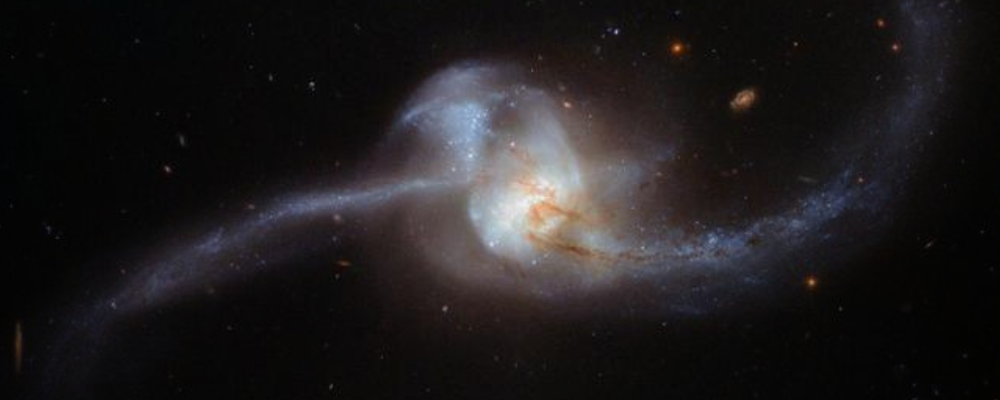
At a Glance
|
The Euclid space telescope is designed to map more than one-third of the sky in optical and near-infrared wavelengths, producing the most detailed three-dimensional map of the universe to date. Operating for at least six years, Euclid will observe galaxies back to when the universe was roughly three billion years old, probing nearly ten billion years of cosmic history.
In a recent SETI Live conversation, science communicator Dr. Moiya McTier spoke with Dr. Berta Margalef-Bentabol, Dr. Lingyu Wang, and Antonio la Marca from the Space Research Organization Netherlands (SRON) to discuss two Euclid studies that address different aspects of a long-standing astrophysical hypothesis: that galaxy mergers play a central role in triggering the most powerful phases of black hole activity, known as active galactic nuclei.
According to Dr. Wang, an expert in galaxy evolution at SRON, what distinguishes Euclid is its unique combination of sharp imaging, depth, and sky coverage. Remarkably, the two studies rely on just one week of Euclid observations, covering an area comparable to the total sky observed by the Hubble Space Telescope over its entire lifetime.
Selecting Half a Million Galaxies
From this early dataset, the team constructed a statistically complete sample of approximately 500,000 massive galaxies. These systems have stellar masses comparable to the Milky Way, between six and ten billion solar masses, and span a critical epoch between three and eight billion years after the Big Bang.
As la Marca, a PhD candidate specializing in galaxy evolution, explains, this period captures galaxies at both their peak of star formation and maximum black hole accretion (the process by which matter falls onto a black hole, releasing energy). Studying galaxies at roughly half the universe’s current age allows researchers to investigate mature systems during their most transformative phase.
Identifying Mergers Using Machine Learning
Galaxy mergers leave distinct morphological signatures. Isolated galaxies tend to appear symmetric, with spiral arms or smooth elliptical shapes. Merging systems, by contrast, exhibit distorted structures, tidal tails, scattered stars, and sometimes multiple bright nuclei.
Because visual inspection is impossible at this scale, the team developed a machine learning model trained on simulated galaxies. The algorithm classifies each Euclid image as either a merger or a non-merger based solely on image morphology. This approach enables rapid, unbiased classification across hundreds of thousands of galaxies.
The findings provide strong statistical confirmation of a long-standing hypothesis: Galaxies undergoing mergers are two to six times more likely to host AGN than non-merging systems.
Measuring Black Hole Activity Without Bias
Detecting AGN presents an additional challenge. Traditional methods, such as X-ray detection, are biased toward only the most powerful sources. To overcome this, Dr. Margalef-Bentabol, an expert in galaxy structure and deep learning, led the development of a second machine learning model.
This model quantifies the AGN light fraction – the proportion of a galaxy’s total light produced by its central black hole. By inserting artificial point sources of varying brightness into galaxy images, the algorithm learns to identify AGN and measure their intrinsic luminosity.
A second Euclid analysis examined not only the presence of AGN but also how their luminosity depends on whether galaxies are merging. More significantly, when AGN are ranked by brightness, a clear trend emerges: the most luminous AGN are almost always found in merging galaxies. In cases where the AGN contributes more than 50 percent of the total galaxy light, a rare population comprising less than one percent of the sample, mergers dominate nearly entirely.
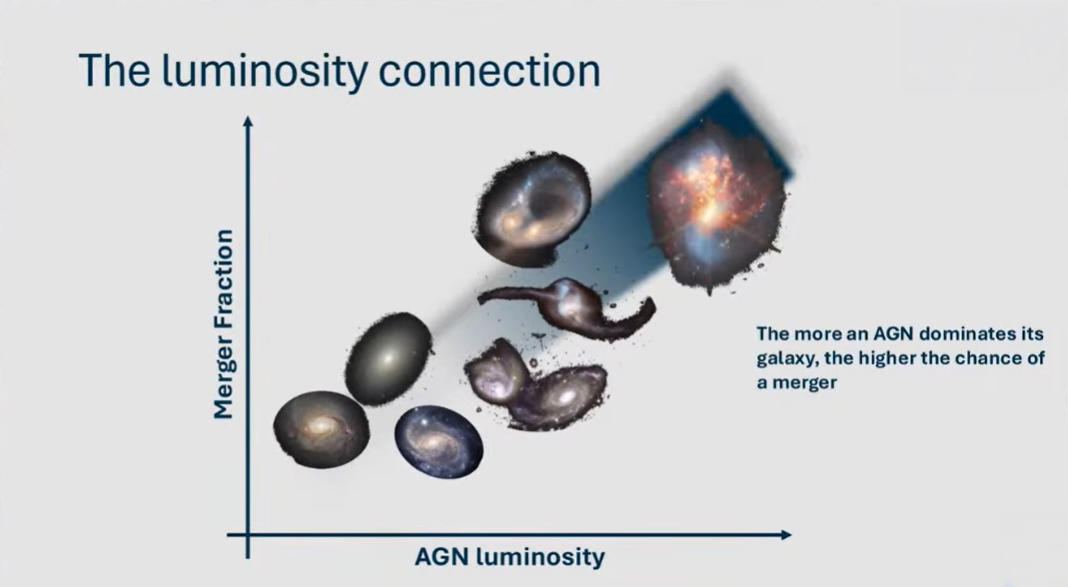
This demonstrates that while lower-level black hole activity can occur in isolated galaxies through internal processes, the most extreme accretion events require galaxy collisions.
Mass, Fuel, and Cosmic Collisions
The brightest AGN reside in the most massive galaxies. This result reflects basic physics: massive systems contain more gas, providing the fuel needed for intense accretion. Galaxy mergers both increase mass and efficiently funnel gas toward galactic centers, igniting powerful AGN.
Despite their dramatic appearance, mergers are not violent at the level of individual stars. As noted during the discussion, stellar collisions are exceedingly rare. Instead, it is the redistribution of gas and dust that drives transformation.
Looking Ahead: Tracing the Merger Sequence
Future Euclid observations will expand the sample from millions to billions of galaxies. Dr. Wang outlines a long-term goal: reconstructing the full merger sequence over a period of 1 to 2 billion years.
This includes identifying dust-obscured growth phases, starburst episodes, and the energetic blowout phase, when radiation from the AGN expels the surrounding dust, revealing the black hole across optical and X-ray wavelengths.
Together with upcoming observations from the James Webb Space Telescope and the Nancy Grace Roman Space Telescope, Euclid will enable an unprecedented, time-resolved view of how galaxies and black holes grow together.
Watch the full conversation on SETI Live here.







News
Related News
Jul 2, 2026
How Clouds Hide Alien Worlds—and How Astronomers See Through Them
#Blog #Lauren Sgro
Jun 29, 2026
Humanity's Plan for First Contact: Who Speaks for Earth?
#Blog #Lauren Sgro #Lucian Walkowicz #Chelsea Haramia #SETI #SETI Institute
Jun 26, 2026
What Juice Revealed About Interstellar Comet 3I/ATLAS
#Blog #3I/ATLAS #Franck Marchis #Juice
Jun 12, 2026
Not Planets, Not Stars: NASA Volunteers Doubled the Number of Known Brown Dwarfs
#Blog #Lauren Sgro
Jun 11, 2026
Life is But a Stream: Planetary Systems Along Stellar Streams
#Blog #Moiya McTier
Jun 8, 2026
The Sounds of Intelligence: A Conversation with 2026 Drake Award Recipient Lori Marino
#Blog #Drake Awards #Lori Marino #SETI
Jul 2, 2026
#Blog
#Lauren Sgro
Jun 29, 2026
#Blog
#Lauren Sgro
#Lucian Walkowicz
#Chelsea Haramia
#SETI
#SETI Institute
Humanity's Plan for First Contact: Who Speaks for Earth?
Jun 26, 2026
#Blog
#3I/ATLAS
#Franck Marchis
#Juice
What Juice Revealed About Interstellar Comet 3I/ATLAS
Jun 12, 2026
#Blog
#Lauren Sgro
Not Planets, Not Stars: NASA Volunteers Doubled the Number of Known Brown Dwarfs
Jun 11, 2026
#Blog
#Moiya McTier
Life is But a Stream: Planetary Systems Along Stellar Streams
Jun 8, 2026
#Blog
#Drake Awards
#Lori Marino
#SETI
The Sounds of Intelligence: A Conversation with 2026 Drake Award Recipient Lori Marino
Research
Related Projects

SkyMapper • SETI • Citizen Science • Astronomy
SkyMapper: Expanding Access to Real-time Astronomy Through a Global Astronomical Network
SkyMapper and the SETI Institute are connecting educators, students and the public to live astronomical observations through a distributed astronomical network. #SkyMapper #SETI #Citizen Science #Astronomy
VPL
Virtual Planetary Laboratory
How can we best assess whether an exoplanet supports life? #VPL
Discovery and Futures Lab
Discovery and Futures Lab
What happens if life beyond Earth is discovered? The Discovery and Futures Lab at the SETI Institute fosters novel and anticipatory research at the intersection of science, society, our planet, and the search for life beyond Earth. #Discovery and Futures Lab
May 17, 2026
SkyMapper: Expanding Access to Real-time Astronomy Through a Global Astronomical Network
SkyMapper and the SETI Institute are connecting educators, students and the public to live astronomical observations through a distributed astronomical network.
#SkyMapper
#SETI
#Citizen Science
#Astronomy
May 5, 2026
Virtual Planetary Laboratory
How can we best assess whether an exoplanet supports life?
#VPL
Apr 16, 2026
Discovery and Futures Lab
What happens if life beyond Earth is discovered? The Discovery and Futures Lab at the SETI Institute fosters novel and anticipatory research at the intersection of science, society, our planet, and the search for life beyond Earth.
#Discovery and Futures Lab
Support Us
Support the
SETI Institute
Scientists are getting closer in their search for life beyond earth. But with limited federal funding for the search for extraterrestrial intelligence, supporters are the reason cutting-edge scientists can keep their eyes on the sky.
