)

Tuesday, Nov 18, 2025
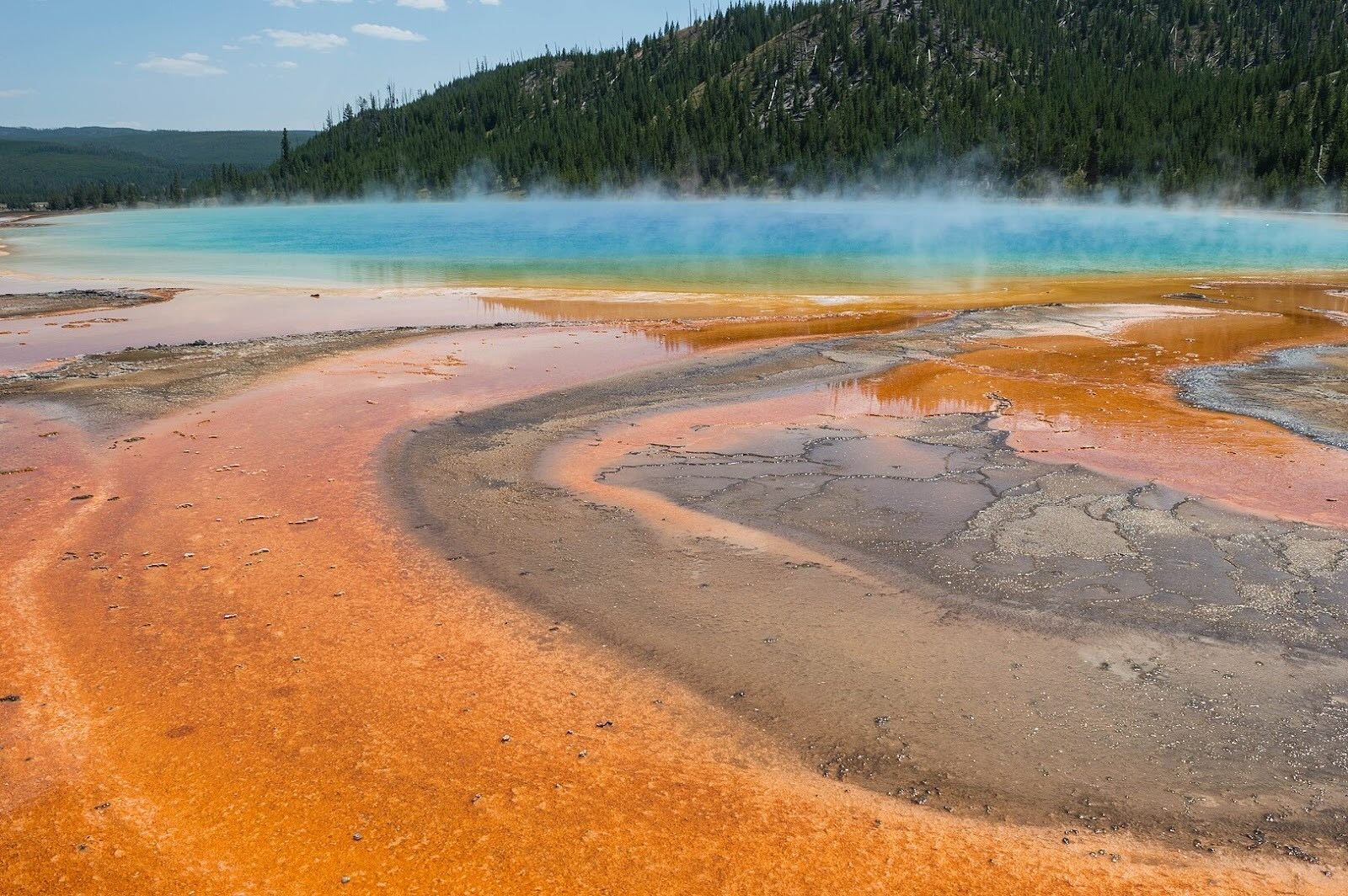
The Grand Prismatic Spring at Yellowstone National Park, seen from the boardwalk. Credit: Supercarwaar via Wikimedia Commons
At a Glance
|
A recent discovery from Yellowstone National Park has redefined one of biology’s most basic assumptions: that a cell must “choose” between using oxygen or other chemicals to breathe. In a recent SETI Live episode, Dr. Eric Boyd, microbial geochemist at Montana State University, joined SETI Institute communications specialist Beth Johnson to discuss his team’s groundbreaking findings. The study describes a bacterium capable of performing both aerobic (oxygen-based) and anaerobic (sulfur-based) respiration simultaneously. This finding, published in Nature Communications, demonstrates a new level of metabolic flexibility that could reshape how we think about life’s adaptability – both on Earth and beyond.
The Microbe That Defies the Textbooks
The organism, an early-evolving bacterium named Hydrogenobacter, thrives in the hydrothermal spring environments of Yellowstone National Park, which are rich in sulfur but have very low dissolved oxygen levels. At around 75–80 °C, these springs present an oxygen paradox: although the atmosphere above contains 21% Oxygen, the hot water itself holds almost none. That makes respiration a biochemical challenge for any organism living in that environment.
Until recently, scientists believed microbes had to choose between oxygen respiration and “breathing” other compounds such as sulfur, iron, or nitrate. This assumption arose partly from the so-called redox tower, a hierarchy that describes which chemical reactions yield the most energy. Oxygen sits at the top of this tower, making it the most favorable electron acceptor. In theory, organisms should always prefer oxygen when it’s available and suppress other pathways.
But the Yellowstone Hydrogenobacter breaks this rule. It utilizes both oxygen and elemental sulfur simultaneously, a dual respiration mode that enables it to survive fluctuations in oxygen concentrations. As Dr. Boyd put it, “It burns hydrogen with oxygen just like a rocket engine, but when oxygen drops, it switches on sulfur respiration without missing a beat.”
How It Works
When oxygen levels are high, the bacterium’s enzymes focus exclusively on aerobic metabolism. But as oxygen concentrations fall, a genetic switch appears to activate sulfur-reducing enzymes. These enzymes convert elemental sulfur into hydrogen sulfide (H₂S), generating energy in the absence of oxygen. The key biochemical challenge is that most sulfur-metabolizing enzymes are oxygen-sensitive (oxygen typically inactivates them). Yet the Hydrogenobacter somehow regulates its internal chemistry to protect these enzymes long enough to use both pathways concurrently.
While the molecular mechanism behind this regulation remains unknown, the evidence suggests a sophisticated balance between gene expression, enzyme activity, and environmental sensing. Understanding this system could provide insight into how early life navigated Earth’s first major atmospheric shift: the Great Oxidation Event, which occurred approximately 2.4 billion years ago.
A Window Into Early Earth
Before cyanobacteria began producing oxygen, Earth’s biosphere was almost entirely anaerobic. When oxygen began to accumulate, it posed both a threat and an opportunity. For ancient microbes, oxygen was highly toxic yet also offered a more efficient way to extract energy. Dr. Boyd’s team suggests that dual-respiring microbes, such as Hydrogenobacter, could resemble transitional forms from that era – cells that learned to use oxygen intermittently while still relying on older anaerobic metabolisms.
These Yellowstone organisms, then, may represent living analogs of life as it existed billions of years ago. Because the solubility of oxygen decreases with temperature, their hydrothermal environment today might mirror the chemistry of early Earth’s hot springs.
Implications Beyond Earth
The implications extend far beyond terrestrial microbiology. If microbes on Earth can exploit multiple energy pathways to survive unstable conditions, similar strategies might exist elsewhere in the Solar System. Worlds like Mars, Europa, and Enceladus contain evidence of liquid water and redox gradients (chemical imbalances that can fuel metabolism).
As Dr. Boyd noted, “Where there’s water, life finds a way.” Yellowstone’s sulfur-rich springs could serve as analog environments for Martian hydrothermal systems, where minerals formed under similar conditions have been detected. Dual-metabolism microbes could also inform mission designs for astrobiological exploration, particularly those searching for chemical signatures of mixed metabolic processes.
Beyond Discovery: Earthquake-Driven Microbial Life
Dr. Boyd’s lab continues to explore Yellowstone’s subsurface biosphere, focusing on how geological processes sustain microbial ecosystems. In an upcoming open-access research paper in PNAS Nexus, his team demonstrates that microbial activity beneath the park's surface responds dynamically to earthquakes. Seismic events appear to release bursts of hydrogen and other reduced compounds that temporarily energize subsurface microbes, producing measurable “blooms” of life. This finding links the geosphere and biosphere more closely than ever before, strengthening parallels between Earth’s dynamic crust and potentially active environments on other planets.
Why It Matters
This discovery does more than expand the tree of life – it challenges the biochemical limits we’ve long assumed. By demonstrating that respiration need not be an either-or process, it opens new questions in biochemistry, evolutionary biology, and astrobiology. It may even inspire industrial or biotechnological applications that harness mixed respiration pathways to generate energy efficiently in variable environments.
Science thrives when it questions its own assumptions. As Dr. Boyd emphasized, “As soon as someone tells you something can’t exist, that’s when you start looking for it.” In Yellowstone’s steaming pools, researchers have found exactly that: a microbe that refuses to choose between breathing oxygen and sulfur, proving once again that life’s ingenuity knows no boundaries. Or as Jeff Goldblum famously said, “Life, uh, finds a way.”
Watch the full conversation on SETI live here, and read about Dr. Boyd’s study here.







News
Related News
Jul 2, 2026
How Clouds Hide Alien Worlds—and How Astronomers See Through Them
#Blog #Lauren Sgro
Jun 29, 2026
Humanity's Plan for First Contact: Who Speaks for Earth?
#Blog #Lauren Sgro #Lucian Walkowicz #Chelsea Haramia #SETI #SETI Institute
Jun 26, 2026
What Juice Revealed About Interstellar Comet 3I/ATLAS
#Blog #3I/ATLAS #Franck Marchis #Juice
Jun 12, 2026
Not Planets, Not Stars: NASA Volunteers Doubled the Number of Known Brown Dwarfs
#Blog #Lauren Sgro
Jun 11, 2026
Life is But a Stream: Planetary Systems Along Stellar Streams
#Blog #Moiya McTier
Jun 8, 2026
The Sounds of Intelligence: A Conversation with 2026 Drake Award Recipient Lori Marino
#Blog #Drake Awards #Lori Marino #SETI
Jul 2, 2026
#Blog
#Lauren Sgro
Jun 29, 2026
#Blog
#Lauren Sgro
#Lucian Walkowicz
#Chelsea Haramia
#SETI
#SETI Institute
Humanity's Plan for First Contact: Who Speaks for Earth?
Jun 26, 2026
#Blog
#3I/ATLAS
#Franck Marchis
#Juice
What Juice Revealed About Interstellar Comet 3I/ATLAS
Jun 12, 2026
#Blog
#Lauren Sgro
Not Planets, Not Stars: NASA Volunteers Doubled the Number of Known Brown Dwarfs
Jun 11, 2026
#Blog
#Moiya McTier
Life is But a Stream: Planetary Systems Along Stellar Streams
Jun 8, 2026
#Blog
#Drake Awards
#Lori Marino
#SETI
The Sounds of Intelligence: A Conversation with 2026 Drake Award Recipient Lori Marino
Research
Related Projects

SkyMapper • SETI • Citizen Science • Astronomy
SkyMapper: Expanding Access to Real-time Astronomy Through a Global Astronomical Network
SkyMapper and the SETI Institute are connecting educators, students and the public to live astronomical observations through a distributed astronomical network. #SkyMapper #SETI #Citizen Science #Astronomy
VPL
Virtual Planetary Laboratory
How can we best assess whether an exoplanet supports life? #VPL
Discovery and Futures Lab
Discovery and Futures Lab
What happens if life beyond Earth is discovered? The Discovery and Futures Lab at the SETI Institute fosters novel and anticipatory research at the intersection of science, society, our planet, and the search for life beyond Earth. #Discovery and Futures Lab
May 17, 2026
SkyMapper: Expanding Access to Real-time Astronomy Through a Global Astronomical Network
SkyMapper and the SETI Institute are connecting educators, students and the public to live astronomical observations through a distributed astronomical network.
#SkyMapper
#SETI
#Citizen Science
#Astronomy
May 5, 2026
Virtual Planetary Laboratory
How can we best assess whether an exoplanet supports life?
#VPL
Apr 16, 2026
Discovery and Futures Lab
What happens if life beyond Earth is discovered? The Discovery and Futures Lab at the SETI Institute fosters novel and anticipatory research at the intersection of science, society, our planet, and the search for life beyond Earth.
#Discovery and Futures Lab
Support Us
Support the
SETI Institute
Scientists are getting closer in their search for life beyond earth. But with limited federal funding for the search for extraterrestrial intelligence, supporters are the reason cutting-edge scientists can keep their eyes on the sky.
