)

Thursday, Dec 18, 2025

At a Glance
|
In a recent SETI Live discussion, communication specialist Beth Johnson spoke with astronomer and entrepreneur Dr. Franck Marchis, CEO of SkyMapper and Senior Planetary Astronomer at the SETI Institute. The conversation introduced SkyMapper, a global network of smart telescopes and all-sky sensors designed to expand access to astronomical observations. The platform connects professional observatories, citizen astronomers, and classrooms into a single decentralized system that supports real scientific discovery.
SkyMapper integrates global imaging systems, AI-driven processing, and Web3 technology. The network monitors satellites, meteors, comets, and transient astronomical events in real time. It also allows users to request observations, upload data, and participate directly in modern astronomy.
Why decentralization matters
Astronomy has traditionally depended on centralized observatories with limited observing time, weather constraints, and competitive proposal rounds. This structure restricts access, particularly for educators and institutions without major telescope facilities. SkyMapper distributes observing capability across many instruments, ensuring that somewhere on Earth, there is a usable night sky.
Users connect their telescopes with a device called the SkyBridge, which links each instrument to the network. SkyBridge handles scheduling, instrument control, and data transfer. SkyMapper also incorporates digital tokens that reward users for sharing telescope time, increasing overall observational capacity.
Architecture and data validation
SkyMapper consists of several distributed components that operate together. The SkyBridge acts as the interface between a user’s telescope and the system. A central coordination system receives observation requests and assigns targets to available instruments based on geographic location, weather conditions, and network availability. Data is sent to an on-chain repository and validated using proof of space observability, a mechanism that confirms the origin, timing, and authenticity of each observation.
The use of a blockchain ledger provides a permanent record of observational data and its processing history. This approach ensures that astronomers, educators, and the public can verify precisely where a dataset originated and how it has been handled. In a research landscape that now includes synthetic imagery and AI-generated signals, traceability has become essential for maintaining scientific integrity.
Scientific applications
SkyMapper supports several research areas:
- satellite monitoring
- transient detection
- comet tracking
- photometry (measurement of brightness)
- astrometry (measurement of position)
Industry partners can use the network to map satellite constellations and evaluate orbital debris, including the potential for the Kessler effect – a cascade of debris generated by satellite collisions. The system also provides students with access to real observations for coursework and scientific training, enabling early involvement in data-driven astronomy.
The network coordinates with survey telescopes by providing rapid follow-up observations. Alerts from facilities such as the Vera C. Rubin Observatory will trigger automated responses, allowing SkyMapper telescopes to investigate transient events, including supernovae and comet disruptions. These measurements help determine brightness, color, motion, and temporal change, all of which are essential parameters for characterizing short-lived astronomical events.
Collaboration with the SETI Institute
The collaboration enables SETI Institute researchers to request observations, access archival data, and develop new citizen-science programs focused on optical and transient-sky monitoring. Other SETI Institute instruments, including LaserSETI, are planned for network integration to expand continuous monitoring of bright optical signals that may indicate energetic astrophysical processes.
Archived records enable researchers to examine whether unusual astronomical signals have appeared previously. This capability supports long-baseline studies of rare events, including potential optical transients and fast, short-duration flashes that traditional surveys may miss.
Public engagement and global participation
SkyMapper supports participation from professional astronomers, educators, and citizen scientists. The platform enables comparisons of sky conditions worldwide and supports studies of atmospheric transparency and aerosols, including smoke from wildfires and pollution events.
Museums and planetariums can display real-time sky views from around the world and use SkyMapper to illustrate global sky conditions during daytime hours by accessing telescopes on the opposite side of Earth.
Verifying unusual aerial events
As public interest in unidentified anomalous phenomena (UAPs) continues to increase, SkyMapper provides verifiable observational records that help distinguish between aircraft, drones, satellites, and true anomalies. Multiple observing stations will be able to confirm and classify events, reducing misinterpretation and false claims based on fabricated or altered imagery.
A new model for astronomy
SkyMapper changes how astronomical observing is conducted by distributing telescope capacity and enabling continuous monitoring worldwide. Instead of relying solely on a limited number of major observatories, researchers can draw on a network of independent instruments.
The long-term vision is to make SkyMapper compatibility a standard capability, ensuring that future astronomical data remains scientifically reliable and traceable.
Learn more
Watch the full conversation on SETI Live.







News
Related News
Jul 2, 2026
How Clouds Hide Alien Worlds—and How Astronomers See Through Them
#Blog #Lauren Sgro
Jun 29, 2026
Humanity's Plan for First Contact: Who Speaks for Earth?
#Blog #Lauren Sgro #Lucian Walkowicz #Chelsea Haramia #SETI #SETI Institute
Jun 26, 2026
What Juice Revealed About Interstellar Comet 3I/ATLAS
#Blog #3I/ATLAS #Franck Marchis #Juice
Jun 12, 2026
Not Planets, Not Stars: NASA Volunteers Doubled the Number of Known Brown Dwarfs
#Blog #Lauren Sgro
Jun 11, 2026
Life is But a Stream: Planetary Systems Along Stellar Streams
#Blog #Moiya McTier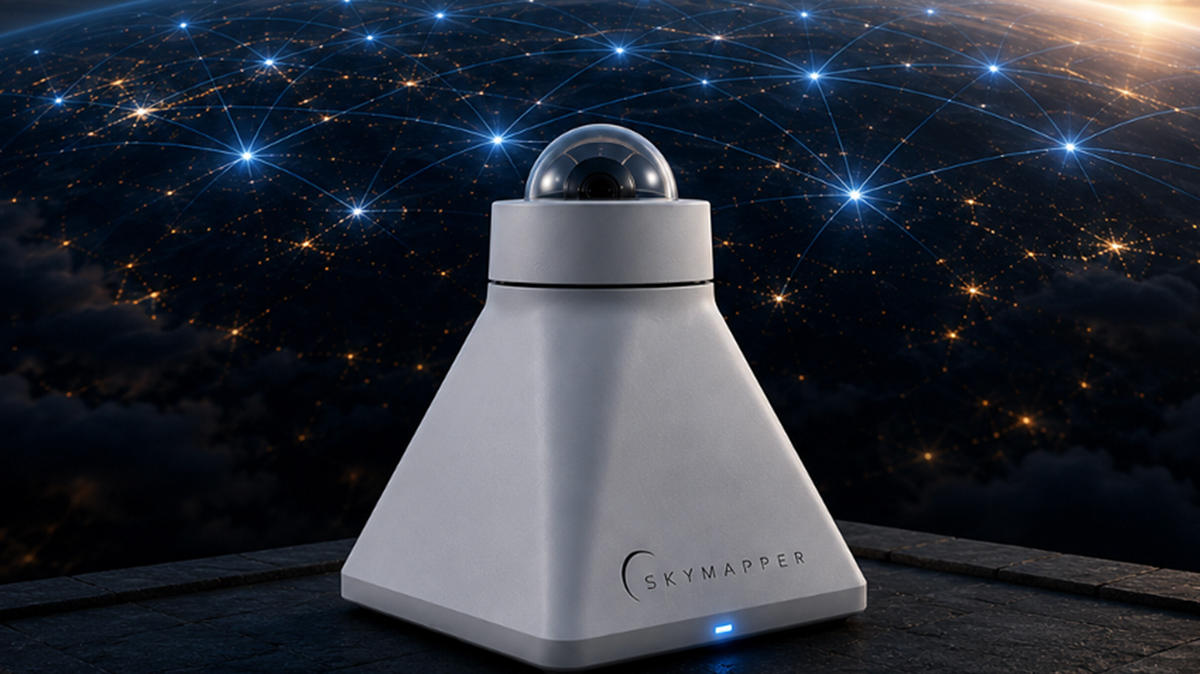
Jun 9, 2026
Disclosure Needs Data
#SkyMapper #Franck Marchis #SETI #citizen science
Jul 2, 2026
#Blog
#Lauren Sgro
Jun 29, 2026
#Blog
#Lauren Sgro
#Lucian Walkowicz
#Chelsea Haramia
#SETI
#SETI Institute
Humanity's Plan for First Contact: Who Speaks for Earth?
Jun 26, 2026
#Blog
#3I/ATLAS
#Franck Marchis
#Juice
What Juice Revealed About Interstellar Comet 3I/ATLAS
Jun 12, 2026
#Blog
#Lauren Sgro
Not Planets, Not Stars: NASA Volunteers Doubled the Number of Known Brown Dwarfs
Jun 11, 2026
#Blog
#Moiya McTier
Life is But a Stream: Planetary Systems Along Stellar Streams
Jun 9, 2026
#SkyMapper
#Franck Marchis
#SETI
#citizen science
Disclosure Needs Data
Research
Related Projects
SkyMapper • SETI • Citizen Science • Astronomy
SkyMapper: Expanding Access to Real-time Astronomy Through a Global Astronomical Network
SkyMapper and the SETI Institute are connecting educators, students and the public to live astronomical observations through a distributed astronomical network. #SkyMapper #SETI #Citizen Science #Astronomy
VPL
Virtual Planetary Laboratory
How can we best assess whether an exoplanet supports life? #VPL
Discovery and Futures Lab
Discovery and Futures Lab
What happens if life beyond Earth is discovered? The Discovery and Futures Lab at the SETI Institute fosters novel and anticipatory research at the intersection of science, society, our planet, and the search for life beyond Earth. #Discovery and Futures Lab
May 17, 2026
SkyMapper: Expanding Access to Real-time Astronomy Through a Global Astronomical Network
SkyMapper and the SETI Institute are connecting educators, students and the public to live astronomical observations through a distributed astronomical network.
#SkyMapper
#SETI
#Citizen Science
#Astronomy
May 5, 2026
Virtual Planetary Laboratory
How can we best assess whether an exoplanet supports life?
#VPL
Apr 16, 2026
Discovery and Futures Lab
What happens if life beyond Earth is discovered? The Discovery and Futures Lab at the SETI Institute fosters novel and anticipatory research at the intersection of science, society, our planet, and the search for life beyond Earth.
#Discovery and Futures Lab
Support Us
Support the
SETI Institute
Scientists are getting closer in their search for life beyond earth. But with limited federal funding for the search for extraterrestrial intelligence, supporters are the reason cutting-edge scientists can keep their eyes on the sky.
