At A Glance
|
This month’s stories highlight how SETI Institute scientists combine rigorous analysis with curiosity, whether working alongside citizen astronomers, refining how technosignatures are identified, or improving the precision of radio observations that underpin both astrophysics and the search for extraterrestrial intelligence. Together, these highlights offer a snapshot of how SETI Institute research continues to address some of the most enduring questions in space science by testing bold ideas, sharing data openly, and inviting broader participation in the scientific process.
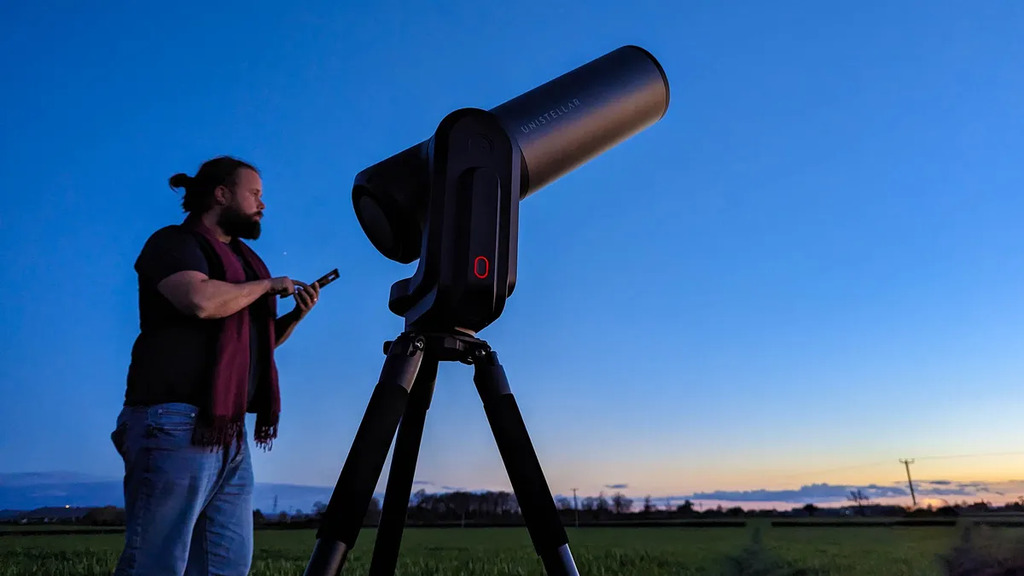
Help Defend Earth from Asteroids with Your Unistellar Telescope
Astronomy is increasingly becoming a collaborative effort between professionals and the public, as new technologies enable everyday observers to contribute to frontline scientific research. Through Unistellar’s and SETI Institute’s citizen science program, users of smart telescopes participate in coordinated observations focused on near-Earth asteroids, comets, occultations, exoplanet transits, and other transient celestial events.
Dr. Franck Marchis, Senior Planetary Astronomer at the SETI Institute, explains that this distributed global network helps overcome the geographic and scheduling limitations of large observatories. Observations submitted by participants are validated and archived in professional databases, where they can be incorporated into ongoing research.
The program has demonstrated its scientific value through contributions to planetary defense efforts, including observations related to NASA’s Double Asteroid Redirection Test (DART), as well as the tracking of interstellar visitors. In some cases, contributors whose data prove especially valuable may be acknowledged in scientific publications, highlighting how coordinated public participation can directly support time-critical astronomical research.
Read the full article by Space.com: Help Defend Earth from Asteroids with Your Unistellar Telescope
The Search for Alien Artifacts Is Coming Into Focus
Beyond searching for radio signals, some researchers are exploring whether the physical evidence of extraterrestrial technology might exist within the solar system. At the SETI Institute, this line of inquiry draws on established frameworks such as the Search for Extraterrestrial Artifacts (SETA), which outlines systematic approaches for identifying non-natural objects in space.
Dr. Sofia Sheikh, a technosignature researcher at the SETI Institute, has contributed to frameworks for assessing candidate technosignatures and led targeted searches for artificial radio signals from the interstellar object 3I/ATLAS. These efforts include evaluating unusual orbital or physical characteristics, reviewing historical astronomical records, and conducting targeted radio and optical surveys of interstellar visitors.
Other projects such as the VASCO initiative analyze archival sky surveys taken before the era of artificial satellites to identify unexplained transient objects, helping establish a peer-reviewed scientific foundation for these searches. While all known interstellar objects to date appear natural, proposed methods for focused searches of near-Earth and geosynchronous space continue to be evaluated using rigorous scientific standards.
Read the full story by Wired: The Search for Alien Artifacts Is Coming Into Focus
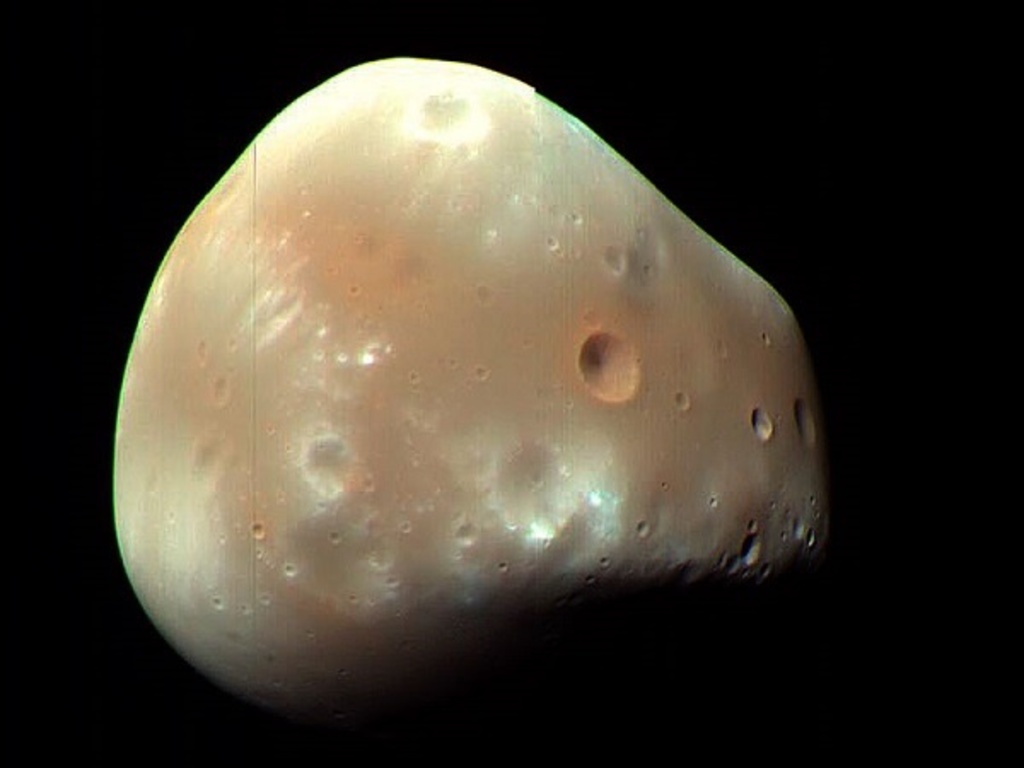
Martian Moon Deimos Might Have Reshaped Itself and Its Orbit
Mars’s smaller moon, Deimos, has long puzzled astronomers. Although its surface properties resemble those of carbon-rich asteroids, its nearly circular, equatorial orbit does not fit traditional capture models, which typically predict more elongated or inclined paths.
New research co-authored by Dr. Matija Ćuk of the SETI Institute proposes that Deimos may have experienced a “sesquinary catastrophe,” in which material ejected by repeated impacts escaped the moon, entered orbit around Mars, and later re-impacted and reassembled the satellite.
This cycle of fragmentation and reaccretion could explain both Deimos’s smooth surface and its unexpectedly stable orbit, offering a single model for previously conflicting observations. Future measurements from upcoming Mars moon missions may help test whether this process played a role in shaping Deimos’s present-day form.
Read the full article by Skyandtelescope.org: Martian Moon Deimos Might Have Reshaped Itself and Its Orbit
Astronomers Searching for Alien Life Are Sharpening Our Cosmic Clocks: Here’s Why
Pulsars, rapidly rotating neutron stars that emit regular beams of radio waves, serve as some of the most precise natural timekeepers in the universe, supporting studies of gravitational waves and the structure of the interstellar medium itself.
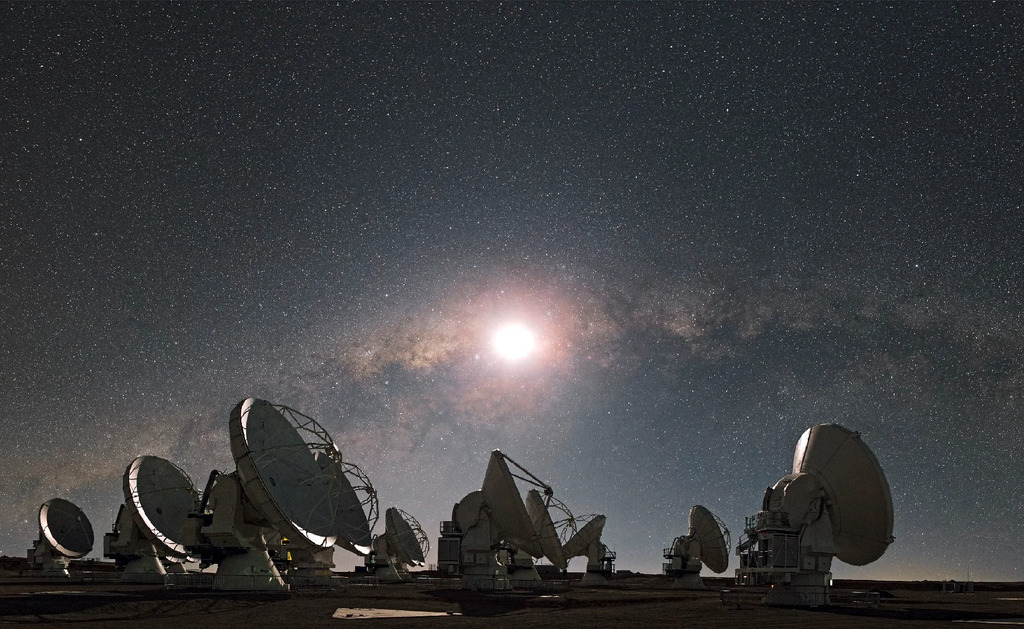
In a study led by Grayce Brown of the SETI Institute, researchers used the Allen Telescope Array to tracked how the slow changes in radio scintillation, the “twinkling” of signals caused by free electrons in interstellar gas, can shift pulsar timing by tens of nanoseconds. By monitoring pulsar PSR J0332+5434 over nearly ten months, researchers quantified how these subtle delays accumulate as radio waves propagate through space.
Accounting for these effects improves the accuracy of ultra-precise timing experiments and provides an additional tool for distinguishing genuine cosmic signals from human-made radio interference, strengthening both astrophysical research and technosignature searches.
Read the full article by Space.com: Astronomers Searching for Alien Life Are Sharpening Our Cosmic Clocks: Here’s Why
Inside the Massive Radio Search of Our Newest Interstellar Guest
Interstellar object 3I/ATLAS became the focus of an extensive technosignature search as it passed through the solar system. Using the upgraded Allen Telescope Array, researchers conducted more than seven hours of radio observations spanning frequencies from roughly 1 to 12 gigahertz and analyzed tens of millions of narrowband signal candidates.
Led by Dr. Sofia Sheikh, scientists at the SETI Institute applied advanced filtering pipelines and rigorous radio-frequency interference mitigation to remove terrestrial sources. Candidate signals were further evaluated using Doppler drift corrections to account for relative motion between the telescope and the target.
All remaining candidates were traced to Earth-based interference, reinforcing the conclusion that 3I/ATLAS is a natural interstellar object and demonstrating the growing technical sophistication of large-scale radio searches for extraterrestrial technology.
Read the full article by Phys.org: Inside the Massive Radio Search of Our Newest Interstellar Guest
News
Related News
The Sounds of Intelligence: A Conversation with 2026 Drake Award Recipient Lori Marino
#Blog #Drake Awards #Lori Marino #SETI
A Rare Visitor from Another Star System
#3I/ATLAS #Quiz
Beyond Disclosure Day: The Real-World Protocols
#Press Releases #SETI #Astronomy #Bill Diamond #SETI Institute
SETI Institute In the News: May Roundup 2026
#SETI Institute in the News #SETI Institute #Community #Solar System #Matija Ćuk #Neptune #SETI #Bill Diamond #UAPs #Drake Awards #Lori Marino #Matthew Tiscareno #Outreach #Exoplanets #Carl Sagan Center
SETI Institute Looks for Signs of Technology in Interstellar Visitor 3I/ATLAS
Observations with the Allen Telescope Array set new limits on possible signals from extraterrestrial transmitters. #Press Releases #ATA #3I/ATLAS #Hat Creek Radio Observatory #Radio Astronomy #SETI
SETI Institute Awards $1 Million in STRIDE Grants to Advance Astrobiology, Exoplanet Science, and Public Engagement
#Press Releases #STRIDE #Research #Carl Sagan Center #Spectroscopy #Solar System #SETI #Climate and Bioscience #Astronomy #Astrobiology #Exoplanets #Data Science #Education #Outreach #Hat Creek Radio Observatory #Unistellar #SkyMapperResearch
Related Projects
SkyMapper: Expanding Access to Real-time Astronomy Through a Global Astronomical Network
SkyMapper and the SETI Institute are connecting educators, students and the public to live astronomical observations through a distributed astronomical network. #SkyMapper #SETI #Citizen Science #Astronomy
Virtual Planetary Laboratory
How can we best assess whether an exoplanet supports life? #VPL
Discovery and Futures Lab
What happens if life beyond Earth is discovered? The Discovery and Futures Lab at the SETI Institute fosters novel and anticipatory research at the intersection of science, society, our planet, and the search for life beyond Earth. #Discovery and Futures LabSupport the
SETI Institute
Scientists are getting closer in their search for life beyond earth. But with limited federal funding for the search for extraterrestrial intelligence, supporters are the reason cutting-edge scientists can keep their eyes on the sky.