)

Author: Beth Johnson
Monday, Jul 20, 2026
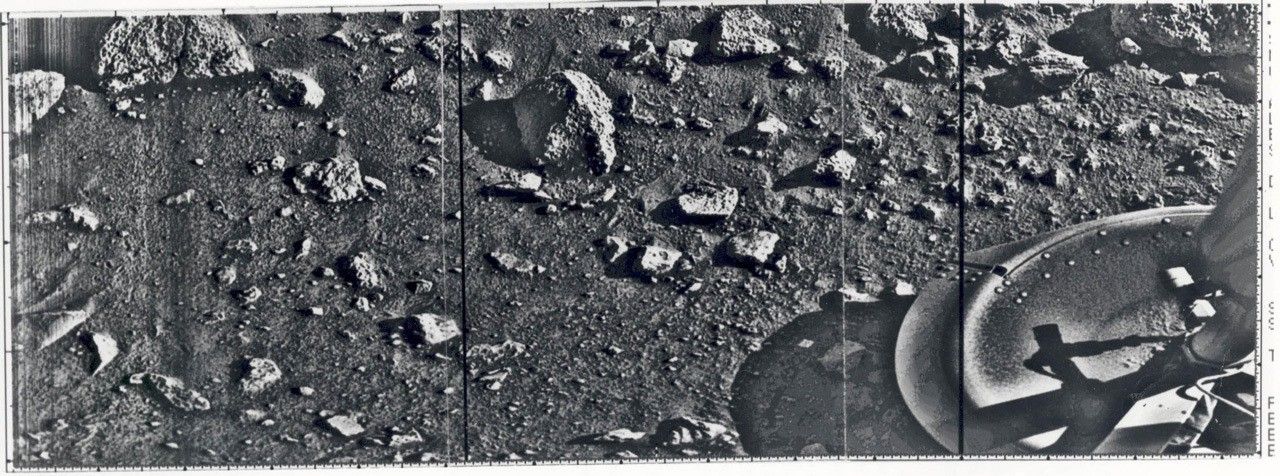
This is the first photograph ever taken on the surface of Mars. It was obtained by NASA's Viking 1 minutes after the spacecraft landed on July 20, 1976. Credit: NASA/JPL-Caltech
At a Glance:
|
For thousands of years, Mars has inspired myths, speculation and scientific curiosity. Fifty years ago today, humanity took a major step toward understanding our neighboring world when Viking 1 became the first spacecraft to successfully land and operate on the Martian surface.
From Martian Myths to Martian Reality
Long before spacecraft explored the Red Planet, astronomers could only speculate about what lay there. In the late 1800s, Giovanni Schiaparelli mapped faint linear features on Mars that he called canali, meaning channels. The word was later mistranslated as canals, fueling the now-famous belief that an intelligent civilization had engineered waterways across the Martian landscape. The myth was finally dispelled by NASA’s Mariner 4 flyby in 1965 which returned close-up images.
While the Mariner missions were a massive accomplishment, humanity would have to wait another decade before landing successfully on the red planet’s surface. This year, we celebrate the 50th anniversary of the Viking 1 landing, which occurred on July 20, 1976. (The Soviet Mars 3 lander did touch down in 1971, but contact was lost mere seconds later.)
The First Laboratory on Another World
Both orbiters carried cameras for global mapping, while the landers were equipped with instruments to analyze rocks, soil, weather and the chemistry of Mars’ surface, including the first experiments specifically designed to search for signs of life.
But Viking is remembered for more than its engineering. It was humanity's first serious attempt to answer one of our oldest questions: Are we alone?
What is perhaps most remarkable is that we not only placed the first successful landers on Mars, but those missions ran far longer than expected, setting a trend for many more Mars missions to follow. Viking 1 operated for over six Earth years and may have continued longer had a fault command not been sent.
A New Way to Think About Life
Viking 1 gathered soil samples and tested them, recorded atmospheric temperature readings across seasons, and even attempted to look for evidence of life. Most of Viking's life-detection results were interpreted as not supporting biological activity. One experiment, however, produced results consistent with metabolic activity, leading to a debate that continues today. While the accepted answer remains that life was unlikely to have been detected, more recent work has questioned whether the methods used in the experiments may have harmed organisms unlike any life the experiments were designed to detect.
The debate surrounding Viking's life-detection experiments raised a bigger question: What exactly does life look like, and how should we search for it?
Mars today is very different from most environments on Earth -- but not all. Regions in the Arctic and Antarctic are used as analogs for Mars in testing and research, and studying organisms that thrive in some of Earth's most extreme environments could offer another explanation for the life-detection results.
In the decades since Viking landed, our understanding of life itself has changed dramatically. Many extremophiles - organisms that thrive in extreme environments - have been cataloged around the world. They have been found in dry, dark, salty, and acidic regions. There’s a pink alga that grows on snow, and even tardigrades can survive in the vacuum of space. Astrobiology as a field has expanded as a result of searching for life in stranger and stranger places, raising the possibility that life, if it ever existed on Mars, might survive in places once thought impossible.
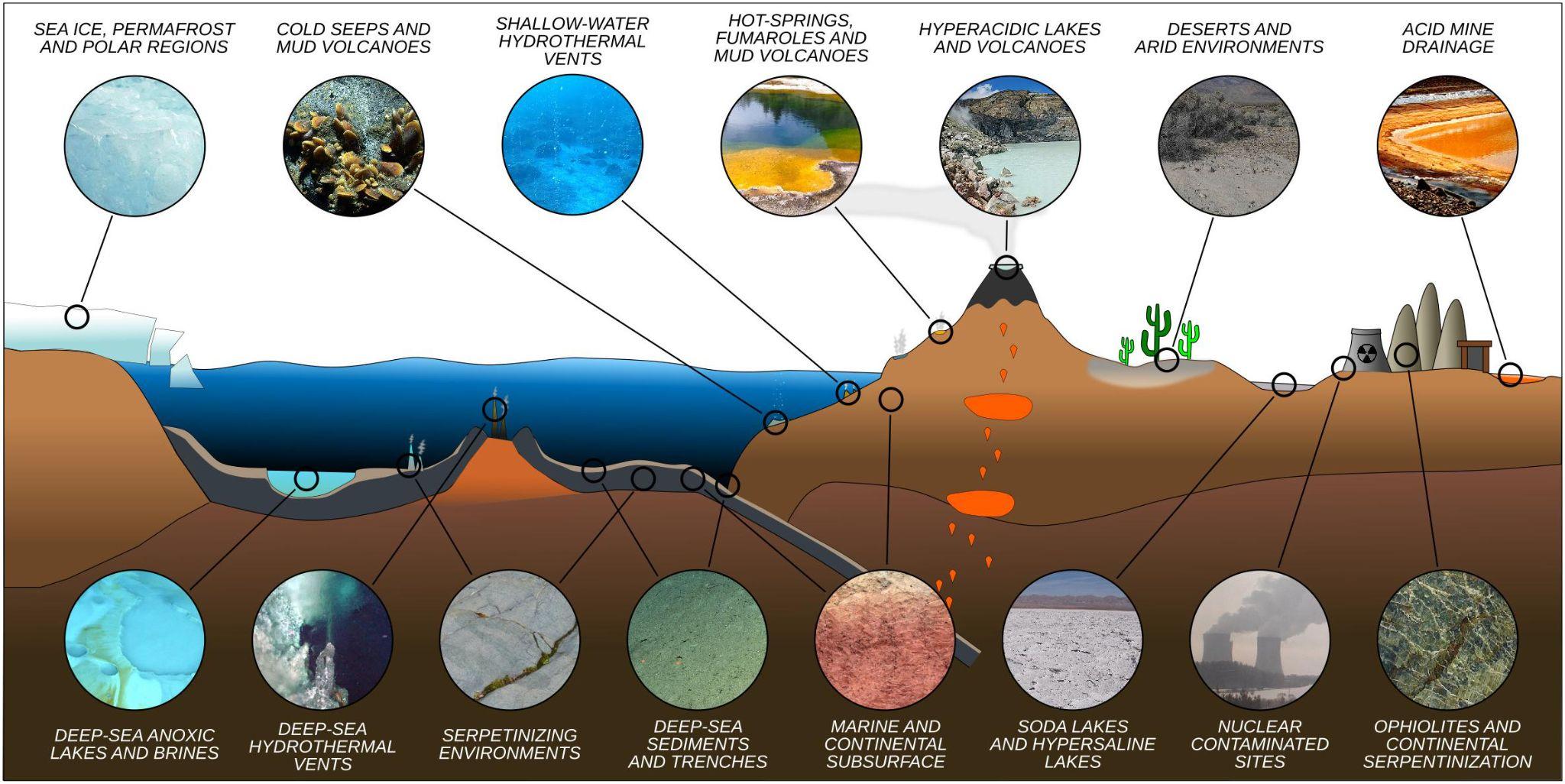
Representative idealized cross section of Earth’s crust showing the diversity of extreme environments and their approximate location. Credit: Nancy Merino, Heidi S. Aronson, Diana P. Bojanova, Jayme Feyhl-Buska, Michael L. Wong, Shu Zhang and Donato Giovannelli
A Legacy Beyond Mars
Viking's legacy went beyond the laboratory and into popular culture. As Ann Druyan recently wrote, the fading public interest in the Viking missions inspired Carl Sagan to rethink how scientists communicated with the public, eventually leading to the creation of the television series Cosmos. Science communication shifted from buzzwords and technological jargon to more thoughtful, evocative language, allowing everyone to feel the joy and wonder of the universe. That philosophy continues today at the SETI Institute, where understanding the universe is inseparable from helping people experience the wonder of exploration and discovery.
The Questions That Remain
Now, we take the presence of landers and rovers on Mars nearly for granted. From Pathfinder to Curiosity, Perseverance, and future missions, humanity’s work studying the Red Planet continues, due in part to the success and tenacity of Viking 1.
Viking 1 proved that we could land safely on another world. Just as importantly, it transformed Mars from a distant point of light into a place that could be explored, questioned and ultimately understood. Fifty years later, every rover, orbiter and future astronaut mission follows a path Viking helped chart. The questions remain as compelling as ever—and so does our determination to answer them.







News
Related News

May 7, 2026
SETI Institute In the News: April Roundup 2026
#SETI Institute in the News #SETI Institute #Community #SETI #Discovery and Futures Lab #Lucian Walkowicz #Chelsea Haramia #NASA Missions and Observatories #Pascal Lee #Mars #Janice Bishop #Mark Showalter #JWST #Uranus #Bill Diamond #UAPs
Apr 30, 2026
Narrowing the Search: The 45 Best Targets for Alien Life
#Blog #Astronomy #JWST #NASA Missions and Observatories #Trappist-1 #LaserSETI #ATA #Franck Marchis
Apr 27, 2026
Rethinking Organics on Mars
By Nathalie A. Cabrol, Director of the Carl Sagan Center for Research, SETI Institute #Mars #Astrobiology #Solar System #Curiosity Rover #NASA Missions and Observatories #Nathalie Cabrol
Apr 6, 2026
Women With Impact: Reclaiming the Moon's Missing Half
#Bettina Forget #AIR #Artemis II #Moon #NASA Missions and Observatories
Apr 3, 2026
SETI Institute In the News: March Roundup 2026
In March 2026, SETI Institute researchers contributed to a wide range of conversations about our solar system and the search for life beyond Earth. From explaining unusual features on Mars and studying meteor airbursts in Earth’s atmosphere to advancing new ways of detecting technosignatures, this work reflects how scientists are continually refining our understanding of both nearby and distant worlds. #SETI Institute in the News #SETI Institute #Community #Mars #Pascal Lee #Peter Jenniskens #Comets, Meteors, and Asteroids #Astronomy #Vishal Gajjar #SETI #AI and Machine Learning #Astrobiology #Nathalie Cabrol #Carl Sagan Center #Seth Shostak #Movie Reviews #Bill Diamond
Mar 30, 2026
We Finally Have a Shortlist for Finding Life Beyond Earth
#SETI #Astronomy #Exoplanets #NASA Missions and Observatories #JWST #Technosignatures #Franck Marchis
May 7, 2026
#SETI Institute in the News
#SETI Institute
#Community
#SETI
#Discovery and Futures Lab
#Lucian Walkowicz
#Chelsea Haramia
#NASA Missions and Observatories
#Pascal Lee
#Mars
#Janice Bishop
#Mark Showalter
#JWST
#Uranus
#Bill Diamond
#UAPs
Apr 30, 2026
#Blog
#Astronomy
#JWST
#NASA Missions and Observatories
#Trappist-1
#LaserSETI
#ATA
#Franck Marchis
Narrowing the Search: The 45 Best Targets for Alien Life
Apr 27, 2026
Rethinking Organics on Mars
By Nathalie A. Cabrol, Director of the Carl Sagan Center for Research, SETI Institute
#Mars
#Astrobiology
#Solar System
#Curiosity Rover
#NASA Missions and Observatories
#Nathalie Cabrol
Apr 6, 2026
#Bettina Forget
#AIR
#Artemis II
#Moon
#NASA Missions and Observatories
Women With Impact: Reclaiming the Moon's Missing Half
Apr 3, 2026
SETI Institute In the News: March Roundup 2026
In March 2026, SETI Institute researchers contributed to a wide range of conversations about our solar system and the search for life beyond Earth. From explaining unusual features on Mars and studying meteor airbursts in Earth’s atmosphere to advancing new ways of detecting technosignatures, this work reflects how scientists are continually refining our understanding of both nearby and distant worlds.
#SETI Institute in the News
#SETI Institute
#Community
#Mars
#Pascal Lee
#Peter Jenniskens
#Comets, Meteors, and Asteroids
#Astronomy
#Vishal Gajjar
#SETI
#AI and Machine Learning
#Astrobiology
#Nathalie Cabrol
#Carl Sagan Center
#Seth Shostak
#Movie Reviews
#Bill Diamond
Mar 30, 2026
#SETI
#Astronomy
#Exoplanets
#NASA Missions and Observatories
#JWST
#Technosignatures
#Franck Marchis
We Finally Have a Shortlist for Finding Life Beyond Earth
Research
Related Projects

SkyMapper • SETI • Citizen Science • Astronomy
SkyMapper: Expanding Access to Real-time Astronomy Through a Global Astronomical Network
SkyMapper and the SETI Institute are connecting educators, students and the public to live astronomical observations through a distributed astronomical network. #SkyMapper #SETI #Citizen Science #Astronomy
VPL
Virtual Planetary Laboratory
How can we best assess whether an exoplanet supports life? #VPL
Discovery and Futures Lab
Discovery and Futures Lab
What happens if life beyond Earth is discovered? The Discovery and Futures Lab at the SETI Institute fosters novel and anticipatory research at the intersection of science, society, our planet, and the search for life beyond Earth. #Discovery and Futures Lab
May 17, 2026
SkyMapper: Expanding Access to Real-time Astronomy Through a Global Astronomical Network
SkyMapper and the SETI Institute are connecting educators, students and the public to live astronomical observations through a distributed astronomical network.
#SkyMapper
#SETI
#Citizen Science
#Astronomy
May 5, 2026
Virtual Planetary Laboratory
How can we best assess whether an exoplanet supports life?
#VPL
Apr 16, 2026
Discovery and Futures Lab
What happens if life beyond Earth is discovered? The Discovery and Futures Lab at the SETI Institute fosters novel and anticipatory research at the intersection of science, society, our planet, and the search for life beyond Earth.
#Discovery and Futures Lab
Support Us
Support the
SETI Institute
Scientists are getting closer in their search for life beyond earth. But with limited federal funding for the search for extraterrestrial intelligence, supporters are the reason cutting-edge scientists can keep their eyes on the sky.
