)

Friday, Feb 27, 2026
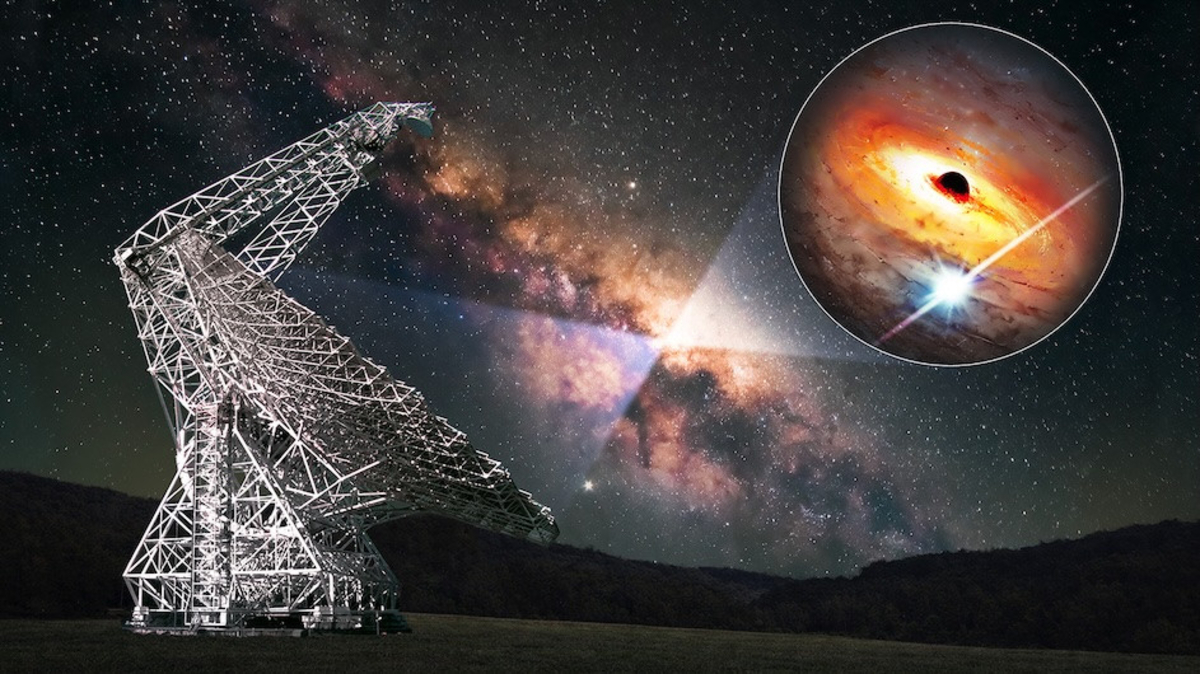
Illustration of the Green Bank radio telescope observing a pulsar in the center of the Milky Way galaxy. (Danielle Futselaar/Breakthrough Listen)
At a Glance
- What: Researchers report the possible discovery of a millisecond pulsar near the Galactic Center using data from the Breakthrough Listen Deep Pulsar Survey and the Green Bank Telescope.
- Guests: SETI Institute Communications Specialist Beth Johnson and William J. Welch Postdoctoral Fellow Dr. Karen Perez (SETI Institute; formerly Columbia University).
- Why it matters: Confirming a pulsar orbiting close to Sagittarius A* would provide an unprecedented laboratory for testing gravity, measuring black hole properties, and probing one of the most extreme environments in the Milky Way.
- Key science:
- Pulsars are rapidly rotating and highly magnetized neutron stars that emit periodic radio pulses
- Scattering is the smearing of radio waves by turbulent ionized gas, which obscures signals at low frequencies
- High-frequency (8 to 12 GHz) observations reduce scattering and improve sensitivity toward the Galactic Center
- Precise pulsar timing near a supermassive black hole would test general relativity in a strong-field regime
- Looking ahead: Continued high-frequency monitoring and re-detection efforts are required to confirm the candidate and determine whether it orbits the central black hole.
For decades, radio astronomers have used radio observations to investigate some of the universe's most extreme environments. From technosignature searches to precision pulsar timing experiments, these efforts depend on measuring faint radio signals that have traveled across vast cosmic distances. The Galactic Center is among the most demanding targets in modern radio astronomy – a region where black hole physics, stellar evolution, and gravitational theory converge.
In a recent SETI Live conversation, SETI Institute Communications Specialist Beth Johnson spoke with William J. Welch Postdoctoral Fellow Dr. Karen Perez, lead author of a new study reporting the possible discovery of a pulsar candidate near the Galactic Center. Using data from the Breakthrough Listen Deep Pulsar Survey and observations with the NSF Green Bank Telescope, Dr. Perez and collaborators are investigating one of the most important regions of the Milky Way.
The Galactic Center’s Missing Pulsars
The center of the Milky Way is the galaxy's most energetic region. Dense star clusters crowd the inner parsec, star formation proceeds at elevated rates, and stellar evolution unfolds rapidly. At the heart of this environment lies Sagittarius A*, a supermassive black hole containing roughly four million times the mass of the Sun.
Given this intense stellar activity, astrophysicists have long predicted that the Galactic Center should host a substantial population of neutron stars. Many massive stars end their lives in supernova explosions, leaving behind compact remnants known as neutron stars. A fraction of these become pulsars, rapidly rotating, highly magnetized neutron stars that emit beams of electromagnetic radiation from their magnetic poles.
Yet despite decades of targeted searches, very few pulsars have been detected close to Sagittarius A*. This discrepancy between theoretical predictions and observations has become known as the “missing pulsar problem.” A newly reported candidate may begin to address that mystery.
Pulsars as Cosmic Clocks
A pulsar forms when a massive star, typically between eight and twenty-five solar masses, collapses under its own gravity after a supernova. The resulting neutron star contains more mass than the Sun compressed into a sphere only about twenty kilometers across. As it spins, beams of radio emission sweep through space like a cosmic lighthouse.
When one of those beams crosses Earth’s line of sight, radio telescopes detect a pulse.
Pulsars are extraordinary for their stability. Their rotation periods can rival or exceed the precision of atomic clocks. Because each pulse arrival time can be measured with microsecond and sometimes nanosecond precision, pulsars serve as powerful probes of gravitational physics.
If a pulsar orbits a massive object, such as a black hole, distortions in spacetime predicted by general relativity will subtly alter the timing of its pulses. By measuring those deviations over years, astronomers can test gravity in regimes far stronger than those accessible within the Solar System.
A pulsar in a tight orbit around Sagittarius A* would provide an unparalleled laboratory for probing spacetime near a supermassive black hole.
Sagittarius A* and Strong-Field Gravity
The Galactic Center is both scientifically promising and observationally frustrating.
Between Earth and Sagittarius A* lies a dense, turbulent sea of ionized gas. This plasma causes scattering, a phenomenon in which radio waves are delayed and smeared as they propagate through irregular fluctuations in electron density. Scattering broadens pulses and can render them undetectable, especially at low radio frequencies.
Scattering becomes much weaker at higher radio frequencies, decreasing roughly with the fourth power of frequency. In practical terms, doubling the observing frequency reduces the smearing by about sixteen times.
To mitigate this problem, Dr. Perez and collaborators conducted observations at X-band frequencies between 8 and 12 gigahertz using the NSF Green Bank Telescope, one of the world’s largest fully steerable single-dish radio telescopes, with a 100-meter diameter.
The team performed eleven hours of deep observations toward the Galactic Center as part of the Breakthrough Listen Galactic Center survey. Although the primary goal of Breakthrough Listen is to search for technosignatures, the data also enable high-sensitivity pulsar searches.
The 8.19-Millisecond Candidate
During the first hour of one observing session, the team detected a repeating signal every 8.19 milliseconds. Signals this fast usually come from millisecond pulsars—ultra-dense neutron stars that spin hundreds of times per second after gaining material from a nearby companion star.
The signal also showed a very large dispersion measure, about 2,775 parsecs per cubic centimeter. Dispersion happens because radio waves slow down slightly as they travel through clouds of charged particles in space. Lower-frequency waves are delayed more than higher-frequency ones. By measuring this delay, astronomers can estimate how many electrons the signal passed through on its way to Earth. The large value seen here suggests the source lies in the dense region near the center of the Milky Way.
During the observation, the signal remained consistent over time and across multiple radio frequencies, and it passed the standard tests astronomers use to identify periodic signals.
However, a pulsar cannot be confirmed until it is detected again. Despite follow-up observations, the signal has not yet reappeared at the same period and dispersion measure. Until it is seen again, it remains a pulsar candidate rather than a confirmed discovery.
Why Confirmation Would Matter
If confirmed, the candidate would represent one of the closest pulsars detected to Sagittarius A*. Such a discovery would strengthen the case for a large population of pulsars in the central parsec, which has remained hidden due to observational challenges.
Several astrophysical scenarios are possible. The pulsar could be:
- Orbiting the supermassive black hole itself
- Orbiting a stellar-mass black hole
- Orbiting a normal main-sequence star
In some configurations, eclipses by a companion or surrounding material could temporarily obscure the pulsar signal, potentially explaining its non-reappearance.
The most scientifically transformative scenario would involve a pulsar in a tight orbit, on the order of one year or less, around Sagittarius A*. Long-term timing of such a system could measure black hole mass, spin, and relativistic frame-dragging effects with extraordinary precision.
The Role of Breakthrough Listen
This discovery emerged from the Breakthrough Listen Deep Pulsar Survey, demonstrating the scientific breadth of technosignature-focused observations. The same high-time-resolution radio data used to search for artificial narrowband signals can also uncover exotic astrophysical phenomena.
The survey data have been made publicly available, allowing independent teams to analyze and attempt confirmation.
Dr. Perez, now the William J. Welch Postdoctoral Fellow at the SETI Institute, continues work at the Allen Telescope Array, advancing real-time signal processing methods for technosignature detection while contributing to ongoing Galactic Center pulsar searches.
Looking Ahead
The Galactic Center remains one of the most compelling frontiers in astrophysics. It is a region where gravity dominates, stellar densities peak, and spacetime is warped by a supermassive black hole.
Whether this candidate proves genuine or not, the search itself is reshaping observational strategy. High-frequency radio surveys are expanding sensitivity to compact objects in extreme environments.
The “missing pulsar problem” reflects the difficulty of observing compact objects in a highly turbulent environment.
With deeper surveys, higher frequencies, and increasingly sophisticated signal-processing tools, that challenge is narrowing.
Watch the full SETI Live conversation here. Read the press release and the published paper.







News
Related News
Jul 2, 2026
How Clouds Hide Alien Worlds—and How Astronomers See Through Them
#Blog #Lauren Sgro
Jun 29, 2026
Humanity's Plan for First Contact: Who Speaks for Earth?
#Blog #Lauren Sgro #Lucian Walkowicz #Chelsea Haramia #SETI #SETI Institute
Jun 26, 2026
What Juice Revealed About Interstellar Comet 3I/ATLAS
#Blog #3I/ATLAS #Franck Marchis #Juice
Jun 12, 2026
Not Planets, Not Stars: NASA Volunteers Doubled the Number of Known Brown Dwarfs
#Blog #Lauren Sgro
Jun 11, 2026
Life is But a Stream: Planetary Systems Along Stellar Streams
#Blog #Moiya McTier
Jun 9, 2026
Disclosure Needs Data
#SkyMapper #Franck Marchis #SETI #citizen science
Jul 2, 2026
#Blog
#Lauren Sgro
Jun 29, 2026
#Blog
#Lauren Sgro
#Lucian Walkowicz
#Chelsea Haramia
#SETI
#SETI Institute
Humanity's Plan for First Contact: Who Speaks for Earth?
Jun 26, 2026
#Blog
#3I/ATLAS
#Franck Marchis
#Juice
What Juice Revealed About Interstellar Comet 3I/ATLAS
Jun 12, 2026
#Blog
#Lauren Sgro
Not Planets, Not Stars: NASA Volunteers Doubled the Number of Known Brown Dwarfs
Jun 11, 2026
#Blog
#Moiya McTier
Life is But a Stream: Planetary Systems Along Stellar Streams
Jun 9, 2026
#SkyMapper
#Franck Marchis
#SETI
#citizen science
Disclosure Needs Data
Research
Related Projects

SkyMapper • SETI • Citizen Science • Astronomy
SkyMapper: Expanding Access to Real-time Astronomy Through a Global Astronomical Network
SkyMapper and the SETI Institute are connecting educators, students and the public to live astronomical observations through a distributed astronomical network. #SkyMapper #SETI #Citizen Science #Astronomy
VPL
Virtual Planetary Laboratory
How can we best assess whether an exoplanet supports life? #VPL
Discovery and Futures Lab
Discovery and Futures Lab
What happens if life beyond Earth is discovered? The Discovery and Futures Lab at the SETI Institute fosters novel and anticipatory research at the intersection of science, society, our planet, and the search for life beyond Earth. #Discovery and Futures Lab
May 17, 2026
SkyMapper: Expanding Access to Real-time Astronomy Through a Global Astronomical Network
SkyMapper and the SETI Institute are connecting educators, students and the public to live astronomical observations through a distributed astronomical network.
#SkyMapper
#SETI
#Citizen Science
#Astronomy
May 5, 2026
Virtual Planetary Laboratory
How can we best assess whether an exoplanet supports life?
#VPL
Apr 16, 2026
Discovery and Futures Lab
What happens if life beyond Earth is discovered? The Discovery and Futures Lab at the SETI Institute fosters novel and anticipatory research at the intersection of science, society, our planet, and the search for life beyond Earth.
#Discovery and Futures Lab
Support Us
Support the
SETI Institute
Scientists are getting closer in their search for life beyond earth. But with limited federal funding for the search for extraterrestrial intelligence, supporters are the reason cutting-edge scientists can keep their eyes on the sky.
