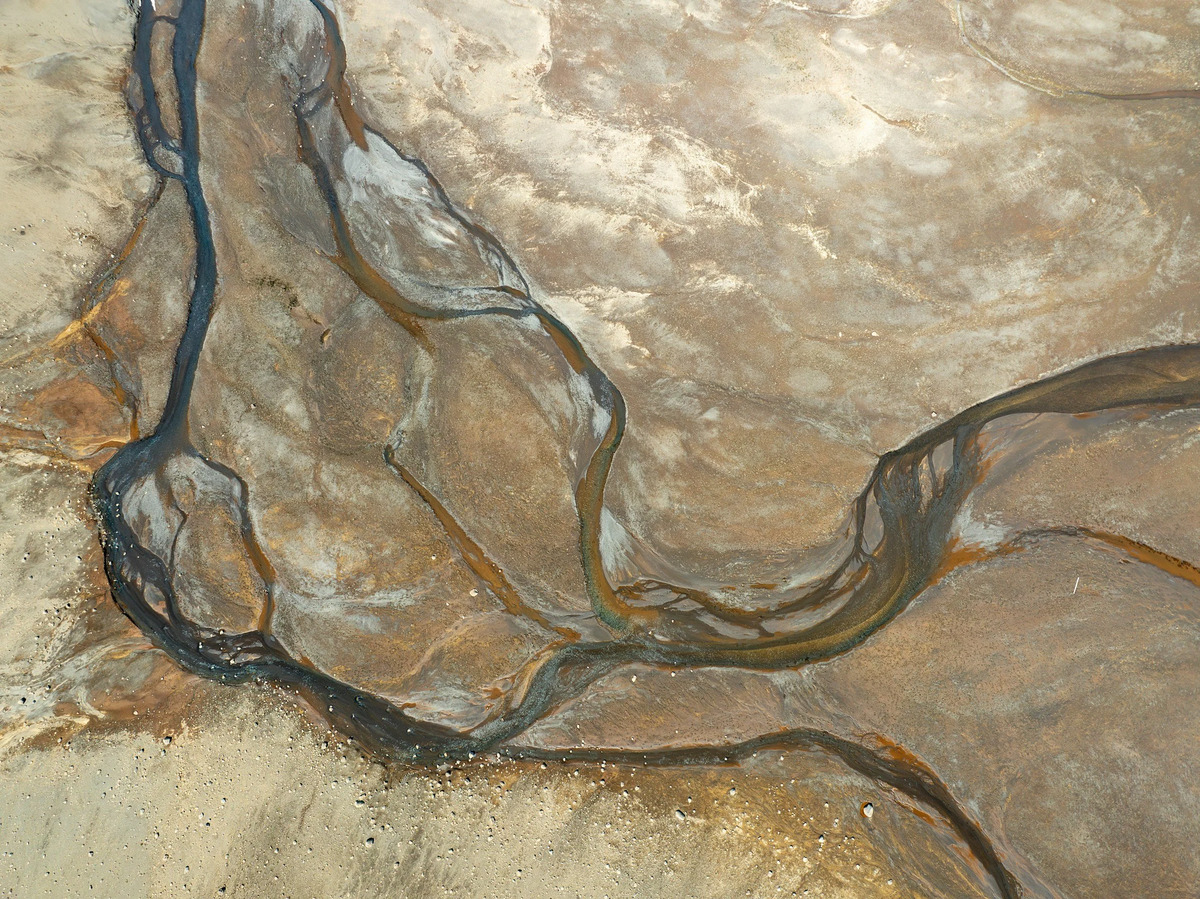
To celebrate the groundbreaking research of 2025 Drake Award recipients Dr. David Deamer and Dr. John Baross, the SETI Institute commissioned bioartist Dr. Jennifer Willet to create a unique artwork that brings biogenesis, the origin of life, to visual form. The result is Dreams of Biogenesis, a vivid, large-scale collage that synthesizes scientific hypotheses, living organisms, and immersive aesthetics to tell a story as old as the Earth itself.
In a recent SETI Live, SETI Institute’s Director of the Artist-in-Residence Program, Bettina Forget, spoke with Dr. Willet about her creative process, her broader body of work, and how it helps us engage with the complex scientific questions regarding the origins of life in an accessible and imaginative way.
What Is Bioart?
Dr. Willet is a Canada Research Chair in Art, Science, and Ecology at the University of Windsor and Director of the INCUBATOR art lab. She works with living biological media, from algae and bacteria to genetically modified microorganisms, and combines these with techniques from sculpture, collage, and performance art.
In her lab, she cultivates a “palette” of colorful genetically modified bacteria and living cultures, which are then incorporated into installations and artworks. This medium requires strict biosafety protocols to safely exhibit living organisms in gallery settings.
For Dr. Willet, bioart is not only about material experimentation. It is about establishing a dynamic, sensory relationship between humans and microorganisms — organisms that are essential to life on Earth yet often misunderstood or overlooked.
Exploring Biogenesis Through Art
The artwork Dreams of Biogenesis was developed in response to the scientific contributions of SETI Institute 2025 Drake Award recipients Dr. Deamer and Dr. Baross, who study how life may have originated under radically different early-Earth conditions.
-
Dr. John Baross, an ecologist at the University of Washington, has conducted deep-sea fieldwork to study hydrothermal vents (high-temperature fissures on the seafloor known as black smokers). These environments host extremophiles, microorganisms that thrive in extreme conditions. Dr. Baross hypothesizes that life may have begun in these nutrient-rich, high-pressure environments.
-
Dr. David Deamer, a chemist, explores wet-dry cycling in freshwater volcanic pools as a mechanism for biogenesis. His experiments focus on how liposomes (fatty vesicles capable of enclosing molecules) could have served as early protocells. He also considers the role of organic compounds delivered by asteroids in catalyzing life.
Rather than treat these origin-of-life hypotheses as mutually exclusive, Dr. Willet emphasized how they can coexist. “Both theories may represent valid pathways in early Earth’s diverse environments,” she explained. This dual perspective became central to her artistic interpretation.
A Visual Cacophony of Life
Dreams of Biogenesis is a monumental, immersive collage measuring 80 feet long and 16 feet tall. It expands upon Dr. Willet’s earlier project, When Microbes Dream, inviting viewers to inhabit a microscopic world where biochemical processes are sensory experiences.
Incorporated into the new collage are artistic references to both scientists’ work:
-
Black smokers from Dr. Baross’s research appear in painted form, layered into the oceanic background
-
A volcano and freshwater hot spring illustrate the environment central to Dr. Deamer’s hypothesis
-
Ribofoam structures, net-like molecular matrices possibly involved in prebiotic chemistry, are depicted as abstract red and purple forms
-
Vibrant liposomes, drawn from Dr. Deamer’s work, appear as fluorescent yellow and pink vesicles
In addition to the paper collage, Dr. Willet also created a “stop motion animation featuring moving collage elements that illustrate the cavalcade of life at a microscopic scale” that can be viewed here.
Performance and Public Engagement
Dr. Willet’s approach to science communication is rooted in long-term engagement and joyful interaction. Through the INCUBATOR art lab, she runs workshops for students, artists, and the public. Over 3,000 participants have explored microbiology, microscopy, and creative science experiments thanks to her unique approach.
The INCUBATOR art lab includes a fully operational BSL-2 laboratory merged with a theatrical venue, allowing live scientific processes to be projected and performed. This hybrid space redefines how science and art can co-exist.
Honoring Discovery Through Art
In creating Dreams of Biogenesis, Dr. Willet sought not just to visualize competing scientific hypotheses, but to celebrate the researchers themselves. “This was a gift,” she said. “Their work contributes to our shared human understanding, and I wanted to place that in a broader story of life on Earth.”
The artwork debuted at the 2025 Drake Awards, where Dr. Deamer and Dr. Baross shared the stage in a thoughtful dialogue about the origins of life. Their conversation and Dr. Willet’s art reflected a shared spirit of inquiry that spans disciplines and worldviews.
To learn more about this artwork and Dr. Jennifer Willet’s work, watch the full SETI Live here.
To watch the presentation of the artwork and the subsequent conversation between Dr. Deamer and Dr. Baross, click here.
)