)

Friday, Feb 28, 2025

SETI research often involves hunting for technosignatures—evidence of technology from distant civilizations. But how detectable is Earth to others with technology similar to our own?
In a recent SETI Live, Dr. Sofia Sheikh and Dr. Simon Steel from the SETI Institute explored Dr. Sheikh’s study examining how detectable Earth is to extraterrestrial civilizations. Rather than focusing on advanced megastructures like Dyson spheres, the research investigates the signals humankind currently emits and how they might be observed from afar.
How Earth’s Technosignatures Could Be Detected
Alien civilizations could detect Earth through several means:
- Radio Signals: 4G LTE cell towers, Wi-Fi, GPS, and planetary radar continuously emit radio waves.
- Optical Signals: High-powered lasers, developed for communication, could be visible across interstellar distances.
- Atmospheric and Surface Impacts: Pollution, such as nitrogen dioxide emissions, and city lights on Earth’s night side could signal technological activity.
- Artificial Objects: Satellites, lunar landing modules, and space debris highlight a spacefaring civilization.
How Far Can Earth Be Detected?
Some signals are more detectable than others. Powerful planetary radar bursts, such as those from the now-decommissioned Arecibo telescope, could be observed from great distances. In contrast, everyday signals from the Deep Space Network (DSN) or laser communications require much closer proximity.
Interestingly, low-level radiation from 4G LTE signals could be detectable within about four light years—enough to reach Proxima Centauri, our closest stellar neighbor.
Challenges in Detecting Earth
Several factors affect Earth's detectability:
- Signal Strength: Most signals are weak compared to cosmic noise, making detection difficult at interstellar distances.
- Signal Type: Narrow-band signals are clearer technology indicators confined to a small frequency range.
- Directionality: Many of Earth's strongest signals, such as radar pulses, aren’t evenly distributed across the sky, requiring an observer to be in the right place at the right time.
- Time Delay: Signals travel at the speed of light, meaning an advanced civilization would detect Earth’s past transmissions—for example, the Arecibo message has only traveled 50 light-years since 1974.
The Future of Earth’s Detectability
As technology evolves, so do our technosignatures. Changes in energy consumption, pollution reduction, and advancements in communication could affect Earth's visibility in the cosmos. Revisiting this research over time will enhance our understanding of how our detectability shifts.
Lead author, Dr. Sofia Sheikh, and Dr. Simon Steel, the Deputy Director of the Carl Sagan Center, explore these ideas in more detail. They discuss how Earth could be detected and what this means for SETI. Watch "Earth Detecting Earth: How Far Away Can We Detect Earth's Technosignatures?" on our YouTube channel to learn more.







News
Related News
Jul 2, 2026
How Clouds Hide Alien Worlds—and How Astronomers See Through Them
#Blog #Lauren Sgro
Jun 29, 2026
Humanity's Plan for First Contact: Who Speaks for Earth?
#Blog #Lauren Sgro #Lucian Walkowicz #Chelsea Haramia #SETI #SETI Institute
Jun 26, 2026
What Juice Revealed About Interstellar Comet 3I/ATLAS
#Blog #3I/ATLAS #Franck Marchis #Juice
Jun 12, 2026
Not Planets, Not Stars: NASA Volunteers Doubled the Number of Known Brown Dwarfs
#Blog #Lauren Sgro
Jun 11, 2026
Life is But a Stream: Planetary Systems Along Stellar Streams
#Blog #Moiya McTier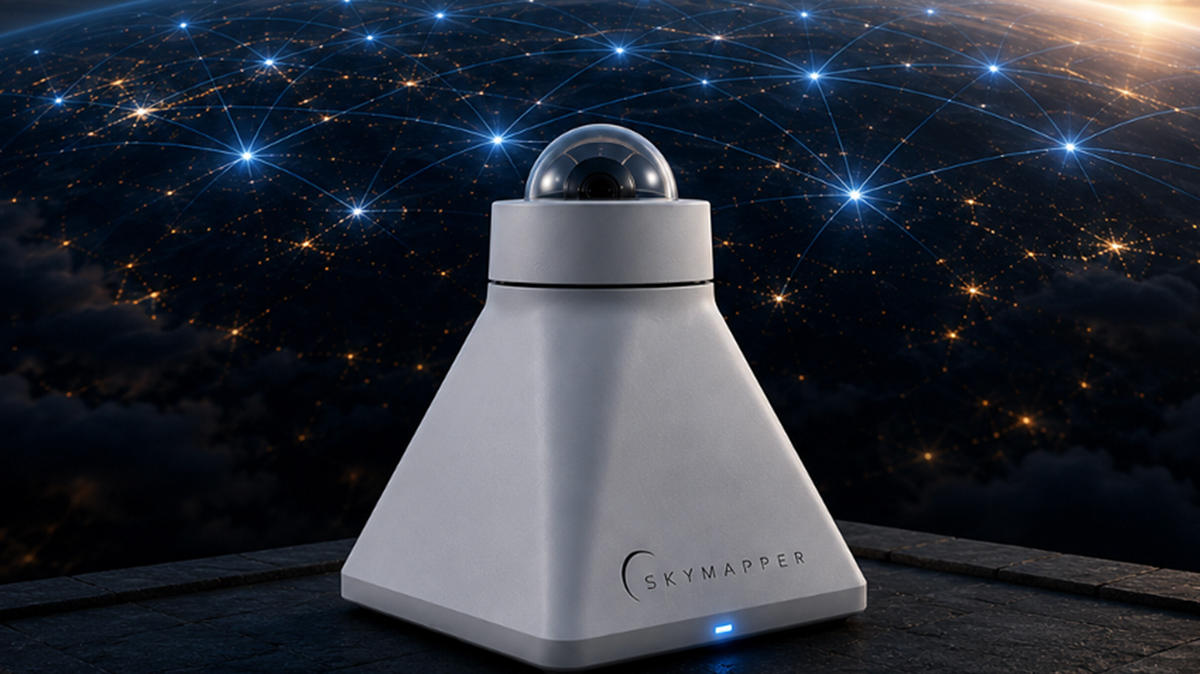
Jun 9, 2026
Disclosure Needs Data
#SkyMapper #Franck Marchis #SETI #citizen science
Jul 2, 2026
#Blog
#Lauren Sgro
Jun 29, 2026
#Blog
#Lauren Sgro
#Lucian Walkowicz
#Chelsea Haramia
#SETI
#SETI Institute
Humanity's Plan for First Contact: Who Speaks for Earth?
Jun 26, 2026
#Blog
#3I/ATLAS
#Franck Marchis
#Juice
What Juice Revealed About Interstellar Comet 3I/ATLAS
Jun 12, 2026
#Blog
#Lauren Sgro
Not Planets, Not Stars: NASA Volunteers Doubled the Number of Known Brown Dwarfs
Jun 11, 2026
#Blog
#Moiya McTier
Life is But a Stream: Planetary Systems Along Stellar Streams
Jun 9, 2026
#SkyMapper
#Franck Marchis
#SETI
#citizen science
Disclosure Needs Data
Research
Related Projects

SkyMapper • SETI • Citizen Science • Astronomy
SkyMapper: Expanding Access to Real-time Astronomy Through a Global Astronomical Network
SkyMapper and the SETI Institute are connecting educators, students and the public to live astronomical observations through a distributed astronomical network. #SkyMapper #SETI #Citizen Science #Astronomy
VPL
Virtual Planetary Laboratory
How can we best assess whether an exoplanet supports life? #VPL
Discovery and Futures Lab
Discovery and Futures Lab
What happens if life beyond Earth is discovered? The Discovery and Futures Lab at the SETI Institute fosters novel and anticipatory research at the intersection of science, society, our planet, and the search for life beyond Earth. #Discovery and Futures Lab
May 17, 2026
SkyMapper: Expanding Access to Real-time Astronomy Through a Global Astronomical Network
SkyMapper and the SETI Institute are connecting educators, students and the public to live astronomical observations through a distributed astronomical network.
#SkyMapper
#SETI
#Citizen Science
#Astronomy
May 5, 2026
Virtual Planetary Laboratory
How can we best assess whether an exoplanet supports life?
#VPL
Apr 16, 2026
Discovery and Futures Lab
What happens if life beyond Earth is discovered? The Discovery and Futures Lab at the SETI Institute fosters novel and anticipatory research at the intersection of science, society, our planet, and the search for life beyond Earth.
#Discovery and Futures Lab
Support Us
Support the
SETI Institute
Scientists are getting closer in their search for life beyond earth. But with limited federal funding for the search for extraterrestrial intelligence, supporters are the reason cutting-edge scientists can keep their eyes on the sky.
