)

Monday, Aug 18, 2025

Astronomers using the James Webb Space Telescope (JWST) have reported a potential detection of a Saturn-like exoplanet orbiting Alpha Centauri A: the closest Sun-like star to Earth, located just over four light-years away. If confirmed, this would mark a major milestone in exoplanet science, as the new planet – though likely a gas giant – would be the closest to orbit in the habitable zone of its star.
The discussion featured astronomer and instrument scientist Dr. Julien Girard of the Space Telescope Science Institute (STScI), interviewed by SETI Institute senior astronomer Dr. Franck Marchis.
The Discovery and Observational Approach
The potential exoplanet was detected using JWST’s Mid-Infrared Instrument (MIRI) at a wavelength of 15 microns, part of the thermal infrared spectrum that is inaccessible from ground-based telescopes due to atmospheric water vapor absorption. To isolate the planet’s faint signal from its bright host star, the team employed MIRI’s coronagraph, a mask that blocks direct starlight and allows detection of objects several orders of magnitude fainter.
Alpha Centauri is a triple star system comprising Alpha Centauri A, Alpha Centauri B, and Proxima Centauri, which hosts three planets of its own. This candidate planet appears to orbit Alpha Centauri A at approximately 2 astronomical units (AU), twice the Earth-Sun distance, with an estimated temperature of about 225 Kelvin (−50 °C). Based on its observed brightness, the object is consistent with a gas giant between the sizes of Saturn and Jupiter.
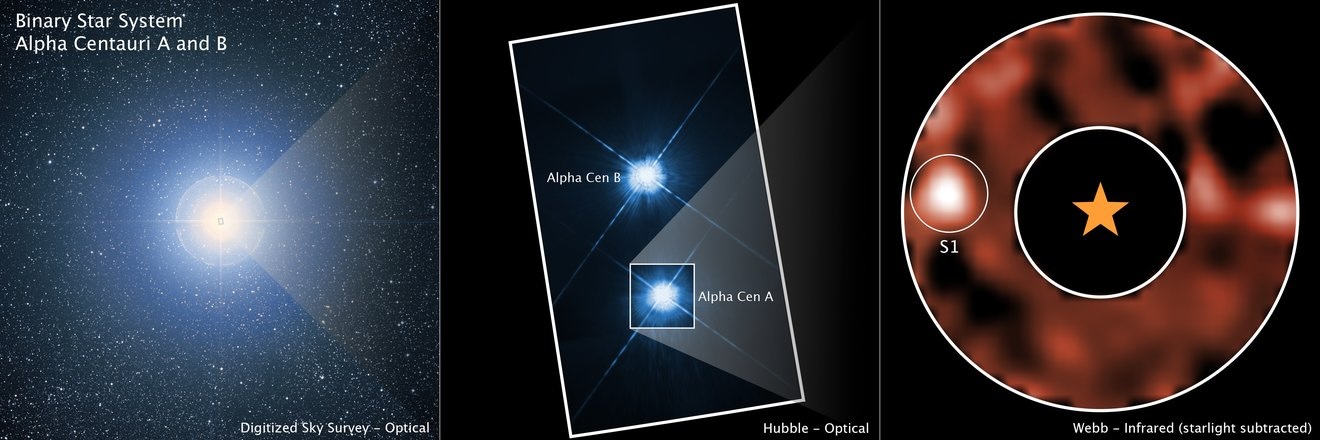
Observations of the Alpha Centauri triple star system: From left, the ground-based Digitized Sky Survey shows all three stars as a single source of light; NASA’s Hubble resolves two Sun-like stars; the MIRI instrument on NASA’s Webb blocks the bright glare from one star, revealing a potential planet. Credit: NASA, ESA, CSA, Aniket Sanghi (Caltech), Chas Beichman (NExScI, NASA/JPL-Caltech), Dimitri Mawet (Caltech), Joseph DePasquale (STScI).
Why It Remains a Candidate
High-contrast imaging of exoplanets is inherently challenging. Planetary signals are often at the limits of instrument sensitivity and can be confused with optical or detector artifacts. To confirm a detection, astronomers seek to:
- Re-image the object at multiple roll angles of the telescope to verify its position relative to the star
- Observe it at different epochs (times) to track orbital motion or rule out background stars and galaxies
In this case, the JWST team obtained three observation sets between 2024 and 2025. The planet candidate was detected once but not recovered in the other two datasets, possibly because it moved too close to the coronagraph’s inner working angle. The result gains credibility from earlier Very Large Telescope mid-infrared observations that recorded a similar source at a compatible position and brightness, suggesting both detections may be of the same object.
Scientific Implications
If confirmed, the planet’s existence would inform models of planetary stability in binary systems. Alpha Centauri A and B are separated by 11-35 AU, close enough to limit where stable planetary orbits can exist. A gas giant at 2 AU could also influence the potential habitability of inner, smaller worlds by affecting their orbital dynamics.
While a cold gas giant is unlikely to host life, its moons, if large and geologically active, could be potential habitats.
Next Steps in Observation
Further JWST observations, combined with complementary methods like radial velocity measurements (detecting stellar wobbles caused by orbiting planets), will be required to confirm the candidate. Future missions could also contribute:
- Nancy Grace Roman Space Telescope: Launching in 2027, Roman’s coronagraph instrument will pioneer space-based wavefront control, enabling direct imaging of Jupiter-sized planets in reflected light.
- SETI Institute’s Project Blue: A proposed dedicated telescope designed to directly image planets around Alpha Centauri A and B in visible light at contrasts of 10⁻¹⁰ after prolonged observation.
- Habitable Worlds Observatory: A future flagship mission aiming to directly image and characterize Earth-like planets, building on JWST and Roman technologies.
Why Alpha Centauri Matters
Alpha Centauri’s proximity offers unmatched opportunities for follow-up study. Planets here could be prime targets for atmospheric characterization via spectroscopy, and their closeness raises the possibility of future interstellar probes. As Dr. Girard noted, “The Alpha Centauri system will always be observed. It’s our nearest laboratory for studying exoplanets in detail.”
Watch the full conversation with Dr. Julien Girard on the SETI Institute’s YouTube channel to learn more about this discovery and its implications.







News
Related News

Jul 10, 2026
A Remarkably Ancient Visitor: 3I/ATLAS
#3I/ATLAS #Comets, Meteors, and Asteroids #JWST
Jul 2, 2026
How Clouds Hide Alien Worlds—and How Astronomers See Through Them
#Blog #Lauren Sgro
Jun 29, 2026
Humanity's Plan for First Contact: Who Speaks for Earth?
#Blog #Lauren Sgro #Lucian Walkowicz #Chelsea Haramia #SETI #SETI Institute
Jun 26, 2026
What Juice Revealed About Interstellar Comet 3I/ATLAS
#Blog #3I/ATLAS #Franck Marchis #Juice
Jun 12, 2026
Not Planets, Not Stars: NASA Volunteers Doubled the Number of Known Brown Dwarfs
#Blog #Lauren Sgro
Jun 11, 2026
Life is But a Stream: Planetary Systems Along Stellar Streams
#Blog #Moiya McTier
Jul 10, 2026
#3I/ATLAS
#Comets, Meteors, and Asteroids
#JWST
Jul 2, 2026
#Blog
#Lauren Sgro
How Clouds Hide Alien Worlds—and How Astronomers See Through Them
Jun 29, 2026
#Blog
#Lauren Sgro
#Lucian Walkowicz
#Chelsea Haramia
#SETI
#SETI Institute
Humanity's Plan for First Contact: Who Speaks for Earth?
Jun 26, 2026
#Blog
#3I/ATLAS
#Franck Marchis
#Juice
What Juice Revealed About Interstellar Comet 3I/ATLAS
Jun 12, 2026
#Blog
#Lauren Sgro
Not Planets, Not Stars: NASA Volunteers Doubled the Number of Known Brown Dwarfs
Jun 11, 2026
#Blog
#Moiya McTier
Life is But a Stream: Planetary Systems Along Stellar Streams
Research
Related Projects

SkyMapper • SETI • Citizen Science • Astronomy
SkyMapper: Expanding Access to Real-time Astronomy Through a Global Astronomical Network
SkyMapper and the SETI Institute are connecting educators, students and the public to live astronomical observations through a distributed astronomical network. #SkyMapper #SETI #Citizen Science #Astronomy
VPL
Virtual Planetary Laboratory
How can we best assess whether an exoplanet supports life? #VPL
Discovery and Futures Lab
Discovery and Futures Lab
What happens if life beyond Earth is discovered? The Discovery and Futures Lab at the SETI Institute fosters novel and anticipatory research at the intersection of science, society, our planet, and the search for life beyond Earth. #Discovery and Futures Lab
May 17, 2026
SkyMapper: Expanding Access to Real-time Astronomy Through a Global Astronomical Network
SkyMapper and the SETI Institute are connecting educators, students and the public to live astronomical observations through a distributed astronomical network.
#SkyMapper
#SETI
#Citizen Science
#Astronomy
May 5, 2026
Virtual Planetary Laboratory
How can we best assess whether an exoplanet supports life?
#VPL
Apr 16, 2026
Discovery and Futures Lab
What happens if life beyond Earth is discovered? The Discovery and Futures Lab at the SETI Institute fosters novel and anticipatory research at the intersection of science, society, our planet, and the search for life beyond Earth.
#Discovery and Futures Lab
Support Us
Support the
SETI Institute
Scientists are getting closer in their search for life beyond earth. But with limited federal funding for the search for extraterrestrial intelligence, supporters are the reason cutting-edge scientists can keep their eyes on the sky.
