



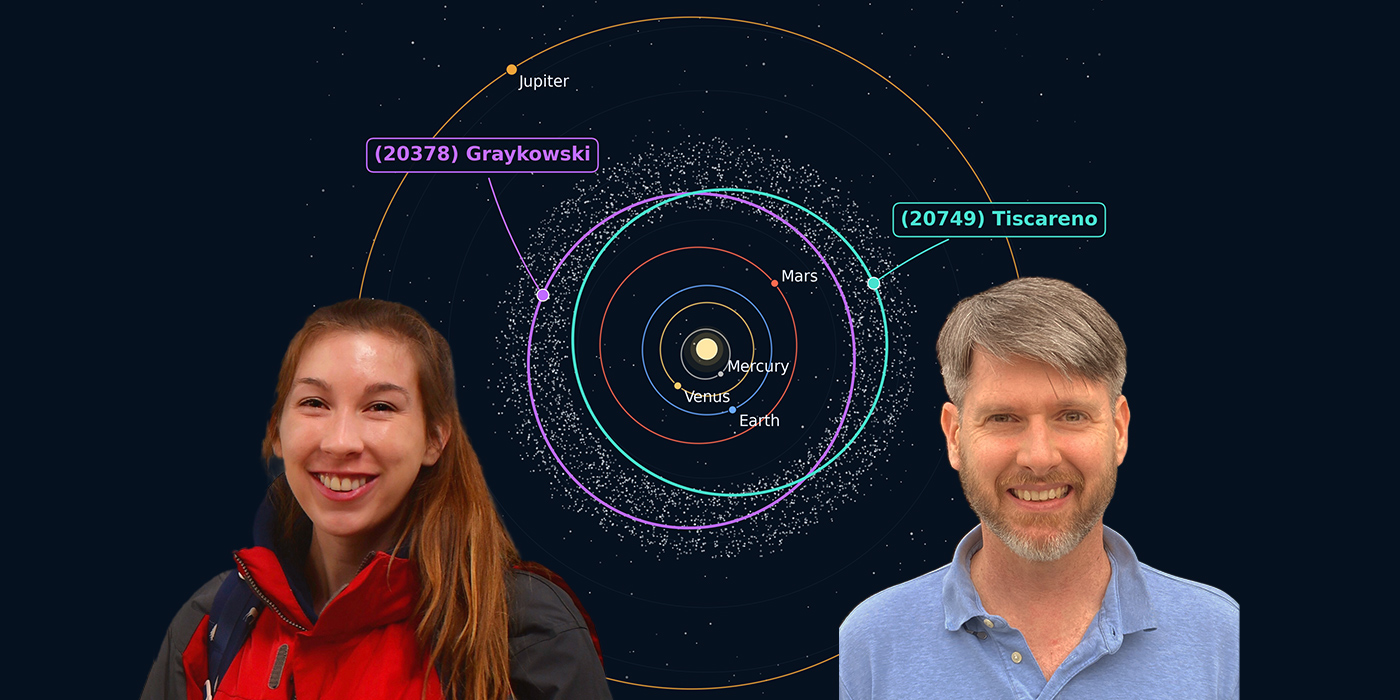
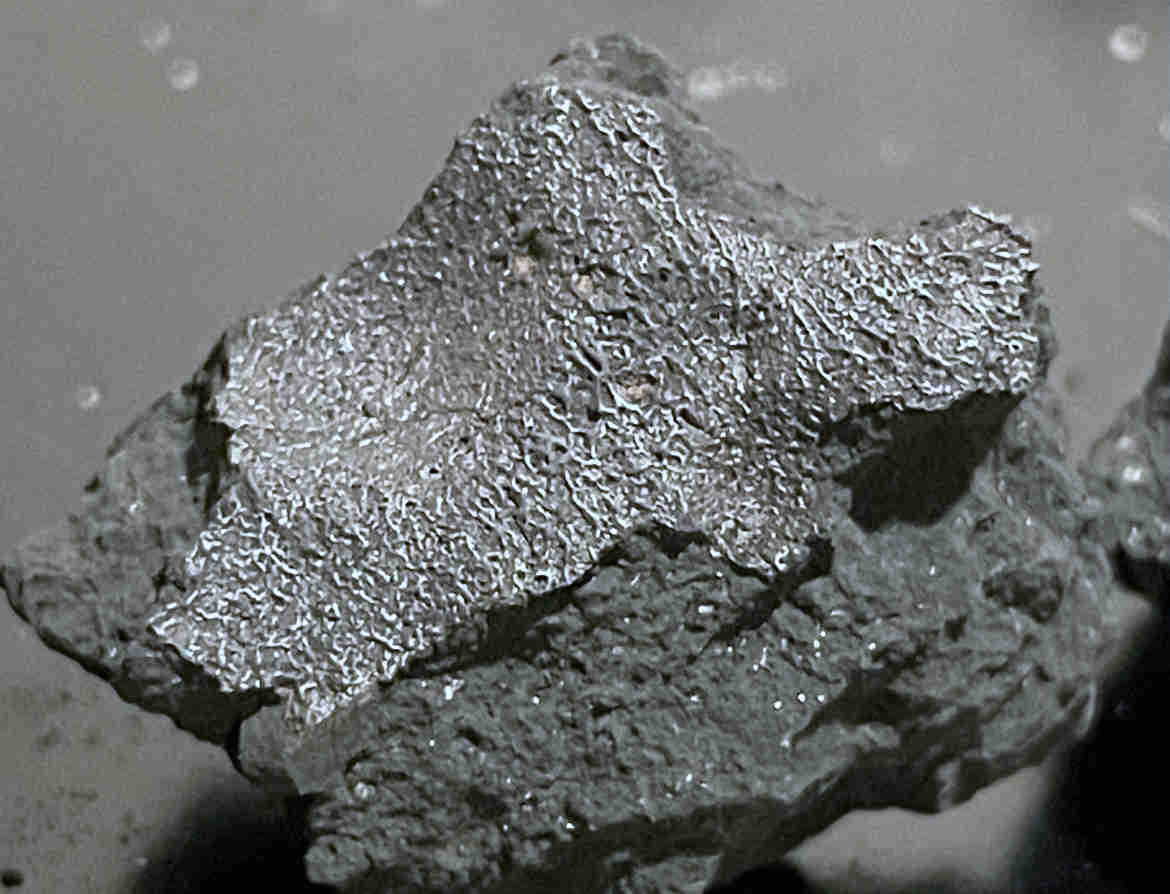
Second recovered meteorite from asteroid 2023 CX1, found by Peter Jenniskens in searches with astronomer François Colas (right) and volunteers.
At A Glance: Asteroid Exploded on Atmospheric Entry
|
| Listen to this article read by AI: |
Some asteroids are more dangerous than others, according to a report issued this week in Nature Astronomy by an international team of researchers, led by astrophysicist Auriane Egal of the Montreal Planetarium in Canada. The team presented their findings of an investigation into the impact of small asteroid 2023 CX1 over France in February 2023. This new paper revealed that small asteroids can explode on atmospheric entry.
"The asteroid was discovered in space about 7 hours before entering the Earth's atmosphere over Normandy," said astronomer and senior author Peter Jenniskens of the SETI Institute and NASA Ames Research Center. "I immediately phoned my brother in the Netherlands, who went outside and saw the fireball."
Other observers were alerted to the imminent impact and recorded spectacular images and videos of the resulting meteor.
"Our team determined that the asteroid was nearly spherical and measured about 72 centimeters in diameter, just under a yard," said Egal. "It had an estimated mass of about 650 kg."
That photographic and video data revealed that the calculated asteroid orbit was slightly off because not all observatories reported their elevation in the same geodetic framework. This has since been corrected.
"This was the third announced impact over land," said Jenniskens, who had earlier guided the recovery of the first two impacts of asteroids 2008 TC3 in Sudan and 2018 LA in Botswana.
For this fall, Jenniskens teamed up with astronomer François Colas of the Paris Observatory, the lead of the FRIPON fireball camera network. They guided a team of volunteers from FRIPON/Vigie-Ciel to their first find just hours after arriving in the small town of Saint-Pierre-le-Viger in Normandy.
"This recovery was difficult because of strong winds that blew the meteorites off course," said Jenniskens. "The atmosphere tends to sort the stones by mass, but the first stone found was much heavier than I had expected, so we still didn't quite know where the center line of the strewn field was located."
After scanning the area systematically with a group of about 12 searchers from FRIPON/Vigie-Ciel, Jenniskens himself found the second meteorite, a small 3-gram mass, late the next day, a meteorite that is now in the Natural History Museum in Paris.
"The meteorite was so small that it only stood out because the rock sat on top of moss in short grass", says Jenniskens. "With a large stone on one end and a small stone on the other, that finding established the location of the strewn field."
Analysis showed that the meteorite was a common type—the most frequently falling and recovered on Earth—a low-iron 'L-type' ordinary chondrite.
"Such types are also common among larger asteroid impacts," said Jenniskens. "What made this impact unusual was the bright double flare towards the end of the fireball."
The team concluded that this particular asteroid held together well until deeper in the atmosphere, where it lost 98% of its kinetic energy in a fraction of a second.
"The asteroid disintegrated abruptly around 28 km altitude, generating a concentrated spherical shock wave," said Egal.
Calculations performed at NASA Ames Research Center by co-author Darrel Robertson showed that the area affected by high overpressures was four times larger than for a typical asteroid impact, where the energy is released over a longer distance, starting higher in the atmosphere. And the closer the blast occurs to the ground, the more pronounced these differences will be.
"Our team confirmed the existence of a new population of asteroids linked to L-type chondrites, capable of fragmenting abruptly in the atmosphere and releasing almost all their energy at once," said Egal. "Such asteroids must be accounted for in planetary defense strategies, as they pose an increased risk to populated areas.”
The paper appears in Nature Astronomy here: https://www.nature.com/articles/s41550-025-02659-8
News
Related News
Beyond Disclosure Day: The Real-World Protocols
#Press Releases #SETI #Astronomy #Bill Diamond #SETI Institute
SETI Institute Awards $1 Million in STRIDE Grants to Advance Astrobiology, Exoplanet Science, and Public Engagement
#Press Releases #STRIDE #Research #Carl Sagan Center #Spectroscopy #Solar System #SETI #Climate and Bioscience #Astronomy #Astrobiology #Exoplanets #Data Science #Education #Outreach #Hat Creek Radio Observatory #Unistellar #SkyMapper
Asteroid Named in Honor of SETI Researcher and Communicator Seth Shostak
#Comets, Meteors, and Asteroids #Seth Shostak #SETI #Astronomy #Big Picture Science #Outreach #Andrew Fraknoi
Narrowing the Search: The 45 Best Targets for Alien Life
#Blog #Astronomy #JWST #NASA Missions and Observatories #Trappist-1 #LaserSETI #ATA #Franck Marchis
SkyMapper Goes Live: Building a Real-Time, Global Network for Astronomy
SkyMapper functions as an observational infrastructure, a system that links instruments, users, and data streams. Its goal is ambitious: to continuously observe and map the entire sky. #Blog #SkyMapper #LaserSETI #SETI #Astronomy #Exoplanet Detection #Comets, Meteors, and Asteroids #Planetary Defense #Technosignatures #Franck Marchis #Lauren Sgro
SETI Institute In the News: March Roundup 2026
In March 2026, SETI Institute researchers contributed to a wide range of conversations about our solar system and the search for life beyond Earth. From explaining unusual features on Mars and studying meteor airbursts in Earth’s atmosphere to advancing new ways of detecting technosignatures, this work reflects how scientists are continually refining our understanding of both nearby and distant worlds. #SETI Institute in the News #SETI Institute #Community #Mars #Pascal Lee #Peter Jenniskens #Comets, Meteors, and Asteroids #Astronomy #Vishal Gajjar #SETI #AI and Machine Learning #Astrobiology #Nathalie Cabrol #Carl Sagan Center #Seth Shostak #Movie Reviews #Bill DiamondResearch
Related Projects
SkyMapper: Expanding Access to Real-time Astronomy Through a Global Astronomical Network
SkyMapper and the SETI Institute are connecting educators, students and the public to live astronomical observations through a distributed astronomical network. #SkyMapper #SETI #Citizen Science #Astronomy
Virtual Planetary Laboratory
How can we best assess whether an exoplanet supports life? #VPL
Discovery and Futures Lab
What happens if life beyond Earth is discovered? The Discovery and Futures Lab at the SETI Institute fosters novel and anticipatory research at the intersection of science, society, our planet, and the search for life beyond Earth. #Discovery and Futures LabSupport the
SETI Institute
Scientists are getting closer in their search for life beyond earth. But with limited federal funding for the search for extraterrestrial intelligence, supporters are the reason cutting-edge scientists can keep their eyes on the sky.