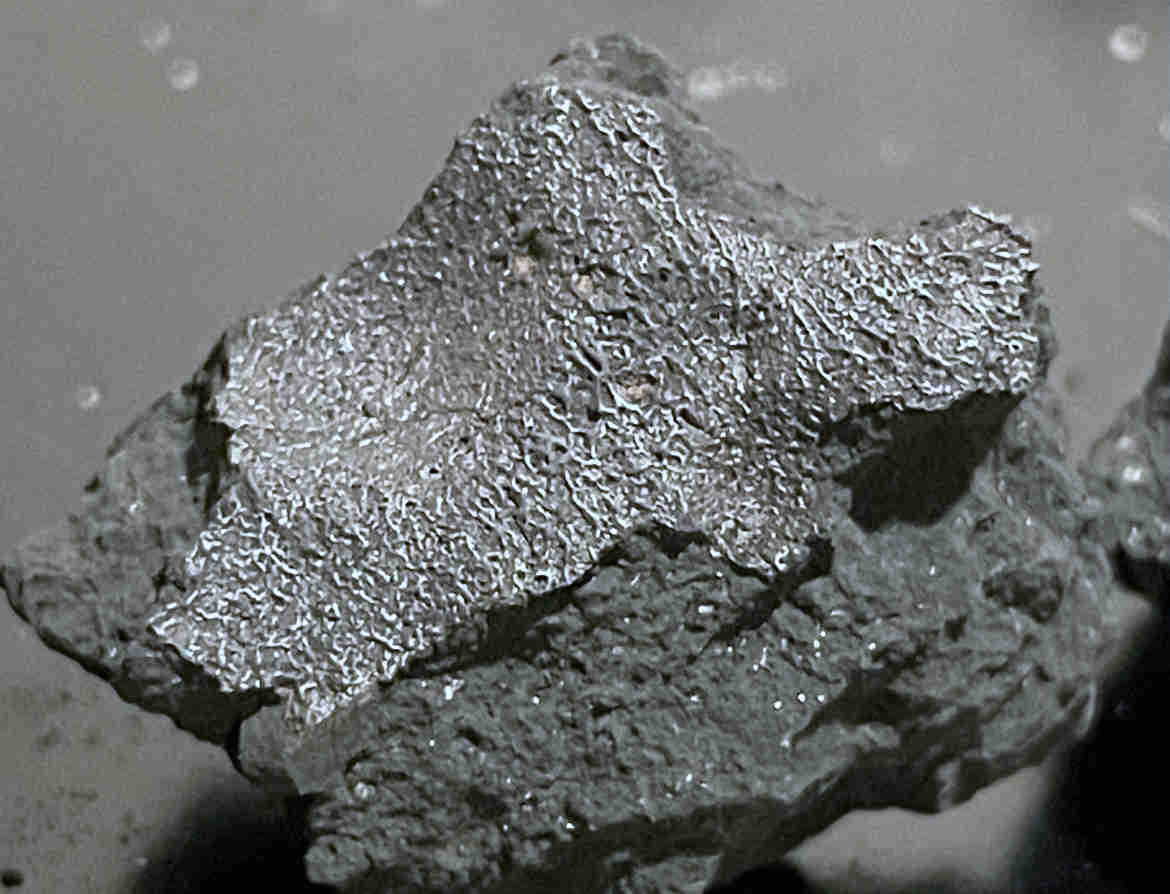
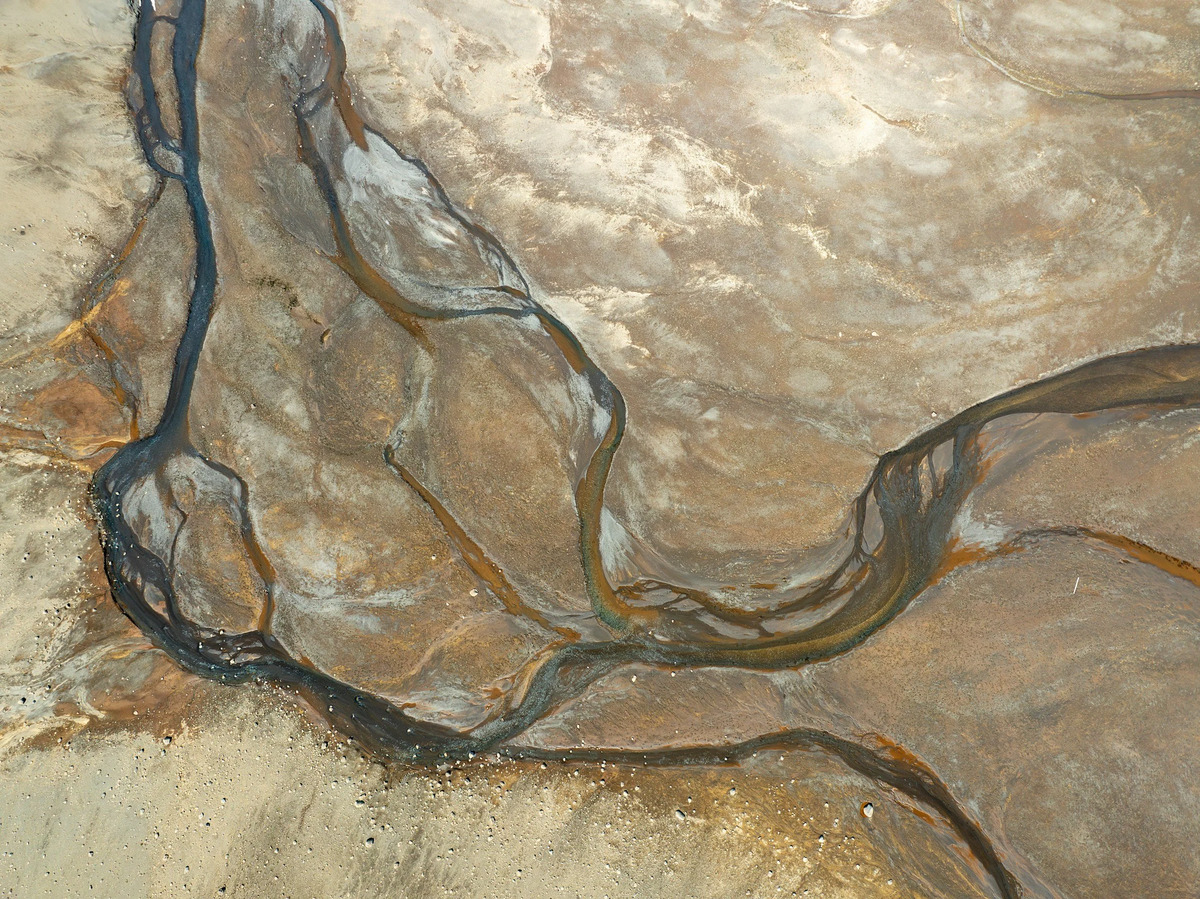
Figure 1: Meteorites from the backside of asteroid 2008 TC3 as Jenniskens found them on the ground in the Nubian Desert of Sudan. Photo: P. Jenniskens, SETI Institute/NASA Ames Research Center.
August 8, 2022, Mountain View, CA - When a small asteroid enters Earth's atmosphere from space, its surface is brutally heated, causing melting and fragmenting. Therefore, it was somewhat of a mystery why the rocks near the surface survive to the ground as meteorites. That mystery is solved in a new study of the fiery entry of asteroid 2008 TC3, published online today in Meteoritics and Planetary Science.
"Most of our meteorites fall from rocks the size of grapefruits to small cars," says lead author and meteor astronomer Peter Jenniskens of the SETI Institute and NASA Ames Research Center. "Rocks that big do not spin fast enough to spread the heat during the brief meteor phase, and we now have evidence that the backside survives to the ground."
In 2008, a 6-meter-sized asteroid called 2008 TC3 was detected in space and tracked for over 20 hours before it hit the Earth's atmosphere, creating a bright meteor that disintegrated over the Nubian Desert of Sudan. The breakup scattered a shower of meteorites over a 7 x 30 km area. Jenniskens collaborated with University of Khartoum professor Muawia Shaddad and his students to recover these meteorites.
"In a series of dedicated search campaigns, our students recovered over 600 meteorites, some as big as a fist, but most no bigger than a thumbnail," says Shaddad. "For each meteorite, we recorded the find location."
While conducting grid searches perpendicular to the asteroid path, the researchers were surprised to find that the larger fist-sized meteorites were spread out more than the smaller meteorites. Teaming up with NASA's Asteroid Threat Assessment Project (ATAP) at NASA Ames Research Center, they decided to investigate.
"While the asteroid approached Earth, its brightness flickered from spinning and tumbling," says theoretical astronomer Darrel Robertson of ATAP. "Because of that, asteroid 2008 TC3 is unique in that we know the shape and orientation of the asteroid when it entered Earth's atmosphere."
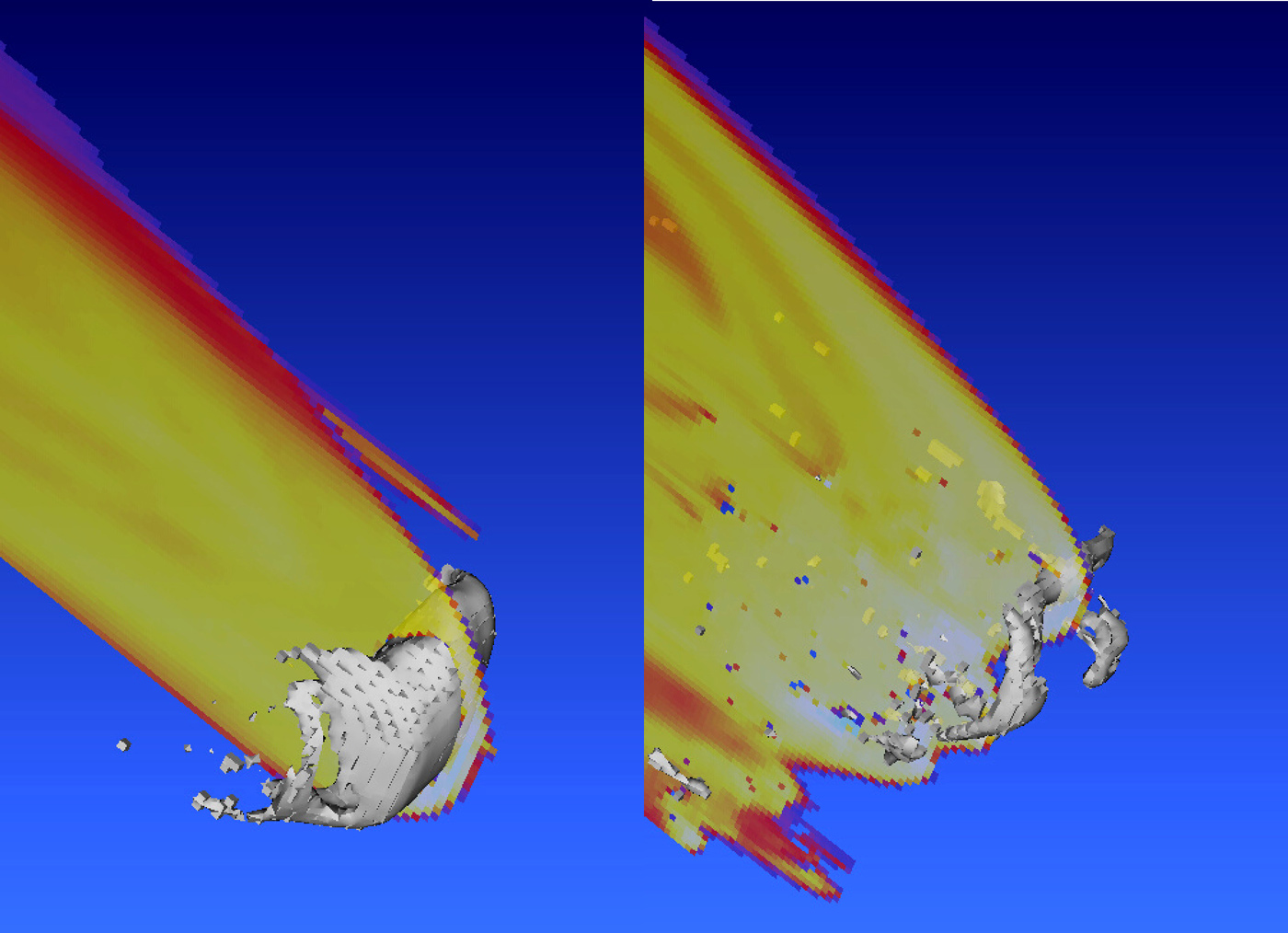
Robertson created a hydrodynamic model of the entry of 2008 TC3 into Earth's atmosphere that showed how the asteroid melts and breaks up. The observed altitudes of meteor brightness and dust clouds were used to calibrate the altitude of phenomena recognized in the model.
"Because of the high speed coming in, we found that the asteroid punched a near vacuum wake in the atmosphere," says Robertson. "The first fragments came from the sides of the asteroid and tended to move into that wake, where they mixed and fell to the ground with low relative speeds."
While falling to the ground, the smallest meteorites were soon stopped by friction with the atmosphere, falling close to the breakup point, while larger meteorites were harder to stop and fell further downrange. As a result, most recovered meteorites were found along a narrow 1-km wide strip in the asteroid’s path.
"The asteroid melted more and more at the front until the surviving part at the back and bottom-back of the asteroid reached a point where it suddenly collapsed and broke into many pieces," said Robertson. "The bottom-back surviving as long as it did was because of the shape of the asteroid."
No longer trapped by the shock from the asteroid itself, the shocks from the individual pieces now repulsed them, sending these final fragments flying outwards with much higher relative speed.
"The largest meteorites from 2008 TC3 were spread wider than the small ones, which means that they originated from this final collapse," said Jenniskens. "Based on where they were found, we concluded that these pieces stayed relatively large all the way to the ground."
The location of the large meteorites on the ground still reflects their location in the back and bottom-back part of the original asteroid.
"This asteroid was a mixed bag of rocks," said co-author Cyrena Goodrich of the Lunar and Planetary Institute (USRA). Goodrich led a team of meteoriticists who determined the meteorite type of each recovered fragment in the large mass area.
The researchers found that the different meteorite types were spread randomly on the ground, and therefore were also spread randomly in the original asteroid.
"That agrees with the fact that other meteorites of this kind, albeit on a much smaller scale, also contain random mixtures," said Goodrich.
These results may also help understand other meteorite falls. Asteroids are exposed to cosmic rays while in space, creating a low level of radioactivity and more near the surface.
"From that radioactivity, we often find that the meteorites did not come from the better-shielded interior," said Jenniskens. "We now know they came from the surface at the back of the asteroid."
More information
Peter Jenniskens, Darrel Robertson, Cyrena A. Goodrich, Muawia H. Shaddad, Ayman Kudoda, Anna M. Fioretti, Michael E. Zolensky (2022) Bolide fragmentation: What parts of asteroid 2008 TC3 survived to the ground? Meteoritics and Planetary Science:
https://onlinelibrary.wiley.com/doi/10.1111/maps.13892
About the SETI Institute
Founded in 1984, the SETI Institute is a non-profit, multi-disciplinary research and education organization whose mission is to lead humanity's quest to understand the origins and prevalence of life and intelligence in the Universe and share that knowledge with the world. Our research encompasses the physical and biological sciences and leverages data analytics, machine learning, and advanced signal detection technologies. The SETI Institute is a distinguished research partner for industry, academia, and government agencies, including NASA and the National Science Foundation.
Contact information
Rebecca McDonald
Director of Communications
SETI Institute
[email protected]
News
Related News
Beyond Disclosure Day: The Real-World Protocols
#Press Releases #SETI #Astronomy #Bill Diamond #SETI Institute
SETI Institute Looks for Signs of Technology in Interstellar Visitor 3I/ATLAS
Observations with the Allen Telescope Array set new limits on possible signals from extraterrestrial transmitters. #Press Releases #ATA #3I/ATLAS #Hat Creek Radio Observatory #Radio Astronomy #SETI
SETI Institute Awards $1 Million in STRIDE Grants to Advance Astrobiology, Exoplanet Science, and Public Engagement
#Press Releases #STRIDE #Research #Carl Sagan Center #Spectroscopy #Solar System #SETI #Climate and Bioscience #Astronomy #Astrobiology #Exoplanets #Data Science #Education #Outreach #Hat Creek Radio Observatory #Unistellar #SkyMapper
SETI Institute to Honor Dr. Matthew Tiscareno with 2026 Carl Sagan Center Director’s Award
The Drake Awards event will also recognize SETI Forward and SETI Institute REU student award recipients. #Press Releases #Drake Awards #Frank Drake #SETI #Awards #Planetary Astronomy #Astrobiology #SETI Forward #Education #Carl Sagan Center #Matthew Tiscareno #Nathalie Cabrol #REU
Asteroid Named in Honor of SETI Researcher and Communicator Seth Shostak
#Comets, Meteors, and Asteroids #Seth Shostak #SETI #Astronomy #Big Picture Science #Outreach #Andrew Fraknoi
Narrowing the Search: The 45 Best Targets for Alien Life
#Blog #Astronomy #JWST #NASA Missions and Observatories #Trappist-1 #LaserSETI #ATA #Franck MarchisResearch
Related Projects
SkyMapper: Expanding Access to Real-time Astronomy Through a Global Astronomical Network
SkyMapper and the SETI Institute are connecting educators, students and the public to live astronomical observations through a distributed astronomical network. #SkyMapper #SETI #Citizen Science #Astronomy
Virtual Planetary Laboratory
How can we best assess whether an exoplanet supports life? #VPL
Discovery and Futures Lab
What happens if life beyond Earth is discovered? The Discovery and Futures Lab at the SETI Institute fosters novel and anticipatory research at the intersection of science, society, our planet, and the search for life beyond Earth. #Discovery and Futures LabSupport the
SETI Institute
Scientists are getting closer in their search for life beyond earth. But with limited federal funding for the search for extraterrestrial intelligence, supporters are the reason cutting-edge scientists can keep their eyes on the sky.