)

Wednesday, Jul 15, 2026
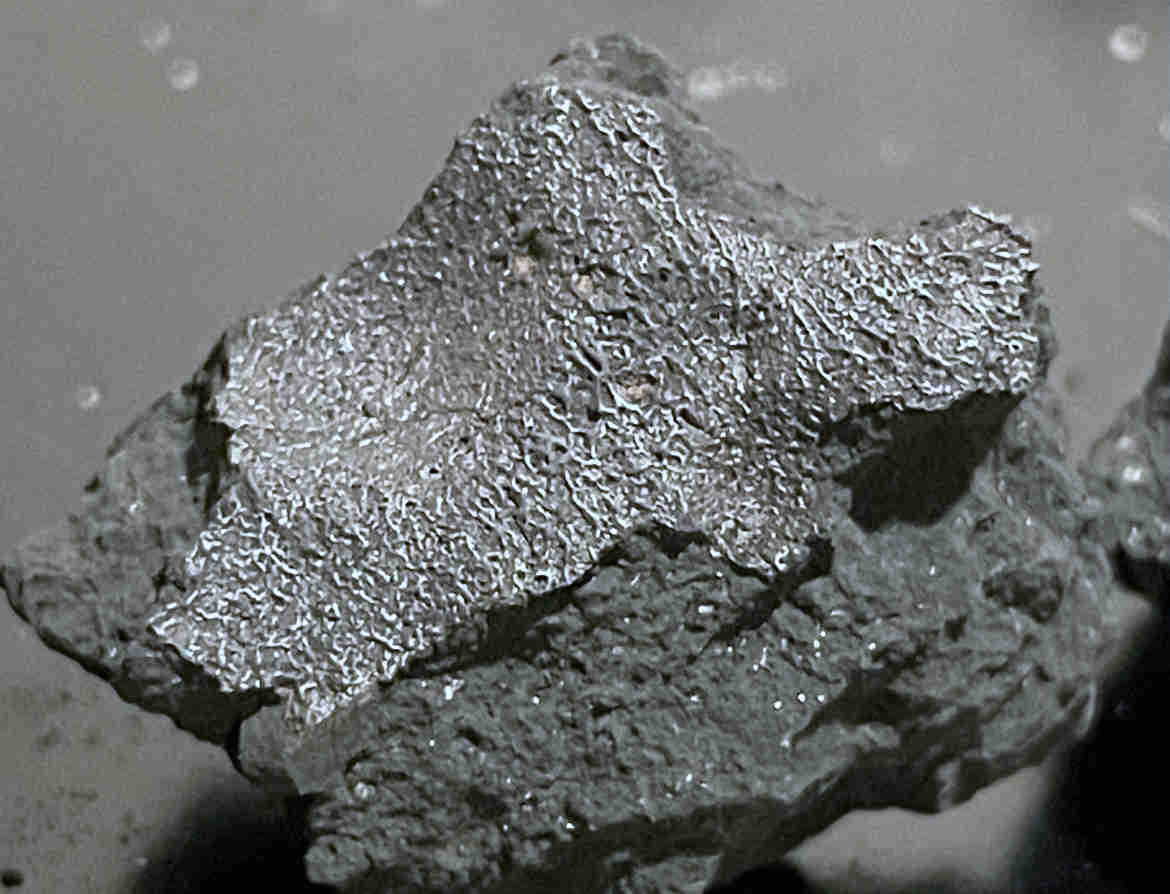
Fragment of the Hillsborough meteorite, broken on impact, with fusion crust from passing at high speed through the Earth’s atmosphere.
Listen to this article read by Beth Johnson:
At a Glance
|
July 15, 2026, Mountain View, CA -- On July 16, 2024 a daytime meteor shook New York City with a sonic boom as it passed just south of the Statue of Liberty. Now, an international team of researchers reports in the journal Science Advances that a short time later, a more than two-pound meteorite crashed through the roof of a house in the town of Hillsborough, New Jersey.
"A forensic study of the fragments revealed that they contained preserved bits from near the surface of a small primitive asteroid where it experienced concentrated salty fluids—a process not previously known from this type of proto planet world," said lead author and meteor astronomer Peter Jenniskens of the SETI Institute and NASA's Ames Research Center in California's Silicon Valley.
The Meteorite Fall
On that day, a rock the size of a heavy airline bag entered the Earth's atmosphere at a speed of 32,000 miles/h (14.4 kilometers per second). Sixty observers from New York, New Jersey, Connecticut, Rhode Island and Pennsylvania reported seeing the meteor to the American Meteor Society, while sixteen in New York and New Jersey felt the shockwave.
"Our cameras in Northford, Connecticut, and Douglassville, Pennsylvania, as well as a doorbell camera in Wayne, New Jersey, captured the meteor, and from that we measured its trajectory," said American Meteor Society operations manager Mike Hankey. "The path traced back to low in the asteroid belt."
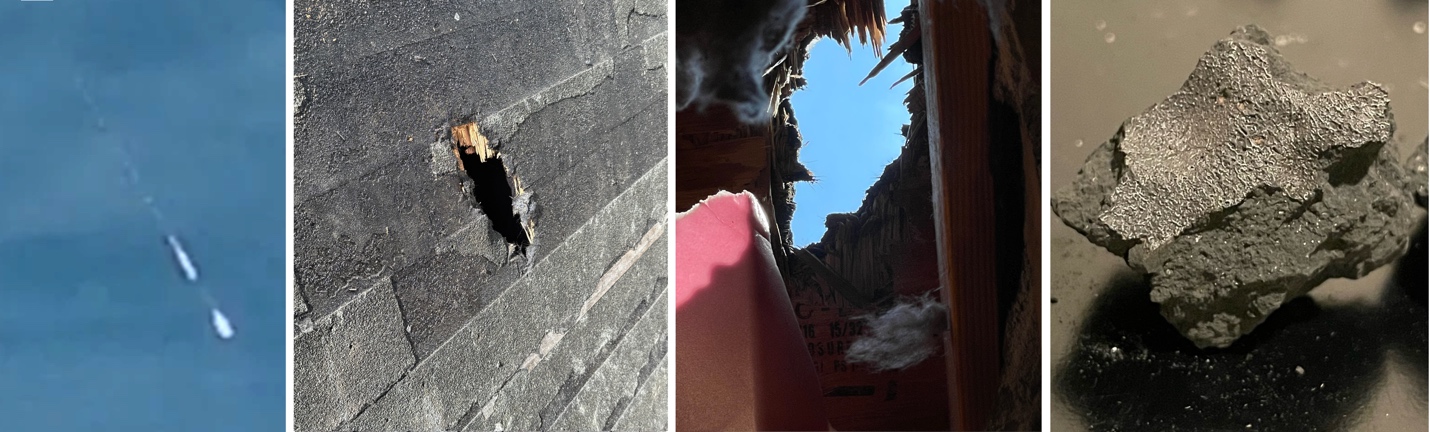
Daytime meteor (left), impact site and a fragment of the Hillsborough meteorite.
The rock was fragile and quickly broke into pieces. The meteor stopped being visible at an altitude of 22 miles (35 kilometers). After it faded, a Doppler weather radar at Newark Airport briefly detected a long cloud of falling pebbles stretching from Staten Island into New Jersey. Hillsborough was at the far end of that cloud, where the largest rocks came down. Only one was recovered because it hit a house.
The owner of the house described the scene as follows: "I was at home at the time, heard a loud crash and found a hole in the ceiling of the master bedroom. I smelled a strong sulfur-like odor and saw many black fragments along with debris and black dust that covered my bed, carpet and surrounding areas.”
He then immediately preserved and documented the entire scene using disposable gloves and aluminum foil to place the meteorite fragments in glass jars.
Evidence of Ancient Brines
When scientists examined the rocks, they determined it belonged to one of two known types of primitive meteorites called CM-type carbonaceous chondrites, where the letter "M" refers to the Mighei meteorite that fell in Ukraine in 1889.
According to paper co-author Mike Zolensky, a meteoriticist at NASA's Johnson Space Center in Houston, analysis of the Hillsborough meteorite found fragments that were more extensively altered by water on the meteorite's parent asteroid than is typically seen in CM2 carbonaceous chondrites and classified the specimen as a CM1/2 carbonaceous chondrite, an intermediate classification between petrographic types CM1 and CM2.
Hillsborough is the 22nd observed CM-type meteorite fall, but only the second witnessed fall of a CM1/2 carbonaceous chondrite, following the Kolang meteorite that fell in North Sumatra, Indonesia, in 2020. All others are CM2-types. No CM1-type falls have been witnessed.
"Thanks to the homeowner's quick reaction, these are the most pristine CM1/2 meteorites we know of," said Jenniskens.
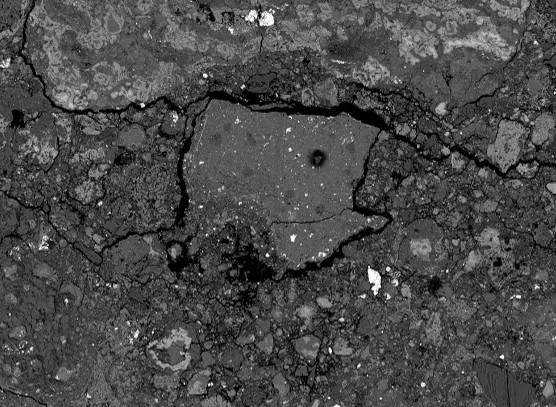
Scientists discovered that this bit of the Hillsborough meteorite is rich in salts and came from near the surface of the parent body asteroid.
Another prominent primitive type of carbonaceous chondrite is called CI, with "I" after the meteorite Ivuna that fell in Tanzania in 1938. Samples of this type were brought back in pristine condition from asteroid Ryugu by JAXA's Hayabusa 2 mission and from asteroid Bennu by NASA's OSIRIS-REx mission. They were found to contain ample evidence of the influence of briny fluids from just below the surface of their parent asteroid.
Zolensky and colleague JangMi Han found small salt-rich CM1 fragments within the Hillsborough meteorite, suggesting they originated from a near-surface region of the parent asteroid where liquid water evaporated and concentrated salts. They are now working to identify the salt minerals for comparison with similar phases found among samples returned to Earth from asteroids Ryugu and Bennu.
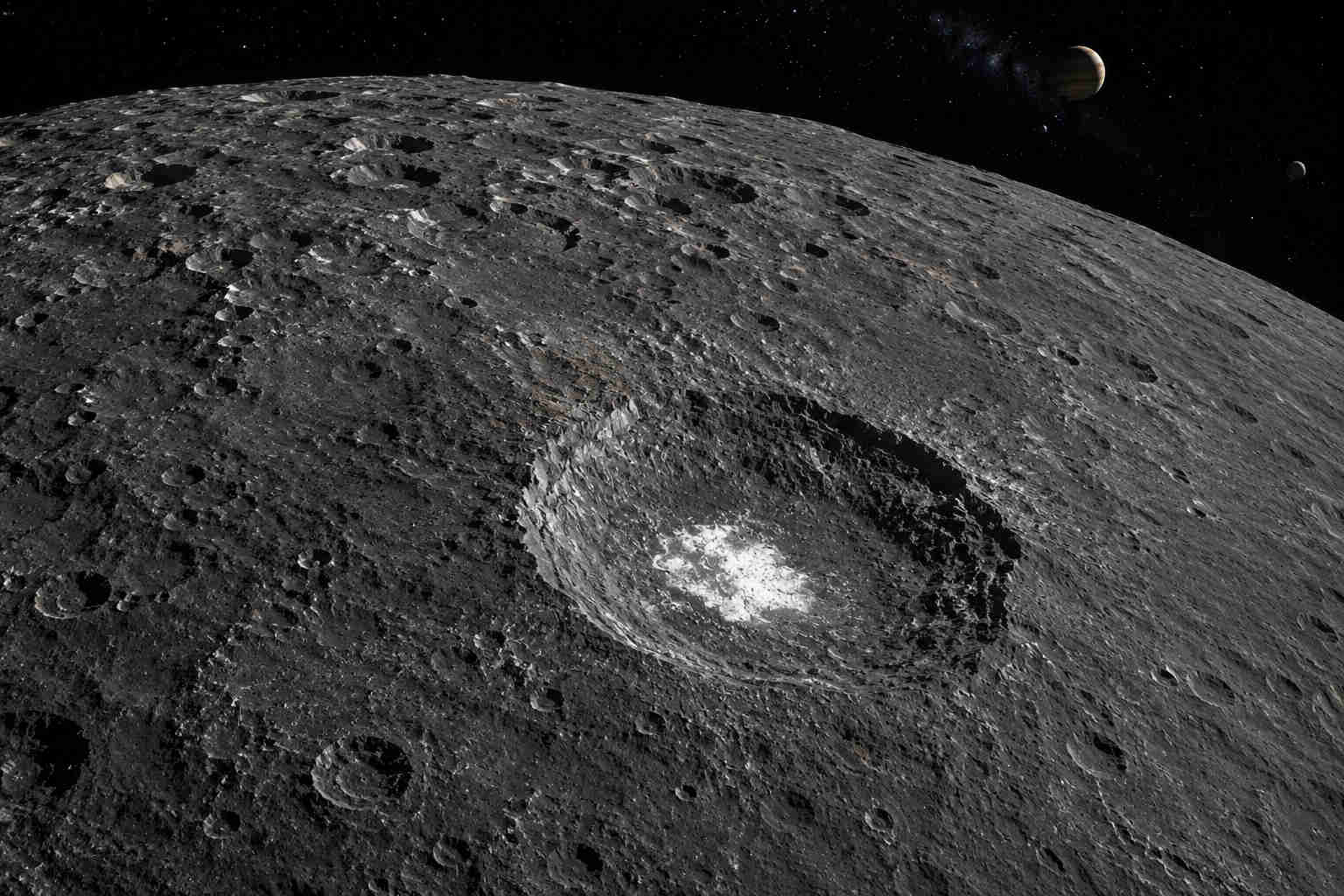
Artist illustration (using ChatGPT) of a CM-type carbonaceous chondrite parent body asteroid with a near-surface brine deposit exposed in an impact crater.
Clues to the Origins of Life
The high concentration of salt in briny fluids can potentially create molecules crucial to life on Earth. Brines allow phosphate to remain in solution and can catalyze chemical reactions between organics and precipitate minerals.
“Isotope studies of carbon and nitrogen suggest that primitive carbonaceous chondrites, including CM-types, delivered organic matter to the early Earth,” said cosmochemist Queenie Chan of Royal Holloway University of London, England, and biogeochemist Nana Ogawa of the Biogeochemistry Research Center at the Japan Agency for Marine-Earth Science and Technology. "The Hillsborough meteorite contained 1.8% by weight of carbon and 0.07% of nitrogen, and had carbon and nitrogen isotopes typical for CM-type meteorites."
The meteorite contained a wide variety of soluble organic compounds, and its compositional range confirms that the Hillsborough meteorite was more altered by water than most other CM-type meteorites.
"A high fraction of compounds were the product of organic chemistry with minerals," said organic mass spectrometry specialist Phil Schmitt-Kopplin of Technical University Munich. "We do not know if these magnesium organic compounds were contributed by brine chemistry or were simply left over from earlier impact shock processes."
In living organisms, organo-metallic compounds are found in blood and used in photosynthesis. Among the soluble organic compounds were also many amino acids, similar to those found in more moderately altered CM2 chondrites.
Astrobiologist Danny Glavin of NASA's Goddard Space Flight Center in Greenbelt, Maryland, and his team in Goddard’s Astrobiology Analytical Lab, concluded that the delivery of amino acids, carboxylic acids, and other soluble organic molecules by CM-type bodies may have contributed to the prebiotic organic inventory that preceded the emergence of life on Earth. Their analysis suggests the complex distribution of amino acids observed in the Hillsborough meteorite formed within the parent body, likely assisted by brine fluid chemistry.
Some of the meteorite fragments will be curated at the American Museum of Natural History in New York City.
"We are thrilled that nature delivered such a precious asteroid sample on our doorstep," said curator Denton Ebel.
Read the original paper: www.science.org/doi/10.1126/sciadv.ea2105
About the SETI Institute
Founded in 1984, the SETI Institute is a non-profit, multi-disciplinary research and education organization whose mission is to lead humanity’s quest to understand the origins and prevalence of life and intelligence in the Universe and to share that knowledge with the world. Our research encompasses the physical and biological sciences and leverages expertise in data analytics, machine learning and advanced signal detection technologies. The SETI Institute is a distinguished research partner for industry, academia and government agencies, including NASA and NSF.
About JAMSTEC’s Biogeochemistry Research Center
 The Biogeochemistry Research Center (BGC) at the Japan Agency for Marine-Earth Science and Technology (JAMSTEC) investigates the origins and evolution of life-related primordial organic matter through chemical and isotopic analyses. Its research includes studies of asteroid samples (i.e., Ryugu, Bennu) and carbonaceous meteorite samples, contributing to our understanding of the pristine chemical processes in molecular evolution.
Contact information
Rebecca McDonald
Director of Communications
SETI Institute
[email protected]







News
Related News

Jun 5, 2026
Beyond Disclosure Day: The Real-World Protocols
#Press Releases #SETI #Astronomy #Bill Diamond #SETI Institute
Jun 3, 2026
SETI Institute Looks for Signs of Technology in Interstellar Visitor 3I/ATLAS
Observations with the Allen Telescope Array set new limits on possible signals from extraterrestrial transmitters. #Press Releases #ATA #3I/ATLAS #Hat Creek Radio Observatory #Radio Astronomy #SETI
Jun 1, 2026
SETI Institute Awards $1 Million in STRIDE Grants to Advance Astrobiology, Exoplanet Science, and Public Engagement
#Press Releases #STRIDE #Research #Carl Sagan Center #Spectroscopy #Solar System #SETI #Climate and Bioscience #Astronomy #Astrobiology #Exoplanets #Data Science #Education #Outreach #Hat Creek Radio Observatory #Unistellar #SkyMapper
May 13, 2026
SETI Institute to Honor Dr. Matthew Tiscareno with 2026 Carl Sagan Center Director’s Award
The Drake Awards event will also recognize SETI Forward and SETI Institute REU student award recipients. #Press Releases #Drake Awards #Frank Drake #SETI #Awards #Planetary Astronomy #Astrobiology #SETI Forward #Education #Carl Sagan Center #Matthew Tiscareno #Nathalie Cabrol #REU
Apr 21, 2026
SETI Institute Launches Discovery and Futures Lab to Explore the Human Dimensions of Life Beyond Earth
New initiative bridges science, society, and the future of discovery in astrobiology and SETI #Press Releases #Discovery and Futures Lab #Lucian Walkowicz #Chelsea Haramia #Carl Sagan Center #Nathalie Cabrol #Simon Steel #Bill Diamond #Astrobiology #SETI
Apr 3, 2026
SETI Institute In the News: March Roundup 2026
In March 2026, SETI Institute researchers contributed to a wide range of conversations about our solar system and the search for life beyond Earth. From explaining unusual features on Mars and studying meteor airbursts in Earth’s atmosphere to advancing new ways of detecting technosignatures, this work reflects how scientists are continually refining our understanding of both nearby and distant worlds. #SETI Institute in the News #SETI Institute #Community #Mars #Pascal Lee #Peter Jenniskens #Comets, Meteors, and Asteroids #Astronomy #Vishal Gajjar #SETI #AI and Machine Learning #Astrobiology #Nathalie Cabrol #Carl Sagan Center #Seth Shostak #Movie Reviews #Bill Diamond
Jun 5, 2026
#Press Releases
#SETI
#Astronomy
#Bill Diamond
#SETI Institute
Jun 3, 2026
SETI Institute Looks for Signs of Technology in Interstellar Visitor 3I/ATLAS
Observations with the Allen Telescope Array set new limits on possible signals from extraterrestrial transmitters.
#Press Releases
#ATA
#3I/ATLAS
#Hat Creek Radio Observatory
#Radio Astronomy
#SETI
Jun 1, 2026
#Press Releases
#STRIDE
#Research
#Carl Sagan Center
#Spectroscopy
#Solar System
#SETI
#Climate and Bioscience
#Astronomy
#Astrobiology
#Exoplanets
#Data Science
#Education
#Outreach
#Hat Creek Radio Observatory
#Unistellar
#SkyMapper
SETI Institute Awards $1 Million in STRIDE Grants to Advance Astrobiology, Exoplanet Science, and Public Engagement
May 13, 2026
SETI Institute to Honor Dr. Matthew Tiscareno with 2026 Carl Sagan Center Director’s Award
The Drake Awards event will also recognize SETI Forward and SETI Institute REU student award recipients.
#Press Releases
#Drake Awards
#Frank Drake
#SETI
#Awards
#Planetary Astronomy
#Astrobiology
#SETI Forward
#Education
#Carl Sagan Center
#Matthew Tiscareno
#Nathalie Cabrol
#REU
Apr 21, 2026
SETI Institute Launches Discovery and Futures Lab to Explore the Human Dimensions of Life Beyond Earth
New initiative bridges science, society, and the future of discovery in astrobiology and SETI
#Press Releases
#Discovery and Futures Lab
#Lucian Walkowicz
#Chelsea Haramia
#Carl Sagan Center
#Nathalie Cabrol
#Simon Steel
#Bill Diamond
#Astrobiology
#SETI
Apr 3, 2026
SETI Institute In the News: March Roundup 2026
In March 2026, SETI Institute researchers contributed to a wide range of conversations about our solar system and the search for life beyond Earth. From explaining unusual features on Mars and studying meteor airbursts in Earth’s atmosphere to advancing new ways of detecting technosignatures, this work reflects how scientists are continually refining our understanding of both nearby and distant worlds.
#SETI Institute in the News
#SETI Institute
#Community
#Mars
#Pascal Lee
#Peter Jenniskens
#Comets, Meteors, and Asteroids
#Astronomy
#Vishal Gajjar
#SETI
#AI and Machine Learning
#Astrobiology
#Nathalie Cabrol
#Carl Sagan Center
#Seth Shostak
#Movie Reviews
#Bill Diamond
Research
Related Projects

SkyMapper • SETI • Citizen Science • Astronomy
SkyMapper: Expanding Access to Real-time Astronomy Through a Global Astronomical Network
SkyMapper and the SETI Institute are connecting educators, students and the public to live astronomical observations through a distributed astronomical network. #SkyMapper #SETI #Citizen Science #Astronomy
VPL
Virtual Planetary Laboratory
How can we best assess whether an exoplanet supports life? #VPL
Discovery and Futures Lab
Discovery and Futures Lab
What happens if life beyond Earth is discovered? The Discovery and Futures Lab at the SETI Institute fosters novel and anticipatory research at the intersection of science, society, our planet, and the search for life beyond Earth. #Discovery and Futures Lab
May 17, 2026
SkyMapper: Expanding Access to Real-time Astronomy Through a Global Astronomical Network
SkyMapper and the SETI Institute are connecting educators, students and the public to live astronomical observations through a distributed astronomical network.
#SkyMapper
#SETI
#Citizen Science
#Astronomy
May 5, 2026
Virtual Planetary Laboratory
How can we best assess whether an exoplanet supports life?
#VPL
Apr 16, 2026
Discovery and Futures Lab
What happens if life beyond Earth is discovered? The Discovery and Futures Lab at the SETI Institute fosters novel and anticipatory research at the intersection of science, society, our planet, and the search for life beyond Earth.
#Discovery and Futures Lab
Support Us
Support the
SETI Institute
Scientists are getting closer in their search for life beyond earth. But with limited federal funding for the search for extraterrestrial intelligence, supporters are the reason cutting-edge scientists can keep their eyes on the sky.
