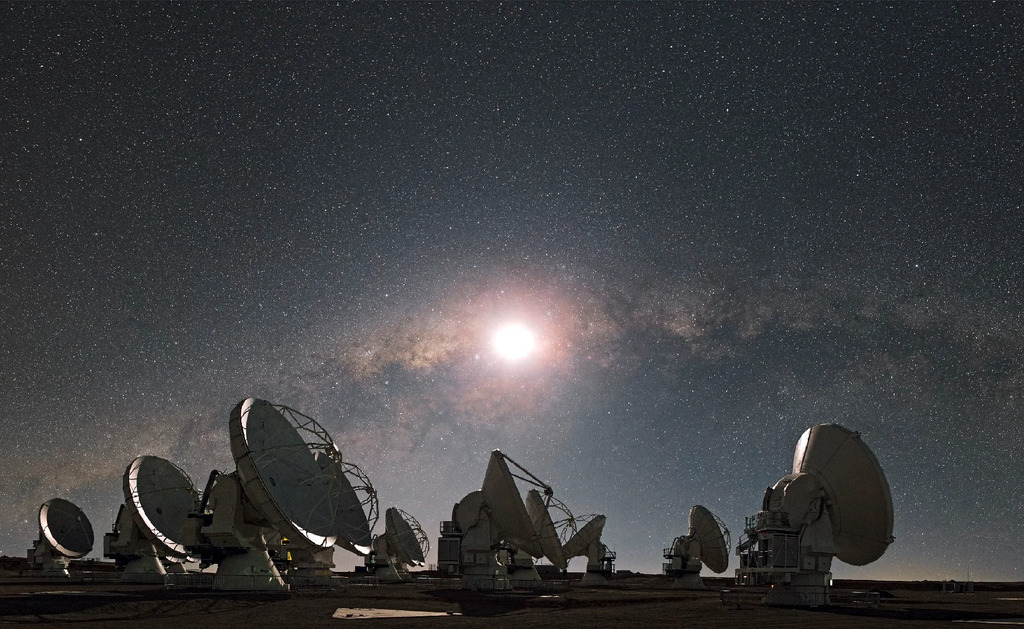
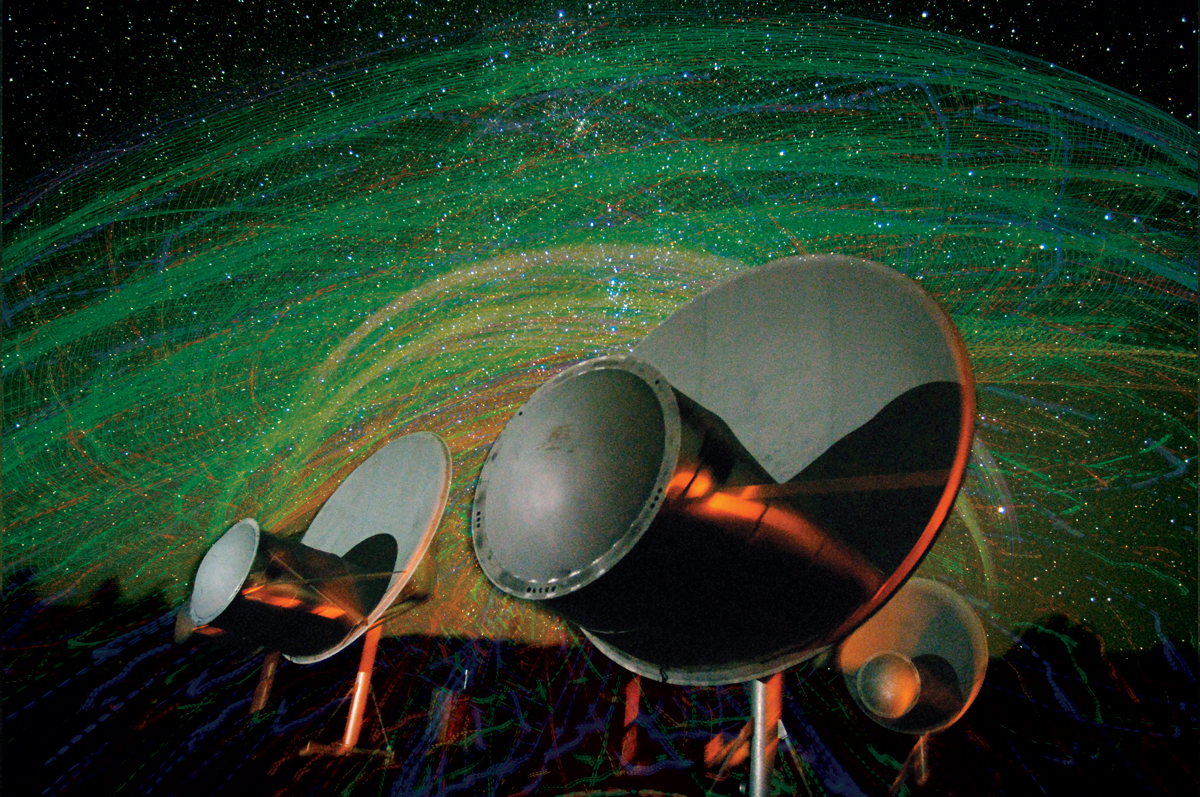
December 10, 2025, Mountain View, CA -- For 10 months, a SETI Institute–led team watched pulsar PSR J0332+5434 (also called B0329+54) to study how its radio signal "twinkles" as it passes through gas between the star and Earth. The team used the Allen Telescope Array (ATA) to take measurements between 900 and 1956 MHz and observed slow, significant changes in the twinkling pattern, or scintillation, over time.
Pulsars are spinning remnants of massive stars that emit flashes of radio waves, a type of light, in very precise and regular rhythms. Due to their high rotation speed and incredible density. Scientists can use sensitive radio telescopes to measure the exact times at which pulses arrive in the search for patterns that can indicate phenomena such as low-frequency gravitational waves. However, gas in interstellar space can scatter a pulsar’s radio waves—spreading them out and slightly delaying when each pulse is received. Understanding and correcting these tiny, changing delays, which can be as small as tens of nanoseconds (a nanosecond is one-billionth of a second), helps keep pulsar timing as precise as possible.
Just as starlight “twinkles” in Earth’s atmosphere, pulsar radio waves also “twinkle”, or scintillate, in space. As the signal travels through clouds of electrons between the pulsar and Earth, it creates bright and dim patches across radio frequencies. These patterns aren’t static; they evolve as the pulsar, the gas, and Earth move relative to each other. This twinkling delays the pulses, and the amount of scintillation matches the extent of the delay. By frequently monitoring a single bright, nearby pulsar, the team observed these patterns shift and translated them into tiny timing delays. These methods can then correct the delays that matter for the most precise pulsar experiments.
“Pulsars are wonderful tools that can teach us much about the universe and our own stellar neighborhood,” said project leader Grayce Brown, a SETI Institute intern. “Results like these help not just pulsar science, but other fields of astronomy as well, including SETI.” All radio signals passing through the interstellar medium experience scintillation. Noticeable scintillation can help SETI scientists distinguish between human-made radio signals and signals from other star systems.
The ATA observations used a wide range of radio frequencies and frequent, short observation sessions). The team measured the scintillation bandwidth (the size of the bright spots in the twinkling pattern) almost daily for ~300 days with the ATA and found that the amount of scintillation changed noticeably over timescales ranging from days to months. The observations suggest an overarching long-timescale variation of about 200 days. The study also included a newly developed, more robust method to estimate how scintillation increases with radio frequency, leveraging the ATA's wide frequency range.
"The Allen Telescope Array is perfectly designed for studying pulsar scintillation due to its wide bandwidths and ability to commit to projects that need to run for long stretches of time," said Dr. Sofia Sheikh, co-author and Technosignature Research Scientist at the SETI Institute.
The observations provide a window into pulsars, Earth, and the space between them, helping scientists better understand how to distinguish radio frequency interference from a signal of potentially artificial origin.
The paper can be found at doi: 10.3847/1538-4357/ae0fff.
About the SETI Institute
Founded in 1984, the SETI Institute is a non-profit, multi-disciplinary research and education organization whose mission is to lead humanity's quest to understand the origins and prevalence of life and intelligence in the universe and to share that knowledge with the world. Our research encompasses the physical and biological sciences and leverages expertise in data analytics, machine learning and advanced signal detection technologies. The SETI Institute is a distinguished research partner for industry, academia and government agencies, including NASA and NSF.
Contact information
Rebecca McDonald
Director of Communications
SETI Institute
[email protected]
)