Wednesday, Oct 15, 2025

We have been exploring our solar system for over 80s years now, and we have learned so much. This week, we examine a Voyager 2 image of Triton, a Cassini image of Saturn with its moons, a panoramic view of Mars from the Curiosity rover, and our newest exploratory subject: asteroid 52246 Donaldjohanson. The asteroid was recently captured by the Lucy mission, which is en route to study the Trojan asteroids at Jupiter. Plus, a gorgeous image of a face-on barred spiral galaxy taken by Hubble.

Credit: NASA/JPL

Monday, 6 October 2025

Triton

NASA's Voyager 2 spacecraft captured dark streaks produced by geysers visible on the icy surface of Triton's south polar region during its flyby on August 25, 1989.

Credit: NASA/JPL-Caltech

Tuesday, 7 October 2025

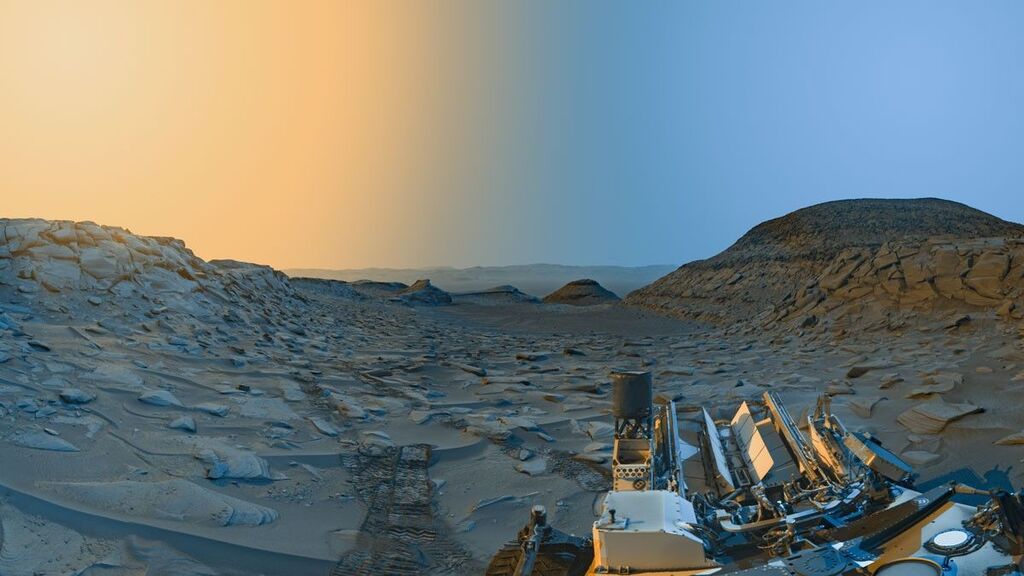
Martian Morning

NASA’s Curiosity Mars rover used its black-and-white navigation cameras to capture panoramas at two times of day on April 8, 2023. The panoramas were captured at 9:20 a.m. and 3:40 p.m. local Mars time, then merged together. Color was added for an artistic interpretation of the scene, with blue representing the morning panorama and yellow representing the afternoon one.

At the bottom right of the postcard is Curiosity. The rover’s three antennas and nuclear power source are visible. Trailing behind Curiosity are rover tracks, and beyond those is "Marker Band Valley," a winding region where the rover discovered unexpected signs of an ancient lake. Further below are two hills – "Bolivar" and “Deepdale” – that Curiosity drove between while exploring "Paraitepuy Pass."

Credit: NASA, ESA, and D. Maoz (Tel-Aviv University and Columbia University)

Wednesday, 8 October 2025

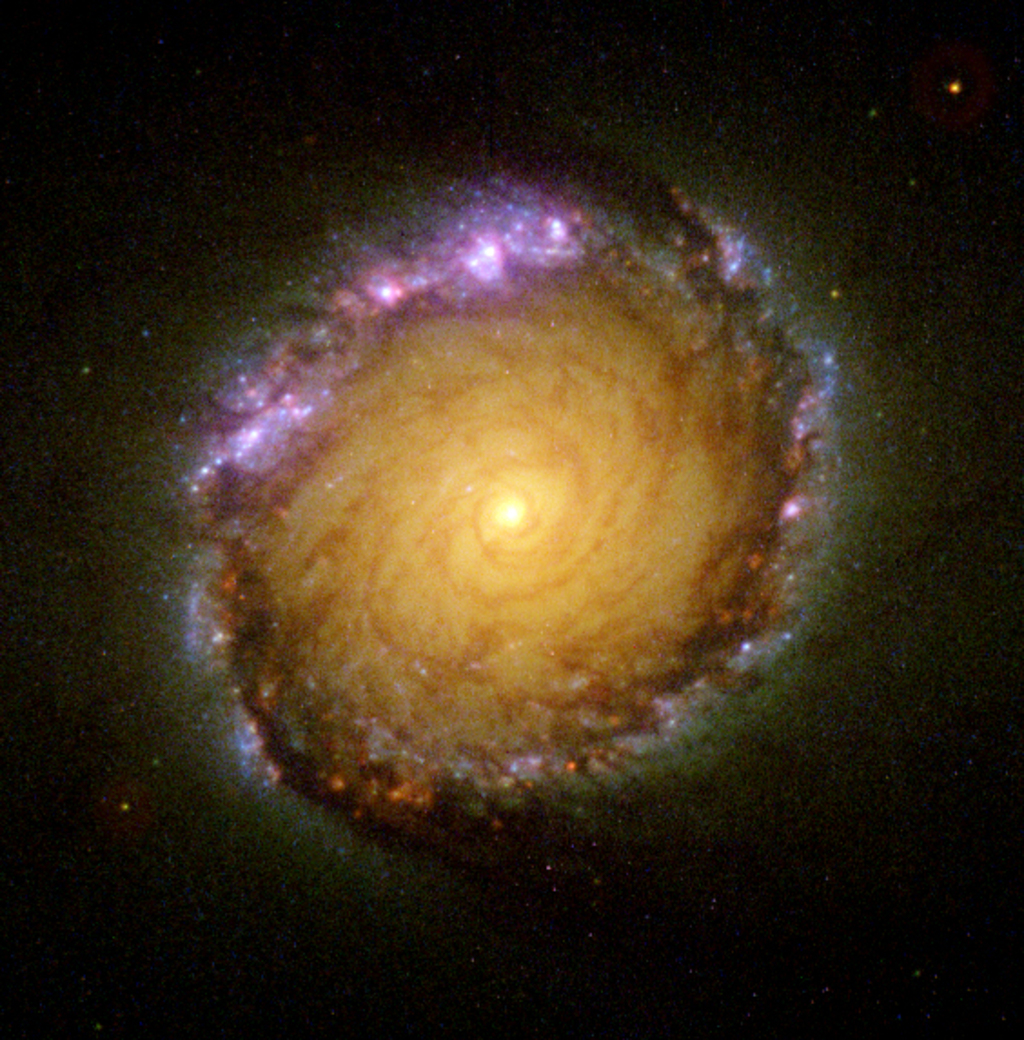
Barred Spiral Galaxy NGC 1512

In this view of the center of the magnificent barred spiral galaxy NGC 1512, the NASA Hubble Space Telescope's broad spectral vision reveals the galaxy at all wavelengths from ultraviolet to infrared. The colors (which indicate differences in light intensity) map where newly born star clusters exist in both "dusty" and "clean" regions of the galaxy.

This color-composite image was created from seven images taken with three different Hubble cameras: the Faint Object Camera (FOC), the Wide Field and Planetary Camera 2 (WFPC2), and the Near Infrared Camera and Multi-Object Spectrometer (NICMOS).

NGC 1512 is a barred spiral galaxy in the southern constellation of Horologium. Located 30 million light-years away, relatively "nearby" as galaxies go, it is bright enough to be seen with amateur telescopes. The galaxy spans 70,000 light-years, nearly as much as our own Milky Way galaxy.

The galaxy's core is unique for its stunning 2,400 light-year-wide circle of infant star clusters, called a "circumnuclear" starburst ring. Starbursts are episodes of vigorous formation of new stars and are found in a variety of galaxy environments.

Credit: NASA/SwRI/Goddard/JHUAPL

Thursday, 9 October 2025

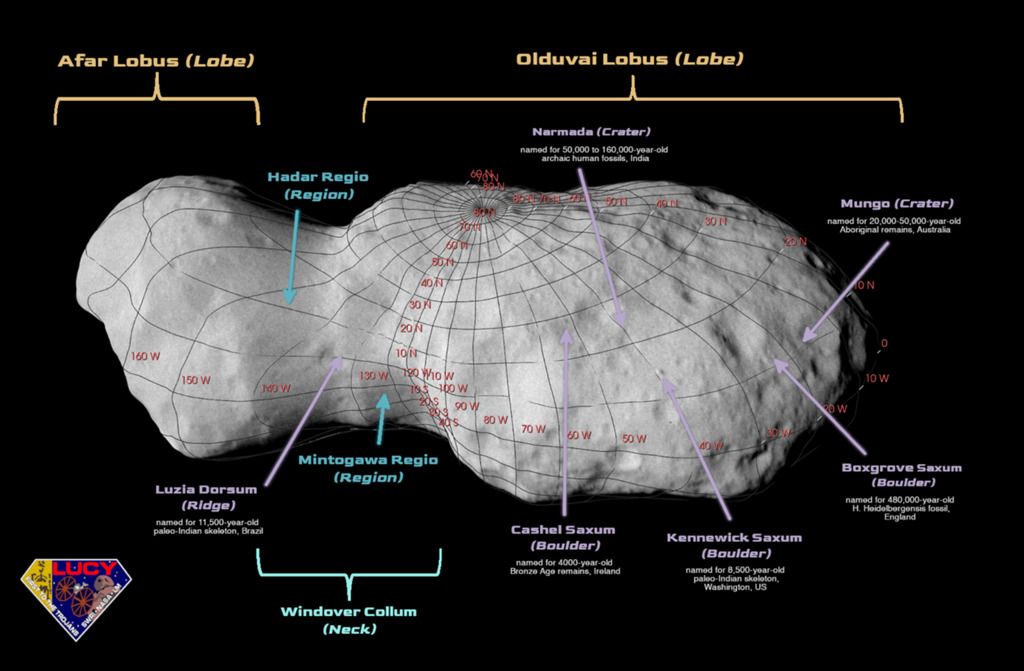
Features on Asteroid Donaldjohanson

The official names of asteroid 52246 Donaldjohanson’s surface features — as identified by the Southwest Research Institute-led Lucy Mission — have been approved by the International Astronomical Union (IAU). Latitude and longitude lines and arrows indicate the names of various features on the surface, which are named after significant paleoanthropological sites and discoveries. The NASA Lucy spacecraft flew past the asteroid on April 20, 2025.

Credit: NASA/JPL/Space Science Institute/CICLOPS

Friday, 10 October 2025

Fantastic Planet

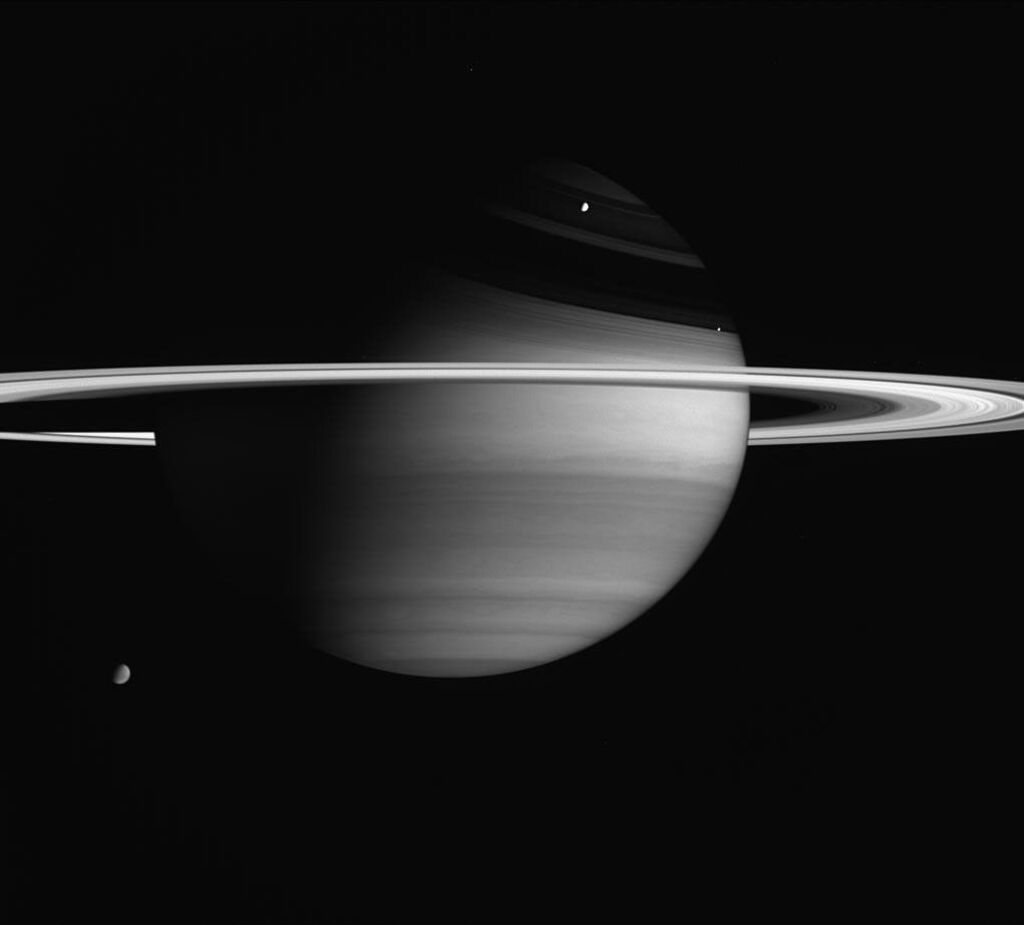
Saturn's biggest and brightest moons are visible in this portrait by Cassini.

Titan (5,150 kilometers across) is Saturn's largest moon and appears at the lower left. Note that some details in the moon's smoggy atmosphere are visible here. Rhea (1,528 kilometers across) is the planet's second-largest moon and is seen above center. Enceladus (505 kilometers across) has the brightest surface in the solar system, reflecting nearly all of the sunlight that falls upon it. Enceladus is just above the rings, right of center.

Titan was on the far side of the planet at the time of this exposure, while the other moons were on the near side, much closer to Cassini.

Also seen here are details in the cloud bands of Saturn's mostly hydrogen atmosphere, variations in brightness across the dazzling rings, and magnificent ring shadows cast upon the northern hemisphere.

The image was taken with the Cassini spacecraft's wide-angle camera on Feb. 5, 2005, at a distance of approximately 3.4 million kilometers from Saturn.


News

Related News

Featured Image
Jun 24, 2026
Planetary Picture of the Day - Week of June 15, 2026
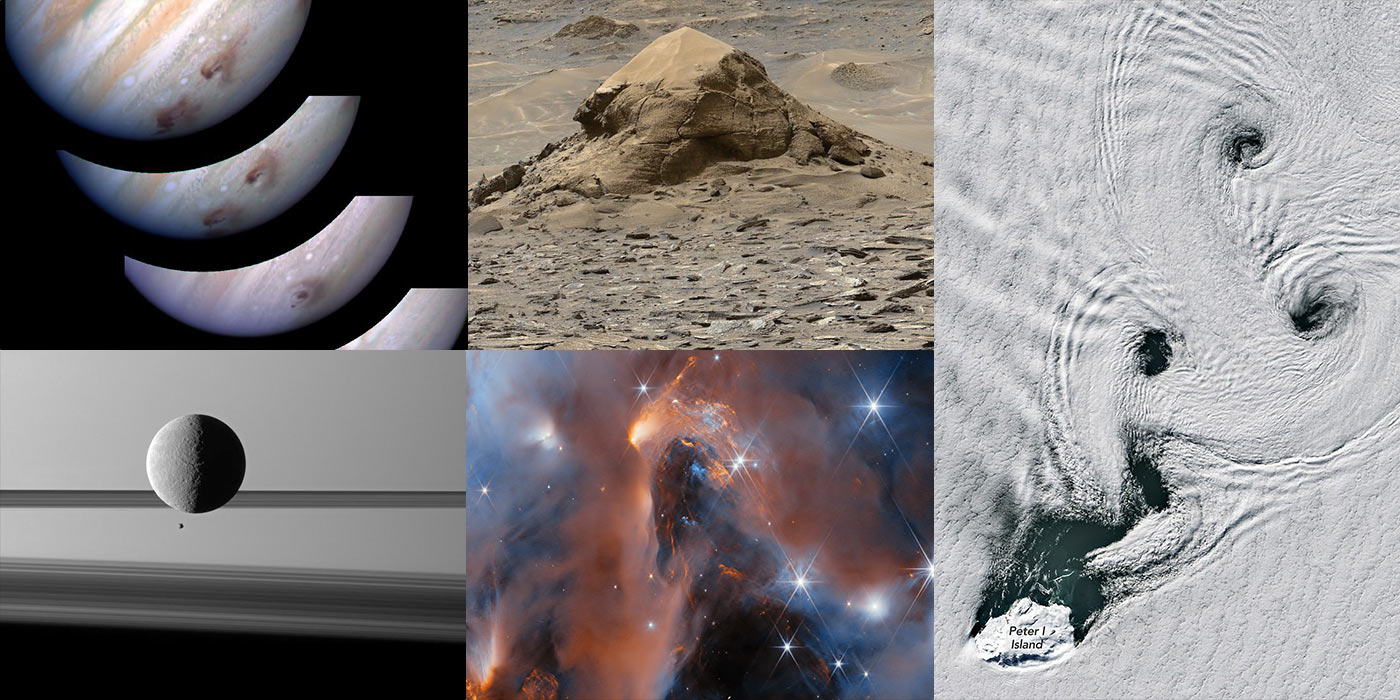
This collection showcases a solar system in motion, from Saturn’s moons playing tricks on perspective and a comet’s dramatic collision with Jupiter to winds swirling across Earth’s southern oceans and ancient landscapes on Mars. Together, these images reveal the forces that shape worlds over time—erosion, impacts, atmospheric currents, and planetary evolution—while capturing moments of beauty, violence, and wonder across the cosmos. #PPOD
Featured Image
Jun 16, 2026
Planetary Picture of the Day - Week of June 8, 2026
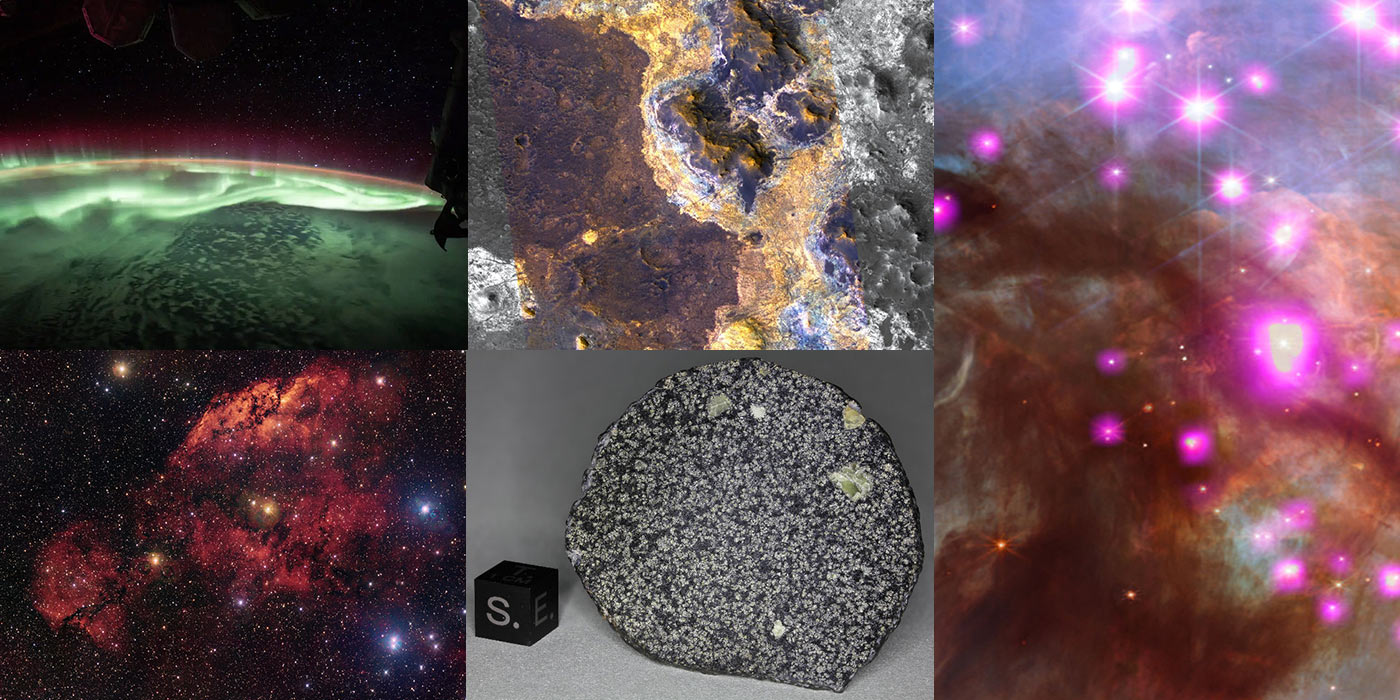
Ancient Martian landscapes, glowing auroras, and stellar nurseries come together in this week’s PPOD collection, highlighting worlds and phenomena shaped by billions of years of cosmic history. From a rare meteorite born in the earliest days of the solar system to colorful nebulae where new stars are forming today, these images offer a remarkable look at both our origins and the ongoing evolution of the universe. #PPOD
Featured Image
Jun 10, 2026
Planetary Picture of the Day - Week of June 1, 2026
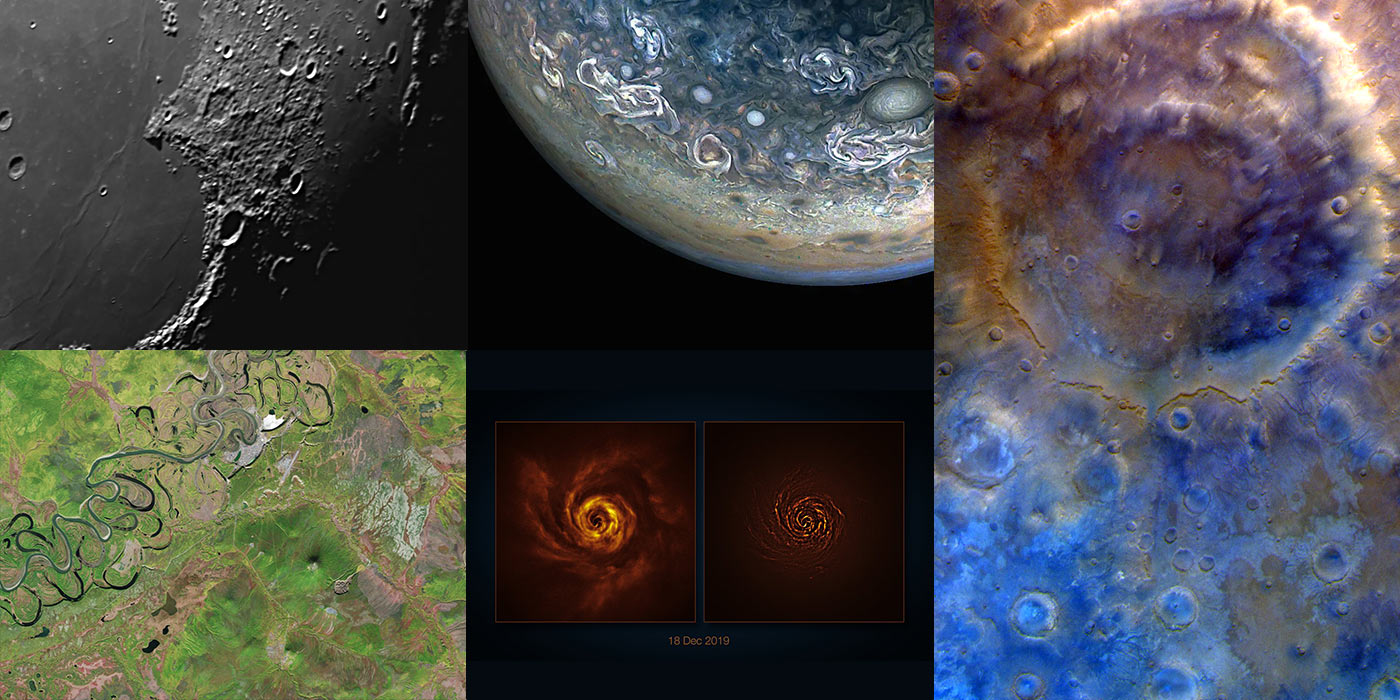
Our solar system contains dynamic worlds near and far, and our cameras capture amazing images of them every day, from a close-up flyby of Mars and the Moon’s beautiful Bay of Rainbows to the swirling storms of Jupiter. We also explore landscapes shaped by change, including Siberia’s expanding Batagaika mega-slump and a young star’s planet-forming disk, offering a glimpse of both Earth’s evolving surface and the processes that build new worlds. #PPOD
Featured Image
Jun 3, 2026
Planetary Picture of the Day - Week of May 25, 2026
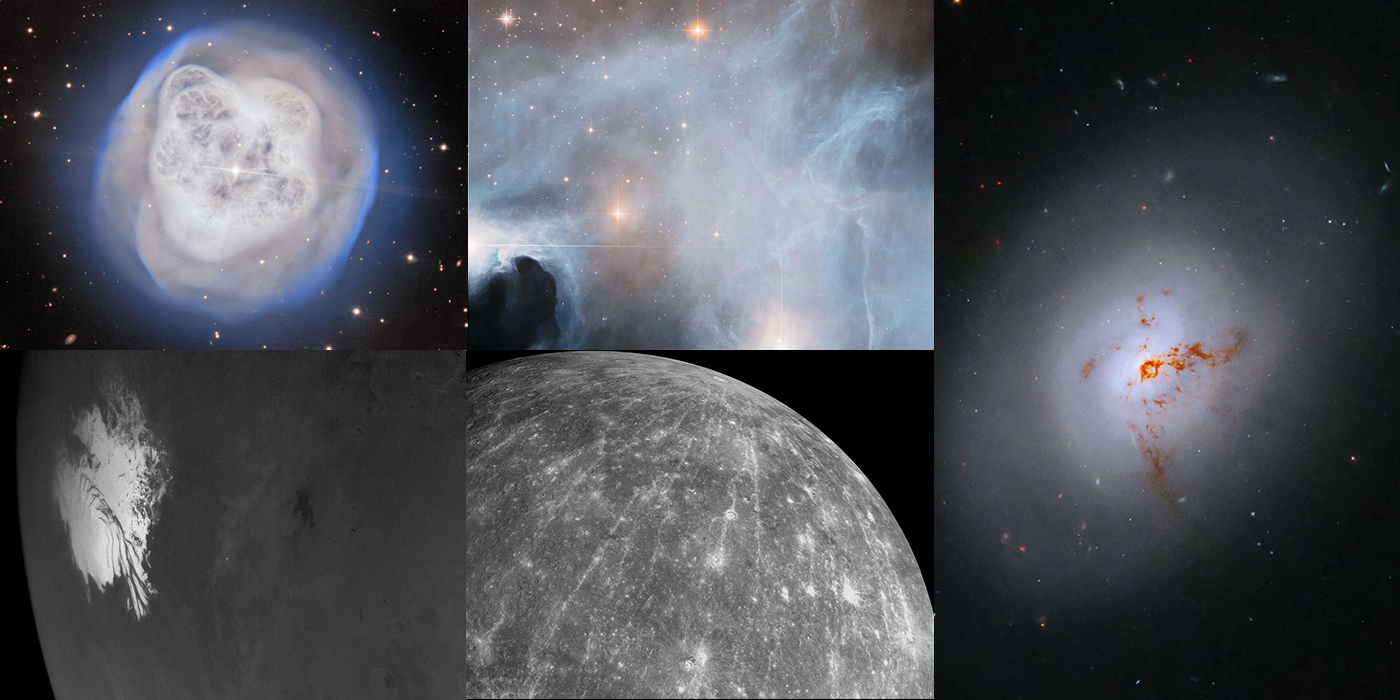
This week's images journeyed from the shimmering Crystal Ball Nebula to the icy south pole of Mars, highlighting beauty and change across our solar system and beyond. The collection also captured stars being born in a ghostly nebula, the dramatic rays of Mercury’s Hokusai Crater, and a distant galaxy caught in transition—offering a striking look at cosmic evolution across space and time. #PPOD
Featured Image
May 27, 2026
Planetary Picture of the Day - Week of May 18, 2026
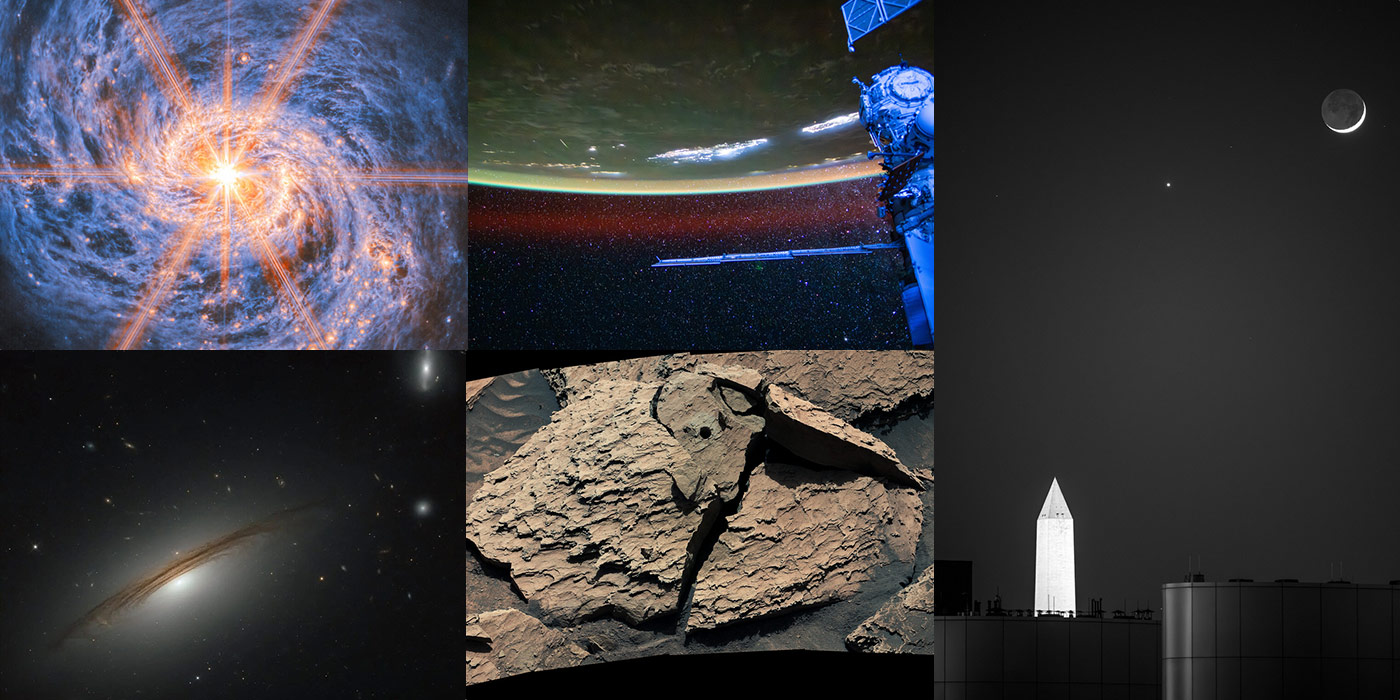
Moments both fleeting and immense—from a Moon–Venus conjunction over Washington, D.C. to a meteor streaking through Earth’s atmosphere as seen from the International Space Station. These images also spanned the cosmic scale, featuring a massive hybrid galaxy, a stubborn rock sampled by the Curiosity rover on Mars, and a stunning mid-infrared view of Messier 77 from JWST. #PPOD
Featured Image
May 21, 2026
Planetary Picture of the Day - Week of May 11, 2026
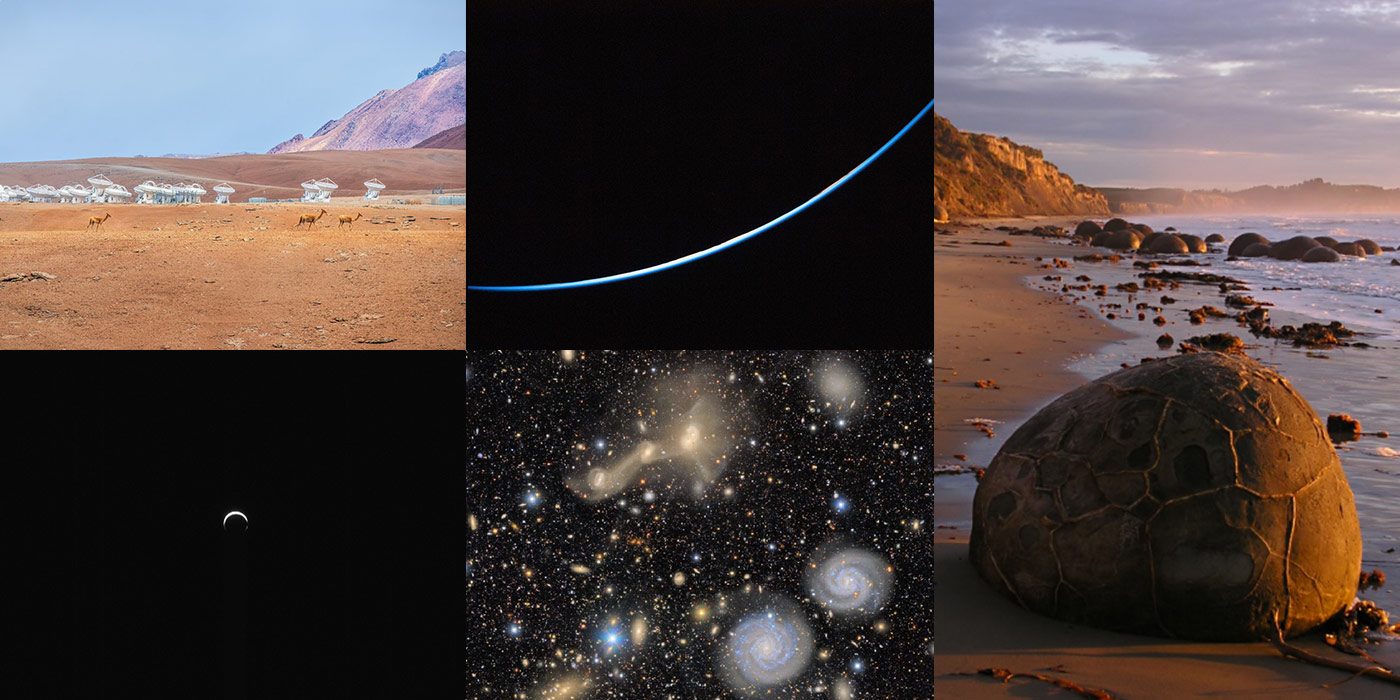
Where the round things are: From spherical boulders and circular radio telescope dishes to the curve of our blue marble, distant Mars, and far-away spiral galaxies, the universe comes back to circles. #PPOD
Research

Related Projects

Featured Image
SkyMapper • SETI • Citizen Science • Astronomy
SkyMapper: Expanding Access to Real-time Astronomy Through a Global Astronomical Network
SkyMapper and the SETI Institute are connecting educators, students and the public to live astronomical observations through a distributed astronomical network. #SkyMapper #SETI #Citizen Science #Astronomy
Featured Image
VPL
Virtual Planetary Laboratory
How can we best assess whether an exoplanet supports life? #VPL
Featured Image
Discovery and Futures Lab
What happens if life beyond Earth is discovered? The Discovery and Futures Lab at the SETI Institute fosters novel and anticipatory research at the intersection of science, society, our planet, and the search for life beyond Earth.  #Discovery and Futures Lab
Support Us

Support the
SETI Institute

Scientists are getting closer in their search for life beyond earth. But with limited federal funding for the search for extraterrestrial intelligence, supporters are the reason cutting-edge scientists can keep their eyes on the sky.