Planetary Picture of the Day Week of November 4, 2024
We turn our eyes further out into the galaxy this week, toward the heart of the Milky Way, distant stars and supernovae, and a wandering comet due to return in less than 40 years.
Monday, 4 November 2024
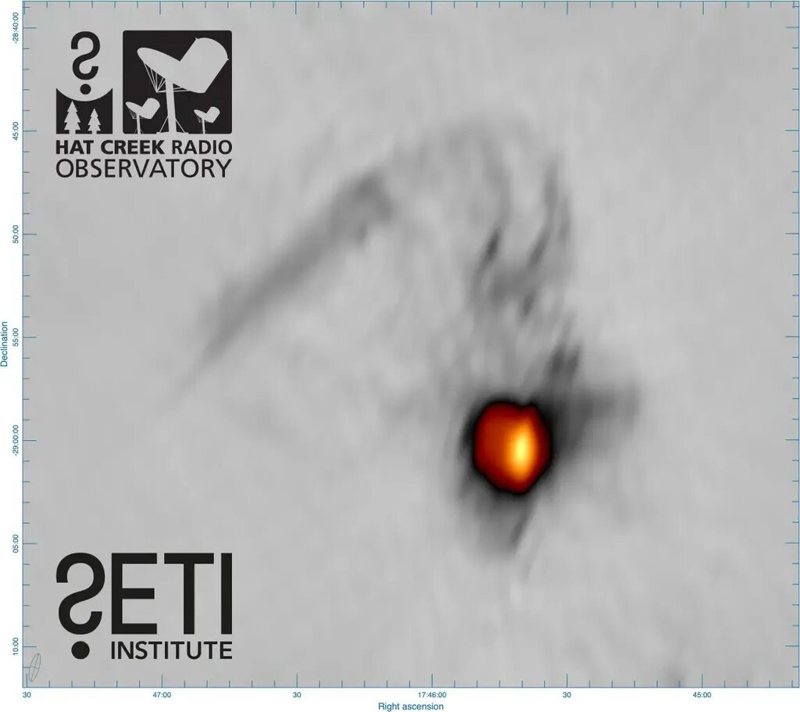
Credit: Dr. Joe Bright, Dr. Wael Farah, JT Earwicker, and the ATA team
Milky Way Heart in Radio The heart of our Milky Way galaxy as seen in radio waves from the Allen Telescope Array at the Hat Creek Observatory in Northern California. The colored region, Sagittarius A, hosts a supermassive black hole, Sagittarius A*, which is more than one million times the mass of our Sun. Surrounding this region are wisps and plumes of radio-emitting plasma, known as arcs and filaments, thought to trace magnetic field structures in the Galactic Center, a region completely obscured in optical light.
Tuesday, 5 November 2024
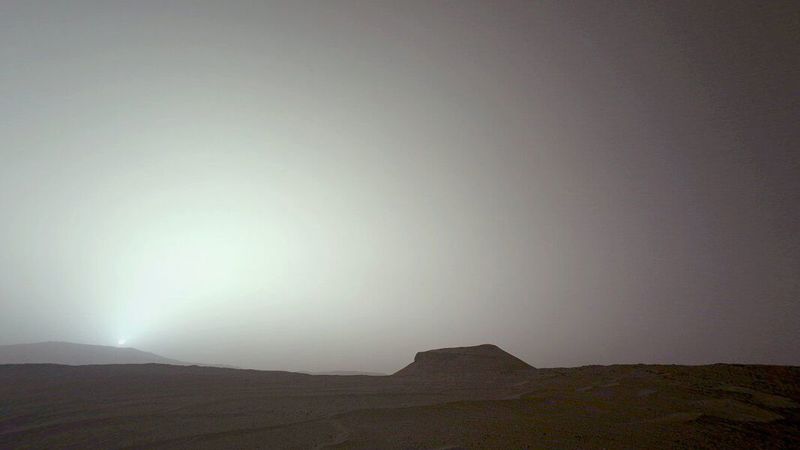
Credit: NASA/JPL-Caltech/Paul Byrne
Sunrise on Mars This image, captured by NASA's Perseverance rover using the Left Navcam at around 7:20 a.m. local time on 4 September 2022, shows what sunrise looks like on Mars. Dust in the Martian atmosphere scatters blue light near the Sun to give it a blueish halo (even though most of the rest of the sky is redder).
Wednesday, 6 November 2024
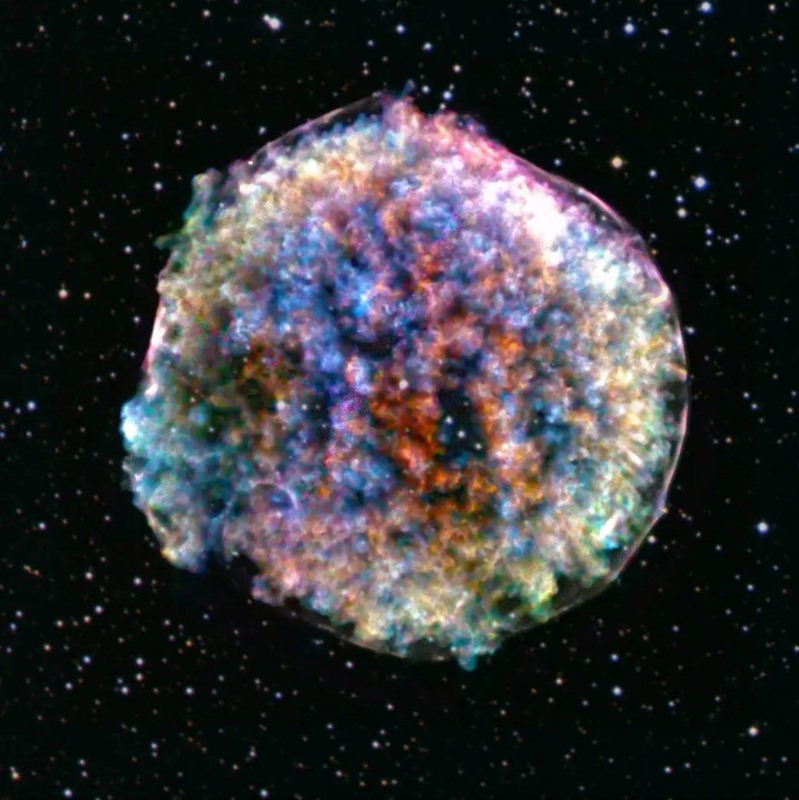
Credit: X-ray: NASA/CXC/RIKEN & GSFC/T. Sato et al; Optical: DSS
Tycho's Supernova In November 1572, Danish astronomer Tycho Brahe was among those who noticed a new bright object in the constellation Cassiopeia. Astronomers now know that Tycho's new star was not new at all. Rather it signaled the death of a star in a supernova, an explosion so bright that it can outshine the light from an entire galaxy. This particular supernova was a Type Ia, which occurs when a white dwarf star pulls material from, or merges with, a nearby companion star until a violent explosion is triggered. The white dwarf star is obliterated, sending its debris hurtling into space.
NASA's Chandra X-ray Observatory reveals an intriguing pattern of bright clumps and fainter areas in Tycho. To emphasize the clumps in the image and the three-dimensional nature of Tycho, scientists selected two narrow ranges of X-ray energies to isolate material (silicon, colored red) moving away from Earth, and moving towards us (also silicon, colored blue). The other colors in the image (yellow, green, blue-green, orange and purple) show a broad range of different energies and elements, and a mixture of directions of motion. In this composite image, Chandra's X-ray data have been combined with an optical image of the stars in the same field of view from the Digitized Sky Survey.
Thursday, 7 November 2024
Credit: NASA, JPL-Caltech, Spitzer Space Telescope via APOD
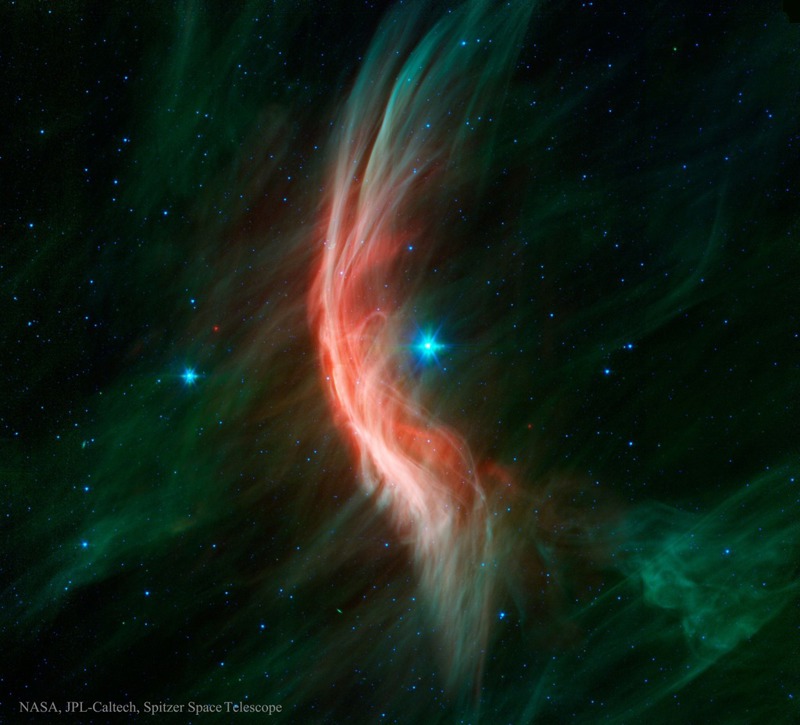
Zeta Oph: The Runaway Star Like a ship plowing through cosmic seas, runaway star Zeta Ophiuchi produces the arcing interstellar bow wave or bow shock seen in this stunning infrared portrait. In the false-color view, bluish Zeta Oph, a star about 20 times more massive than the Sun, lies near the center of the frame, moving toward the left at 24 kilometers per second. Its strong stellar wind precedes it, compressing and heating the dusty interstellar material and shaping the curved shock front.
What set this star in motion? Zeta Oph was likely once a member of a binary star system; its companion star was more massive and, hence, shorter-lived. When the companion star exploded as a supernova, catastrophically losing mass, Zeta Oph was flung out of the system.
About 460 light-years away, Zeta Oph is 65,000 times more luminous than the Sun and would be one of the brighter stars in the sky if it weren't surrounded by obscuring dust. The image spans about 1.5 degrees or 12 light-years at the estimated distance of Zeta Ophiuchi. In January 2020, NASA placed the Spitzer Space Telescope in safe mode, ending its 16 successful years of exploring the cosmos.
Friday, 8 November 2024
Credit: Reinhold Haefner/ESO
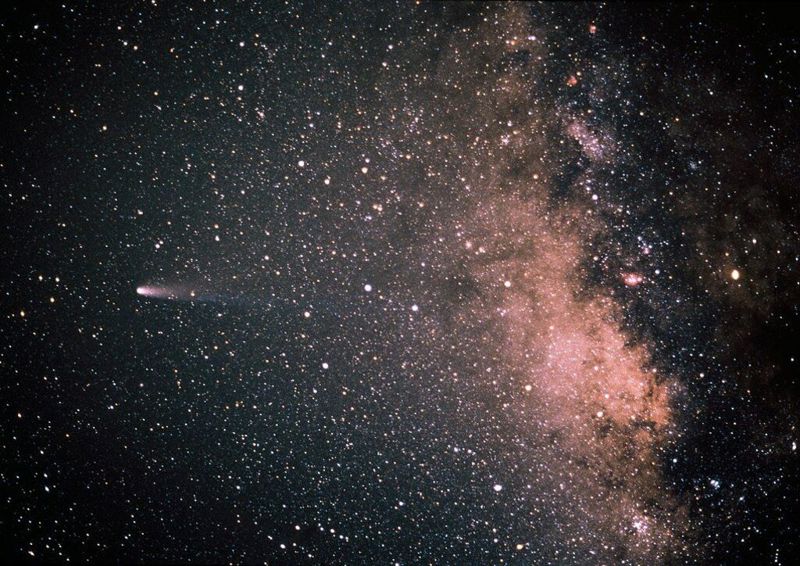
Halley's Comet and the Milky Way Happy birthday, Edmond Halley, after whom Comet 1P is named. While he may have been the first to understand the comet's periodic orbit, astronomers had recorded seeing the icy body as early as 240 BCE. We last saw Halley's Comet in our skies back in 1986, and this picture was taken by the European Southern Observatory. The comet will return at its perihelion - closest point in its orbit to the Sun - in 2061. In the meantime, enjoy not one but two annual meteor showers that occur as a result of Halley's orbit -- the Eta Aquariids in May and the Orionids in October.
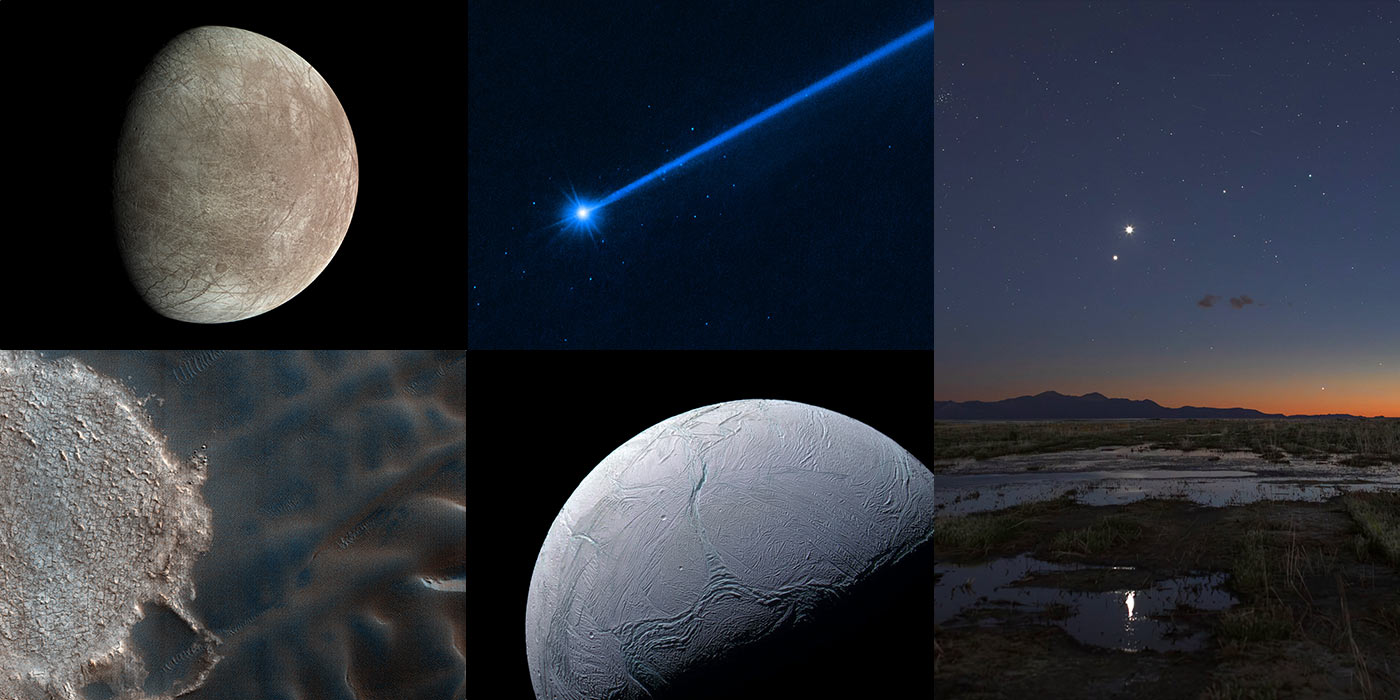
From asteroid fragments drifting through space to icy moons orbiting distant planets, this collection highlights the dynamic and ever-changing nature of our solar system. The images capture everything from a beautiful planetary conjunction in Earth’s skies to active wind-shaped landscapes on Mars, revealing how impacts, gravity, and weather continue to shape worlds both near and far.
#PPOD
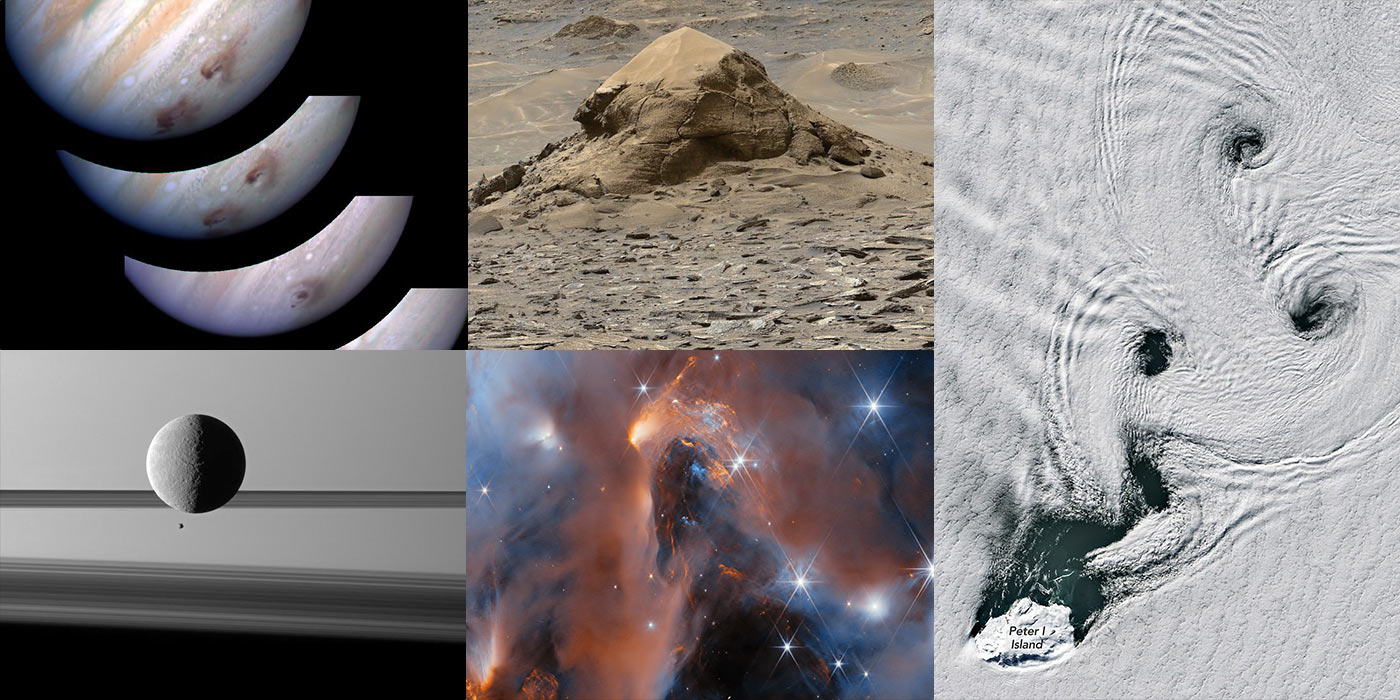
This collection showcases a solar system in motion, from Saturn’s moons playing tricks on perspective and a comet’s dramatic collision with Jupiter to winds swirling across Earth’s southern oceans and ancient landscapes on Mars. Together, these images reveal the forces that shape worlds over time—erosion, impacts, atmospheric currents, and planetary evolution—while capturing moments of beauty, violence, and wonder across the cosmos.
#PPOD
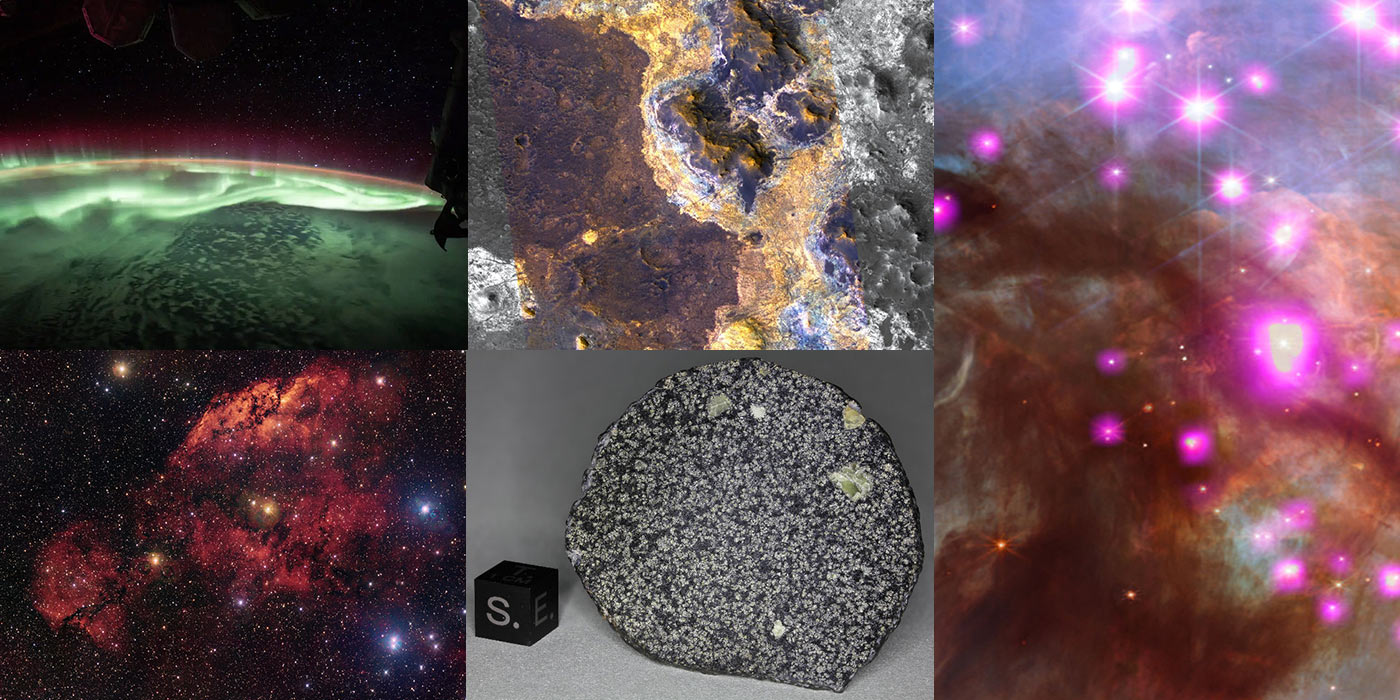
Ancient Martian landscapes, glowing auroras, and stellar nurseries come together in this week’s PPOD collection, highlighting worlds and phenomena shaped by billions of years of cosmic history. From a rare meteorite born in the earliest days of the solar system to colorful nebulae where new stars are forming today, these images offer a remarkable look at both our origins and the ongoing evolution of the universe.
#PPOD
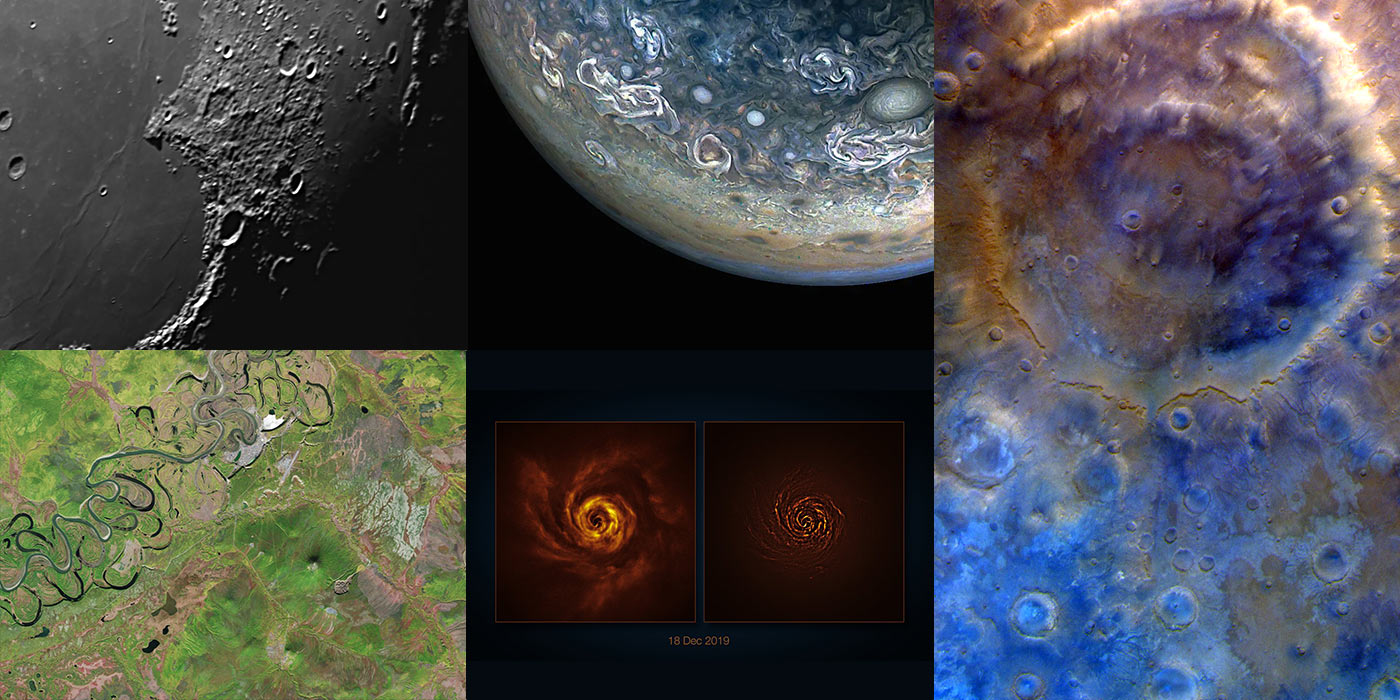
Our solar system contains dynamic worlds near and far, and our cameras capture amazing images of them every day, from a close-up flyby of Mars and the Moon’s beautiful Bay of Rainbows to the swirling storms of Jupiter. We also explore landscapes shaped by change, including Siberia’s expanding Batagaika mega-slump and a young star’s planet-forming disk, offering a glimpse of both Earth’s evolving surface and the processes that build new worlds.
#PPOD
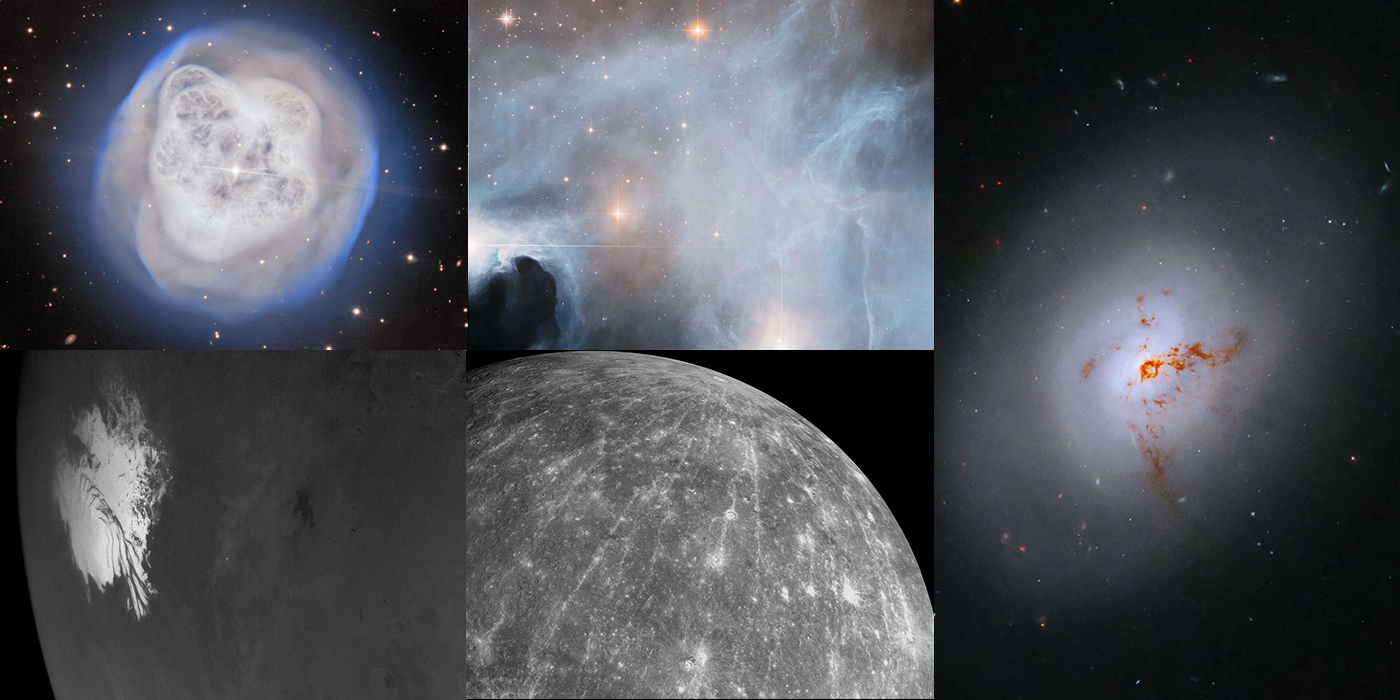
This week's images journeyed from the shimmering Crystal Ball Nebula to the icy south pole of Mars, highlighting beauty and change across our solar system and beyond. The collection also captured stars being born in a ghostly nebula, the dramatic rays of Mercury’s Hokusai Crater, and a distant galaxy caught in transition—offering a striking look at cosmic evolution across space and time.
#PPOD
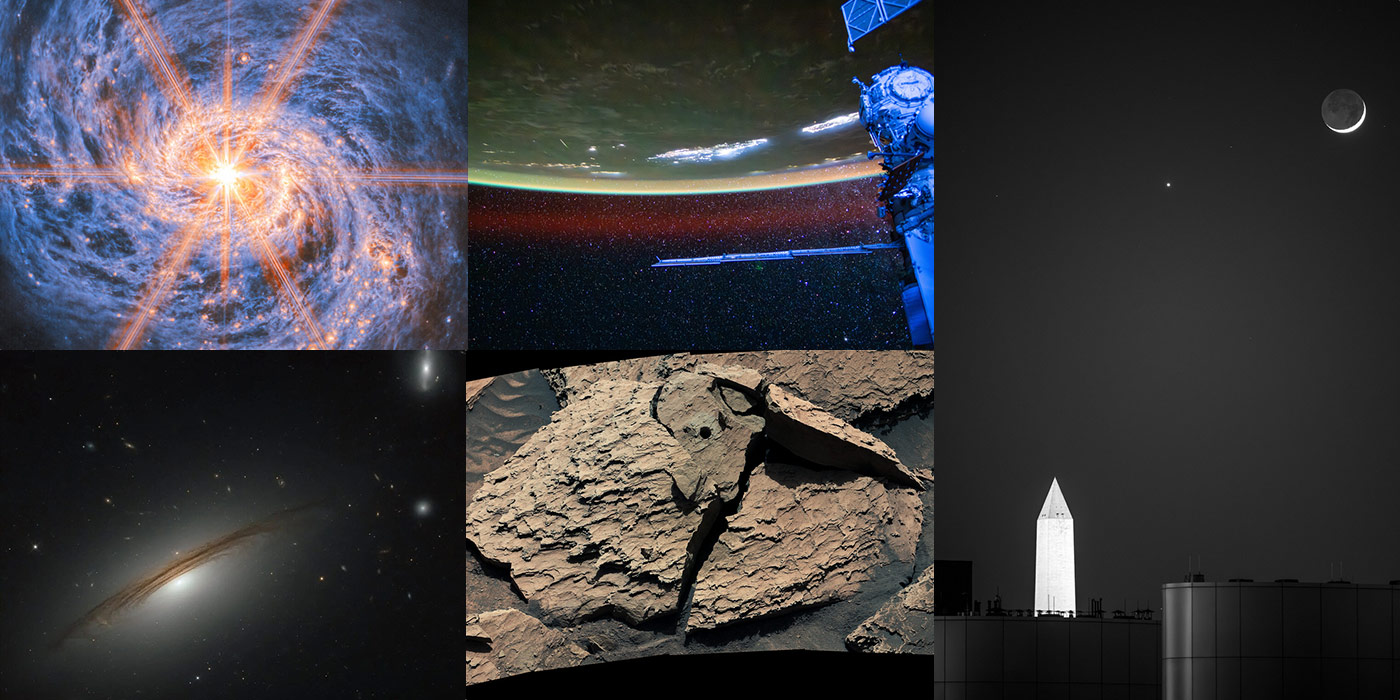
Moments both fleeting and immense—from a Moon–Venus conjunction over Washington, D.C. to a meteor streaking through Earth’s atmosphere as seen from the International Space Station. These images also spanned the cosmic scale, featuring a massive hybrid galaxy, a stubborn rock sampled by the Curiosity rover on Mars, and a stunning mid-infrared view of Messier 77 from JWST.
#PPOD
From asteroid fragments drifting through space to icy moons orbiting distant planets, this collection highlights the dynamic and ever-changing nature of our solar system. The images capture everything from a beautiful planetary conjunction in Earth’s skies to active wind-shaped landscapes on Mars, revealing how impacts, gravity, and weather continue to shape worlds both near and far.
This collection showcases a solar system in motion, from Saturn’s moons playing tricks on perspective and a comet’s dramatic collision with Jupiter to winds swirling across Earth’s southern oceans and ancient landscapes on Mars. Together, these images reveal the forces that shape worlds over time—erosion, impacts, atmospheric currents, and planetary evolution—while capturing moments of beauty, violence, and wonder across the cosmos.
Ancient Martian landscapes, glowing auroras, and stellar nurseries come together in this week’s PPOD collection, highlighting worlds and phenomena shaped by billions of years of cosmic history. From a rare meteorite born in the earliest days of the solar system to colorful nebulae where new stars are forming today, these images offer a remarkable look at both our origins and the ongoing evolution of the universe.
Our solar system contains dynamic worlds near and far, and our cameras capture amazing images of them every day, from a close-up flyby of Mars and the Moon’s beautiful Bay of Rainbows to the swirling storms of Jupiter. We also explore landscapes shaped by change, including Siberia’s expanding Batagaika mega-slump and a young star’s planet-forming disk, offering a glimpse of both Earth’s evolving surface and the processes that build new worlds.
This week's images journeyed from the shimmering Crystal Ball Nebula to the icy south pole of Mars, highlighting beauty and change across our solar system and beyond. The collection also captured stars being born in a ghostly nebula, the dramatic rays of Mercury’s Hokusai Crater, and a distant galaxy caught in transition—offering a striking look at cosmic evolution across space and time.
Moments both fleeting and immense—from a Moon–Venus conjunction over Washington, D.C. to a meteor streaking through Earth’s atmosphere as seen from the International Space Station. These images also spanned the cosmic scale, featuring a massive hybrid galaxy, a stubborn rock sampled by the Curiosity rover on Mars, and a stunning mid-infrared view of Messier 77 from JWST.
SkyMapper and the SETI Institute are connecting educators, students and the public to live astronomical observations through a distributed astronomical network.
#SkyMapper
#SETI
#Citizen Science
#Astronomy
What happens if life beyond Earth is discovered? The Discovery and Futures Lab at the SETI Institute fosters novel and anticipatory research at the intersection of science, society, our planet, and the search for life beyond Earth.
#Discovery and Futures Lab
SkyMapper and the SETI Institute are connecting educators, students and the public to live astronomical observations through a distributed astronomical network.
What happens if life beyond Earth is discovered? The Discovery and Futures Lab at the SETI Institute fosters novel and anticipatory research at the intersection of science, society, our planet, and the search for life beyond Earth.
Scientists are getting closer in their search for life beyond earth. But with limited federal funding for the search for extraterrestrial intelligence, supporters are the reason cutting-edge scientists can keep their eyes on the sky.
)