Planetary Picture of the Day Week of December 16, 2024
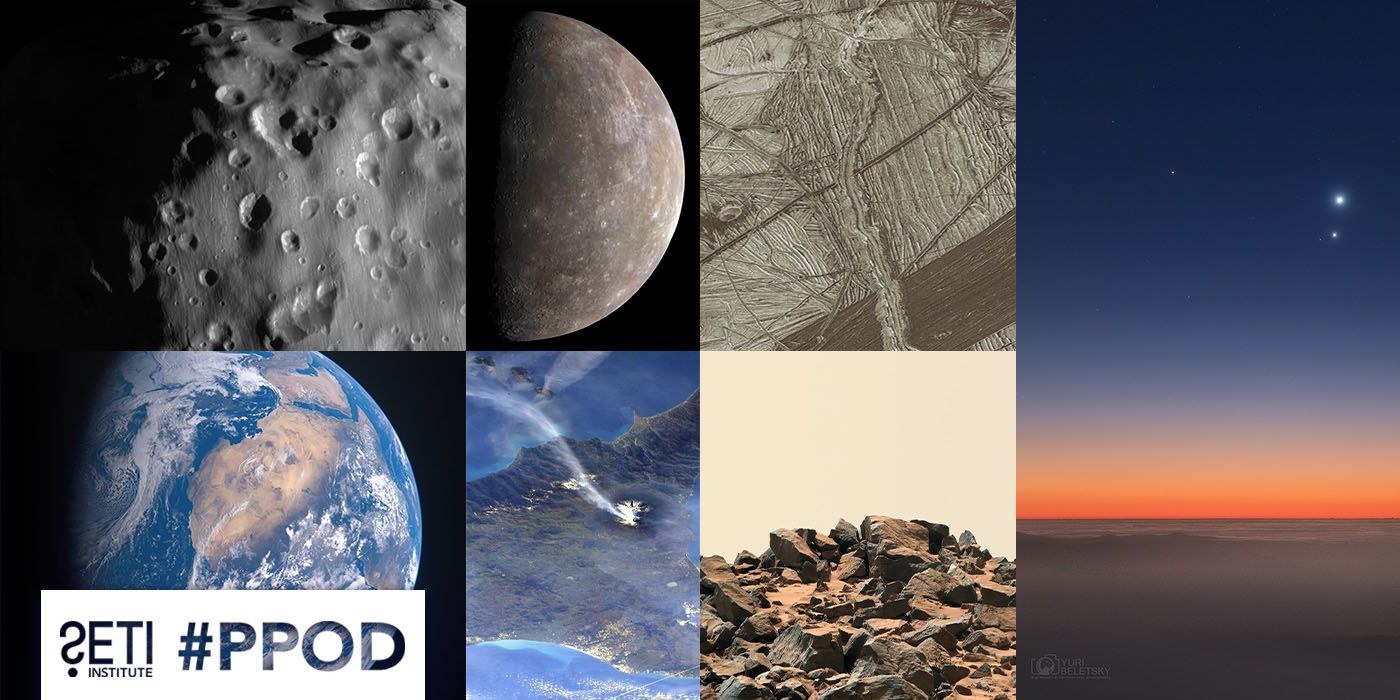
In the lead-up to our end-of-year break, we looked back at Earth and ahead to Mars. Plus, stunning views of the moons Europa and Epimetheus as well as planet Mercury.
Monday, 16 December 2024
Credit: NASA/JPL-Caltech/ASU/Paul Byrne
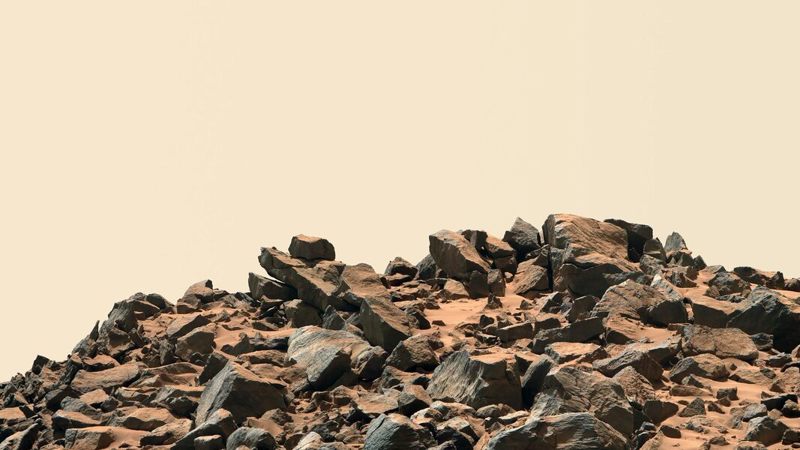
Pile of Mars Rocks Well, there are well-ordered sedimentary layers, and there is whatever this is -- a nice pile of rocks that looks too chaotic to be an eroded lava flow. Perhaps this pile is part of an impact crater ejecta deposit. We'll soon know what it is, as this is one of the newest images captured by NASA's Perseverance rover on 12/12/24 at Jezero crater.
Tuesday, 17 December 2024
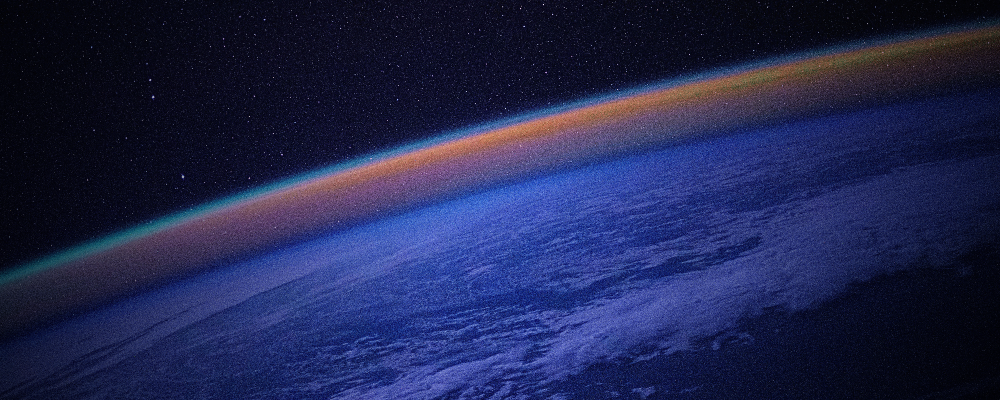
Credit: ESA/Rosetta/MPS for OSIRIS Team MPS/UPD/LAM/IAA/SSO/INTA/UPM/DASP/IDA; Processing: G. Ugarkovic
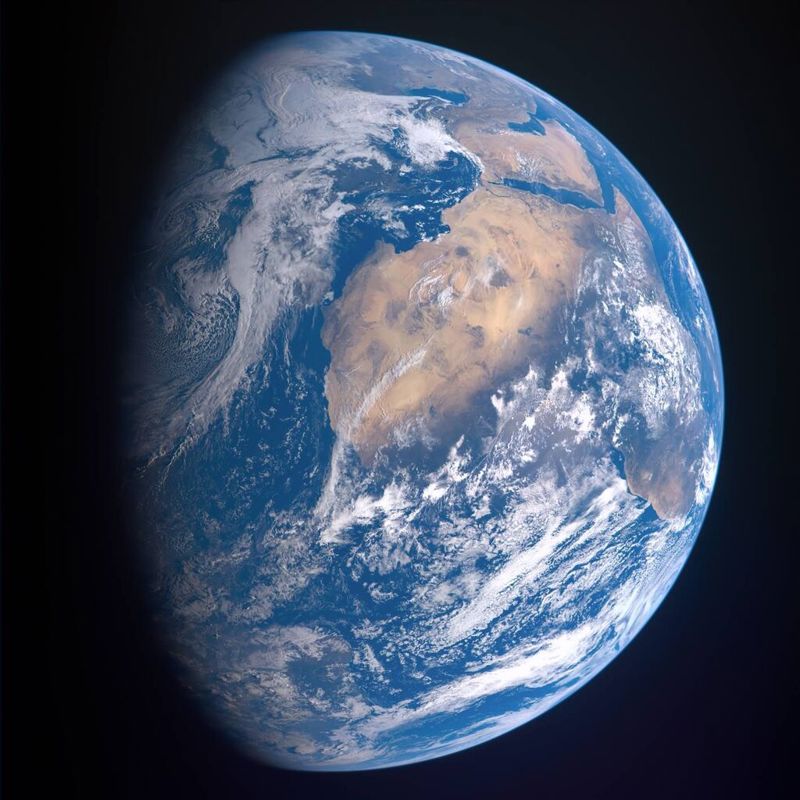
Home ESA's Rosetta captured this absolutely stunning image of Earth on November 13, 2009, during its third flyby of our home. Rosetta was on its way to comet 67P/Churyumov-Gerasimenko, which it reached in May 2014.
Wednesday, 18 December 2024
Credit: NASA/JPL-Caltech Processing: J. Major
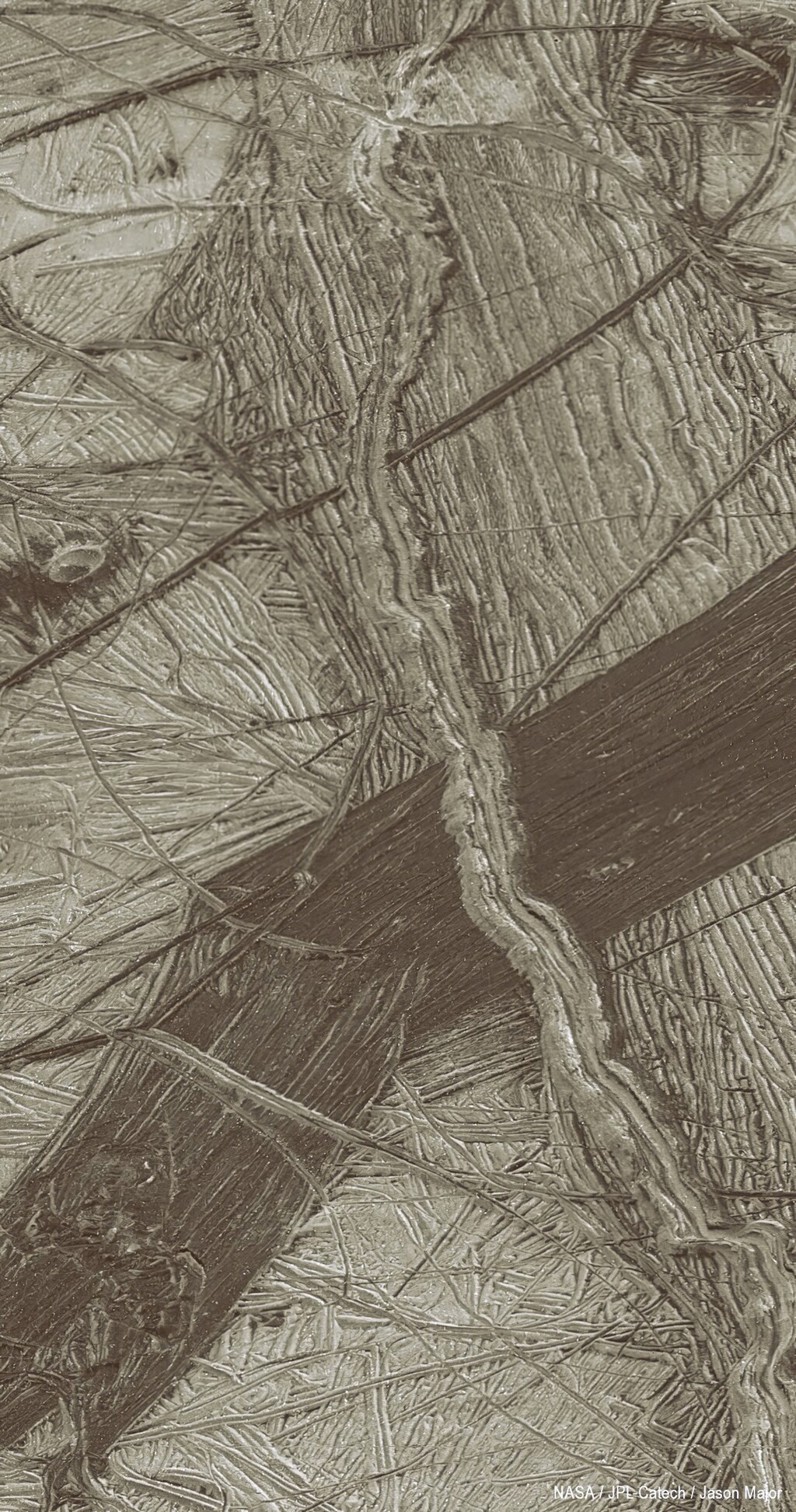
Wallpaper Wednesday - Europa NASA's Galileo spacecraft imaged a portion of the surface of Jupiter's moon Europa on Dec. 16, 1997. This picture uses the monochrome raw image data with color synthesized to approximate natural hues. West on Europa is toward the top. Definitely need a 4-wheel drive for this one, but what an amazing landscape!
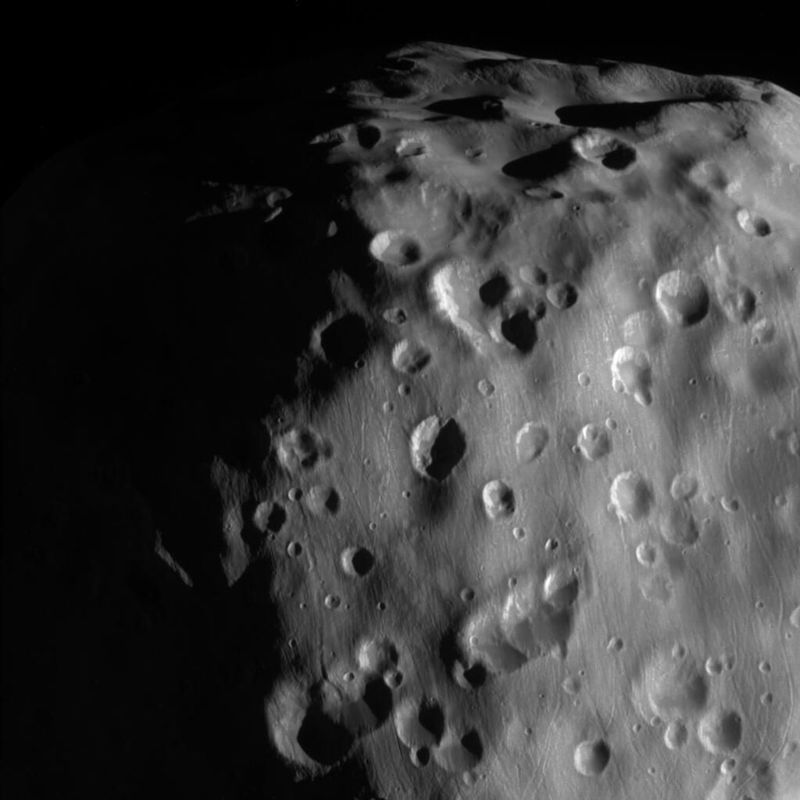
Zoom in on Epimetheus This zoomed-in view of Saturn's moon Epimetheus, one of the highest resolutions ever taken, shows a surface covered in craters, vivid reminders of the hazards of space.
Epimetheus (70 miles or 113 kilometers across) is too small for its gravity to hold onto an atmosphere. It is also too small to be geologically active. There is no way to erase the scars from meteor impacts except for the generation of new impact craters on top of old ones.
The image was taken with the Cassini spacecraft narrow-angle camera on Feb. 21, 2017, using a spectral filter that preferentially admits wavelengths of near-infrared light centered at 939 nanometers.
Friday, 20 December 2024
Credit: Yuri Beletsky Nightscapes
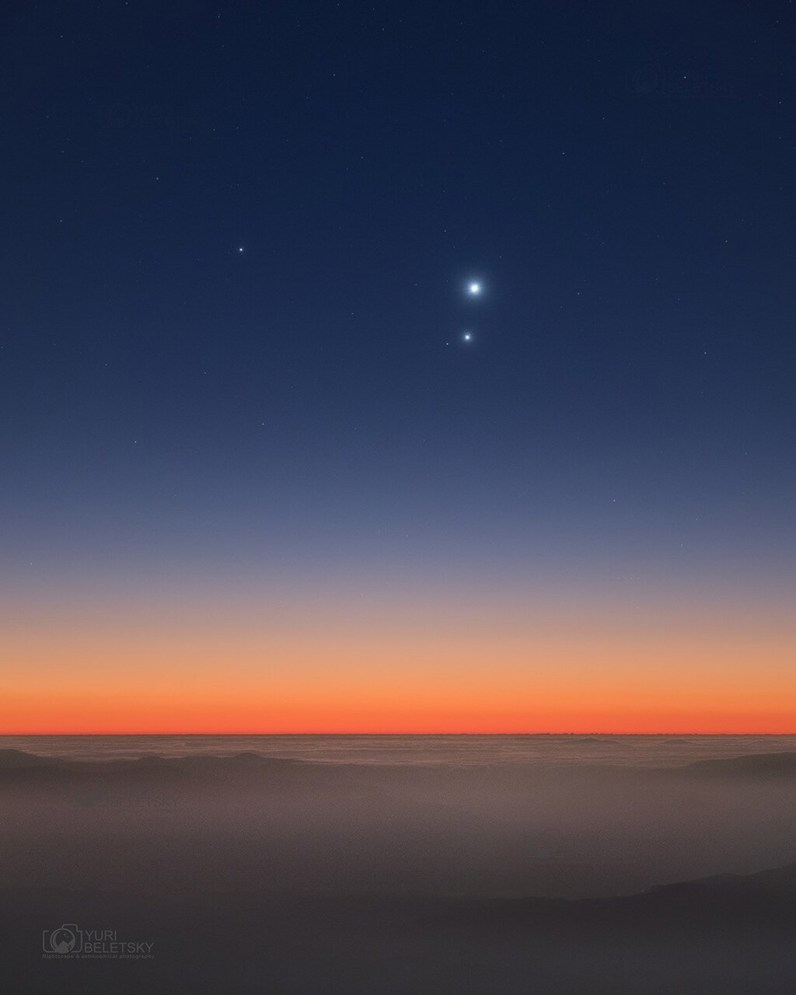
Planetary Conjunction What a beautiful conjunction of three planets over the Pacific: Venus (the brightest), Jupiter (second brightest, below), and Mercury (far left) are all together glowing in the dusk. In the foreground, you can see a foggy valley in the Atacama desert, with clouds covering the ocean in the distance. Taken in 2017.
Monday, 23 December 2024
Credit: Yuri Beletsky Nightscapes
Planetary Conjunction What a beautiful conjunction of three planets over the Pacific: Venus (the brightest), Jupiter (second brightest, below), and Mercury (far left) are all together glowing in the dusk. In the foreground, you can see a foggy valley in the Atacama desert, with clouds covering the ocean in the distance. Taken in 2017.
Monday, 23 December 2024
Credit: NASA/ESA/Matthias Maurer
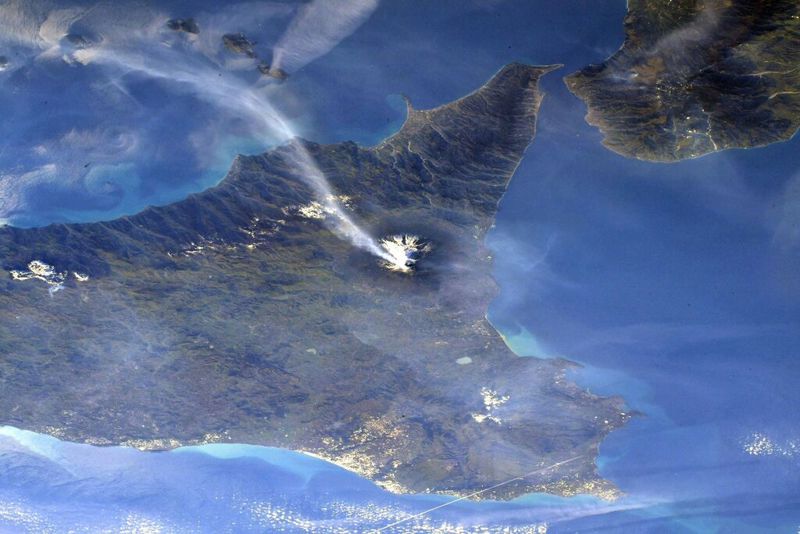
Etna from ISS Etna is a stratovolcano in Sicily, Italy, that has erupted intermittently for hundreds of thousands of years. Eruptions have been documented as early as 1500 BCE. In February 2022, while onboard the International Space Station, ESA astronaut Matthias Maurer captured this image of a plume of smoke wafting from the peak. The volcano was still erupting as recently as November 2024.
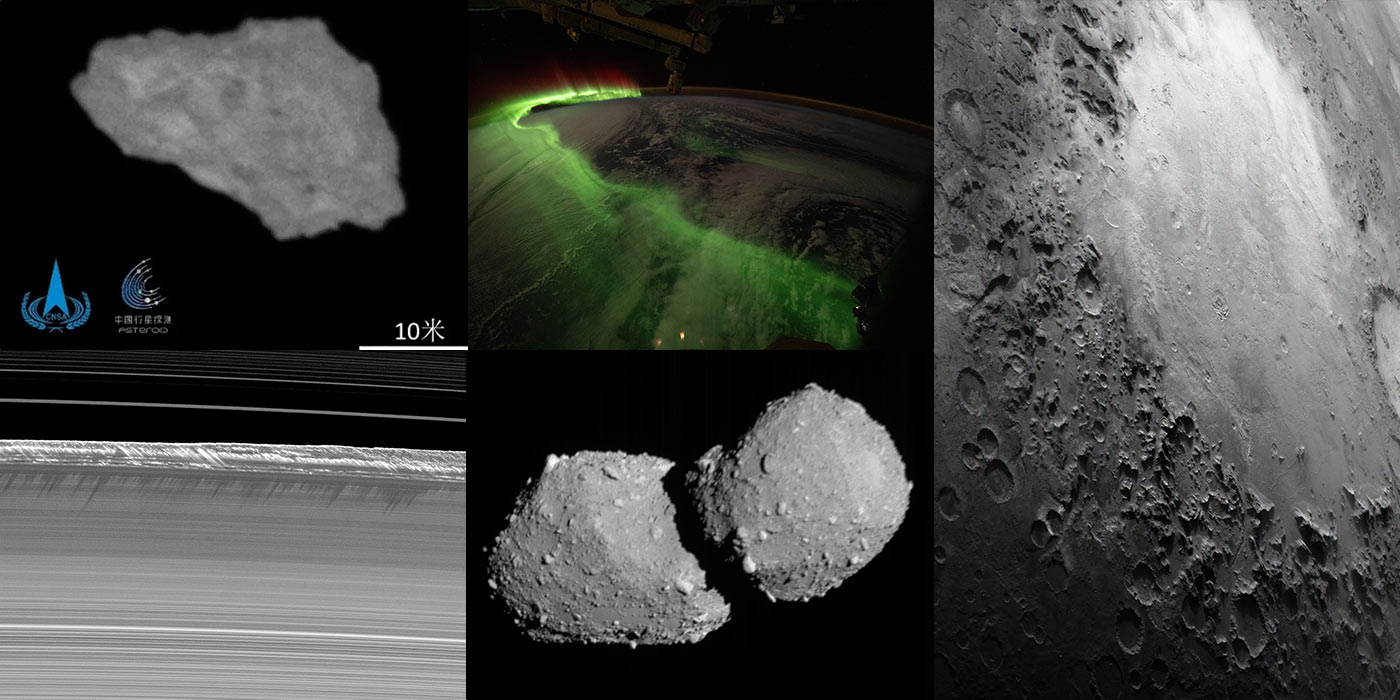
Enjoy fifty years of planetary exploration, from a classic Viking view of Mars’ immense Argyre Basin to new asteroid encounters by the Tianwen-2 and Hayabusa2 missions. The images also capture the beauty and dynamism of our cosmic neighborhood, including a brilliant aurora seen from orbit and towering structures rising from Saturn’s rings, shaped by the hidden influence of embedded moonlets.
#PPOD
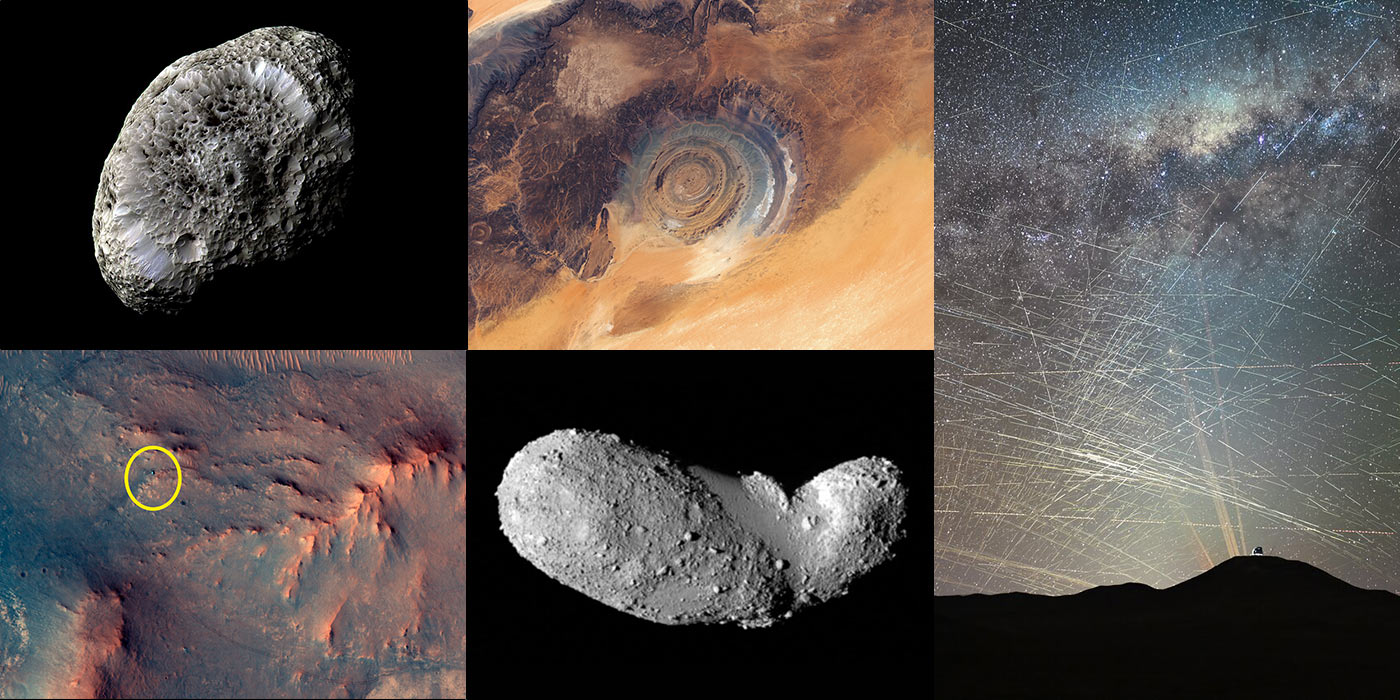
From a marathon milestone on Mars to a sky filled with satellite trails above Chile’s deserts, this week’s collection highlights humanity’s growing exploration of both Earth and space. The images also showcase some of the solar system’s most unusual worlds, including the rubble-pile asteroid Itokawa, the sponge-like moon Hyperion, and the striking Richat Structure—a geologic wonder so distinctive it can be spotted from orbit.
#PPOD
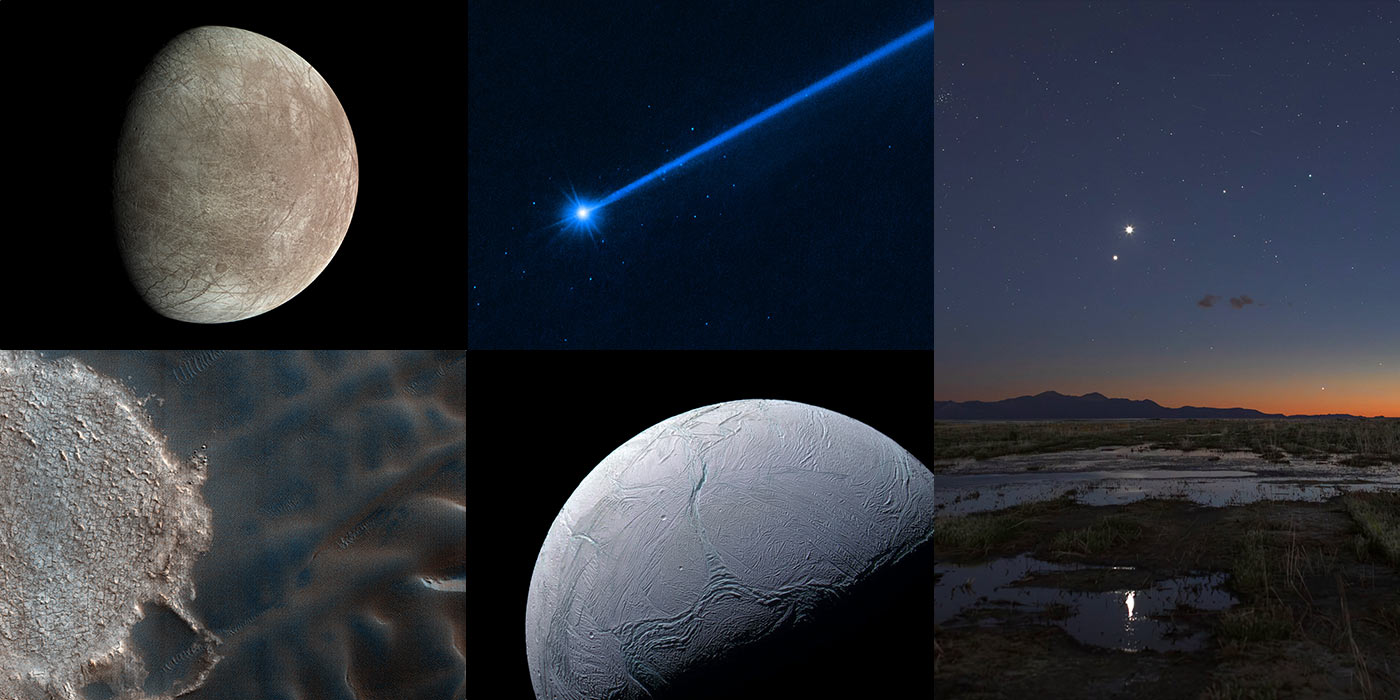
From asteroid fragments drifting through space to icy moons orbiting distant planets, this collection highlights the dynamic and ever-changing nature of our solar system. The images capture everything from a beautiful planetary conjunction in Earth’s skies to active wind-shaped landscapes on Mars, revealing how impacts, gravity, and weather continue to shape worlds both near and far.
#PPOD
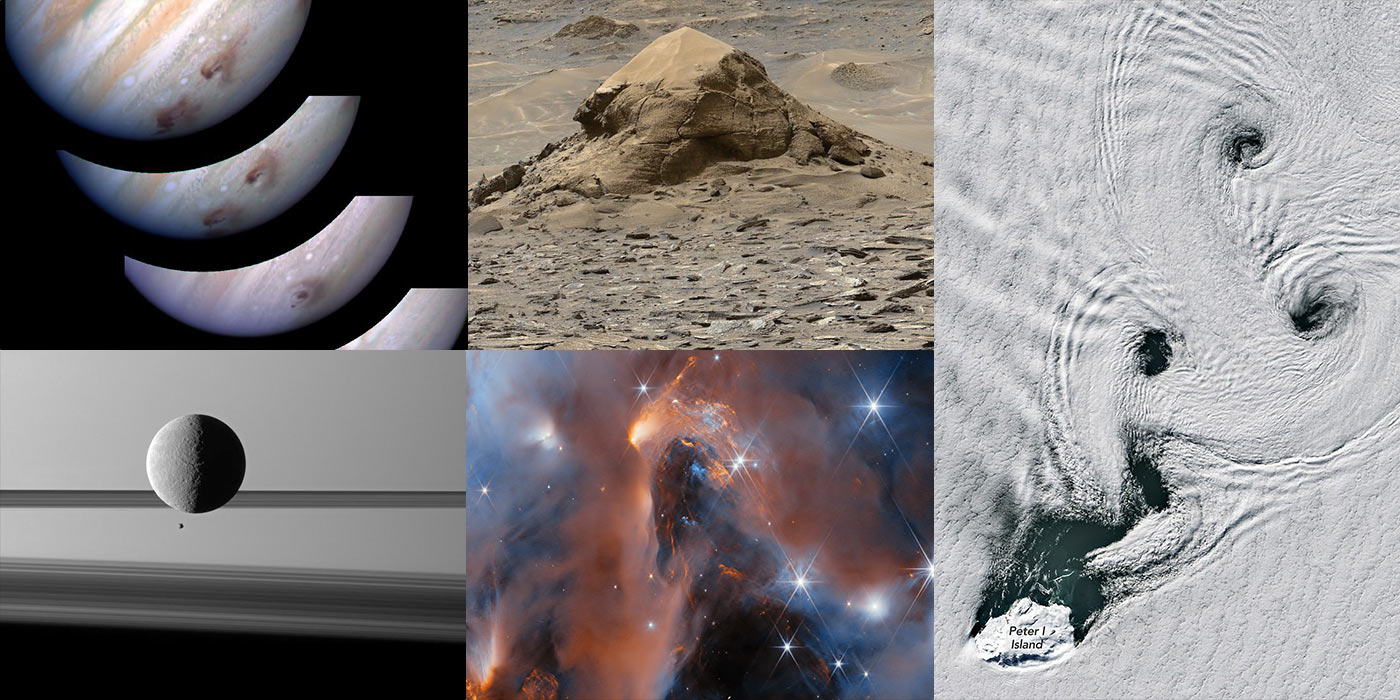
This collection showcases a solar system in motion, from Saturn’s moons playing tricks on perspective and a comet’s dramatic collision with Jupiter to winds swirling across Earth’s southern oceans and ancient landscapes on Mars. Together, these images reveal the forces that shape worlds over time—erosion, impacts, atmospheric currents, and planetary evolution—while capturing moments of beauty, violence, and wonder across the cosmos.
#PPOD
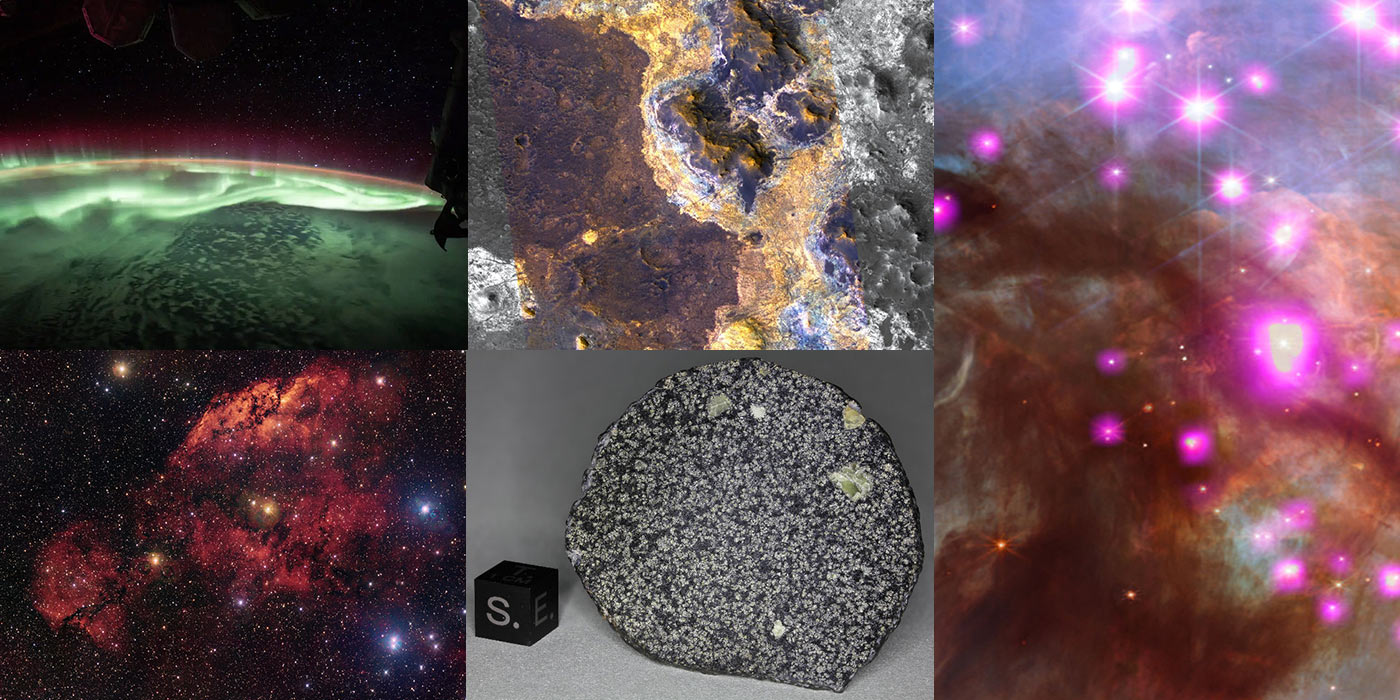
Ancient Martian landscapes, glowing auroras, and stellar nurseries come together in this week’s PPOD collection, highlighting worlds and phenomena shaped by billions of years of cosmic history. From a rare meteorite born in the earliest days of the solar system to colorful nebulae where new stars are forming today, these images offer a remarkable look at both our origins and the ongoing evolution of the universe.
#PPOD
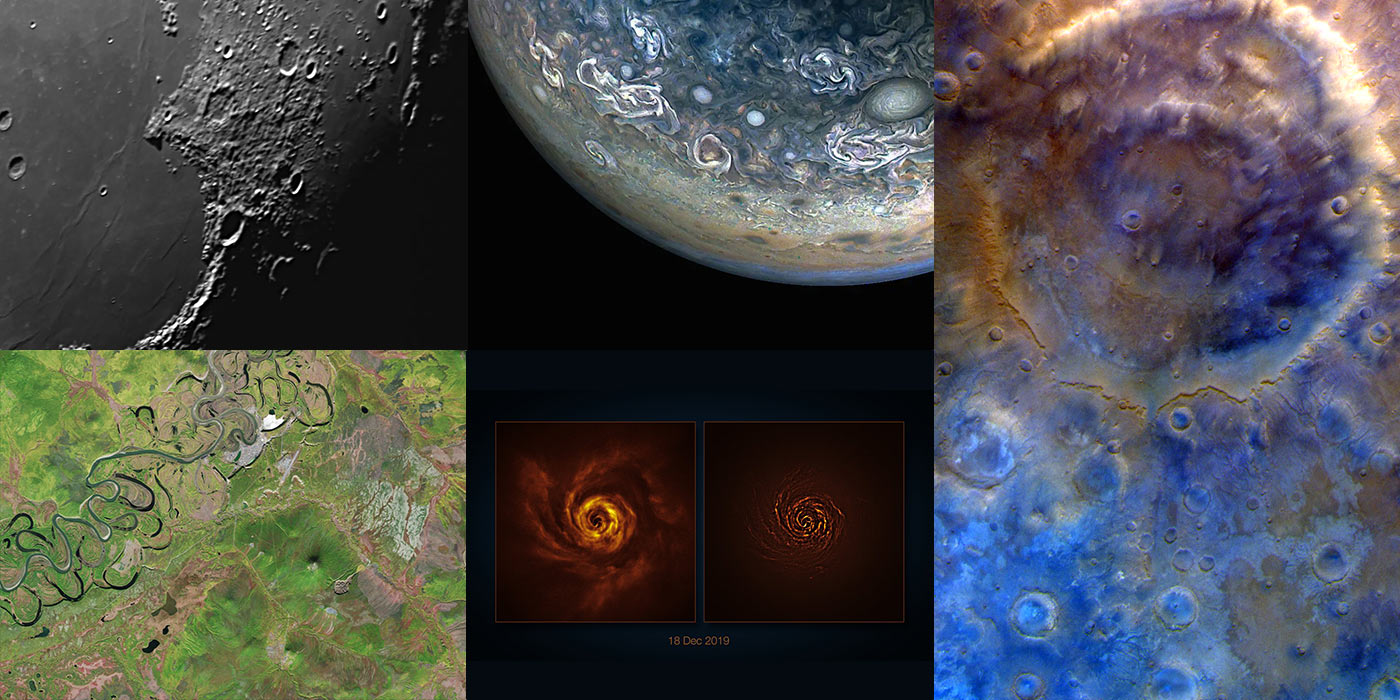
Our solar system contains dynamic worlds near and far, and our cameras capture amazing images of them every day, from a close-up flyby of Mars and the Moon’s beautiful Bay of Rainbows to the swirling storms of Jupiter. We also explore landscapes shaped by change, including Siberia’s expanding Batagaika mega-slump and a young star’s planet-forming disk, offering a glimpse of both Earth’s evolving surface and the processes that build new worlds.
#PPOD
Enjoy fifty years of planetary exploration, from a classic Viking view of Mars’ immense Argyre Basin to new asteroid encounters by the Tianwen-2 and Hayabusa2 missions. The images also capture the beauty and dynamism of our cosmic neighborhood, including a brilliant aurora seen from orbit and towering structures rising from Saturn’s rings, shaped by the hidden influence of embedded moonlets.
From a marathon milestone on Mars to a sky filled with satellite trails above Chile’s deserts, this week’s collection highlights humanity’s growing exploration of both Earth and space. The images also showcase some of the solar system’s most unusual worlds, including the rubble-pile asteroid Itokawa, the sponge-like moon Hyperion, and the striking Richat Structure—a geologic wonder so distinctive it can be spotted from orbit.
From asteroid fragments drifting through space to icy moons orbiting distant planets, this collection highlights the dynamic and ever-changing nature of our solar system. The images capture everything from a beautiful planetary conjunction in Earth’s skies to active wind-shaped landscapes on Mars, revealing how impacts, gravity, and weather continue to shape worlds both near and far.
This collection showcases a solar system in motion, from Saturn’s moons playing tricks on perspective and a comet’s dramatic collision with Jupiter to winds swirling across Earth’s southern oceans and ancient landscapes on Mars. Together, these images reveal the forces that shape worlds over time—erosion, impacts, atmospheric currents, and planetary evolution—while capturing moments of beauty, violence, and wonder across the cosmos.
Ancient Martian landscapes, glowing auroras, and stellar nurseries come together in this week’s PPOD collection, highlighting worlds and phenomena shaped by billions of years of cosmic history. From a rare meteorite born in the earliest days of the solar system to colorful nebulae where new stars are forming today, these images offer a remarkable look at both our origins and the ongoing evolution of the universe.
Our solar system contains dynamic worlds near and far, and our cameras capture amazing images of them every day, from a close-up flyby of Mars and the Moon’s beautiful Bay of Rainbows to the swirling storms of Jupiter. We also explore landscapes shaped by change, including Siberia’s expanding Batagaika mega-slump and a young star’s planet-forming disk, offering a glimpse of both Earth’s evolving surface and the processes that build new worlds.
SkyMapper and the SETI Institute are connecting educators, students and the public to live astronomical observations through a distributed astronomical network.
#SkyMapper
#SETI
#Citizen Science
#Astronomy
What happens if life beyond Earth is discovered? The Discovery and Futures Lab at the SETI Institute fosters novel and anticipatory research at the intersection of science, society, our planet, and the search for life beyond Earth.
#Discovery and Futures Lab
SkyMapper and the SETI Institute are connecting educators, students and the public to live astronomical observations through a distributed astronomical network.
What happens if life beyond Earth is discovered? The Discovery and Futures Lab at the SETI Institute fosters novel and anticipatory research at the intersection of science, society, our planet, and the search for life beyond Earth.
Scientists are getting closer in their search for life beyond earth. But with limited federal funding for the search for extraterrestrial intelligence, supporters are the reason cutting-edge scientists can keep their eyes on the sky.
)