)

Wednesday, Sep 10, 2025

At a Glance
|
September 10, 2025, Mountain View, CA -- NASA’s Perseverance Rover spent three years exploring the floor of Jezero Crater, located just north of the Martian equator. This close-up look at what had previously been seen only from orbit revealed evidence of chemical reactions that shaped the planet billions of years ago. SETI Institute Senior Research Scientist Janice Bishop and University of Massachusetts Engineering Professor Mario Parente analyzed orbital hyperspectral images from the Compact Imaging Spectrometer for Mars (CRISM) aboard the Mars Reconnaissance Orbiter, producing a detailed mineral map at the tens of meters scale of the crater documenting deposits of clays and carbonates signaling abundant water on ancient Mars. In a new Nature News & Views article, Bishop and Parente explore how these findings, combined with Perseverance’s confirmation of the minerals observed from orbit and discoveries of unusual minerals not detectable from orbit, suggest chemical reactions involving minerals, water, and possibly organic material could have created energy-rich environments on early Mars.
"Coordinating mineral detections from orbit at Mars with in situ detections by the Perseverance rover gives us a detailed look at ancient chemical reactions for a few small areas and a broader view across kilometers of the surface," said Bishop.
After landing, Perseverance headed west, analyzing surface materials with its suite of instruments and collecting samples of the most interesting ones for eventual return to Earth. Near the landing site, the rover identified basaltic rocks rich in olivine and pyroxene. Then, as it traveled toward a western delta, it found layers and clays and carbonates, confirming observations from orbit (figure 1). Perseverance's instruments were able to examine these smectite clays and carbonates directly, at a much finer mm to cm scale than CRISM.
Figure 1 Mineralogical map of Jezero crater explored by the Perseverance rover. This mineral map was created from near-infrared (1-2.6 µm) CRISM imagery (Parente et al., 2021) using recently developed technologies (Itoh et al., 2021; Saranathan et al., 2021) and overlain on High Resolution Imaging Science Experiment (HiRISE ) imagery. The basaltic rocks at the landing site are dominated by the minerals olivine (red) and pyroxene (tan). Further west, in regions called the Western Fan and Margin Unit, sedimentary rocks predominate. Smectite clay minerals rich in iron and magnesium (light to dark blue tones) and carbonate rich in magnesium and iron (green-yellow tones) were formed through aqueous processes. Unusual iron phosphate and iron sulfide minerals were found at the Bright Angel and Masonic Temple sites near Neretva Vallis (Hurowitz et al., 2025). Other iron phosphate minerals were observed at the Onahu site in the Western Fan region.
Perseverance discovered unusual millimeter-scale nodules of iron phosphate and iron sulfide embedded in clay-rich mudstone near Neretva Vallis, at the Bright Angel and Masonic Temple sites (Hurowitz et al., 2025). The juxtaposition of the tiny, green-toned specks of chemically reduced iron against the reddish mudstone matrix (Figure 2) prompted further study with the rover's instruments. Phosphates are significant because they play a key role in biology on Earth. Analyses revealed that the mudstone is primarily composed of smectite clays (such as montmorillonite and nontronite), ferric oxides and hydroxides (including hematite and goethite), and calcium sulfates (such as gypsum and bassanite). Interestingly, the reduced minerals appear more abundant where the surrounding mudstone is less oxidized and where organic compounds are more concentrated, based on Raman spectral data. This relationship suggests that organic material may have directly influenced these unusual redox reactions.
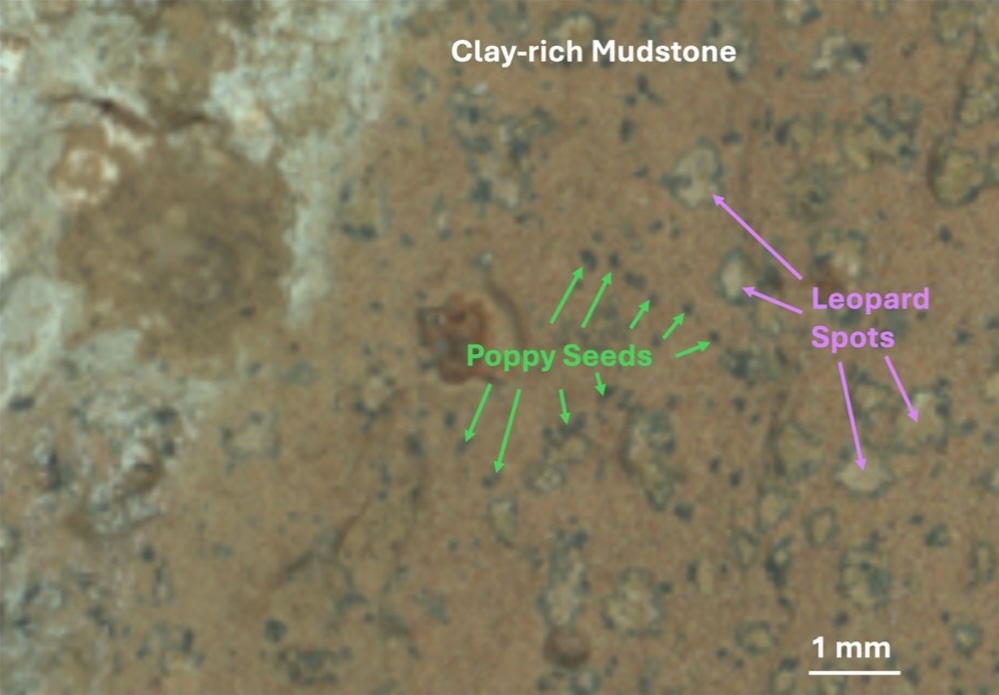
Figure 2 Evidence of unusual geochemical activity on ancient Mars. Perseverance rover image of reddish clay-rich mudstone containing mm-sized green specks termed Poppy Seeds and slightly larger green and light-toned blobs termed Leopard Spots (after Hurowitz et al., 2025). Analyses by instruments onboard Perseverance revealed the tiny green nodules to be the mineral vivianite, while the light-toned material is iron sulfide.
"My group observed redox reactions in lab experiments where ferrihydrite containing oxidized iron was heated with organic compounds, including amino acids, to produce the mineral magnetite containing reduced iron," said Bishop.
Redox reactions are chemical processes where minerals gain or lose electrons, creating energy that can sometimes be used by living organisms. Amino acids are the building blocks of life as we know it and may also have played a role in prebiotic chemistry through interactions with minerals. Data from Perseverance’s SHERLOC instrument (Scanning Habitable Environments with Raman and Luminescence for Organics and Chemicals) suggest that organic compounds at Jezero Crater probably interacted with a variety of minerals on ancient Mars (Scheller et al., 2022).
The greenish specks in Figure 2 are likely the mineral vivianite, a phosphate that can change its chemistry when exposed to different environmental conditions. Perseverance also found phosphate minerals at another site, Onahu (Figure 1), where evidence suggests they were once vivianite that later oxidized, or “rusted.” A separate study of Jezero crater sediments revealed alternating colored layers caused by shifts in iron chemistry, showing that Mars’ environment changed over time in ways that could have influenced habitability.
Identifying specific minerals on Mars is key to reconstructing the ancient geochemical environments that once shaped the planet.
“Spectral analyses of pure minerals and mineral mixtures in the laboratory are necessary for interpreting the spectral data collected at Mars,” said Bishop.
At the SETI Institute, Bishop’s group conducts laboratory experiments on minerals such as phyllosilicates, sulfates, carbonates, and phosphates. These studies provide the foundation for recognizing and characterizing Martian minerals, both from orbit with the CRISM imager and directly on the surface through near-infrared spectra measured by Perseverance’s SuperCam instrument.
However, Mars’s atmosphere and some instrument quirks can distort CRISM’s hyperspectral data, making orbital mineral identification tricky even after standard processing. Itoh and Parente (2021) addressed this problem using the most advanced method yet for correcting and de-noising CRISM data. Earlier processing pipelines still left residual artifacts and noise. The new approach finds and removes those lingering distortions (from Martian gas absorption bands, sensor temperature drifts, or even icy haze), while simultaneously filtering out random noise in each image.
“By extracting the atmosphere’s imprint directly from the image itself, our technique yields cleaner surface spectra,” said Parente. “This approach effectively eliminates the need for manual fixes like spectral ratioing, which scientists used to rely on to cancel out calibration quirks but which risked altering the surface signals and causing misidentification of minerals. With CRISM data now clarified by this method, subtle mineral features once lost in the ‘static’ can be detected with greater confidence.”
Building on this leap in data quality, a companion study by Saranathan and Parente (2021) used AI to turn those cleaned-up spectra into the most accurate mineral maps of Mars to date. The new approach trains a Generative Adversarial Network (GAN) to automatically learn distinctive spectral “fingerprints” of various minerals from CRISM data. In this GAN-derived representation space, even subtle differences between mineral signatures stand out, and simple similarity metrics can reliably match each pixel to its likely mineral identity. The study produced a map of dominant mineralogy that pinpoints the distribution of materials such as carbonates, clays, and pyroxenes with unprecedented clarity and minimal ambiguity. Parente and his team released a map of Jezero Crater’s mineral diversity, successfully identifying known mineral deposits and revealing small mineral outcrops that earlier mapping approaches had overlooked (Parente et al, 2021).
By sharpening the view from orbit, these innovations enabled Mars scientists to improve their understanding of the planet's ancient geochemical environment.
On Earth, microorganisms commonly interact with minerals in ways that transform their chemistry. For example, researchers have observed that microbes in cold, oxygen-free Antarctic lakes can convert sulfates (containing oxidized sulfur) into sulfides (containing reduced sulfur) (Bishop et al., 2003 ). While there is no evidence for microbes on Mars today, if life once existed there, similar processes could have reduced sulfate minerals to sulfides in an ancient lake at Jezero crater. On Earth, bacteria also promote the formation of the phosphate mineral vivianite by reducing iron in oxygen-poor swamps rich in phosphate ions. However, given the long geologic timescales on Mars, the tiny pockets of reduced vivianite and sulfides found within oxidized mudstones at Jezero were more likely formed by non-biological processes — for example, chemical reactions involving organic compounds.
“Sulfur isotope analyses were used on the Antarctic sediments to determine a biologic origin of the tiny sulfide crystals in anoxic water,” said Bishop.
Scientists could gain valuable clues about the geochemical processes that shaped these Martian minerals by running similar sulfur isotope tests on the Bright Angel samples when they return to Earth.
Perseverance’s samples from the Bright Angel and Masonic Temple sites show the potential for complex chemistry on ancient Mars and raise new questions about the redox reactions that created these unusual minerals. Once these cached samples return to Earth, scientists will be able to study them with far more powerful laboratory techniques, revealing finer details about mineral identities, spatial arrangements, and the geochemical processes that shaped them. Such analyses could not only clarify Mars' chemical history but also shed light on the potential for prebiotic — or even biological — chemistry beyond our own planet.
About the SETI Institute
Founded in 1984, the SETI Institute is a non-profit, multi-disciplinary research and education organization whose mission is to lead humanity's quest to understand the origins and prevalence of life and intelligence in the universe and to share that knowledge with the world. Our research encompasses the physical and biological sciences and leverages expertise in data analytics, machine learning and advanced signal detection technologies. The SETI Institute is a distinguished research partner for industry, academia and government agencies, including NASA and NSF.
Contact information
Rebecca McDonald
Director of Communications
SETI Institute
[email protected]







News
Related News
Jul 15, 2026
Alien World Chemistry Found Inside Meteorite That Struck New Jersey home
#Press Releases #Meteorites #Peter Jenniskens #JAMSTEC
Jun 5, 2026
Beyond Disclosure Day: The Real-World Protocols
#Press Releases #SETI #Astronomy #Bill Diamond #SETI Institute
Jun 3, 2026
SETI Institute Looks for Signs of Technology in Interstellar Visitor 3I/ATLAS
Observations with the Allen Telescope Array set new limits on possible signals from extraterrestrial transmitters. #Press Releases #ATA #3I/ATLAS #Hat Creek Radio Observatory #Radio Astronomy #SETI
Jun 1, 2026
SETI Institute Awards $1 Million in STRIDE Grants to Advance Astrobiology, Exoplanet Science, and Public Engagement
#Press Releases #STRIDE #Research #Carl Sagan Center #Spectroscopy #Solar System #SETI #Climate and Bioscience #Astronomy #Astrobiology #Exoplanets #Data Science #Education #Outreach #Hat Creek Radio Observatory #Unistellar #SkyMapper
May 13, 2026
SETI Institute to Honor Dr. Matthew Tiscareno with 2026 Carl Sagan Center Director’s Award
The Drake Awards event will also recognize SETI Forward and SETI Institute REU student award recipients. #Press Releases #Drake Awards #Frank Drake #SETI #Awards #Planetary Astronomy #Astrobiology #SETI Forward #Education #Carl Sagan Center #Matthew Tiscareno #Nathalie Cabrol #REU
May 7, 2026
SETI Institute In the News: April Roundup 2026
#SETI Institute in the News #SETI Institute #Community #SETI #Discovery and Futures Lab #Lucian Walkowicz #Chelsea Haramia #NASA Missions and Observatories #Pascal Lee #Mars #Janice Bishop #Mark Showalter #JWST #Uranus #Bill Diamond #UAPs
Jul 15, 2026
#Press Releases
#Meteorites
#Peter Jenniskens
#JAMSTEC
Jun 5, 2026
#Press Releases
#SETI
#Astronomy
#Bill Diamond
#SETI Institute
Beyond Disclosure Day: The Real-World Protocols
Jun 3, 2026
SETI Institute Looks for Signs of Technology in Interstellar Visitor 3I/ATLAS
Observations with the Allen Telescope Array set new limits on possible signals from extraterrestrial transmitters.
#Press Releases
#ATA
#3I/ATLAS
#Hat Creek Radio Observatory
#Radio Astronomy
#SETI
Jun 1, 2026
#Press Releases
#STRIDE
#Research
#Carl Sagan Center
#Spectroscopy
#Solar System
#SETI
#Climate and Bioscience
#Astronomy
#Astrobiology
#Exoplanets
#Data Science
#Education
#Outreach
#Hat Creek Radio Observatory
#Unistellar
#SkyMapper
SETI Institute Awards $1 Million in STRIDE Grants to Advance Astrobiology, Exoplanet Science, and Public Engagement
May 13, 2026
SETI Institute to Honor Dr. Matthew Tiscareno with 2026 Carl Sagan Center Director’s Award
The Drake Awards event will also recognize SETI Forward and SETI Institute REU student award recipients.
#Press Releases
#Drake Awards
#Frank Drake
#SETI
#Awards
#Planetary Astronomy
#Astrobiology
#SETI Forward
#Education
#Carl Sagan Center
#Matthew Tiscareno
#Nathalie Cabrol
#REU
May 7, 2026
#SETI Institute in the News
#SETI Institute
#Community
#SETI
#Discovery and Futures Lab
#Lucian Walkowicz
#Chelsea Haramia
#NASA Missions and Observatories
#Pascal Lee
#Mars
#Janice Bishop
#Mark Showalter
#JWST
#Uranus
#Bill Diamond
#UAPs
SETI Institute In the News: April Roundup 2026
Research
Related Projects

SkyMapper • SETI • Citizen Science • Astronomy
SkyMapper: Expanding Access to Real-time Astronomy Through a Global Astronomical Network
SkyMapper and the SETI Institute are connecting educators, students and the public to live astronomical observations through a distributed astronomical network. #SkyMapper #SETI #Citizen Science #Astronomy
VPL
Virtual Planetary Laboratory
How can we best assess whether an exoplanet supports life? #VPL
Discovery and Futures Lab
Discovery and Futures Lab
What happens if life beyond Earth is discovered? The Discovery and Futures Lab at the SETI Institute fosters novel and anticipatory research at the intersection of science, society, our planet, and the search for life beyond Earth. #Discovery and Futures Lab
May 17, 2026
SkyMapper: Expanding Access to Real-time Astronomy Through a Global Astronomical Network
SkyMapper and the SETI Institute are connecting educators, students and the public to live astronomical observations through a distributed astronomical network.
#SkyMapper
#SETI
#Citizen Science
#Astronomy
May 5, 2026
Virtual Planetary Laboratory
How can we best assess whether an exoplanet supports life?
#VPL
Apr 16, 2026
Discovery and Futures Lab
What happens if life beyond Earth is discovered? The Discovery and Futures Lab at the SETI Institute fosters novel and anticipatory research at the intersection of science, society, our planet, and the search for life beyond Earth.
#Discovery and Futures Lab
Support Us
Support the
SETI Institute
Scientists are getting closer in their search for life beyond earth. But with limited federal funding for the search for extraterrestrial intelligence, supporters are the reason cutting-edge scientists can keep their eyes on the sky.
