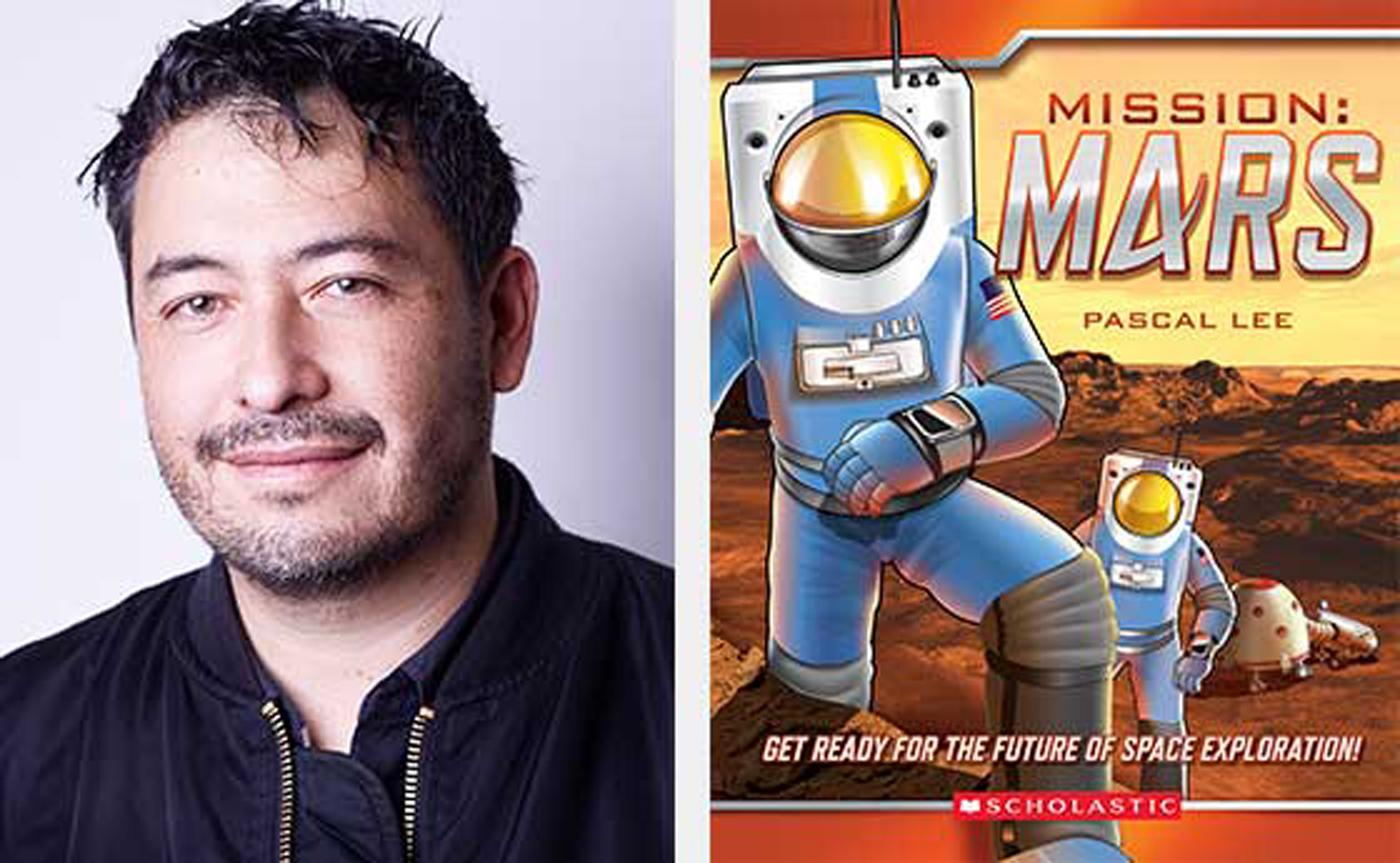
It’s his first time out of the gate writing a book, but Pascal Lee, a SETI Institute researcher who studies Mars, has taken first place.
Lee has been designated a winner of the American Association for the Advancement of Science/Subaru Science Books and Film Prize for Excellence in Children’s Books. Entitled Mission: Mars, Lee’ short tome not only conveys fascinating facts about the Red Planet, but, by describing the nuts and bolts of future human expeditions, shows middle school students that science is not a subject to be feared but is understandable and compelling.
The ability of books to stimulate interests in young people is well known to Lee: “When I was growing up, humans were walking on the Moon. I picked up every book I could find that showed the insides of spacecraft and the workings of spacesuits,” he says. Lee went on to elaborate his childhood interest with a research career focused on the history of water on the Red Planet and its two small moons.
Beyond fostering an interest in science, Lee speculates that some of the readers of his book may be among the first humans to actually explore Mars.
The Prize will be awarded on February 14, 2015, at the Association’s Annual Meeting in San Jose, California.
Read the entire press release below
MOUNTAIN VIEW, CA – Human journeys to Mars could become a reality in the 2030s, says NASA. Consequently, some of today’s kids already have their eyes set on becoming tomorrow’s Mars explorers. To help them prepare for this epic voyage, SETI Institute scientist Pascal Lee has written Mission: Mars, a nonfiction children’s book that reads like a training manual. This book has won the American Association for the Advancement of Science’s (AAAS) 2015 AAAS/Subaru Science Books & Films Prize for Excellence in Children’s Science Books.
The AAAS is the world’s largest general scientific society and the publisher of the renowned journal Science. Its annual Science Books & Films (SB&F) prize, co-sponsored by Subaru of America, Inc., celebrates outstanding works that foster an understanding and appreciation of science in young readers. Mission: Mars earned the top prize in the Middle Grades category.
Published by Scholastic, Mission: Mars is geared for kids ages 8 to 13. Besides being scientifically probing and technically rigorous, the book is written in lively language and is richly illustrated. The book also draws on ongoing research at NASA and elsewhere to make human missions to Mars a reality, including Lee’s own efforts at the SETI Institute and at NASA’s Ames Research Center in Mountain View, California.
Pascal Lee was born in Hong Kong and grew up in France. He studied physics and geology at the University of Paris, and got his doctorate in astronomy and space sciences from Cornell University. He joined the NASA Ames Research Center in 1997, and then the SETI Institute in 2000. Lee’s research focuses on Mars, especially the history of water on that planet. He also studies Mars’ moons, which are featured in his book. An expert on polar regions that can serve as Mars analogs, Lee has led over 30 expeditions to the Arctic and Antarctica.
Mission: Mars is Lee’s first book. “When I was growing up, humans were walking on the Moon. That was amazing to me. I picked up every book I could find that showed the insides of spacecraft and the workings of spacesuits”. Lee credits these publications for exposing him to science. “I wanted to write a book that would inspire the kids of today to join humanity’s next giant leap in space. Above all, I wanted them to not fear science, but embrace it”, said Lee.
One of Lee’s childhood heroes, Apollo 11 astronaut Buzz Aldrin, praises Mission: Mars, saying “Pascal Lee is a true pioneer of Mars exploration. This book makes me want to put on a spacesuit and go to Mars!”
Lee will receive the AAAS/Subaru SB&F prize at the AAAS Annual Meeting on February 12-16, 2015 in San Jose, California.
)