)

Wednesday, Jun 17, 2026
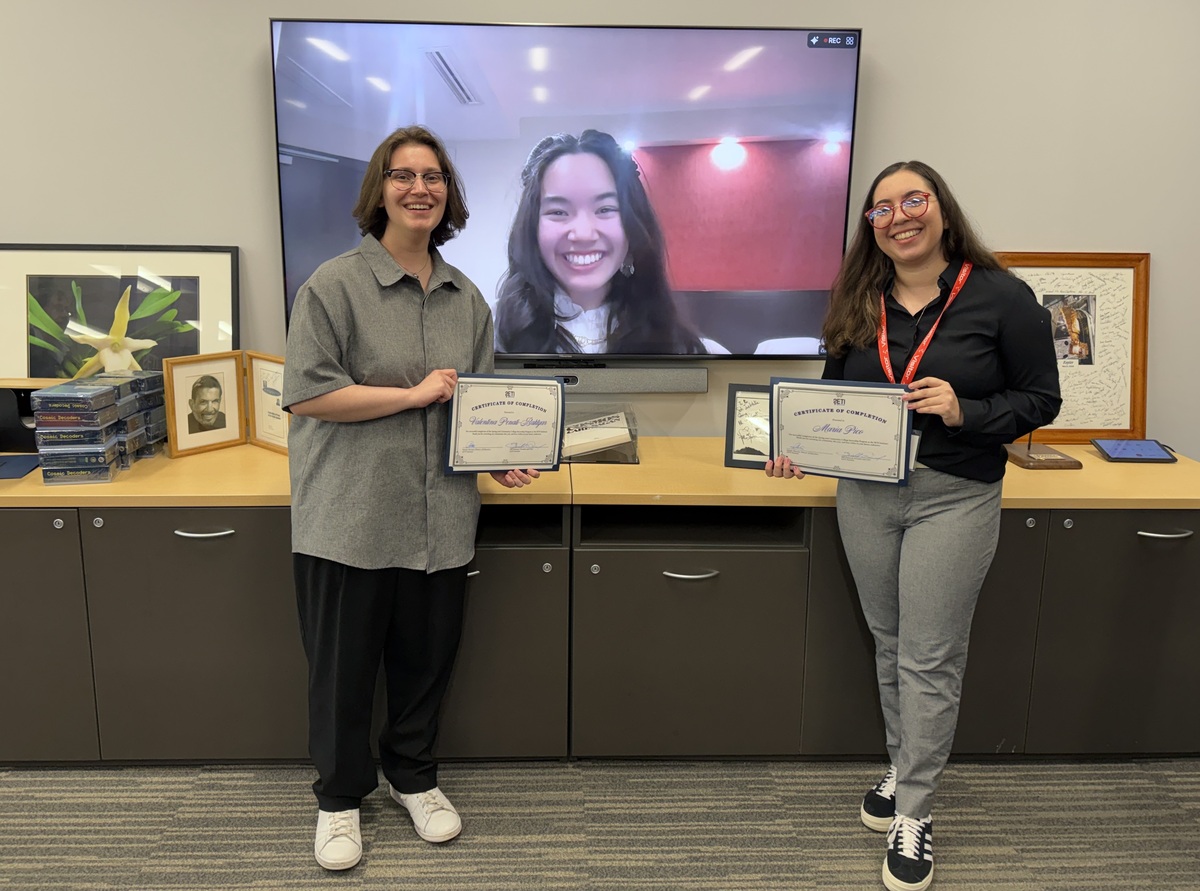
Image: L-R Valentina Penati-Baktyar, Ariana Estrada, Maria Pico (Image Credit: Simon Steel)
At a Glance:
|
The SETI Institute’s Community College Internship program continues to provide students with meaningful, hands-on research experience during the academic year through its partnership with Bay Area community colleges. Now in its fourth year, the program welcomed applicants from Foothill College in Los Altos, Diablo Valley Community College in Pleasant Hill and Evergreen Valley College in San Jose.
This year’s program culminated on June 5 with a final presentation event showcasing the work of three student interns and the scientific skills they developed throughout the spring semester.
Ariana Estrada, mentored by Dr. Lauren Sgro, joined remotely from Spain and presented her work on exoplanet detection through the Unistellar Citizen Science Program. Her work included transit photometry analysis and the development of a Python tool that matches observed targets with scientific catalogs, helping to streamline the identification of exoplanet candidates.
Valentina Penati-Baktyar, mentored by Dr. Uma Gorti, shared her research on detecting water snow lines in protoplanetary disks using data from the James Webb Space Telescope and IRIS modeling. While data saturation issues prevented a successful detection, her project highlighted the challenges and realities of cutting-edge astronomical research.
Maria Pico, mentored by Dr. Doug Caldwell, presented her work on exoplanet detection and vetting workflows using data from NASA’s TESS spacecraft. She also demonstrated a website she developed to help researchers filter and validate potential planet candidates more efficiently.
The event concluded with certificate presentations by Pamela Harman, the SETI Institute’s outgoing Director of Education, recognizing the interns’ accomplishments in balancing rigorous scientific research while maintaining full course loads at their home institutions. “This ongoing collaboration between the SETI Institute and local colleges expands the student internship experience beyond traditional summer programming, in addition to providing opportunities for students studying at colleges that cannot offer in-house research experiences,” said Dr. Simon Steel, Deputy Director of the Carl Sagan Center at the SETI Institute and lead for the community college internship program. “The three clear, engaging and informative research presentations today show how fruitful this relationship between the SETI Institute and the community colleges of the Bay Area has become.”







News
Related News

Jul 24, 2026
A New Way to Search for Alien Civilizations
#Blog #Lauren Sgro
Jul 10, 2026
SETI Institute Achievements: Q1 2026 Activity Report
#Activity Reports #Carl Sagan Center #Outreach #Education #AIR #Community #Research
Jul 2, 2026
How Clouds Hide Alien Worlds—and How Astronomers See Through Them
#Blog #Lauren Sgro
Jun 29, 2026
Humanity's Plan for First Contact: Who Speaks for Earth?
#Blog #Lauren Sgro #Lucian Walkowicz #Chelsea Haramia #SETI #SETI Institute
Jun 12, 2026
Not Planets, Not Stars: NASA Volunteers Doubled the Number of Known Brown Dwarfs
#Blog #Lauren Sgro
Jun 1, 2026
SETI Institute Awards $1 Million in STRIDE Grants to Advance Astrobiology, Exoplanet Science, and Public Engagement
#Press Releases #STRIDE #Research #Carl Sagan Center #Spectroscopy #Solar System #SETI #Climate and Bioscience #Astronomy #Astrobiology #Exoplanets #Data Science #Education #Outreach #Hat Creek Radio Observatory #Unistellar #SkyMapper
Jul 24, 2026
#Blog
#Lauren Sgro
Jul 10, 2026
#Activity Reports
#Carl Sagan Center
#Outreach
#Education
#AIR
#Community
#Research
SETI Institute Achievements: Q1 2026 Activity Report
Jul 2, 2026
#Blog
#Lauren Sgro
How Clouds Hide Alien Worlds—and How Astronomers See Through Them
Jun 29, 2026
#Blog
#Lauren Sgro
#Lucian Walkowicz
#Chelsea Haramia
#SETI
#SETI Institute
Humanity's Plan for First Contact: Who Speaks for Earth?
Jun 12, 2026
#Blog
#Lauren Sgro
Not Planets, Not Stars: NASA Volunteers Doubled the Number of Known Brown Dwarfs
Jun 1, 2026
#Press Releases
#STRIDE
#Research
#Carl Sagan Center
#Spectroscopy
#Solar System
#SETI
#Climate and Bioscience
#Astronomy
#Astrobiology
#Exoplanets
#Data Science
#Education
#Outreach
#Hat Creek Radio Observatory
#Unistellar
#SkyMapper
SETI Institute Awards $1 Million in STRIDE Grants to Advance Astrobiology, Exoplanet Science, and Public Engagement
Research
Related Projects

SkyMapper • SETI • Citizen Science • Astronomy
SkyMapper: Expanding Access to Real-time Astronomy Through a Global Astronomical Network
SkyMapper and the SETI Institute are connecting educators, students and the public to live astronomical observations through a distributed astronomical network. #SkyMapper #SETI #Citizen Science #Astronomy
VPL
Virtual Planetary Laboratory
How can we best assess whether an exoplanet supports life? #VPL
Discovery and Futures Lab
Discovery and Futures Lab
What happens if life beyond Earth is discovered? The Discovery and Futures Lab at the SETI Institute fosters novel and anticipatory research at the intersection of science, society, our planet, and the search for life beyond Earth. #Discovery and Futures Lab
May 17, 2026
SkyMapper: Expanding Access to Real-time Astronomy Through a Global Astronomical Network
SkyMapper and the SETI Institute are connecting educators, students and the public to live astronomical observations through a distributed astronomical network.
#SkyMapper
#SETI
#Citizen Science
#Astronomy
May 5, 2026
Virtual Planetary Laboratory
How can we best assess whether an exoplanet supports life?
#VPL
Apr 16, 2026
Discovery and Futures Lab
What happens if life beyond Earth is discovered? The Discovery and Futures Lab at the SETI Institute fosters novel and anticipatory research at the intersection of science, society, our planet, and the search for life beyond Earth.
#Discovery and Futures Lab
Support Us
Support the
SETI Institute
Scientists are getting closer in their search for life beyond earth. But with limited federal funding for the search for extraterrestrial intelligence, supporters are the reason cutting-edge scientists can keep their eyes on the sky.
