)

Monday, Sep 15, 2025

At a Glance: LaserSETI in Puerto Rico
|
Under the tropical skies of Puerto Rico, a new observatory joined the LaserSETI Network, expanding the SETI Institute’s ability to search for technosignatures. Bringing cutting-edge instruments to an island with an already astronomical history, the project will scan the heavens for fleeting flashes of light. With this installation, Puerto Rico now plays a central role in optical SETI efforts.
What is LaserSETI?
LaserSETI differs from traditional telescopes, which focus on a narrow slice of the sky. Instead, each instrument uses pairs of off-the-shelf, wide-field, optical cameras to continuously monitor swaths of the heavens that span 75 degrees across. These instruments are tuned to catch brief, millisecond-order bursts of monochromatic light by splitting all incoming light into its parts. Since optical pulses from natural, known sources are not monochromatic, such a detection could indicate an optical technosignature — a hallmark expected of advanced civilizations. While radio astronomy has long been the cornerstone of SETI, the addition of optical SETI broadens the search, opening a new avenue to explore the SETI Institute’s founding question: are we alone?
LaserSETI at Isla Magueyes

The view from UPR Mayagüez’s Department of Marine Sciences rooftop, the site of the new LaserSETI observatory.
This new LaserSETI site, marking the fourth observatory in the network, was made possible through collaboration with the University of Puerto Rico (UPR) at Mayagüez’s Department of Marine Sciences and with the support of local partners who continue the island’s proud tradition of cosmic discovery. Collaborator Dr. Abel Méndez, professor at UPR at Arecibo and Director of UPR’s Planetary Habitability Laboratory, scouted the island for the perfect place to host the new instruments. Thanks to his efforts and the generosity of the Department of Marine Sciences, LaserSETI was provided a prime location. Now, the new instruments sit atop the main building of the Department’s Magueyes Marine Station on a small islet off the southern coast, called Isla Magueyes. In a recent SETI Live, Méndez stated the myriad reasons why Isla Magueyes was his top pick for the new observatory, and with the Department’s help to prepare the roof, the LaserSETI instruments have the perfect home in Puerto Rico.
Puerto Rico’s location provides crucial sky coverage, filling in a geographic gap and ensuring confirmation of potential signals when combined with LaserSETI’s other sites. This new observatory is the first with three instruments, each pointed in a different direction. Two of the stations will overlap in field of view with the Sedona, AZ instruments, while the other will overlap with a future site currently slated for the Canary Islands. Despite the overlap, LaserSETI Puerto Rico will still increase the network’s coverage from a third of the night sky to approximately 40% of it.
A timelapse of the second day of the LaserSETI installation.
The installation not only expands LaserSETI’s sights but also offers new opportunities for local students and researchers, who now have a front-row seat to a new generation of SETI research. Dr. Méndez will continue to collaborate with the team to analyze the data once all systems are go, and he will train students to tap into LaserSETI’s scientific potential in other realms, such as meteor studies.
A Smooth Installation
Although it’s never a true LaserSETI experience without a delayed flight, the team — including Méndez, LaserSETI Principal Investigator Eliot Gillum, Project Manager Dr. Franck Marchis, and Outreach Manager Dr. Lauren Sgro — traveled to La Parguera, the nearest town to the islet observatory site. From there, they took a boat to Isla Magueyes, where they assessed the rooftop location and inspected the instruments. Shipping damage was minimal; however, the marine environment will likely require more frequent maintenance than other LaserSETI sites. Volunteers Evans Ortiz Ortolaza and Martin Jude Irizarry from the Astronomical Society of the Caribbean (Sociedad de Astronomía del Caribe) and its president, Rafael Emmanuelli, joined the effort, moving the instruments to the roof and helping prepare them for installation. Once everything was roughly in place, the team set about cutting wires and tubing to close out the day’s work.
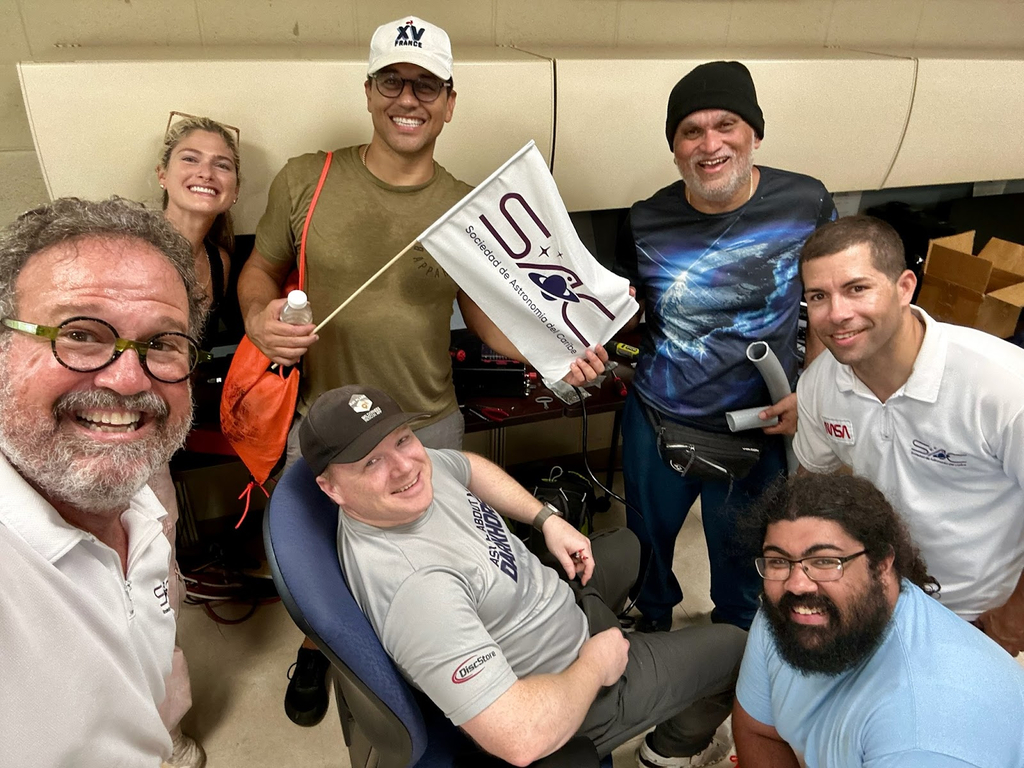
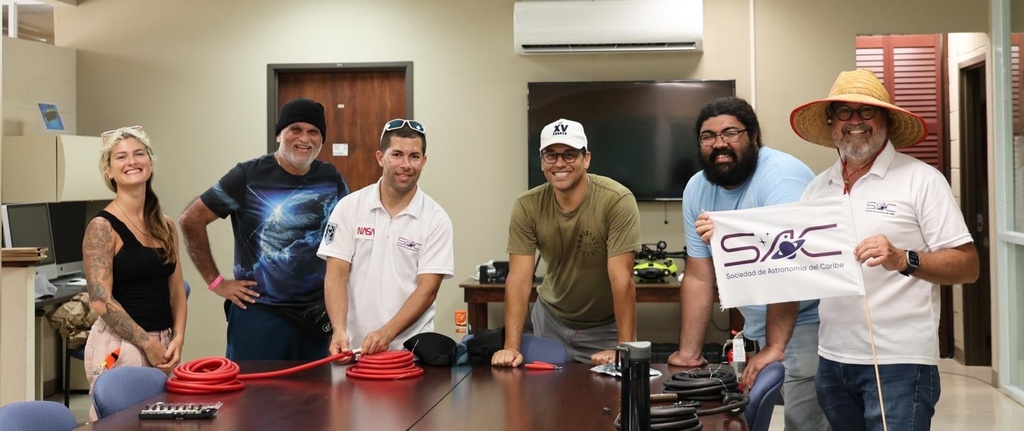
Preparing to cut wiring with the LaserSETI team and Dr. Méndez, joined by the president of the Astronomical Society of the Caribbean (SAC), Rafael Emmanuelli (right), and dedicated SAC volunteers Martin Jude Irizarry (next to Emmanuelli) and Evans Ortiz Ortolaza (middle).
The team — joined by Francisco Pacheco-Vellón, a student from UPR Mayagüez who will perform monthly maintenance at the observatory — spent the next day connecting wiring and bringing the instruments online. With support from the Department of Marine Sciences, the instruments were powered and linked to the internet, with one unit (known to the LaserSETI team as MAG1) serving as the hub for the others. After confirming that all systems functioned at a basic level, the team adjusted their positioning and completed the assembly.
On the final day of installation, the team applied finishing touches—for example, securing the instrument housing and testing every connection—before departing the next morning. Gillum worked through the night (even sleeping on site!) to ensure that all the instruments were communicating properly. Thanks to that dedication, the team achieved first light with one of the units, known as MAG3. This instrument is now fully online, precisely focused, and already capable of making SETI observations. The two remaining instruments developed camera shutter issues. These challenges are expected to be resolved quickly with the support of local collaborators. In projects such as this, teamwork truly makes the dream work.

Dr. Marchis with student Francisco installing power into the instrument known as MAG1.
Overall, the installation went smoothly and successfully, with the team continuing to refine the process for greater efficiency. The contributions of volunteers and students were invaluable, providing essential support that helped bring this new observatory to life. It is this communal effort that LaserSETI aims to foster, and that will continue to keep the observatories’ eyes on the sky for years to come.
Looking Ahead, Around the Globe
The vision for LaserSETI has always been global, aiming to have eyes on the entire sky at all times. With observatories already in California, Hawaii, and Arizona, the addition of Puerto Rico marks a critical expansion. Each site pairs with others around the world to create overlapping fields of view that help distinguish genuine astronomical events from local interference. The next steps for the teams at the SETI Institute and in Puerto Rico will be to focus the remaining two instruments and to begin sharing data, echoing the collaborative effort behind this global search. Then, the team will look forward to the next LaserSETI site.
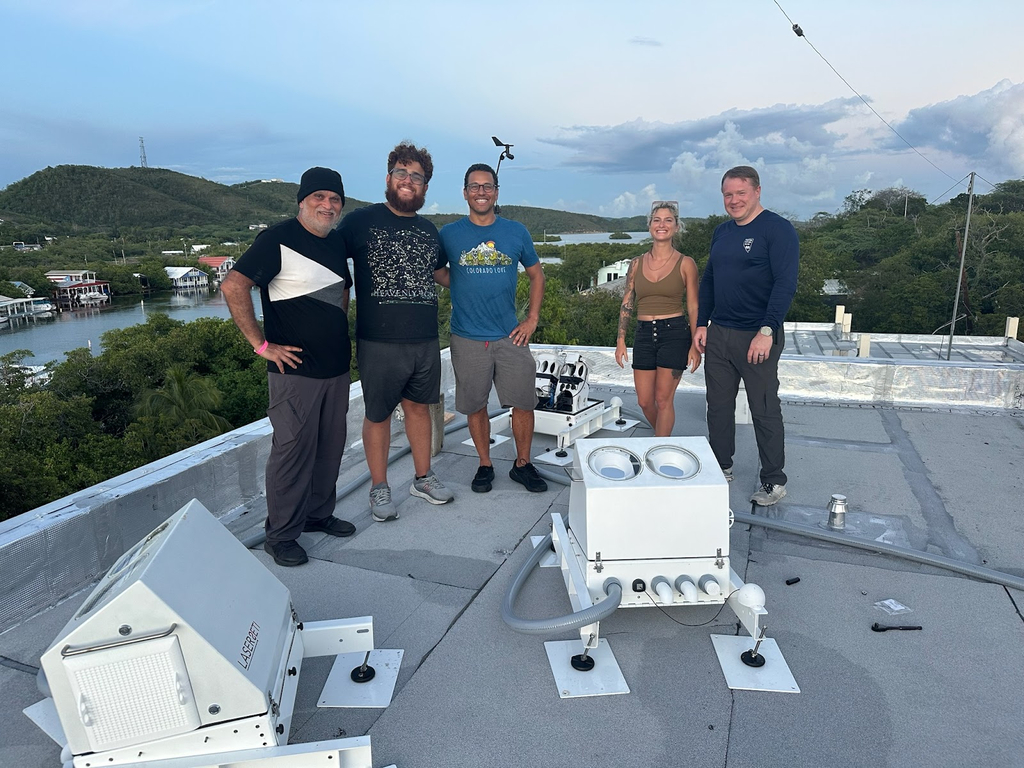
Part of the LaserSETI team with the instruments atop the main building of UPR Mayagüez’s Magueyes Marine Station. From left to right: Dr. Abel Méndez, Francisco Pacheco-Vellón, Dr. Franck Marchis, Dr. Lauren Sgro, PI Eliot Gillum.
This worldwide coverage is essential because a true technosignature could appear anywhere and at any time. By connecting observatories across longitudes, LaserSETI continues to build toward its ambitious goal: a planet-wide network capable of continuously monitoring the night sky. While much work remains, each new installation brings us one step closer to that vision.







News
Related News
Jun 17, 2026
Community College Internship Program Celebrates Fourth Year of Student Research Achievement
#Community College Internship #Education #Lauren Sgro #Unistellar #Uma Gorti #Douglas Caldwell #Pamela Harman #Simon Steel
Jun 12, 2026
Not Planets, Not Stars: NASA Volunteers Doubled the Number of Known Brown Dwarfs
#Blog #Lauren Sgro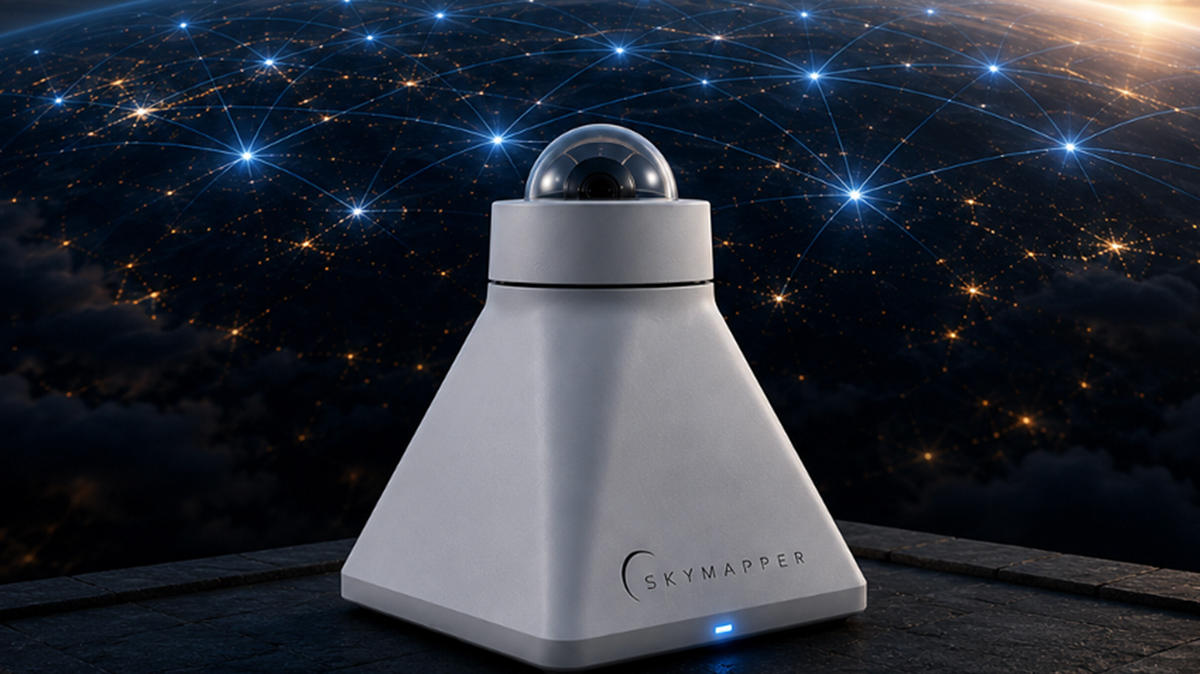
Jun 9, 2026
Disclosure Needs Data
#SkyMapper #Franck Marchis #SETI #citizen science
Jun 8, 2026
The Sounds of Intelligence: A Conversation with 2026 Drake Award Recipient Lori Marino
#Blog #Drake Awards #Lori Marino #SETI
Jun 5, 2026
Beyond Disclosure Day: The Real-World Protocols
#Press Releases #SETI #Astronomy #Bill Diamond #SETI Institute
Jun 4, 2026
SETI Institute In the News: May Roundup 2026
#SETI Institute in the News #SETI Institute #Community #Solar System #Matija Ćuk #Neptune #SETI #Bill Diamond #UAPs #Drake Awards #Lori Marino #Matthew Tiscareno #Outreach #Exoplanets #Carl Sagan Center
Jun 17, 2026
#Community College Internship
#Education
#Lauren Sgro
#Unistellar
#Uma Gorti
#Douglas Caldwell
#Pamela Harman
#Simon Steel
Jun 12, 2026
#Blog
#Lauren Sgro
Not Planets, Not Stars: NASA Volunteers Doubled the Number of Known Brown Dwarfs
Jun 9, 2026
#SkyMapper
#Franck Marchis
#SETI
#citizen science
Disclosure Needs Data
Jun 8, 2026
#Blog
#Drake Awards
#Lori Marino
#SETI
The Sounds of Intelligence: A Conversation with 2026 Drake Award Recipient Lori Marino
Jun 5, 2026
#Press Releases
#SETI
#Astronomy
#Bill Diamond
#SETI Institute
Beyond Disclosure Day: The Real-World Protocols
Jun 4, 2026
#SETI Institute in the News
#SETI Institute
#Community
#Solar System
#Matija Ćuk
#Neptune
#SETI
#Bill Diamond
#UAPs
#Drake Awards
#Lori Marino
#Matthew Tiscareno
#Outreach
#Exoplanets
#Carl Sagan Center
SETI Institute In the News: May Roundup 2026
Research
Related Projects

SkyMapper • SETI • Citizen Science • Astronomy
SkyMapper: Expanding Access to Real-time Astronomy Through a Global Astronomical Network
SkyMapper and the SETI Institute are connecting educators, students and the public to live astronomical observations through a distributed astronomical network. #SkyMapper #SETI #Citizen Science #Astronomy
VPL
Virtual Planetary Laboratory
How can we best assess whether an exoplanet supports life? #VPL
Discovery and Futures Lab
Discovery and Futures Lab
What happens if life beyond Earth is discovered? The Discovery and Futures Lab at the SETI Institute fosters novel and anticipatory research at the intersection of science, society, our planet, and the search for life beyond Earth. #Discovery and Futures Lab
May 17, 2026
SkyMapper: Expanding Access to Real-time Astronomy Through a Global Astronomical Network
SkyMapper and the SETI Institute are connecting educators, students and the public to live astronomical observations through a distributed astronomical network.
#SkyMapper
#SETI
#Citizen Science
#Astronomy
May 5, 2026
Virtual Planetary Laboratory
How can we best assess whether an exoplanet supports life?
#VPL
Apr 16, 2026
Discovery and Futures Lab
What happens if life beyond Earth is discovered? The Discovery and Futures Lab at the SETI Institute fosters novel and anticipatory research at the intersection of science, society, our planet, and the search for life beyond Earth.
#Discovery and Futures Lab
Support Us
Support the
SETI Institute
Scientists are getting closer in their search for life beyond earth. But with limited federal funding for the search for extraterrestrial intelligence, supporters are the reason cutting-edge scientists can keep their eyes on the sky.
