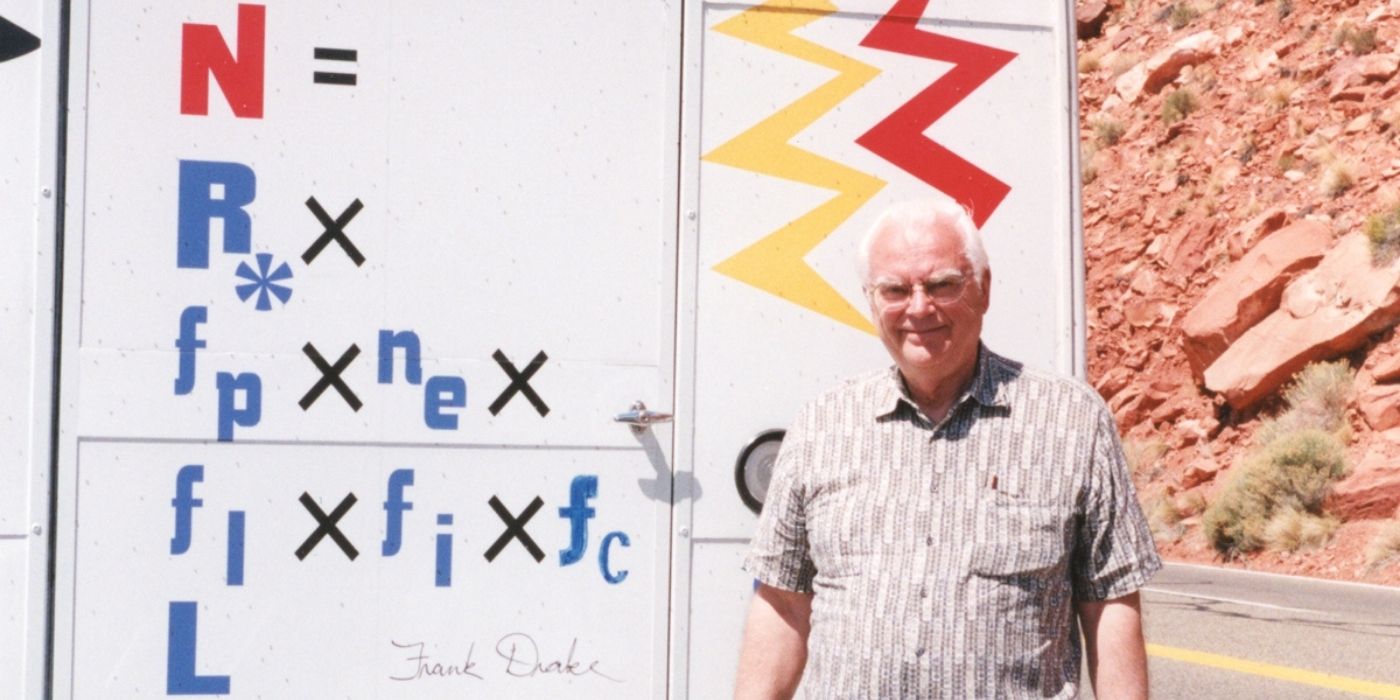
Frank Donald Drake, an astronomer who pioneered the field of SETI (Search for Extraterrestrial Intelligence) died on September 2 at the age of 92.
Born in Chicago, Drake showed an early interest in chemistry and electronics. He entered Cornell University as an undergraduate and a participant in the Navy’s Reserve Office Training Corps. Upon graduation, he was assigned to the U.S.S. Albany and put in charge of the ship’s electronics. He followed this interest upon entering Harvard University as a graduate student in radio astronomy.
After earning his PhD, Drake took a position with the newly constituted National Radio Astronomy Observatory (NRAO) in Green Bank, West Virginia. In 1958, the fledgling Observatory purchased a radio telescope “kit” from the Blaw-Knox Corporation in order to quickly have a research-grade instrument until a planned, larger antenna could be built. A year later, the assembled telescope, with its 85 foot reflector, was outfitted for observations and dedicated to Howard Tatel, an engineer who designed its novel mount. This prompted the NRAO director, to suggest to Drake that he come up with a research program to use the telescope.
Drake decided to follow another of his long-standing interests, and do a search, at microwave frequencies, for extraterrestrial transmissions. The idea that intelligent beings elsewhere might be using radio as a communication mode was already old – both Guglielmo Marconi and Nikola Tesla had attempted to pick up signals from Mars that they could attribute to beings on the Red Planet. With the greater astronomical sophistication that had developed by the 1950s, Drake opted to point the Tatel telescope in the direction of two nearby stars, Tau Ceti and Epsilon Eridani, each at about a dozen light-years’ distance. For several weeks Drake alternately pointed the telescope at these stars. The receiver was a commercial receiver designed for shortwave listening, and he used a simple motor drive to sweep its tuning up and down the dial. He chose to look at frequencies adjacent to the radio emission line (1420 MHz) of neutral hydrogen, on the grounds that this naturally produced line would be known to any technically proficient civilization, and therefore would serve as a marker for the guidance of societies who might wish to make contact. Drake was unaware of a paper published in 1959 by two Cornell University physicists who were arguing for just such experiments, pointing out that anyone with technology that was at least as advanced as our own could send detectable radio signals.
Drake named this first, modern SETI experiment Project Ozma, a reference to the princess in Frank Baum’s books, as she was in a world “both wonderful and far away.”
Although Project Ozma didn’t detect any extraterrestrial transmissions, it nonetheless attracted world-wide attention. As a consequence, the National Academy of Sciences suggested that Drake organize a small conference to discuss the nature and potential of trying to find evidence of intelligence in the cosmos. In response, a group of about a dozen prominent scientists and engineers met during the summer of 1961 in Green Bank. As an agenda for this gathering, Drake wrote a simple equation, consisting of seven concatenated terms whose product would be the estimated number of galactic societies who were producing signals that we, at least in principle, could discover. This formulation has become known as the Drake Equation, and is cited as the second most-famous equation in science (after Einstein’s E=mc2).
Drake eventually worked at both Cornell, at the Arecibo radio telescope, and at the University of California, Santa Cruz. He became president of the SETI Institute after its founding in 1984. He continued to promote SETI even after his official retirement in 2010 at the age of eighty. As he said at the time, “I’m never going to retire from SETI.”
Frank Drake was a man of extensive influence, inspiring many of today’s SETI practitioners who, as students, were informed by his efforts. A book published in 1992 and co-authored with Dava Sobel, “Is Anyone Out There?”, describes his career in detail. He was a soft-spoken person of perpetual good humor and astounding patience. When asked whether his tranquil demeanor was due to dealing with his children, he smiled and responded “No. It was students.”
It is a rare scientific discipline for which the pioneer can live to see an idea and experiment become a continuing research endeavor, one that fascinates not just researchers, but the public at large. But that was the flowering of SETI, an effort that promises to someday deliver profoundly important news; namely, that Earth is not the only world to have spawned life able to seek out and find other worlds that have done the same.
Drake leaves behind his wife, Amahl, and two daughters, as well as three children from a previous marriage.
)