Thursday, Apr 16, 2020

Mountain View and San Francisco, April 16, 2020. -- A group of citizen astronomers scattered all over the world has just demonstrated how a network of digital Unistellar eVscopes can work together to deliver the first-of-its-kind crowd-generated images of Comet ATLAS while its disintegrating.

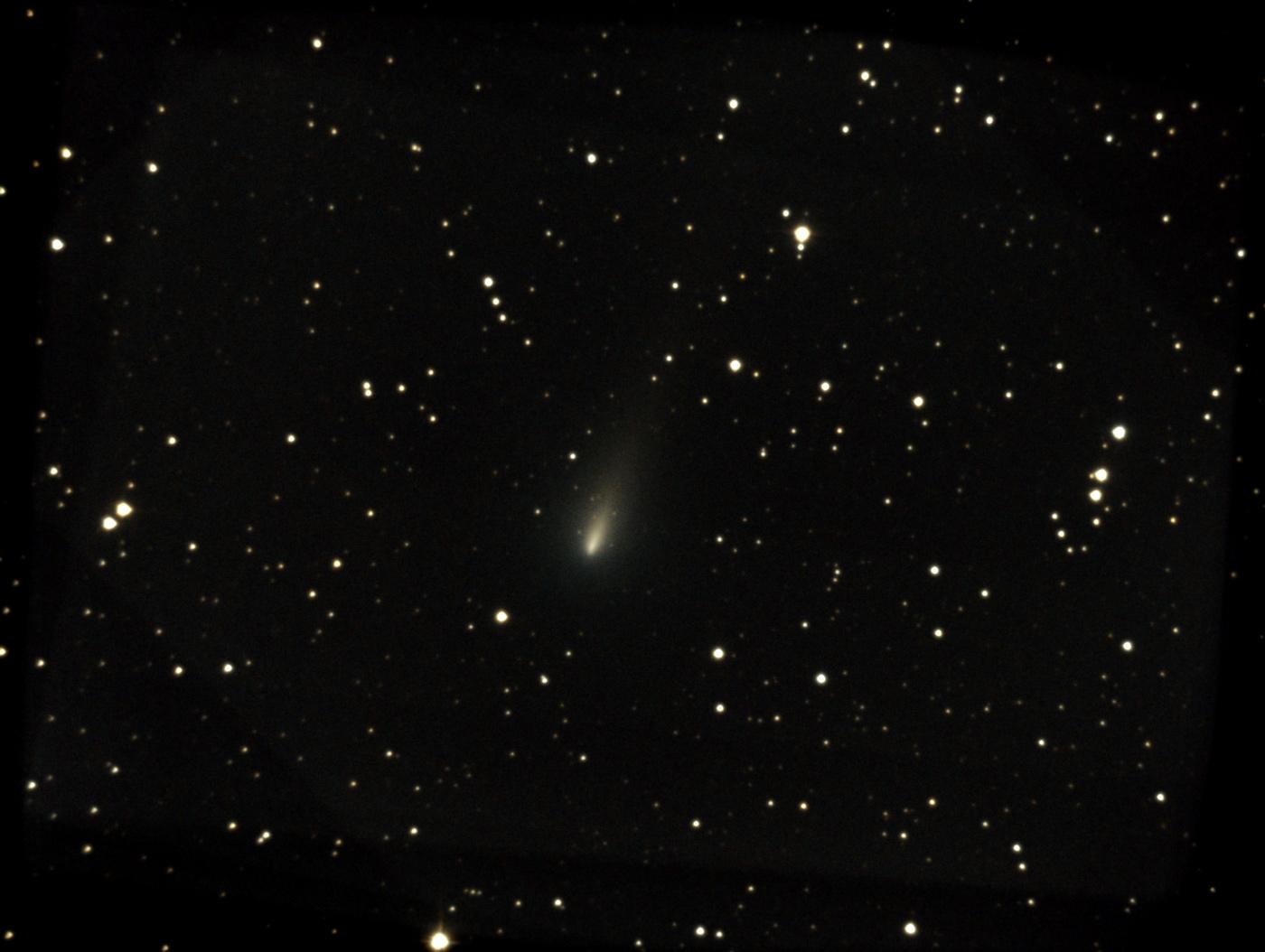
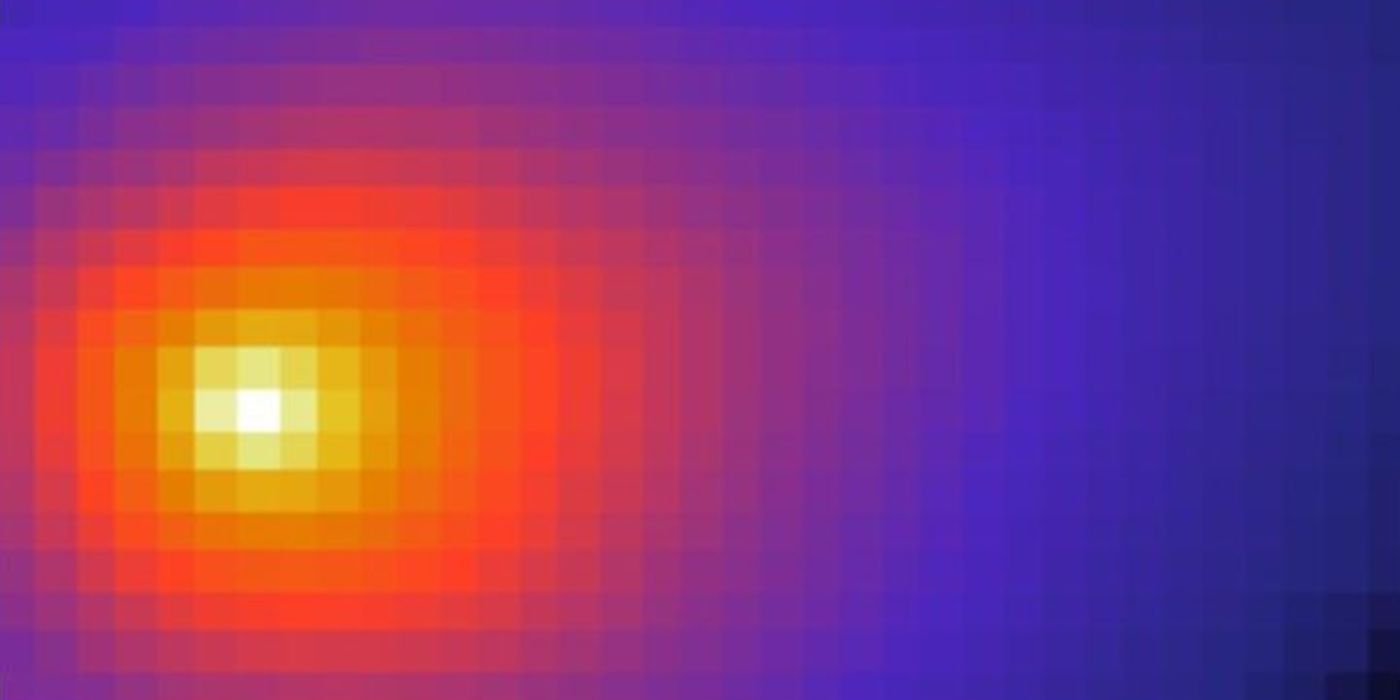
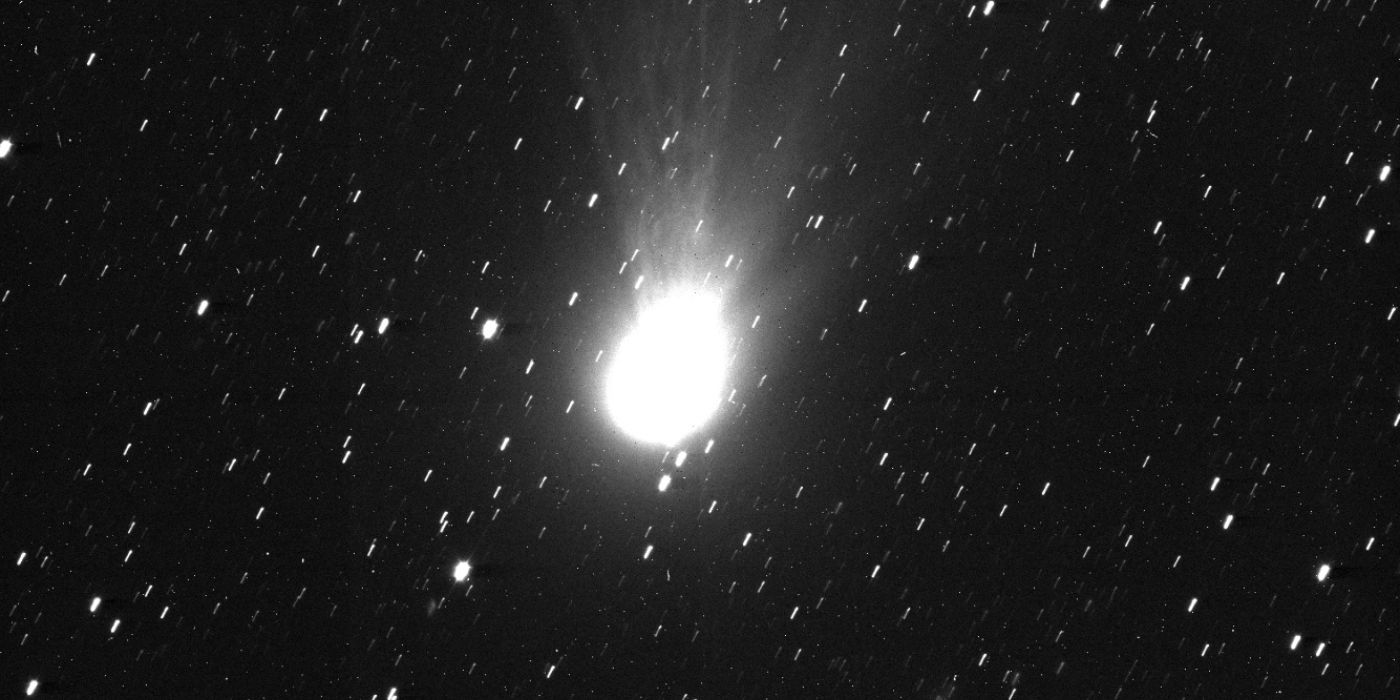
Fig 1. Crowd-sourced Observations of the Comet ATLAS from Unistellar Network on Saturday April 11 (left) and Tuesday April 14 (right). The differences in morphology of the coma suggest that the comet is fragmenting.

Discovered in December, Comet ATLAS was expected to become the brightest comet of 2020, visible to the naked eye. Several days ago, however, astronomers began to suspect that the comet had split into multiple pieces when it began dimming rapidly. At Unistellar, this created a unique opportunity to summon our community of citizen astronomers together to collect a high-quality image of this beautiful, but dying cosmic phenomenon.

On the night of Saturday, April 11, dozens of eVscope users in Belgium, Finland, France, Switzerland, Germany, the United Kingdom, and other countries gathered virtually to set up eVscopes in their backyards, on balconies, or out in the countryside. Their locations varied, but they all had one and only one goal in mind: capture photos of the dying comet. A similar call for observations was released on Tuesday, April 14 for the US after demise of the comet was announced to image variation in the coma of the comet.

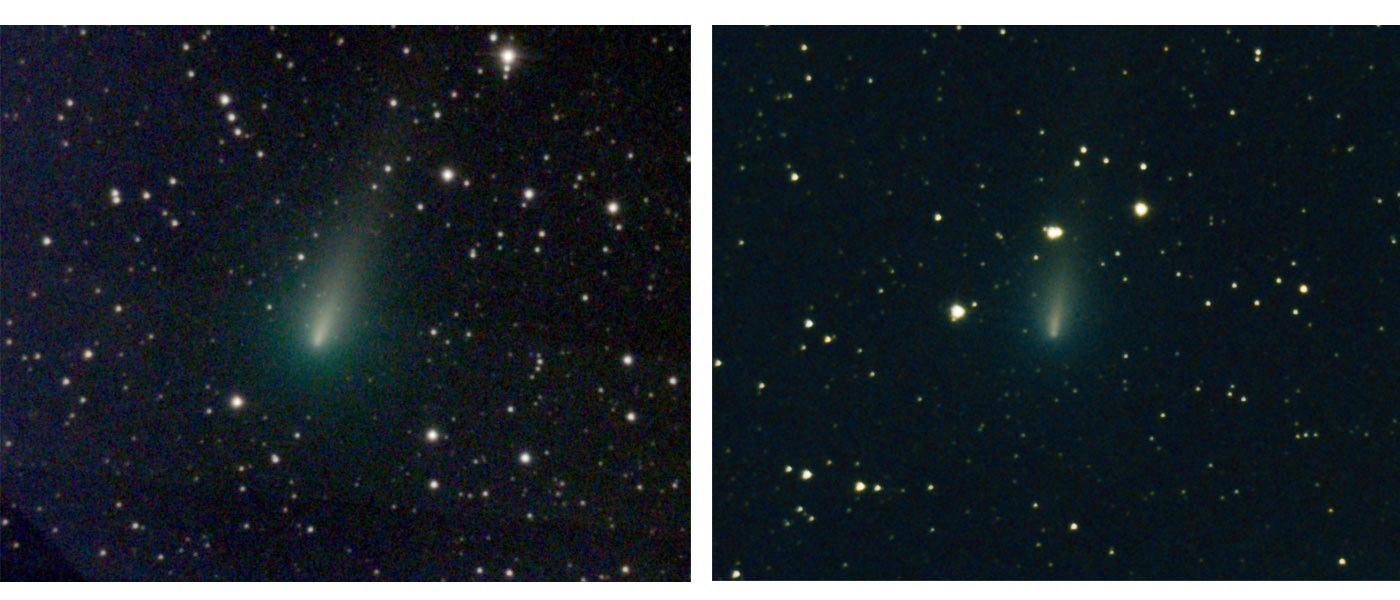
While observing the comet through the eVscope’s eyepiece, forty users in Europe, and twenty users in the US, also collected data they sent to Unistellar’s servers. The data was combined and processed to create a “super image” that revealed Comet ATLAS in an extremely high level of color and detail, including a tail and coma and the eerie greenish glow associated with the presence of cyanide gas. The image taken from the US users three days later show the change in morphology of the coma, which suggests that the comet nucleus is indeed fragmenting.

Fig 2. Variation of the morphology of the coma between observations taken 3 days apart is visible on those “super image” collected by the Unistellar network of small digital telescopes.

“We’ve combined observations from multiple users to produce a highly accurate observing record of Comet ATLAS. Our analysis proves that we can see extremely dim objects, such as very faint stars (up to magnitude 18), in the background behind the comet,” explained Arnaud Malvache, Chief Technology Officer at Unistellar.

Unistellar’s eVscope offers unique observing experiences that also allow users to play an active and important role in astronomy by joining observing campaigns that bring a vast array of connected telescopes together to gather data for a posteriori analysis.

These crowd-sourced events can also be fun and educational, as exemplified by a recent worldwide Messier Marathon. During the Messier Marathon, users observed most of the 110 galaxies, nebulae, and clusters indexed in the Messier Catalog. They seamlessly shared their observations live, thereby achieving one of the most coveted goals on an amateur astronomer’s bucket list.

These events are bringing to life Unistellar’s vision to make astronomy a living adventure where all users can take part for fun, education, outreach, or to generate cutting-edge science. “Future campaigns could include, for example, observing a new supernova and detecting its host galaxy from a myriad of eyes working together to observe an explosion several million light-years away, or observations of a potentially hazardous asteroid as it flies by our planet. More projects than we can currently imagine will emerge from this network of small, powerful, and portable eVscopes,” said Franck Marchis, Senior Astronomer at the SETI Institute and Chief Scientific Officer of Unistellar.

About Unistellar
Unistellar aims to make astronomy an adventure in which anyone can take part. Unistellar is the start-up behind the eVscope, a uniquely fun and easy-to-use digital telescope that is bringing the wonders of the Universe to life. In partnership with the SETI Institute, the Unistellar eVscope also helps people contribute to important scientific discoveries. The Unistellar eVscope received a CES Innovation Award in 2018 in the category Tech for a Better World and has been nominated for a SXSW 2019 Innovation Award. Thousands of digital telescopes have already been ordered, with a thousand already delivered, delighting customers with an unprecedented observing experience.

About the SETI Institute
Founded in 1984, the SETI Institute is a non-profit, multi-disciplinary research and education organization whose mission is to lead humanity’s quest to understand the origins and prevalence of life and intelligence in the Universe and to share that knowledge with the world. Our research encompasses the physical and biological sciences and leverages expertise in data analytics, machine learning and advanced signal detection technologies. The SETI Institute is a distinguished research partner for industry, academia and government agencies, including NASA and NSF.

Contact information

Rebecca McDonald
Director of Communications at the SETI Institute
[email protected]
+1 650-960-4526

Ludovic Nachury 
Head of Communication at Unistellar
[email protected]
+33 6 24 31 63 89

Science Contact:
Franck Marchis
[email protected]

News

Related News

Featured Image
Jun 5, 2026
Beyond Disclosure Day: The Real-World Protocols
#Press Releases #SETI #Astronomy #Bill Diamond #SETI Institute
Featured Image
Jun 4, 2026
SETI Institute In the News: May Roundup 2026
#SETI Institute in the News #SETI Institute #Community #Solar System #Matija Ćuk #Neptune #SETI #Bill Diamond #UAPs #Drake Awards #Lori Marino #Matthew Tiscareno #Outreach #Exoplanets #Carl Sagan Center
Featured Image
Jun 3, 2026
SETI Institute Looks for Signs of Technology in Interstellar Visitor 3I/ATLAS
Observations with the Allen Telescope Array set new limits on possible signals from extraterrestrial transmitters. #Press Releases #ATA #3I/ATLAS #Hat Creek Radio Observatory #Radio Astronomy #SETI
Featured Image
Jun 1, 2026
SETI Institute Awards $1 Million in STRIDE Grants to Advance Astrobiology, Exoplanet Science, and Public Engagement
#Press Releases #STRIDE #Research #Carl Sagan Center #Spectroscopy #Solar System #SETI #Climate and Bioscience #Astronomy #Astrobiology #Exoplanets #Data Science #Education #Outreach #Hat Creek Radio Observatory #Unistellar #SkyMapper
Featured Image
May 28, 2026
Celebrating Frank Drake
#Frank Drake #SETI #Project Ozma #Drake Equation #SETI Institute
Featured Image
May 13, 2026
SETI Institute to Honor Dr. Matthew Tiscareno with 2026 Carl Sagan Center Director’s Award
The Drake Awards event will also recognize SETI Forward and SETI Institute REU student award recipients. #Press Releases #Drake Awards #Frank Drake #SETI #Awards #Planetary Astronomy #Astrobiology #SETI Forward #Education #Carl Sagan Center #Matthew Tiscareno #Nathalie Cabrol #REU
Research

Related Projects

Featured Image
SkyMapper • SETI • Citizen Science • Astronomy
SkyMapper: Expanding Access to Real-time Astronomy Through a Global Astronomical Network
SkyMapper and the SETI Institute are connecting educators, students and the public to live astronomical observations through a distributed astronomical network. #SkyMapper #SETI #Citizen Science #Astronomy
Featured Image
VPL
Virtual Planetary Laboratory
How can we best assess whether an exoplanet supports life? #VPL
Featured Image
Discovery and Futures Lab
What happens if life beyond Earth is discovered? The Discovery and Futures Lab at the SETI Institute fosters novel and anticipatory research at the intersection of science, society, our planet, and the search for life beyond Earth.  #Discovery and Futures Lab
Support Us

Support the
SETI Institute

Scientists are getting closer in their search for life beyond earth. But with limited federal funding for the search for extraterrestrial intelligence, supporters are the reason cutting-edge scientists can keep their eyes on the sky.