)

Author: Lauren Sgro
Friday, Aug 04, 2023
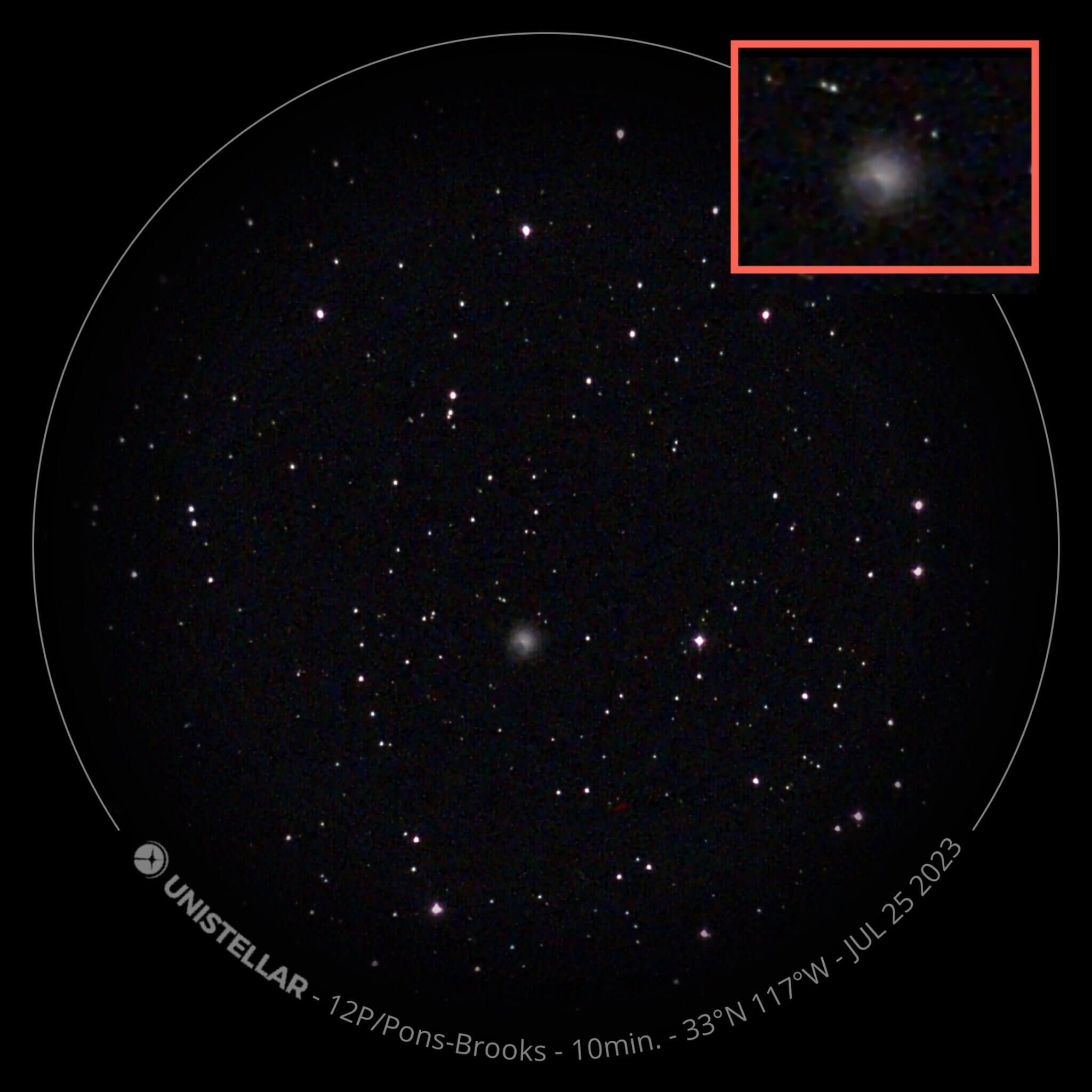
Update March 2024: As we predicted last July, Comet 12P/Pons-Brooks is showing some beautiful activity. Comet 12P is projected to be visible to the naked eye around the time of its perihelion passage on April 21, 2024. This comet has proven itself to be a spectacular one already with its bright coma, structured tail, and repeated outbursts! In fact, the comet will be close to the Sun during the eclipse on April 8. If the comet is bright enough, and you are in the path of totality, you may be able to see it during the eclipse with aid or even with your naked-eye! It will especially help if the comet has another outburst near the time of eclipse, which is not far-fetched considering its history of outbursting since the summer of 2023. After perihelion, the comet will fade, so observe Comet 12P while you can!”

Comet 12P/Pons-Brooks captured by Petri Kuossari (Finland) with his Unistellar telescope.
Comets have long captivated the imagination of stargazers and scientists alike. These celestial wanderers, composed of ice and dust, grace our skies with ethereal tails during their journeys through the solar system. And sometimes, they even show us earthlings some icy fireworks! One such comet, 12P/Pons-Brooks, stunned astronomers with a remarkable outburst recorded recently on July 19, catapulting it into the spotlight of astronomical curiosity.
Comet Pons-Brooks
Comet 12P/Pons-Brooks, known colloquially as Pons-Brooks, is a Halley-Type comet that boasts a rich history of cosmic exploration. Its elliptical orbit, with a period of 71 years, has taken it on numerous passages through the inner solar system. Long ago in 1812, astronomer Jean-Louis Pons first laid eyes on this wandering celestial object through a telescope in Marseille, the home of Unistellar! It was later rediscovered in 1883 by Willian Brooks, hence the hypenated name.
It turns out however that they were not the first to see this comet – by meticulously tracing the comet’s trajectory, researchers were able to link its recent appearances to those observed as far back as 1385 and 1457, painting a vivid picture of the comet’s ancient cosmic journeys.
An Impatient Outburst
Although Comet 12P/Pons-Brooks will reach perihelion in April of 2024, just in time to be visible in the darkness of the Americas’ total solar eclipse, it seems as if it couldn’t wait to put on a show!
This comet has had outbursts in the past, but perhaps none as interesting as the one noticed by amateur astronomers in Hungary just one week ago. During an outburst, a comet experiences a sudden and drastic increase in brightness, transforming it into a brilliant spectacle in the night sky as large portions of its icy makeup sublimate, or turn to gas, at once. This July 20th outburst brought about a staggering 100-fold increase in brightness, equal to a change in magnitude from about 17 to 12.
But the outburst’s peculiarities did not end there. Astronomers noticed that the resulting coma, the glowing cloud of gas and dust surrounding the comet’s nucleus, underwent rapid changes and expanded swiftly during the event. Strangely enough, the shape of the coma appeared distorted, hinting at an uneven distribution of activity across the comet’s surface. Some have even likened this unusual shape to “horns” that cause the comet to resemble Star Wars’ Millennium Falcon flying through space (and completing the Kessel run in 12 parsecs)!
This observation raises intriguing questions about the mechanisms that trigger such outbursts. As researchers delve deeper into the enigmatic nature of this comet, we may one day unravel the secrets of its internal workings and gain a greater understanding of these mesmerizing celestial visitors.
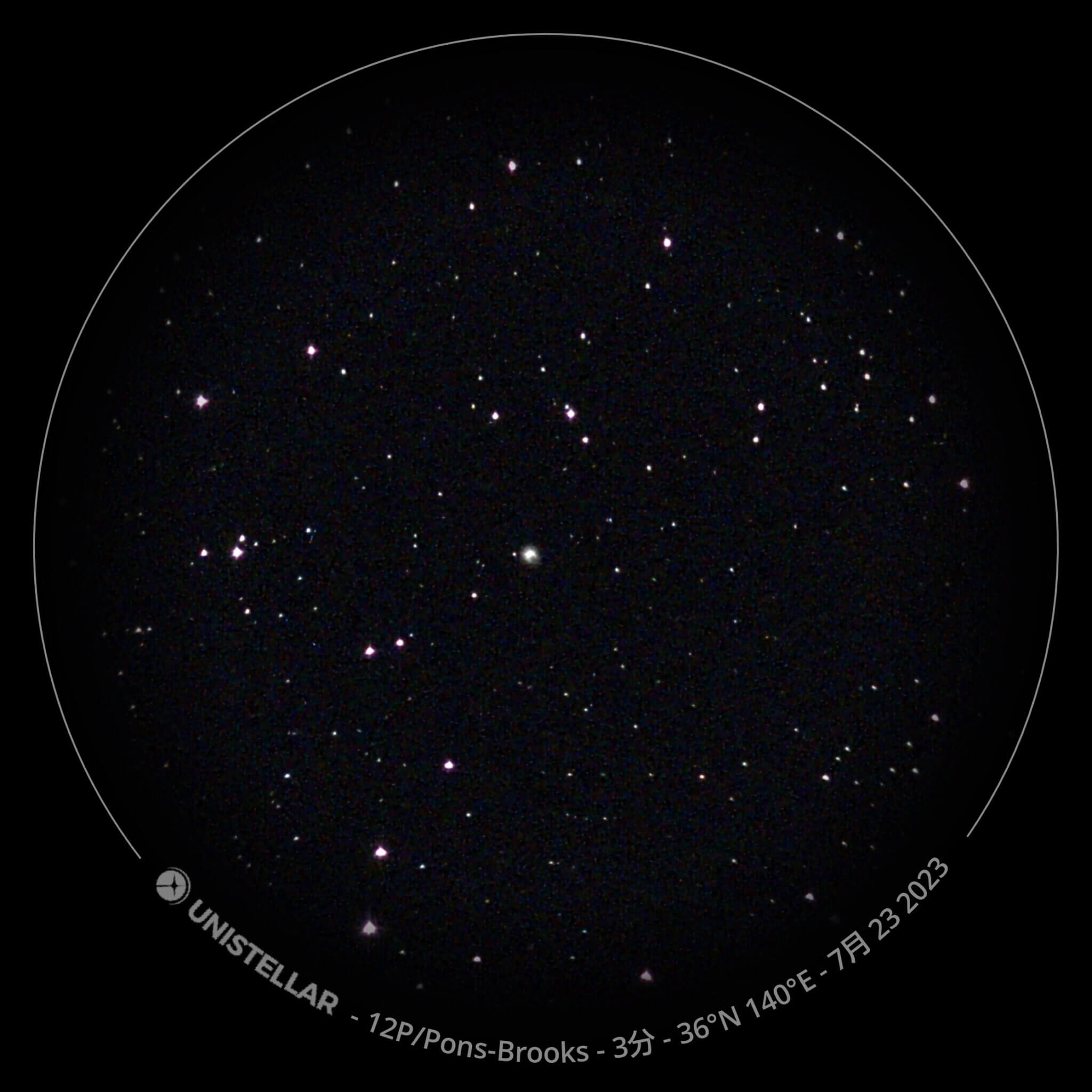
The “horns” of Pons-Brooks are clearly noticable in this eVscope image by Keichii Fukui (Japan).
Observe Comet 12P/Pons-Brooks with your Unistellar Telescope
This comet is in the Unistellar App Catalog, so it is easy to observe! Simply search the comet’s name in your App and click GoTo to visit this comet, currently more than 530 million km (330 million miles) away. For the next few weeks, Pons-Brooks will continue to travel through the constellation Draco, so you can spot it from the Northern Hemisphere. Make sure to observe while it is still bright! Despite the outburst, the material ejected from the comet will continue to disperse, eventually causing the newly bright comet to fade once more.
To make a Science observation, simply visit the Comets Tutorial Page and follow the Observation section instructions for 1A: The target is in the Unistellar app’s database.
In the Recording field be sure the following information is entered:
Record duration : 20min
Exposure time : 3971ms
Gain : 25db
When you are done, don’t forget to submit a Comet Observation Report. Happy Comet Watching!
This article was originally published at https://www.unistellar.com/blog/comet-12p-pons-brooks-outburst/







News
Related News

Jul 24, 2026
A New Way to Search for Alien Civilizations
#Blog #Lauren Sgro
Jul 2, 2026
How Clouds Hide Alien Worlds—and How Astronomers See Through Them
#Blog #Lauren Sgro
Jun 29, 2026
Humanity's Plan for First Contact: Who Speaks for Earth?
#Blog #Lauren Sgro #Lucian Walkowicz #Chelsea Haramia #SETI #SETI Institute
Jun 17, 2026
Community College Internship Program Celebrates Fourth Year of Student Research Achievement
#Community College Internship #Education #Lauren Sgro #Unistellar #Uma Gorti #Douglas Caldwell #Pamela Harman #Simon Steel
Jun 12, 2026
Not Planets, Not Stars: NASA Volunteers Doubled the Number of Known Brown Dwarfs
#Blog #Lauren Sgro
Jun 5, 2026
Beyond Disclosure Day: The Real-World Protocols
#Press Releases #SETI #Astronomy #Bill Diamond #SETI Institute
Jul 24, 2026
#Blog
#Lauren Sgro
Jul 2, 2026
#Blog
#Lauren Sgro
How Clouds Hide Alien Worlds—and How Astronomers See Through Them
Jun 29, 2026
#Blog
#Lauren Sgro
#Lucian Walkowicz
#Chelsea Haramia
#SETI
#SETI Institute
Humanity's Plan for First Contact: Who Speaks for Earth?
Jun 17, 2026
#Community College Internship
#Education
#Lauren Sgro
#Unistellar
#Uma Gorti
#Douglas Caldwell
#Pamela Harman
#Simon Steel
Community College Internship Program Celebrates Fourth Year of Student Research Achievement
Jun 12, 2026
#Blog
#Lauren Sgro
Not Planets, Not Stars: NASA Volunteers Doubled the Number of Known Brown Dwarfs
Jun 5, 2026
#Press Releases
#SETI
#Astronomy
#Bill Diamond
#SETI Institute
Beyond Disclosure Day: The Real-World Protocols
Research
Related Projects

SkyMapper • SETI • Citizen Science • Astronomy
SkyMapper: Expanding Access to Real-time Astronomy Through a Global Astronomical Network
SkyMapper and the SETI Institute are connecting educators, students and the public to live astronomical observations through a distributed astronomical network. #SkyMapper #SETI #Citizen Science #Astronomy
VPL
Virtual Planetary Laboratory
How can we best assess whether an exoplanet supports life? #VPL
Discovery and Futures Lab
Discovery and Futures Lab
What happens if life beyond Earth is discovered? The Discovery and Futures Lab at the SETI Institute fosters novel and anticipatory research at the intersection of science, society, our planet, and the search for life beyond Earth. #Discovery and Futures Lab
May 17, 2026
SkyMapper: Expanding Access to Real-time Astronomy Through a Global Astronomical Network
SkyMapper and the SETI Institute are connecting educators, students and the public to live astronomical observations through a distributed astronomical network.
#SkyMapper
#SETI
#Citizen Science
#Astronomy
May 5, 2026
Virtual Planetary Laboratory
How can we best assess whether an exoplanet supports life?
#VPL
Apr 16, 2026
Discovery and Futures Lab
What happens if life beyond Earth is discovered? The Discovery and Futures Lab at the SETI Institute fosters novel and anticipatory research at the intersection of science, society, our planet, and the search for life beyond Earth.
#Discovery and Futures Lab
Support Us
Support the
SETI Institute
Scientists are getting closer in their search for life beyond earth. But with limited federal funding for the search for extraterrestrial intelligence, supporters are the reason cutting-edge scientists can keep their eyes on the sky.
