)

Friday, Jul 25, 2025

At a Glance
|
On July 02, 2025, astronomers confirmed the discovery of Comet 3I/ATLAS, marking only the third time in recorded history that an interstellar object (ISO) has been identified passing through our Solar System. This follows the landmark discoveries of 1I/‘Oumuamua in 2017 and 2I/Borisov in 2019.
The confirmation was discussed during a SETI Live broadcast hosted by Dr. Simon Steel, Deputy Director of the Carl Sagan Center at the SETI Institute, and featured expert commentary from University of Washington astronomer Dr. James Davenport, SETI Institute postdoctoral fellow and comet researcher Dr. Ariel Graykowski, and SETI Chair and Allen Telescope Array Project Scientist Dr. Wael Farah.
Discovery by the ATLAS Survey
Comet 3I/ATLAS was first identified by the Asteroid Terrestrial-impact Last Alert System (ATLAS), a global network of four robotic telescopes located in Hawaii, Chile, and South Africa. ATLAS systematically surveys nearly the entire night sky every 24 hours, primarily searching for near-Earth objects that could pose a risk of impact.
Initially, 3I/ATLAS appeared as a faint, fast-moving point of light. However, follow-up observations revealed the object was traveling at a hyperbolic velocity, meaning its speed and trajectory exceeded the Sun’s gravitational binding energy. This is characteristic of interstellar objects on open-ended orbits, distinguishing them from the typical elliptical orbits of bodies in the Solar System.
Cometary Activity Detected: A Distinctive Feature
Unlike 1I/‘Oumuamua, which lacked any visible comet-like features, 3I/ATLAS has displayed clear cometary activity, even while still four astronomical units (AU) from the Sun (one AU is the average distance between Earth and the Sun), making 3I/ATLAS more similar to 2I/Borisov in that regard.
According to Dr. Graykowski, this activity manifests as a coma: a diffuse envelope of gas and dust created by the sublimation (transition from solid to gas) of volatile compounds. The early onset of sublimation indicates the presence of highly volatile ices, potentially providing a pristine record of the object’s origin outside the Solar System.
Dr. Davenport emphasized that 3I/ATLAS is moving faster than either of the previous interstellar visitors at roughly 60 km/s, suggesting it was ejected from its parent stellar system with substantial kinetic energy, possibly due to gravitational interactions with massive planetary bodies or close stellar encounters.
Multi-Wavelength Observations in Progress
Optical Monitoring Through Citizen Science
Dr. Graykowski leads optical monitoring efforts using the UNISTELLAR Network, a decentralized array of small, smart telescopes operated by citizen scientists worldwide. Despite the object's faintness, UNISTELLAR telescopes (with apertures of just 3-4.5 inches) have successfully detected it using image stacking techniques to compensate for the comet’s rapid motion.
Early brightness measurements reveal a steep increase in luminosity, which is consistent with dynamic new comets making their first close approach to a star. This rapid brightening reflects the sublimation of volatile compounds that have remained unaltered since their formation, offering a unique opportunity to probe primordial interstellar materials.
Radio Observations at the Allen Telescope Array
Radio observations began promptly at the SETI Institute’s Allen Telescope Array (ATA), led by Dr. Wael Farah. The ATA team initiated monitoring on the night of July 2, targeting both narrowband emissions (a potential indicator of artificial (technological) signals) and natural emissions such as continuum radiation from dust and specific spectral lines associated with common molecules like hydroxyl (OH).
Within just a week, the ATA had amassed over 21 terabytes of data, equivalent to thousands of hours of high-resolution video. This dataset is under active analysis, with researchers scouring the data for both natural radio signatures and hypothetical technosignatures.
Prospects for Spectroscopic Analysis
Future observations from large facilities, including the Vera C. Rubin Observatory, will enable detailed spectroscopic studies, which are a technique used to decipher the chemical composition of astronomical objects. Spectroscopy will allow scientists to determine whether 3I/ATLAS harbors exotic compounds not commonly found in Solar System comets.

3I/ATLAS captured by Unistellar observer Vamshi Kesireddy (US)
Scientific Significance: A New Era of ISO Studies
One particularly compelling aspect of 3I/ATLAS is the extended opportunity for observation. Unlike 1I/‘Oumuamua, which was discovered after perihelion (closest approach to the Sun) and while outbound from our Solar System, 3I/ATLAS was identified well before its perihelion passage. This provides a full inbound observational window.
Dr. Davenport noted that its galactic trajectory aligns with the thick disk of the Milky Way, a region populated by older stars. This suggests the object may have wandered through interstellar space for millions, if not hundreds of millions, of years before encountering our Solar System.
When and How to Observe 3I/ATLAS
Comet 3I/ATLAS will reach perihelion in October 2025, approaching closest to Mars. Unfortunately, Earth will be on the opposite side of the Sun during this period, meaning ground-based observations will be temporarily impossible due to solar conjunction.
Even at peak brightness, the comet is not expected to become visible to the unaided eye, remaining accessible only to telescopes. However, citizen scientists with small telescopes can still make significant contributions, especially before and after perihelion, by submitting their observations to the UNISTELLAR network or databases such as the Minor Planet Center (MPC).
The Future of Interstellar Object Detection
The discovery of 3I/ATLAS underscores the transformative impact of modern astronomical surveys. Dr. Davenport highlighted that upcoming facilities, such as the Rubin Observatory, are expected to revolutionize the detection of interstellar visitors. Current projections estimate that Rubin may identify dozens to hundreds of such objects during its operational decade, enabling statistical studies on the frequency, composition, and origin of interstellar objects.
As Dr. Steel concluded, interstellar objects are no longer rare curiosities – they are becoming a critical tool for understanding the processes shaping planetary systems beyond our own.
Watch the whole conversation here to learn more about this exciting new discovery.







News
Related News

Jul 24, 2026
A New Way to Search for Alien Civilizations
#Blog #Lauren Sgro
Jul 20, 2026
SETI Institute In the News: June Roundup 2026
Throughout June 2026, SETI Institute scientists, affiliates, and collaborators contributed to discussions spanning interstellar visitors, planetary science, technosignature searches, animal cognition, and the scientific process guiding the search for life beyond Earth. #SETI Institute in the News #SETI Institute #Community #Eduardo Bendek #Optical SETI #SETI #3I/ATLAS #ATA #Comets, Meteors, and Asteroids #Solar System #Franck Marchis #Ariel Graykowski #Jill Tarter #Vishal Gajjar #Radio Astronomy #Bill Diamond #Lori Marino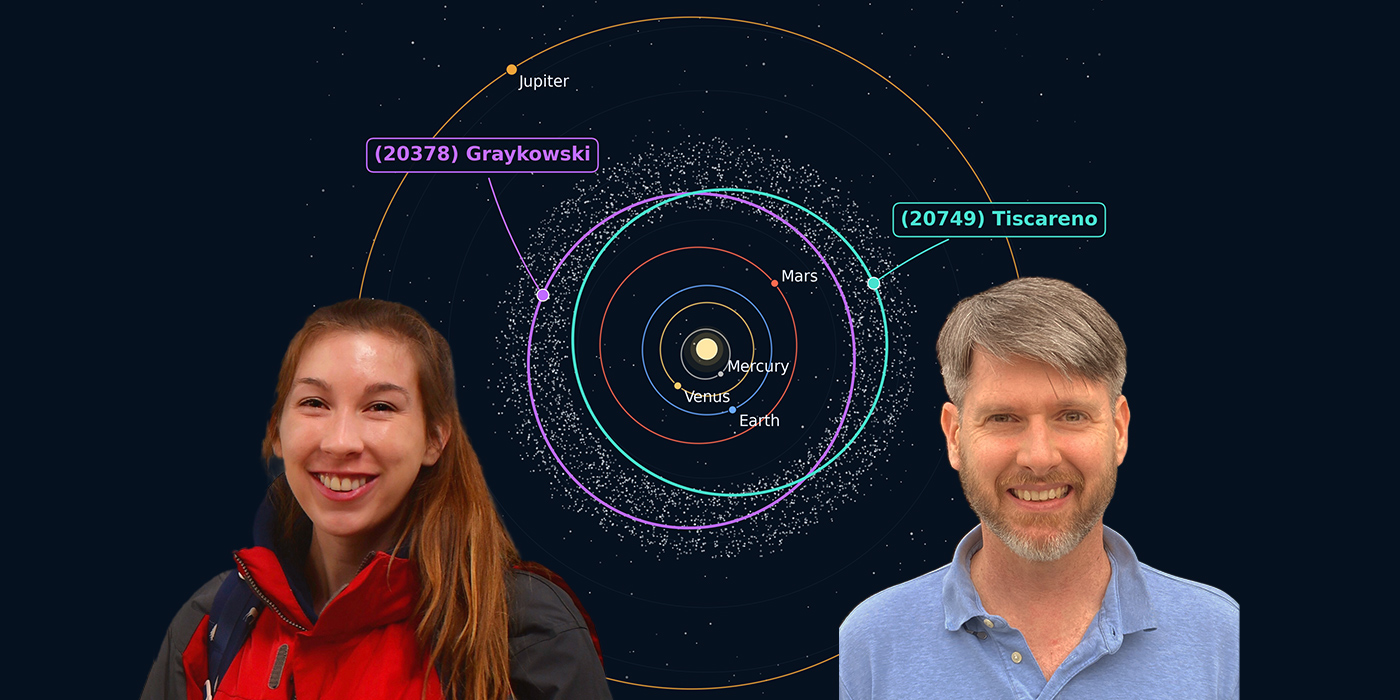
Jul 17, 2026
Two SETI Institute Scientists Honored with Asteroids Bearing Their Names
#Comets, Meteors, and Asteroids #Ariel Graykowski #Matthew Tiscareno #Planetary Astronomy #Solar System #Saturn
Jul 17, 2026
How Clouds Hide Alien Worlds—and How Astronomers See Through Them
#Blog #Moiya McTier
Jul 10, 2026
A Remarkably Ancient Visitor: 3I/ATLAS
#3I/ATLAS #Comets, Meteors, and Asteroids #JWST
Jul 2, 2026
How Clouds Hide Alien Worlds—and How Astronomers See Through Them
#Blog #Lauren Sgro
Jul 24, 2026
#Blog
#Lauren Sgro
Jul 20, 2026
SETI Institute In the News: June Roundup 2026
Throughout June 2026, SETI Institute scientists, affiliates, and collaborators contributed to discussions spanning interstellar visitors, planetary science, technosignature searches, animal cognition, and the scientific process guiding the search for life beyond Earth.
#SETI Institute in the News
#SETI Institute
#Community
#Eduardo Bendek
#Optical SETI
#SETI
#3I/ATLAS
#ATA
#Comets, Meteors, and Asteroids
#Solar System
#Franck Marchis
#Ariel Graykowski
#Jill Tarter
#Vishal Gajjar
#Radio Astronomy
#Bill Diamond
#Lori Marino
Jul 17, 2026
#Comets, Meteors, and Asteroids
#Ariel Graykowski
#Matthew Tiscareno
#Planetary Astronomy
#Solar System
#Saturn
Two SETI Institute Scientists Honored with Asteroids Bearing Their Names
Jul 17, 2026
#Blog
#Moiya McTier
How Clouds Hide Alien Worlds—and How Astronomers See Through Them
Jul 10, 2026
#3I/ATLAS
#Comets, Meteors, and Asteroids
#JWST
A Remarkably Ancient Visitor: 3I/ATLAS
Jul 2, 2026
#Blog
#Lauren Sgro
How Clouds Hide Alien Worlds—and How Astronomers See Through Them
Research
Related Projects

SkyMapper • SETI • Citizen Science • Astronomy
SkyMapper: Expanding Access to Real-time Astronomy Through a Global Astronomical Network
SkyMapper and the SETI Institute are connecting educators, students and the public to live astronomical observations through a distributed astronomical network. #SkyMapper #SETI #Citizen Science #Astronomy
VPL
Virtual Planetary Laboratory
How can we best assess whether an exoplanet supports life? #VPL
Discovery and Futures Lab
Discovery and Futures Lab
What happens if life beyond Earth is discovered? The Discovery and Futures Lab at the SETI Institute fosters novel and anticipatory research at the intersection of science, society, our planet, and the search for life beyond Earth. #Discovery and Futures Lab
May 17, 2026
SkyMapper: Expanding Access to Real-time Astronomy Through a Global Astronomical Network
SkyMapper and the SETI Institute are connecting educators, students and the public to live astronomical observations through a distributed astronomical network.
#SkyMapper
#SETI
#Citizen Science
#Astronomy
May 5, 2026
Virtual Planetary Laboratory
How can we best assess whether an exoplanet supports life?
#VPL
Apr 16, 2026
Discovery and Futures Lab
What happens if life beyond Earth is discovered? The Discovery and Futures Lab at the SETI Institute fosters novel and anticipatory research at the intersection of science, society, our planet, and the search for life beyond Earth.
#Discovery and Futures Lab
Support Us
Support the
SETI Institute
Scientists are getting closer in their search for life beyond earth. But with limited federal funding for the search for extraterrestrial intelligence, supporters are the reason cutting-edge scientists can keep their eyes on the sky.
