Wednesday, Oct 15, 2025

Artist’s interpretation of two massive black holes (MBHs) within a galaxy. A tidal disruption event unfolds around the MBH that resides away from the galactic center and matter from a disrupted star swirls into a bright accretion disk, launching an energetic outflow and resulting in two bright radio flares. Credit: NSF/AUI/NSF NRAO/P.Vosteen.

At a Glance

  • Event: Astronomers observed AT 2024tvd, a tidal disruption event (TDE) — a rare cosmic outburst that occurs when a supermassive black hole rips apart a passing star.
  • Discovery: This TDE is the fastest-evolving of its kind and occurred off-center in its host galaxy, revealing a hidden, wandering black hole about 2,600 light-years from the galaxy’s core.
  • Collaboration: The study was led by astronomers at the University of California, Berkeley, with contributions from radio observatories worldwide, including the SETI Institute’s Allen Telescope Array (ATA).
  • ATA’s Role: The ATA provided precise, time-sensitive radio measurements that helped astronomers track the event’s rapid rise and fall in brightness — demonstrating the array’s growing importance in time-domain astronomy, the study of fast-changing cosmic phenomena.
  • Scientific Impact: The results offer new insight into how supermassive black holes behave outside galaxy centers and how they can remain hidden until a violent event exposes them.
  • Modeling Results: Detailed analysis, incorporating ATA data, reveals that the disrupted star triggered two powerful outflows of material — a first for such an off-nuclear TDE.

Listen to this article read by AI:

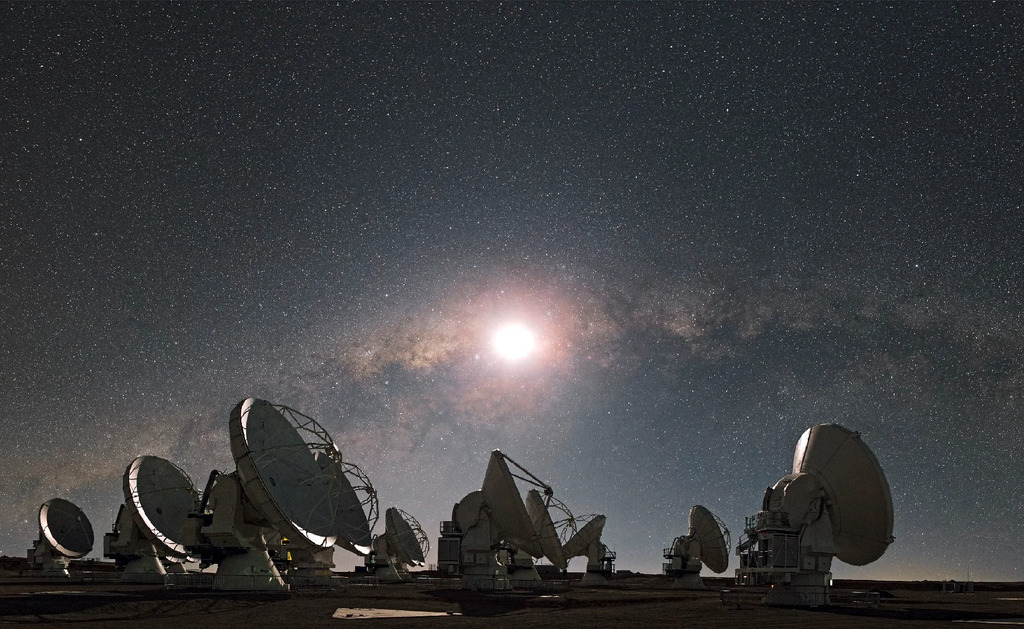
Radio observations with the Allen Telescope Array (ATA) have, as part of an international observing campaign, helped discover an unprecedented burst of radio activity from a tidal disruption event (TDE). TDEs happen when an unfortunate star wanders too close to a supermassive black hole (SMBH) and is ripped apart by its strong gravitational forces. These events light up the cosmos across all wavelengths, from visible and X-ray light to radio waves.

This particular TDE, named AT 2024tvd, stands out from others. It evolved at record-breaking speed, but also took place off-center, away from the nucleus of its galaxy.

“Tidal disruption events are usually found at the hearts of galaxies whereas AT 2024tvd was caused by an off-center black hole, the first time this has been unambiguously seen,” said Dr. Joe Bright, Radio Astronomy Researcher, University of Oxford. “It’s possible that the unprecedented rapid radio evolution is the result of its unusual position in the galaxy.”

The discovery, led by principal investigators Dr. Itai Sfaradi and Dr. Raffaella Margutti of the University of California, Berkeley, and including astronomers from the SETI Institute, represents a breakthrough in understanding how massive black holes can hide in unexpected places throughout the universe.

Most galaxies, including our Milky Way, are thought to have a SMBH at their center. These cosmic monsters pull in surrounding material and launch giant jets of material that shape how galaxies evolve. Not all SMBHs are easy to find; they can remain quiet and only become detectable when something dramatic occurs nearby. TDEs offer a way to probe the properties of SMBHs and the regions surrounding them, as well as to discover black holes in unusual locations.

Radio observations of AT 2024tvd reveal that its host galaxy hosts two SMBH: one at its expected location at its center, and a hidden SMBH offset by 2,600 light-years, which is likely the remnant of an ancient merger of two galaxies. When this off-center black hole shredded an unlucky star, it produced two rapid and powerful bursts of radio emission, offering scientists an unprecedented look at how black holes behave outside galactic centers.

"What makes this discovery even more remarkable is that it reveals a massive black hole that would otherwise be invisible to us," said Dr. Raffaella Margutti, "The only reason we can detect this wandering black hole is because it happened to tear apart a star and produce these incredibly bright radio signals."

“The ATA played an important role in this discovery, providing precise and time-sensitive radio measurements that helped astronomers to track the event’s radio brightness as it rose and faded over time,” said Dr. Sofia Sheikh, Technosignature Research Scientist at the SETI Institute. “The ATA’s ability to monitor changing signals from space — quickly, flexibly, and over a broad range of frequencies — made it uniquely suited to capturing the fast-evolving nature of AT 2024tvd.”

In addition to providing insight into black hole populations, radio observations of AT 2024tvd provide compelling clues into the fate of the disrupted star. Detailed modeling of the radio evolution, including observations from the ATA, reveals that this cataclysmic event launched two outflows, the first of which likely contained remnants of the shredded star.

By contributing to this research, the ATA has demonstrated its growing importance in time-domain astronomy, the study of rapidly changing cosmic phenomena, including TDEs, fast radio bursts, and supernovae.

Read Paper

News

Related News

Featured Image
Jun 9, 2026
Disclosure Needs Data
#SkyMapper #Franck Marchis #SETI #citizen science
Featured Image
Jun 5, 2026
Beyond Disclosure Day: The Real-World Protocols
#Press Releases #SETI #Astronomy #Bill Diamond #SETI Institute
Featured Image
Jun 4, 2026
SETI Institute In the News: May Roundup 2026
#SETI Institute in the News #SETI Institute #Community #Solar System #Matija Ćuk #Neptune #SETI #Bill Diamond #UAPs #Drake Awards #Lori Marino #Matthew Tiscareno #Outreach #Exoplanets #Carl Sagan Center
Featured Image
Jun 3, 2026
SETI Institute Looks for Signs of Technology in Interstellar Visitor 3I/ATLAS
Observations with the Allen Telescope Array set new limits on possible signals from extraterrestrial transmitters. #Press Releases #ATA #3I/ATLAS #Hat Creek Radio Observatory #Radio Astronomy #SETI
Featured Image
Jun 1, 2026
SETI Institute Awards $1 Million in STRIDE Grants to Advance Astrobiology, Exoplanet Science, and Public Engagement
#Press Releases #STRIDE #Research #Carl Sagan Center #Spectroscopy #Solar System #SETI #Climate and Bioscience #Astronomy #Astrobiology #Exoplanets #Data Science #Education #Outreach #Hat Creek Radio Observatory #Unistellar #SkyMapper
Research

Related Projects

Featured Image
SkyMapper • SETI • Citizen Science • Astronomy
SkyMapper: Expanding Access to Real-time Astronomy Through a Global Astronomical Network
SkyMapper and the SETI Institute are connecting educators, students and the public to live astronomical observations through a distributed astronomical network. #SkyMapper #SETI #Citizen Science #Astronomy
Featured Image
VPL
Virtual Planetary Laboratory
How can we best assess whether an exoplanet supports life? #VPL
Featured Image
Discovery and Futures Lab
What happens if life beyond Earth is discovered? The Discovery and Futures Lab at the SETI Institute fosters novel and anticipatory research at the intersection of science, society, our planet, and the search for life beyond Earth.  #Discovery and Futures Lab
Support Us

Support the
SETI Institute

Scientists are getting closer in their search for life beyond earth. But with limited federal funding for the search for extraterrestrial intelligence, supporters are the reason cutting-edge scientists can keep their eyes on the sky.