Tuesday, Feb 10, 2026

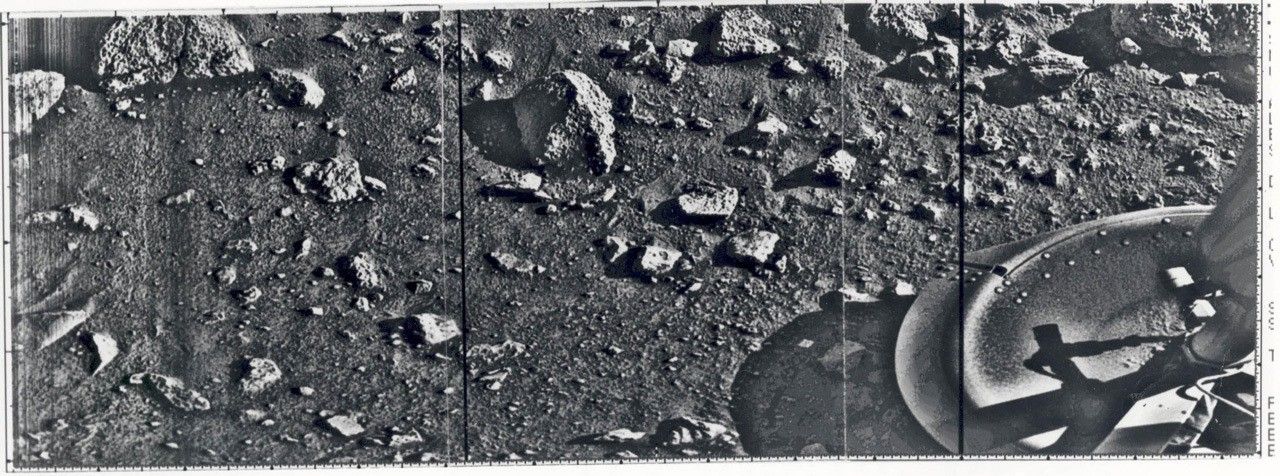
A conceptual rendering drawing of how the Luna 9 flight module might be seen from the lander’s camera (Wikimedia Commons PD and NASA/GSFC/ASU).

At a Glance:

  • What: AI analysis may have identified the landing site of Luna 9, the first spacecraft to soft-land on the Moon in 1966.
  • How: Researchers used a lightweight machine-learning model trained on Apollo imagery to detect faint signs of spacecraft hardware in NASA Lunar Reconnaissance Orbiter images.
  • Why it matters: The location of Luna 9 has been unknown for nearly 60 years. Identifying it helps recover a key moment in space history and demonstrates how AI can catalog human artifacts on the Moon.
  • What’s next: Follow-up imaging could confirm the site and support future lunar exploration and heritage preservation in the Artemis era.

Listen to this article read by AI:

Luna 9 was the first spacecraft to soft-land on the Moon, sending the first images from the lunar surface to Earth. The Luna 9 landing was on February 3, 1966, 60 years ago. Despite the mission's success, its exact landing spot remained a mystery. Now, a new analysis may have solved it.

A study led by SETI Institute affiliate scientist Lewis Pinault, published in npj Space Exploration, describes how researchers used AI machine learning to identify a potential landing site for Luna 9. By beginning to automate the detection of faint human-made objects in vast NASA Lunar Reconnaissance Orbiter image datasets, AI enabled the researchers to quickly and efficiently analyze very large data tiles using only light-weight computing resources.

The team trained the YOLO-ETA model (You Only Look Once – Extraterrestrial Artefact) with images from Apollo landing sites, teaching it to detect features that could have been caused by a spacecraft, such as shapes, shadows, and disturbed ground. They then applied the model to a 5-by-5-kilometer area around Luna 9’s possible landing site. The algorithm consistently found object clusters in these images, even when lighting changed, demonstrating its ability to identify artificial artifacts.

Researchers compared the site with Luna 9’s original surface photos, noting that the terrain and horizon potentially match the flat vistas seen in 1966, supporting the site as the likely landing spot.

“Robotic and human activities on the Moon are now set to dramatically escalate, and yet we’ve had no systematic catalogue or means of cataloguing our artefacts and debris," said Pinault. "Safe siting, appropriate zoning of activities, and preservation of historical and scientific areas of interest can be greatly aided by AI computer vision and machine learning, from the macro scale right down to the behavior and distribution of dust-sized particles and potential contaminants in the lunar regolith. There is a SETI interest here too - as our own technologies accelerate to pack more and more capabilities - including machine intelligence - into even the smallest of objects, searching our own neighborhood for their traces at every scale begins to make practical sense. With 4 billion years of stable history collecting particles from across the Galaxy, the Moon becomes an attractive target for searching for artefacts of every scale, both human, and potentially, extraterrestrial.

We designed YOLO-ETA to be a lightweight computing resource for edge cases, helping make orbital, fly-by, and on-site regolith analyses increasingly mobile and autonomous, not only contributing to space exploration science, safety and best practices but also opening the whole of our Solar System backyard to the search for extraterrestrial artefacts. As a first test we focused our search on locating the ‘missing’ Luna 9 - how elegant if using our new tools we’ve found humanity’s own first artifact to successfully land on another celestial body.”

Further work continues on the AI model, and planned passes over the area by Chandrayaan-2 may soon help confirm the finding. In all cases these results show how AI tools, such as machine learning systems for pattern and object detection, can effectively identify and document space artifacts, thereby helping recover lost chapters of space history. By highlighting the crucial role of efficient, deployable machine learning in documenting lunar human artifacts, the paper supports a task that becomes increasingly important as human activity increases in the Artemis era, while opening a new door in the pursuit of SETI.

News

Related News

Featured Image
May 7, 2026
SETI Institute In the News: April Roundup 2026
#SETI Institute in the News #SETI Institute #Community #SETI #Discovery and Futures Lab #Lucian Walkowicz #Chelsea Haramia #NASA Missions and Observatories #Pascal Lee #Mars #Janice Bishop #Mark Showalter #JWST #Uranus #Bill Diamond #UAPs
Featured Image
Apr 30, 2026
Narrowing the Search: The 45 Best Targets for Alien Life
#Blog #Astronomy #JWST #NASA Missions and Observatories #Trappist-1 #LaserSETI #ATA #Franck Marchis
Featured Image
Apr 27, 2026
Rethinking Organics on Mars
By Nathalie A. Cabrol, Director of the Carl Sagan Center for Research, SETI Institute #Mars #Astrobiology #Solar System #Curiosity Rover #NASA Missions and Observatories #Nathalie Cabrol
Featured Image
Apr 6, 2026
Women With Impact: Reclaiming the Moon's Missing Half
#Bettina Forget #AIR #Artemis II #Moon #NASA Missions and Observatories
Featured Image
Apr 3, 2026
SETI Institute In the News: March Roundup 2026
In March 2026, SETI Institute researchers contributed to a wide range of conversations about our solar system and the search for life beyond Earth. From explaining unusual features on Mars and studying meteor airbursts in Earth’s atmosphere to advancing new ways of detecting technosignatures, this work reflects how scientists are continually refining our understanding of both nearby and distant worlds. #SETI Institute in the News #SETI Institute #Community #Mars #Pascal Lee #Peter Jenniskens #Comets, Meteors, and Asteroids #Astronomy #Vishal Gajjar #SETI #AI and Machine Learning #Astrobiology #Nathalie Cabrol #Carl Sagan Center #Seth Shostak #Movie Reviews #Bill Diamond
Featured Image
Mar 30, 2026
We Finally Have a Shortlist for Finding Life Beyond Earth
#SETI #Astronomy #Exoplanets #NASA Missions and Observatories #JWST #Technosignatures #Franck Marchis
Research

Related Projects

Featured Image
SkyMapper • SETI • Citizen Science • Astronomy
SkyMapper: Expanding Access to Real-time Astronomy Through a Global Astronomical Network
SkyMapper and the SETI Institute are connecting educators, students and the public to live astronomical observations through a distributed astronomical network. #SkyMapper #SETI #Citizen Science #Astronomy
Featured Image
VPL
Virtual Planetary Laboratory
How can we best assess whether an exoplanet supports life? #VPL
Featured Image
Discovery and Futures Lab
What happens if life beyond Earth is discovered? The Discovery and Futures Lab at the SETI Institute fosters novel and anticipatory research at the intersection of science, society, our planet, and the search for life beyond Earth.  #Discovery and Futures Lab
Support Us

Support the
SETI Institute

Scientists are getting closer in their search for life beyond earth. But with limited federal funding for the search for extraterrestrial intelligence, supporters are the reason cutting-edge scientists can keep their eyes on the sky.