)

Tuesday, Jul 21, 2026
At a Glance:
|
The Virtual Planetary Laboratory (VPL), one of NASA's flagship astrobiology research teams, has officially moved its institutional home to the SETI Institute. In 2026 the VPL will also celebrate its 25th anniversary, making the transition a moment to celebrate both a remarkable legacy and a bright future. We are thrilled to welcome VPL to the SETI Institute community and to introduce the many talented scientists and researchers who are now part of our team.
A New Home for the Virtual Planetary Laboratory
VPL was founded in 2001 at the NASA/Caltech Jet Propulsion Laboratory, and was moved to the University of Washington in 2007. There it grew into a distributed research project with over 70 members spanning 20 participating institutions, including NASA Goddard Space Flight Center and NASA Ames Research Center. The team includes 22 Co-Investigators, 8 subawardees, 16 named collaborators, and a vibrant group of postdoctoral researchers, graduate students, and undergraduate students. Today, this scientific community is now anchored at the SETI Institute.

Dr. Victoria Meadows
VPL Principal Investigator Dr. Victoria Meadows leads the team. Transitioning to the SETI Institute she is joined by Co-Investigators Dr. Andrew Lincowski and Dr. Eric Wolf, VPL Scientist Dr. Nick Wogan, Collaborator Dr. Kim Bott, and Project Administrator Dr. Hannah Dawson. Together they bring expertise in climate and photochemical modeling, biosignature science, and more.
Advancing the Search for Life Beyond Earth
VPL's mission has always centered on a single driving question: "How can we best assess whether an exoplanet supports life?" Over 25 years, the team has developed advanced models of planetary atmospheres and biosignatures. They have tackled the challenge of distinguishing true signs of life from false positives and have provided a scientific foundation for future space missions that will study exoplanets and search for signs of life.
Four Research Tasks, One Astrobiology Mission
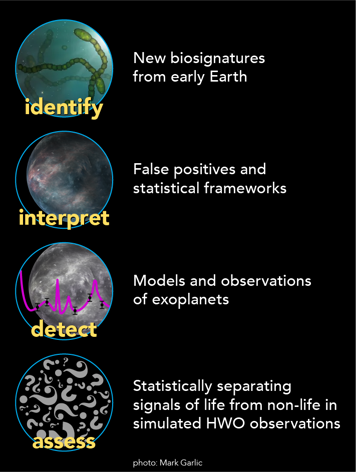 VPL will continue advancing their research mission at the SETI Institute. To accomplish this, four complementary research tasks, funded by NASA’s Interdisciplinary Consortia for Astrobiology Research (ICAR) program support this work. Together, these efforts span three core areas of biosignature science: identifying potential exoplanet biosignatures, determining how to detect them, and assessing whether they truly indicate life.
The Identify task investigates early Earth environments to uncover new potential biosignatures relevant to exoplanets. The Interpret task studies abiotic processes that can mimic signs of life and develops the statistical frameworks needed to evaluate biosignatures within their planetary context. Together, these efforts focus on identifying possible signs of life.
The Detect task explores how biosignatures and their environmental context can be optimally observed by differentobservatories, including JWST and the future Habitable Worlds Observatory.
Finally, the Assess task evaluates how reliably biological and abiotic origins of biosignatures can be distinguished in both simulated and real telescope data, for individual planets and planetary populations.
Building Toward the Habitable Worlds Observatory

VPL members are deeply embedded in the science and mission formulation of the Habitable Worlds Observatory (HWO), NASA's next-generation flagship mission concept for directly imaging and characterizing potentially habitable exoplanets. Currently, Dr. Meadows (SETI Institute) and Dr. Tyler Robinson (UofA) serve on the Community Science and Instrument Team (CSIT), chaired by VPL Co-I Dr. Evgenya Shkolnik (ASU), while VPL team members Dr. Giada Arney (NASA GSFC), Dr. Aki Roberge (NASA GSFC), Dr. Niki Parenteau (NASA Ames) and Dr. Chris Stark (NASA GSFC) are members of the HWO Project Team. VPL team members also held leadership roles across HWO community groups, including the Living Worlds group which worked to define the observatory's astrobiology science case.
The move to the SETI Institute has also opened new funding opportunities for VPL researchers. Two VPL-based proposal teams were recently selected for funding through the SETI Institute STRIDE program, established in 2024 to support high-risk, high-reward research and education concepts. Dr. Lincowski, together with Dr. Meadows and Dr. Wolf, will advance next-generation climate modeling by integrating VPL's SMART spectral tool with the ExoCAM general circulation model, improving the accuracy and flexibility of 3D modeling for planetary and exoplanetary studies. In a second STRIDE award, Dr. Meadows will lead a think tank initiative, with Dr. Natalie Batalha, Dr. Natasha Batalha, Dr. Lincowski, Dr. Wogan, and Dr. Dawson, to build a community collaborative framework bridging exoplanet observers and theorists to accelerate our understanding of small, potentially habitable worlds.
Looking Ahead: The Next Chapter of VPL
Explore the full VPL team, their research, and recent publications at the new VPL website at the SETI Institute: seti.org/vpl. To better understand the breadth of expertise VPL brings to the SETI Institute, visit the VPL team page at seti.org/vpl. As VPL continues to grow, early-career researchers should stay tuned for upcoming opportunities to join VPL at the SETI Institute. Here's to 25 years of VPL, and to everything still to come.
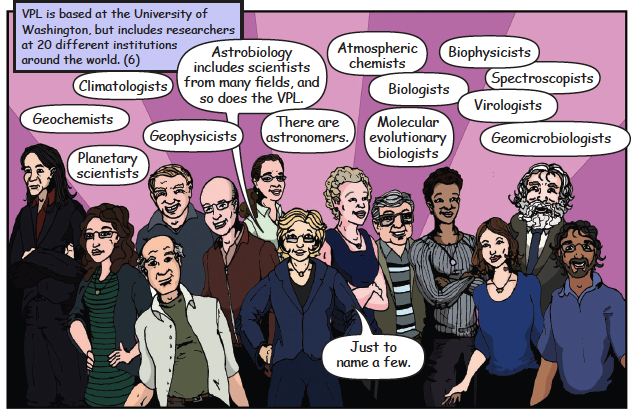
VPL Team Comic (older).







News
Related News

Jun 1, 2026
SETI Institute Awards $1 Million in STRIDE Grants to Advance Astrobiology, Exoplanet Science, and Public Engagement
#Press Releases #STRIDE #Research #Carl Sagan Center #Spectroscopy #Solar System #SETI #Climate and Bioscience #Astronomy #Astrobiology #Exoplanets #Data Science #Education #Outreach #Hat Creek Radio Observatory #Unistellar #SkyMapper
May 13, 2026
SETI Institute to Honor Dr. Matthew Tiscareno with 2026 Carl Sagan Center Director’s Award
The Drake Awards event will also recognize SETI Forward and SETI Institute REU student award recipients. #Press Releases #Drake Awards #Frank Drake #SETI #Awards #Planetary Astronomy #Astrobiology #SETI Forward #Education #Carl Sagan Center #Matthew Tiscareno #Nathalie Cabrol #REU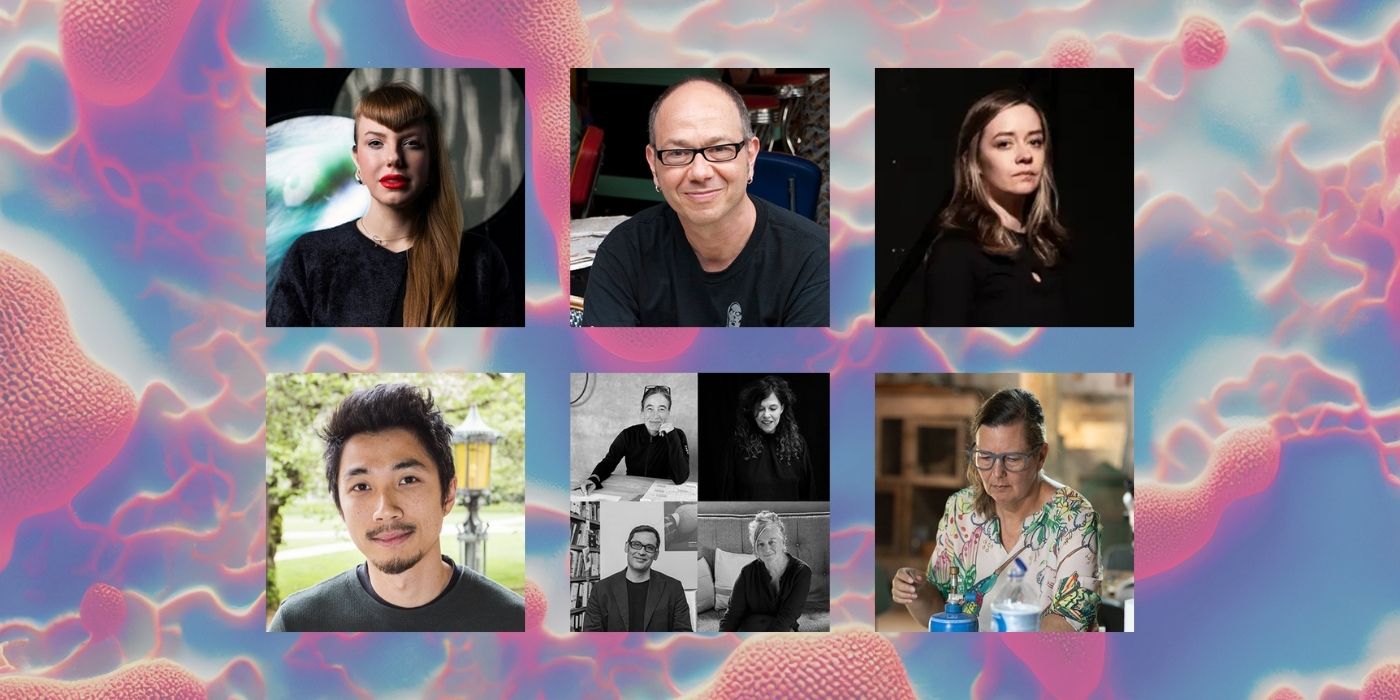
May 4, 2026
SETI Institute Announces Nominees for the Speculative Life BioArt Residency
Six international artists shortlisted for a new residency at the intersection of art, astrobiology, and biotechnology #AIR #SETI Institute #Speculative Life #Astrobiology #Danielle Siembieda #Nathalie Cabrol
Apr 27, 2026
Rethinking Organics on Mars
By Nathalie A. Cabrol, Director of the Carl Sagan Center for Research, SETI Institute #Mars #Astrobiology #Solar System #Curiosity Rover #NASA Missions and Observatories #Nathalie Cabrol
Apr 21, 2026
SETI Institute Launches Discovery and Futures Lab to Explore the Human Dimensions of Life Beyond Earth
New initiative bridges science, society, and the future of discovery in astrobiology and SETI #Press Releases #Discovery and Futures Lab #Lucian Walkowicz #Chelsea Haramia #Carl Sagan Center #Nathalie Cabrol #Simon Steel #Bill Diamond #Astrobiology #SETI
Apr 3, 2026
SETI Institute In the News: March Roundup 2026
In March 2026, SETI Institute researchers contributed to a wide range of conversations about our solar system and the search for life beyond Earth. From explaining unusual features on Mars and studying meteor airbursts in Earth’s atmosphere to advancing new ways of detecting technosignatures, this work reflects how scientists are continually refining our understanding of both nearby and distant worlds. #SETI Institute in the News #SETI Institute #Community #Mars #Pascal Lee #Peter Jenniskens #Comets, Meteors, and Asteroids #Astronomy #Vishal Gajjar #SETI #AI and Machine Learning #Astrobiology #Nathalie Cabrol #Carl Sagan Center #Seth Shostak #Movie Reviews #Bill Diamond
Jun 1, 2026
#Press Releases
#STRIDE
#Research
#Carl Sagan Center
#Spectroscopy
#Solar System
#SETI
#Climate and Bioscience
#Astronomy
#Astrobiology
#Exoplanets
#Data Science
#Education
#Outreach
#Hat Creek Radio Observatory
#Unistellar
#SkyMapper
May 13, 2026
SETI Institute to Honor Dr. Matthew Tiscareno with 2026 Carl Sagan Center Director’s Award
The Drake Awards event will also recognize SETI Forward and SETI Institute REU student award recipients.
#Press Releases
#Drake Awards
#Frank Drake
#SETI
#Awards
#Planetary Astronomy
#Astrobiology
#SETI Forward
#Education
#Carl Sagan Center
#Matthew Tiscareno
#Nathalie Cabrol
#REU
May 4, 2026
SETI Institute Announces Nominees for the Speculative Life BioArt Residency
Six international artists shortlisted for a new residency at the intersection of art, astrobiology, and biotechnology
#AIR
#SETI Institute
#Speculative Life
#Astrobiology
#Danielle Siembieda
#Nathalie Cabrol
Apr 27, 2026
Rethinking Organics on Mars
By Nathalie A. Cabrol, Director of the Carl Sagan Center for Research, SETI Institute
#Mars
#Astrobiology
#Solar System
#Curiosity Rover
#NASA Missions and Observatories
#Nathalie Cabrol
Apr 21, 2026
SETI Institute Launches Discovery and Futures Lab to Explore the Human Dimensions of Life Beyond Earth
New initiative bridges science, society, and the future of discovery in astrobiology and SETI
#Press Releases
#Discovery and Futures Lab
#Lucian Walkowicz
#Chelsea Haramia
#Carl Sagan Center
#Nathalie Cabrol
#Simon Steel
#Bill Diamond
#Astrobiology
#SETI
Apr 3, 2026
SETI Institute In the News: March Roundup 2026
In March 2026, SETI Institute researchers contributed to a wide range of conversations about our solar system and the search for life beyond Earth. From explaining unusual features on Mars and studying meteor airbursts in Earth’s atmosphere to advancing new ways of detecting technosignatures, this work reflects how scientists are continually refining our understanding of both nearby and distant worlds.
#SETI Institute in the News
#SETI Institute
#Community
#Mars
#Pascal Lee
#Peter Jenniskens
#Comets, Meteors, and Asteroids
#Astronomy
#Vishal Gajjar
#SETI
#AI and Machine Learning
#Astrobiology
#Nathalie Cabrol
#Carl Sagan Center
#Seth Shostak
#Movie Reviews
#Bill Diamond
Research
Related Projects

SkyMapper • SETI • Citizen Science • Astronomy
SkyMapper: Expanding Access to Real-time Astronomy Through a Global Astronomical Network
SkyMapper and the SETI Institute are connecting educators, students and the public to live astronomical observations through a distributed astronomical network. #SkyMapper #SETI #Citizen Science #Astronomy
VPL
Virtual Planetary Laboratory
How can we best assess whether an exoplanet supports life? #VPL
Discovery and Futures Lab
Discovery and Futures Lab
What happens if life beyond Earth is discovered? The Discovery and Futures Lab at the SETI Institute fosters novel and anticipatory research at the intersection of science, society, our planet, and the search for life beyond Earth. #Discovery and Futures Lab
May 17, 2026
SkyMapper: Expanding Access to Real-time Astronomy Through a Global Astronomical Network
SkyMapper and the SETI Institute are connecting educators, students and the public to live astronomical observations through a distributed astronomical network.
#SkyMapper
#SETI
#Citizen Science
#Astronomy
May 5, 2026
Virtual Planetary Laboratory
How can we best assess whether an exoplanet supports life?
#VPL
Apr 16, 2026
Discovery and Futures Lab
What happens if life beyond Earth is discovered? The Discovery and Futures Lab at the SETI Institute fosters novel and anticipatory research at the intersection of science, society, our planet, and the search for life beyond Earth.
#Discovery and Futures Lab
Support Us
Support the
SETI Institute
Scientists are getting closer in their search for life beyond earth. But with limited federal funding for the search for extraterrestrial intelligence, supporters are the reason cutting-edge scientists can keep their eyes on the sky.
