)

Wednesday, Aug 06, 2025

SETI Institute in the News
From tracking a rare interstellar visitor to revealing hidden star systems, the SETI Institute is at the forefront of space science. Explore four recent stories showcasing our role in groundbreaking discoveries and global scientific collaboration.
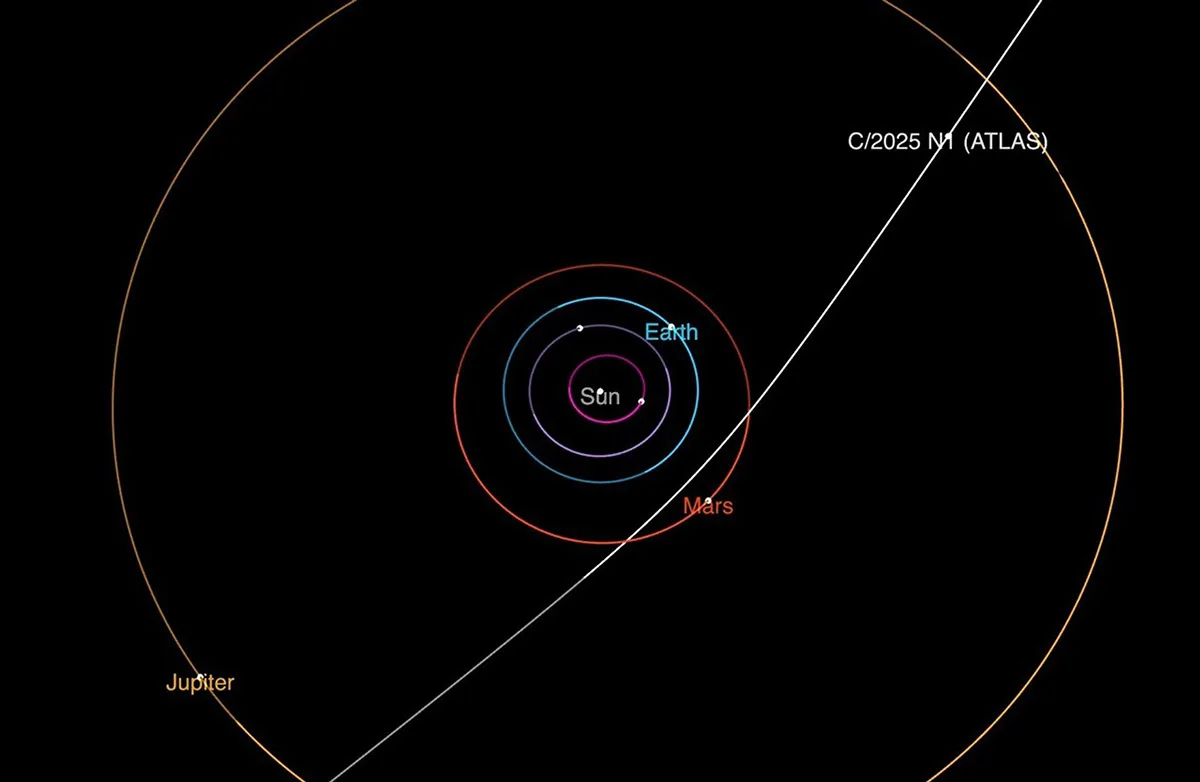
Diagram showing the trajectory of interstellar comet 3I/ATLAS, or C/2025 N1, as it passes through the Solar System.
Credit: NASA/JPL-Caltech
Smart telescope users join forces to photograph the interstellar comet moving through our Solar System
A global network of amateur astronomers using Unistellar smart telescopes, including members of the SETI Institute’s citizen science community, has captured early images of interstellar comet 3I/ATLAS. Dr. Franck Marchis, Senior Astronomer at the SETI Institute and Chief Science Officer at Unistellar, noted this is only the third known interstellar object ever detected and emphasized the value of the early observation for enabling coordinated global observation efforts. By combining data from citizen scientists and professional observatories, researchers hope to learn more about the comet’s trajectory, composition, and behavior as it approaches the Sun.
Read the full article by BBC Sky at Night Magazine: Smart telescope users join forces to photograph the interstellar comet moving through our Solar System
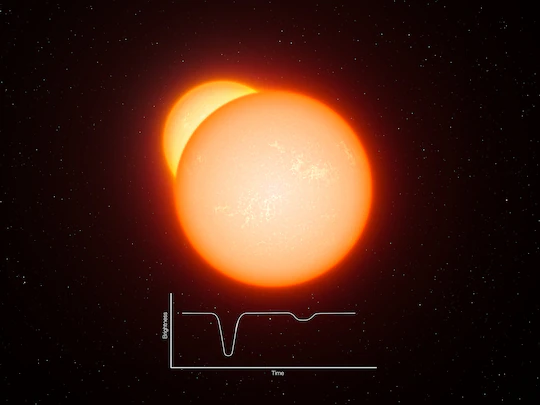
An artist’s impression shows an eclipsing binary star system. As the two stars orbit each other, they pass in front of one another and their combined brightness, seen from a distance, decreases. (European Southern Observatory)
Citizen scientists pinpoint 10,000 eclipsing star pairs
With help from thousands of volunteer stargazers, researchers have confirmed more than 10,000 eclipsing binary star systems, nearly 8,000 of them previously unknown. The discovery comes from the Eclipsing Binary Patrol, a citizen science project validating data from NASA’s Transiting Exoplanet Survey Satellite (TESS) mission. Dr. Veselin Kostov, a research scientist at NASA Goddard and the SETI Institute, co-led the study and emphasized the power of combining human effort with machine learning. The new catalog could guide future searches for exoplanets orbiting these rare and dynamic star systems.
The citizen science project is still recruiting participants. Want to be part of the search for eclipsing binaries? Join the team at https://bit.ly/eclipsingbinaries.
Read the full article by The Washington Post here: Citizen scientists pinpoint 10,000 eclipsing star pairs

Musk is messing with the Cosmic Dawn. Will alien hunters save the day for all mankind?
As concerns grow over radio interference from SpaceX’s expanding Starlink satellite constellation, the SETI Institute has partnered with SpaceX to to address the impact of satellite emissions on sensitive astronomical research. The collaboration comes amid reports from the Square Kilometre Array (SKA) team in Australia, who detected tens of thousands of unintended Starlink signals while testing for faint radio waves from the early universe. With the SETI Institute’s deep expertise in radio astronomy and advocacy for protecting the radio sky, this alliance aims to develop responsible engineering standards for an increasingly crowded orbit.
Read the full article by The Register here: Musk is messing with the Cosmic Dawn. Will alien hunters save the day for all mankind?
The breakthrough was courtesy of NASA's Transiting Exoplanet Survey Satellite (TESS) mission(Image: Maximusnd via Getty Images)
'Rare' planet like Jupiter discovered 400 light years away
An international network of amateur astronomers, working with the SETI Institute and Unistellar, helped confirm the existence of TOI-4465 b, a Jupiter-sized exoplanet located 400 light-years away. Orbiting its star every 102 days, this “temperate Jupiter” is in the rare category of long-period gas giants. Dr. Franck Marchis, Senior Astronomer at the SETI Institute, emphasized the value of bridging the gap between hot Jupiters and the cold giants in our own Solar System. The SETI-Unistellar collaboration proved vital in capturing the planet’s rare, 12-hour transit event.
Read the full article by The Mirror here: 'Rare' planet like Jupiter discovered 400 light years away







News
Related News

Jun 29, 2026
Humanity's Plan for First Contact: Who Speaks for Earth?
#Blog #Lauren Sgro #Lucian Walkowicz #Chelsea Haramia #SETI #SETI Institute
Jun 5, 2026
Beyond Disclosure Day: The Real-World Protocols
#Press Releases #SETI #Astronomy #Bill Diamond #SETI Institute
Jun 4, 2026
SETI Institute In the News: May Roundup 2026
#SETI Institute in the News #SETI Institute #Community #Solar System #Matija Ćuk #Neptune #SETI #Bill Diamond #UAPs #Drake Awards #Lori Marino #Matthew Tiscareno #Outreach #Exoplanets #Carl Sagan Center
May 28, 2026
Celebrating Frank Drake
#Frank Drake #SETI #Project Ozma #Drake Equation #SETI Institute
May 7, 2026
SETI Institute In the News: April Roundup 2026
#SETI Institute in the News #SETI Institute #Community #SETI #Discovery and Futures Lab #Lucian Walkowicz #Chelsea Haramia #NASA Missions and Observatories #Pascal Lee #Mars #Janice Bishop #Mark Showalter #JWST #Uranus #Bill Diamond #UAPs
May 5, 2026
Atlanta Science Festival Exploration Expo and the Arecibo Message
#Community #SETI Institute #Outreach #Education #Lauren Sgro
Jun 29, 2026
#Blog
#Lauren Sgro
#Lucian Walkowicz
#Chelsea Haramia
#SETI
#SETI Institute
Jun 5, 2026
#Press Releases
#SETI
#Astronomy
#Bill Diamond
#SETI Institute
Beyond Disclosure Day: The Real-World Protocols
Jun 4, 2026
#SETI Institute in the News
#SETI Institute
#Community
#Solar System
#Matija Ćuk
#Neptune
#SETI
#Bill Diamond
#UAPs
#Drake Awards
#Lori Marino
#Matthew Tiscareno
#Outreach
#Exoplanets
#Carl Sagan Center
SETI Institute In the News: May Roundup 2026
May 28, 2026
#Frank Drake
#SETI
#Project Ozma
#Drake Equation
#SETI Institute
Celebrating Frank Drake
May 7, 2026
#SETI Institute in the News
#SETI Institute
#Community
#SETI
#Discovery and Futures Lab
#Lucian Walkowicz
#Chelsea Haramia
#NASA Missions and Observatories
#Pascal Lee
#Mars
#Janice Bishop
#Mark Showalter
#JWST
#Uranus
#Bill Diamond
#UAPs
SETI Institute In the News: April Roundup 2026
May 5, 2026
#Community
#SETI Institute
#Outreach
#Education
#Lauren Sgro
Atlanta Science Festival Exploration Expo and the Arecibo Message
Research
Related Projects

SkyMapper • SETI • Citizen Science • Astronomy
SkyMapper: Expanding Access to Real-time Astronomy Through a Global Astronomical Network
SkyMapper and the SETI Institute are connecting educators, students and the public to live astronomical observations through a distributed astronomical network. #SkyMapper #SETI #Citizen Science #Astronomy
VPL
Virtual Planetary Laboratory
How can we best assess whether an exoplanet supports life? #VPL
Discovery and Futures Lab
Discovery and Futures Lab
What happens if life beyond Earth is discovered? The Discovery and Futures Lab at the SETI Institute fosters novel and anticipatory research at the intersection of science, society, our planet, and the search for life beyond Earth. #Discovery and Futures Lab
May 17, 2026
SkyMapper: Expanding Access to Real-time Astronomy Through a Global Astronomical Network
SkyMapper and the SETI Institute are connecting educators, students and the public to live astronomical observations through a distributed astronomical network.
#SkyMapper
#SETI
#Citizen Science
#Astronomy
May 5, 2026
Virtual Planetary Laboratory
How can we best assess whether an exoplanet supports life?
#VPL
Apr 16, 2026
Discovery and Futures Lab
What happens if life beyond Earth is discovered? The Discovery and Futures Lab at the SETI Institute fosters novel and anticipatory research at the intersection of science, society, our planet, and the search for life beyond Earth.
#Discovery and Futures Lab
Support Us
Support the
SETI Institute
Scientists are getting closer in their search for life beyond earth. But with limited federal funding for the search for extraterrestrial intelligence, supporters are the reason cutting-edge scientists can keep their eyes on the sky.
