







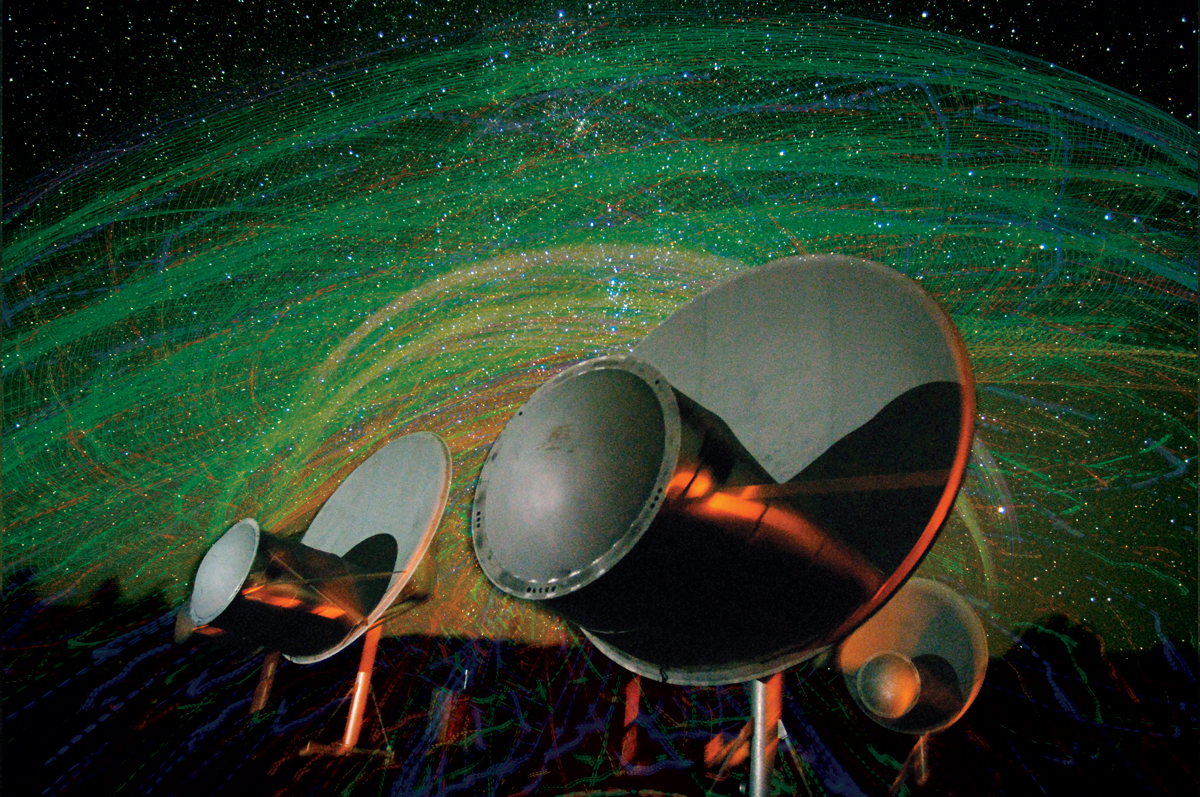
Credit: Zayna Sheikh.
October 16, 2024, Mountain View, CA — Scientists at the SETI Institute and partners from Penn State University used the Allen Telescope Array (ATA) to search for signs of alien technology in the TRAPPIST-1 star system. The team spent 28 hours scanning the system, looking for radio signals that could indicate extraterrestrial technology. This project marks the longest single-target search for radio signals from TRAPPIST-1. Although they didn’t find any evidence of extraterrestrial technology, their work provided valuable data and introduced a new way to search for signals in the future.
“This research shows we are getting closer to detecting radio signals similar to the ones we send into space,” said Nick Tusay, a graduate student research fellow at Penn State University. “Most searches assume some intent, like beacons, because our receivers have a sensitivity limit to a minimum transmitter power beyond anything we unintentionally send out. But, with better equipment, like the upcoming Square Kilometer Array (SKA), we might soon be able to detect signals from an alien civilization communicating with its spacecraft.”
The project focused on a phenomenon called planet-planet occultations (PPOs). PPOs happen when one planet moves in front of another. If intelligent life exists in that star system, radio signals sent between planets could leak and be detected from Earth.
Credit: Zayna Sheikh. Watch full video here.
Using the upgraded ATA, the team scanned a wide range of frequencies, looking for narrowband signals, which are considered possible signs of alien technology. The team filtered millions of potential signals, narrowing down to about 11,000 candidates for detailed analysis. The team detected 2,264 of these signals during predicted PPO windows. However, none of the signals were of non-human origin.
The ATA's new capabilities, which include advanced software to filter signals, helped the team separate possible alien signals from Earth-based ones. They believe that refining these methods and focusing on events like PPOs could help increase the chances of detecting alien signals in the future.
“This project included work by undergraduate students in the 2023 SETI Institute Research Experience for Undergraduates (REU) program,” said Dr. Sofia Sheikh, a SETI researcher at the SETI Institute. “The students looked for signals from human-made orbiters around Mars to check if the system could detect signals correctly. It was an exciting way to involve students in cutting-edge SETI research.”
The TRAPPIST-1 system is a small, cool star about 41 light years from Earth. It has seven rocky planets, some of which are in the habitable zone, where conditions might allow liquid water to exist—an essential ingredient for life as we know it. This makes TRAPPIST-1 a prime target searching for life beyond Earth.
The team did not find any alien signals this time, but they will continue improving their search techniques and exploring other star systems. Future searches with bigger and more powerful telescopes could help scientists detect even fainter signals and expand our understanding of the universe.
A paper describing the research is accepted for publication in the Astronomical Journal and is available online as a preprint.
About the SETI Institute
Founded in 1984, the SETI Institute is a non-profit, multi-disciplinary research and education organization whose mission is to lead humanity’s quest to understand the origins and prevalence of life and intelligence in the universe and to share that knowledge with the world. Our research encompasses the physical and biological sciences and leverages expertise in data analytics, machine learning and advanced signal detection technologies. The SETI Institute is a distinguished research partner for industry, academia and government agencies, including NASA and NSF.
Contact information
Rebecca McDonald
Director of Communications
SETI Institute
[email protected]
News
Related News
Beyond Disclosure Day: The Real-World Protocols
#Press Releases #SETI #Astronomy #Bill Diamond #SETI Institute
SETI Institute Looks for Signs of Technology in Interstellar Visitor 3I/ATLAS
Observations with the Allen Telescope Array set new limits on possible signals from extraterrestrial transmitters. #Press Releases #ATA #3I/ATLAS #Hat Creek Radio Observatory #Radio Astronomy #SETI
SETI Institute Awards $1 Million in STRIDE Grants to Advance Astrobiology, Exoplanet Science, and Public Engagement
#Press Releases #STRIDE #Research #Carl Sagan Center #Spectroscopy #Solar System #SETI #Climate and Bioscience #Astronomy #Astrobiology #Exoplanets #Data Science #Education #Outreach #Hat Creek Radio Observatory #Unistellar #SkyMapper
SETI Institute to Honor Dr. Matthew Tiscareno with 2026 Carl Sagan Center Director’s Award
The Drake Awards event will also recognize SETI Forward and SETI Institute REU student award recipients. #Press Releases #Drake Awards #Frank Drake #SETI #Awards #Planetary Astronomy #Astrobiology #SETI Forward #Education #Carl Sagan Center #Matthew Tiscareno #Nathalie Cabrol #REU
Narrowing the Search: The 45 Best Targets for Alien Life
#Blog #Astronomy #JWST #NASA Missions and Observatories #Trappist-1 #LaserSETI #ATA #Franck Marchis
SETI Institute Launches Discovery and Futures Lab to Explore the Human Dimensions of Life Beyond Earth
New initiative bridges science, society, and the future of discovery in astrobiology and SETI #Press Releases #Discovery and Futures Lab #Lucian Walkowicz #Chelsea Haramia #Carl Sagan Center #Nathalie Cabrol #Simon Steel #Bill Diamond #Astrobiology #SETIResearch
Related Projects
SkyMapper: Expanding Access to Real-time Astronomy Through a Global Astronomical Network
SkyMapper and the SETI Institute are connecting educators, students and the public to live astronomical observations through a distributed astronomical network. #SkyMapper #SETI #Citizen Science #Astronomy
Virtual Planetary Laboratory
How can we best assess whether an exoplanet supports life? #VPL
Discovery and Futures Lab
What happens if life beyond Earth is discovered? The Discovery and Futures Lab at the SETI Institute fosters novel and anticipatory research at the intersection of science, society, our planet, and the search for life beyond Earth. #Discovery and Futures LabSupport the
SETI Institute
Scientists are getting closer in their search for life beyond earth. But with limited federal funding for the search for extraterrestrial intelligence, supporters are the reason cutting-edge scientists can keep their eyes on the sky.