)

Friday, Oct 10, 2025

Dwarf planet Ceres is depicted in these enhanced-color renderings, which utilize images from NASA’s Dawn mission. New thermal and chemical models that rely on the mission’s data indicate Ceres may have long ago had conditions suitable for life. Credit: NASA/JPL-Caltech/UCLA/MPS/DLR/IDA
At a Glance
|
When NASA’s Dawn mission first captured images of the dwarf planet Ceres, bright reflective spots on its surface sparked worldwide fascination. Although the mission concluded in 2018, its data continues to reshape our understanding of this small but complex world.
In a recent episode of SETI Live, host Beth Johnson spoke with Dr. Sam Courville, postdoctoral researcher at Arizona State University and lead author of a new Science Advances paper on the potential past habitability of Ceres. His research suggests that beneath its cold, cratered surface, Ceres may once have harbored the chemical energy necessary to sustain microbial life for an extended period.
“Ceres has a ton of water and organic matter,” said Dr. Courville. In planetary science, organic matter refers to carbon-rich molecules; not evidence of biology, but ingredients that could support it. Compared with other bodies in the inner solar system, Ceres is unusually rich in these compounds, making it a compelling target for astrobiological study.
Inside Ceres: Ice, Rock, and Energy
Ceres is the largest object in the asteroid belt and the only dwarf planet in the inner solar system. Beneath its heavily cratered exterior lies an ice-rich crust over a rocky core. This layered internal structure, known as differentiation, indicates that early in its history, Ceres experienced internal heating sufficient to separate materials by density.
That heating, Dr. Courville explains, could have triggered the release of volatile molecules such as carbon dioxide (CO₂) and methane (CH₄) from minerals in the interior. These gases represent potential sources of redox (reduction-oxidation) energy, meaning they could fuel chemical reactions similar to those that sustain microbial ecosystems on Earth.
“Life needs energy,” Dr. Courville said. “Just as humans extract energy from food and oxygen, microorganisms can extract energy from reactions between molecules like methane and carbon dioxide. On Ceres, these molecules may have been continuously produced by geochemical processes, providing a steady, if limited, energy supply.”
Evidence from the Bright Spots
The Dawn mission provided key evidence supporting this hypothesis. The bright patches scattered across Ceres’ surface are composed of salts, which are remnants of briny water that once reached the surface and evaporated. Some of these deposits appear geologically young, possibly forming within the last tens of millions of years.
This finding implies that liquid, even if extremely salty, was present beneath the surface in the recent past. Such activity suggests that Ceres’ interior remains warm enough to maintain pockets of subsurface brine, creating potential habitats for microbial life.
While these conditions differ from those on icy moons such as Europa and Enceladus, where large subsurface oceans are sustained by tidal heating, Ceres represents a distinct type of world: a relict ocean world – it may have once possessed more extensive liquid regions that gradually froze over time.
Defining Habitability
In planetary science, habitability refers not to comfort but to the presence of conditions that could support life as we know it: specifically, liquid water, a stable energy source, and essential chemical ingredients.
Ceres checks several of these boxes. It contains abundant water and organic molecules and, according to Dr. Courville’s model, a long-lasting internal energy source. What remains uncertain is whether these factors ever aligned to create an environment suitable for microbial metabolism.
The presence of bright surface salts points to active geochemistry. Understanding their composition in detail could reveal how fluids once moved through the crust and how long such processes persisted.
Next Steps
Asked what kind of mission he would send next, Dr. Courville emphasized the importance of direct sampling. “I want to pick up a piece of the bright spots,” he said. “That material could tell us exactly what’s happening inside.”
A future mission equipped with geophysical instruments, such as electromagnetic sensors capable of detecting subsurface brine, could further constrain the current state of Ceres’ interior. A sample-return mission would enable scientists to search for complex organic compounds, including amino acids, which have been detected in meteorites believed to originate from similar bodies.
Why Ceres Matters for Astrobiology
For Dr. Courville, Ceres presents a unique opportunity to investigate how habitability emerges in small planetary bodies. “We want to know why life forms,” he explained. “Earth is too complex to trace life’s origins clearly. Ceres gives us a simpler system that may preserve evidence of the earliest habitable conditions in the solar system.”
As a relatively nearby and well-characterized target, Ceres bridges the gap between rocky planets and icy moons. Studying it in depth deepens our understanding of how water, chemistry, and energy interact across planetary environments, and how these elements might converge to create life.
Watch the full conversation, and read more in the official press release or the full Science Advances paper.
Learn more about the SETI Institute’s research on astrobiology and planetary science.







News
Related News

May 8, 2026
Galactic Islands of Tranquility: How “Little Red Dots” May Brew Life’s Building Blocks
#Blog #Simon Steel
Apr 30, 2026
Narrowing the Search: The 45 Best Targets for Alien Life
#Blog #Astronomy #JWST #NASA Missions and Observatories #Trappist-1 #LaserSETI #ATA #Franck Marchis
Apr 23, 2026
SkyMapper Goes Live: Building a Real-Time, Global Network for Astronomy
SkyMapper functions as an observational infrastructure, a system that links instruments, users, and data streams. Its goal is ambitious: to continuously observe and map the entire sky. #Blog #SkyMapper #LaserSETI #SETI #Astronomy #Exoplanet Detection #Comets, Meteors, and Asteroids #Planetary Defense #Technosignatures #Franck Marchis #Lauren Sgro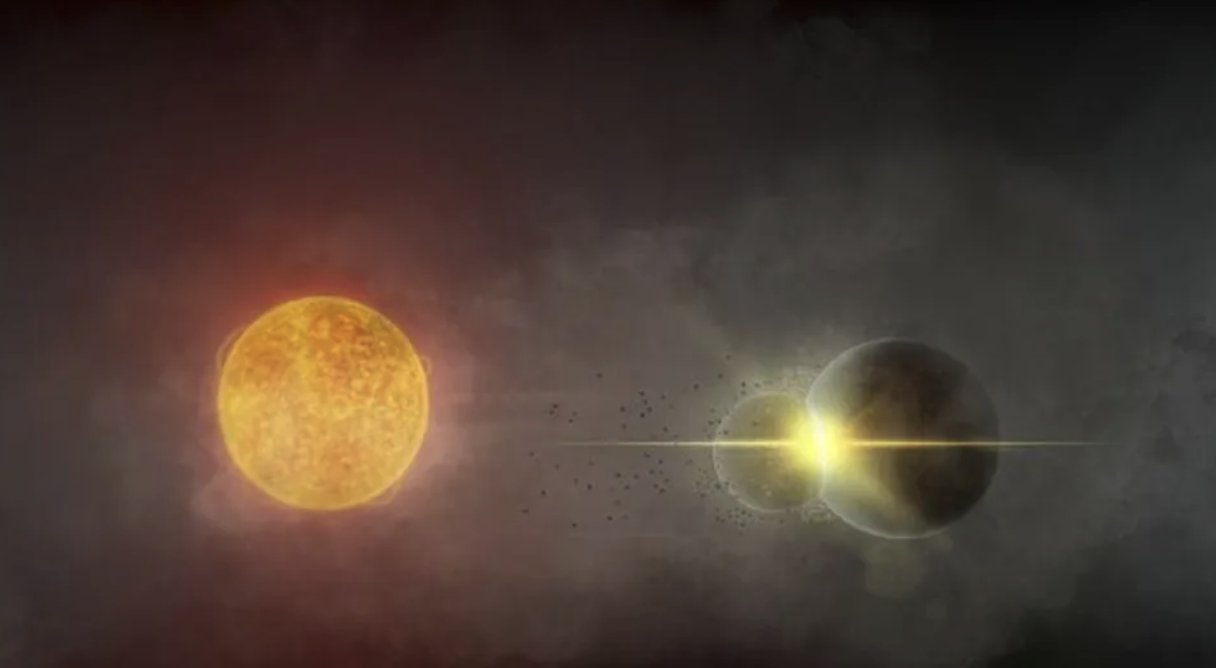
Apr 10, 2026
Planet Crash: Cosmic Collision Caught in Action
#Blog #SETI Institute #Carl Sagan Center #Moiya McTier #Nastasios Tzanidakis #Gaia GIC1
Mar 31, 2026
The Science of SETI: Inside the First Modern Textbook
#Blog #SETI #Technosignatures #Astronomy #Jason Wright #SETI Institute
Mar 27, 2026
From Moon to Mars: What Artemis II Means for the Future
#Blog #Mars #Artemis II #Pascal Lee #Simon Steel #SETI Institute #Carl Sagan Center #Moon
May 8, 2026
#Blog
#Simon Steel
Apr 30, 2026
#Blog
#Astronomy
#JWST
#NASA Missions and Observatories
#Trappist-1
#LaserSETI
#ATA
#Franck Marchis
Narrowing the Search: The 45 Best Targets for Alien Life
Apr 23, 2026
SkyMapper Goes Live: Building a Real-Time, Global Network for Astronomy
SkyMapper functions as an observational infrastructure, a system that links instruments, users, and data streams. Its goal is ambitious: to continuously observe and map the entire sky.
#Blog
#SkyMapper
#LaserSETI
#SETI
#Astronomy
#Exoplanet Detection
#Comets, Meteors, and Asteroids
#Planetary Defense
#Technosignatures
#Franck Marchis
#Lauren Sgro
Apr 10, 2026
#Blog
#SETI Institute
#Carl Sagan Center
#Moiya McTier
#Nastasios Tzanidakis
#Gaia GIC1
Planet Crash: Cosmic Collision Caught in Action
Mar 31, 2026
#Blog
#SETI
#Technosignatures
#Astronomy
#Jason Wright
#SETI Institute
The Science of SETI: Inside the First Modern Textbook
Mar 27, 2026
#Blog
#Mars
#Artemis II
#Pascal Lee
#Simon Steel
#SETI Institute
#Carl Sagan Center
#Moon
From Moon to Mars: What Artemis II Means for the Future
Research
Related Projects

SkyMapper • SETI • Citizen Science • Astronomy
SkyMapper: Expanding Access to Real-time Astronomy Through a Global Astronomical Network
SkyMapper and the SETI Institute are connecting educators, students and the public to live astronomical observations through a distributed astronomical network. #SkyMapper #SETI #Citizen Science #Astronomy
VPL
Virtual Planetary Laboratory
How can we best assess whether an exoplanet supports life? #VPL
Discovery and Futures Lab
Discovery and Futures Lab
What happens if life beyond Earth is discovered? The Discovery and Futures Lab at the SETI Institute fosters novel and anticipatory research at the intersection of science, society, our planet, and the search for life beyond Earth. #Discovery and Futures Lab
May 17, 2026
SkyMapper: Expanding Access to Real-time Astronomy Through a Global Astronomical Network
SkyMapper and the SETI Institute are connecting educators, students and the public to live astronomical observations through a distributed astronomical network.
#SkyMapper
#SETI
#Citizen Science
#Astronomy
May 5, 2026
Virtual Planetary Laboratory
How can we best assess whether an exoplanet supports life?
#VPL
Apr 16, 2026
Discovery and Futures Lab
What happens if life beyond Earth is discovered? The Discovery and Futures Lab at the SETI Institute fosters novel and anticipatory research at the intersection of science, society, our planet, and the search for life beyond Earth.
#Discovery and Futures Lab
Support Us
Support the
SETI Institute
Scientists are getting closer in their search for life beyond earth. But with limited federal funding for the search for extraterrestrial intelligence, supporters are the reason cutting-edge scientists can keep their eyes on the sky.
