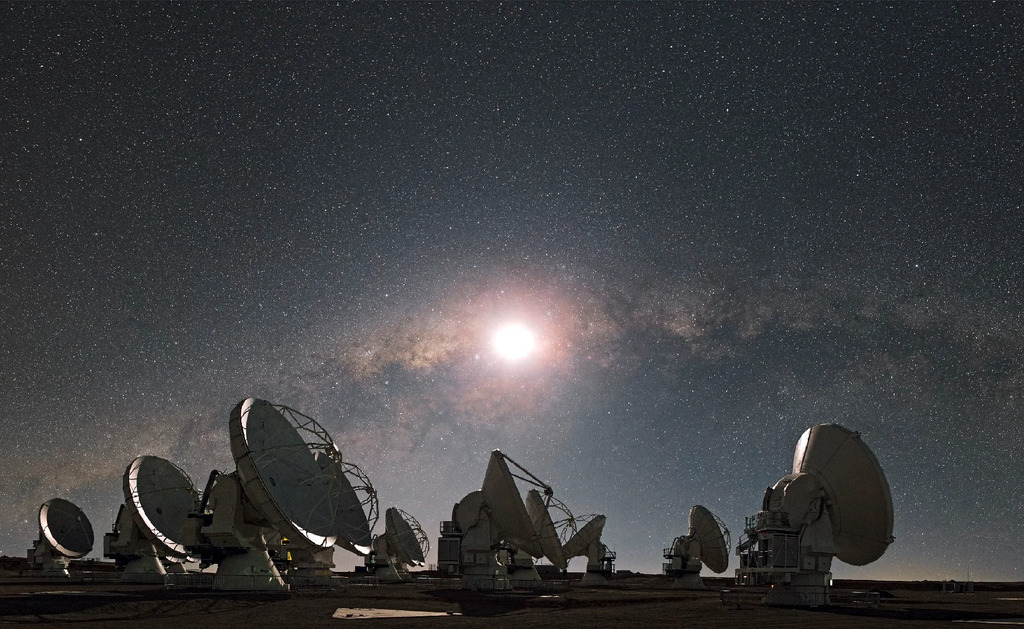
January 8, 2024, Mountain View, CA -- In a groundbreaking cosmic quest, the SETI Institute’s Commensal Open-Source Multimode Interferometer Cluster (COSMIC) at the Karl G. Jansky Very Large Array (VLA) is expanding the search for extraterrestrial intelligence (SETI). This cutting-edge technology is not a distinct telescope; it’s a detector. COSMIC searches for extraterrestrial signals and paves the way for future science using a copy of the raw data from the telescope’s observations. At the heart of COSMIC’s mission is pursuing the age-old question: Are we alone in the universe? Project scientist Dr. Chenoa Tremblay and the team detailed the project in a paper published in The Astronomical Journal.
What sets COSMIC apart is its adaptability to the future. The system is designed for future upgrades, ensuring it remains at the forefront of cosmic exploration. With the potential to expand its capabilities, COSMIC could soon cover more stars, explore new frequencies, and enhance our understanding of the vast cosmic tapestry. It is important to note that COSMIC’s capabilities go beyond searching for extraterrestrial intelligence. Future upgrades could unlock new explorations, from finding fast radio bursts with a submillisecond temporal resolution to studying spectral line science and axionic dark matter.
“COSMIC introduces modern Ethernet-based digital architecture on the VLA, allowing for a test bed for future technologies as we move into the next generation era,” said Tremblay. “Currently, the focus is on creating one of the largest surveys for technological signals, with over 500,000 sources observed in the first six months. However, the flexibility of the design allows for a wide range of other scientific opportunities, such as studying fast radio burst pulse structures and searching for axion dark matter candidates. We hope to open opportunities for other scientists to use our high time (nanoseconds) or our high spectral resolution (sub-Hz) to complete their research. It is an exciting time for increasing the capabilities of this historic telescope.”
COSMIC stands on the shoulders of giants like Project Phoenix, with the capacity to search millions of stars and the potential to expand to tens of millions—a leap in scope and sensitivity. Currently operational on the VLA, COSMIC is searching using observations from the Very Large Array Sky Survey (VLASS), which will map 80% of the sky in three phases over two years and catalog approximately 10 million radio sources.
COSMIC’s Ethernet-based system adds a new collaborative element to the cosmos. The multicasting technology allows other commensal systems to access COSMIC’s processing power, enabling a collaborative scientific ecosystem to develop. Imagine multiple telescopes working together to unlock the universe’s most profound mysteries.
“The COSMIC system greatly enhances the VLA’s scientific capabilities. Its main goal of detecting extraterrestrial technosignatures addresses one of the most profound scientific questions ever. This topic was previously not possible with the VLA,” said Dr. Paul Demorest, National Radio Astronomy Observatory. “By operating in parallel with projects such as the VLA Sky Survey, COSMIC will accomplish one of the largest SETI surveys ever while still allowing the VLA to carry out its usual program of other astronomical research.”
As we embark on this cosmic journey with COSMIC, the possibilities are as vast as the universe. Whether searching for signals from distant civilizations or unraveling the mysteries of dark matter, COSMIC is not just a detector on a telescope; it is a cosmic companion in our quest for knowledge.
COSMIC is supported by NRAO and Breakthrough Listen.
For more information including about the system design and early testing results, the paper is available here:
https://iopscience.iop.org/article/10.3847/1538-3881/ad0fe0
About the SETI Institute
Founded in 1984, the SETI Institute is a non-profit, multi-disciplinary research and education organization whose mission is to lead humanity’s quest to understand the origins and prevalence of life and intelligence in the universe and share that knowledge with the world. Our research encompasses the physical and biological sciences and leverages data analytics, machine learning, and advanced signal detection technologies. The SETI Institute is a distinguished research partner for industry, academia, and government agencies, including NASA and the National Science Foundation.
Contact
Rebecca McDonald
Director of Communications
SETI Institute
[email protected]
DOWNLOAD FULL PRESS RELEASE
)