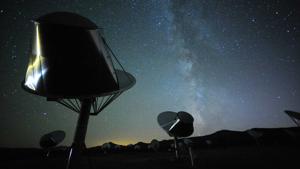





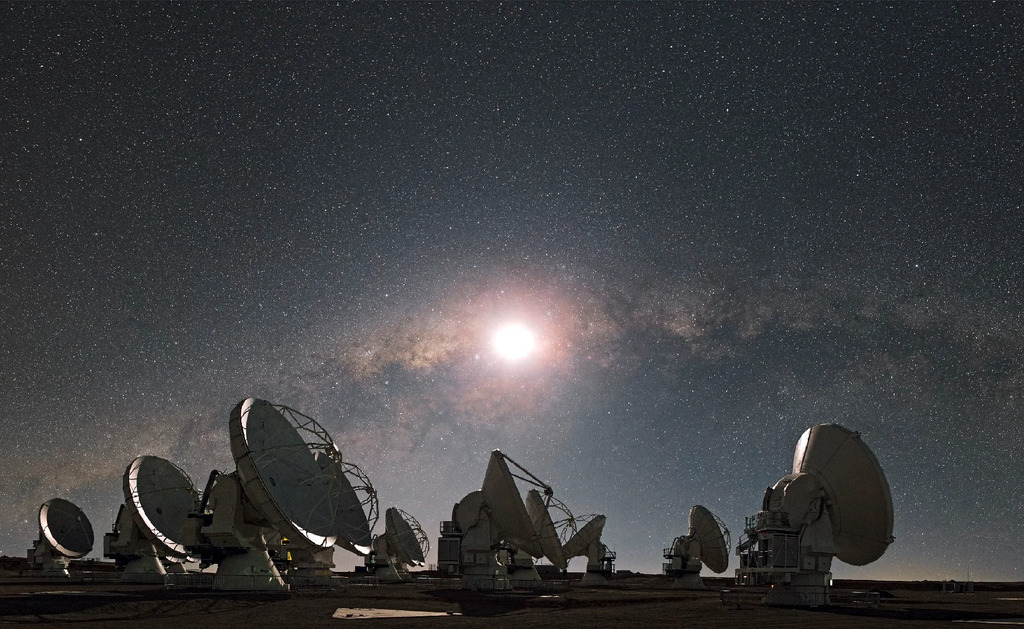




March 30, 2022, Mountain View, CA – The Canadian Hydrogen Intensity Mapping Experiment (CHIME) is expanding its ability to more accurately identify where fast radio bursts (FRBs) are coming from. CHIME is constructing a new radio telescope outrigger at the SETI Institute's Hat Creek Radio Observatory (HCRO), site of the Allen Telescope Array (ATA). The outrigger will work with the main CHIME instrument in British Columbia's Okanagan Valley and enable CHIME-detected FRBs to be precisely localized on the sky. In addition to the new radio telescope at HCRO, CHIME is constructing outriggers near Princeton, British Columbia. on land kindly leased to CHIME by HML Mining Ltd., and at the Green Bank Observatory.
“We are thrilled to welcome the world-class CHIME team to the Hat Creek Radio Observatory,” said Andrew Siemion, Bernard M. Oliver Chair for SETI at the SETI Institute. “Hosting a CHIME outrigger represents a phenomenal and complementary addition to the HCRO’s science mission.”
FRBs are bright, millisecond-wide “flashes” in the radio spectrum, originating at cosmological distances. As they make their few-billion-year journey to earth, FRBs carry the imprint of the material lying between galaxies and stars, making them a significant probe to study these environments. While the current scientific consensus is that FRBs have natural origins, they represent an exciting astronomical phenomenon. Their high degree of spectro-temporal structure and transient nature make them an ideal proving ground for the robust signal processing systems built for technosignature searches.
With the ability to detect 10-100 times more fast radio bursts than all other telescopes combined, CHIME has had a radical impact on FRB science. The telescope has allowed scientists to observe the vanishingly brief bursts with exquisite time resolution. CHIME's limitation, however, has been its inability to identify with any precision an FRB's origin. The outriggers will enable this radical leap.
“The CHIME telescope can currently locate the position of a fast radio burst to a patch of sky equivalent to the size of the full Moon. With the addition of the three new outrigger telescopes, this patch of sky can be reduced to the size of a quarter held at roughly 40 km,” explained Patrick Boyle, Senior Project Manager for the CHIME/FRB Outriggers project and Senior Academic Associate in the Department of Physics at McGill University.

Last year researchers at ATA announced the detection of a bright double-peaked radio burst from the repeating source known as FRB20201124A. The ATA has been undergoing a refurbishment program to upgrade the telescope feeds and the digital signal processing system to improve the sensitivity and capability of the instrument. This discovery marked the first FRB detection with this nascent system.
The SETI Institute will support the construction of the outrigger at the HCRO and looks forward to possible future scientific partnerships when the outrigger comes online.
About the SETI Institute
Founded in 1984, the SETI Institute is a non-profit, multi-disciplinary research and education organization whose mission is to lead humanity's quest to understand the origins and prevalence of life and intelligence in the universe and share that knowledge with the world. Our research encompasses the physical and biological sciences and leverages data analytics, machine learning, and advanced signal detection technologies. The SETI Institute is a distinguished research partner for industry, academia, and government agencies, including NASA and the National Science Foundation.
Contact information
Rebecca McDonald
Director of Communications
SETI Institute
[email protected]
About McGill University
Founded in Montreal, Quebec, in 1821, McGill University is Canada’s top ranked medical doctoral university. McGill is consistently ranked as one of the top universities, both nationally and internationally. It is a world-renowned institution of higher learning with research activities spanning three campuses, 11 faculties, 13 professional schools, 300 programs of study and over 39,000 students, including more than 10,400 graduate students. McGill attracts students from over 150 countries around the world, its 12,000 international students making up 30% of the student body. Over half of McGill students claim a first language other than English, including approximately 20% of our students who say French is their mother tongue.
Contact information
McGill University:
Fergus Grieve
Communications Officer
[email protected]
News
Related News
SETI Institute In the News: May Roundup 2026
#SETI Institute in the News #SETI Institute #Community #Solar System #Matija Ćuk #Neptune #SETI #Bill Diamond #UAPs #Drake Awards #Lori Marino #Matthew Tiscareno #Outreach #Exoplanets #Carl Sagan Center
SETI Institute Looks for Signs of Technology in Interstellar Visitor 3I/ATLAS
Observations with the Allen Telescope Array set new limits on possible signals from extraterrestrial transmitters. #Press Releases #ATA #3I/ATLAS #Hat Creek Radio Observatory #Radio Astronomy #SETI
SETI Institute Awards $1 Million in STRIDE Grants to Advance Astrobiology, Exoplanet Science, and Public Engagement
#Press Releases #STRIDE #Research #Carl Sagan Center #Spectroscopy #Solar System #SETI #Climate and Bioscience #Astronomy #Astrobiology #Exoplanets #Data Science #Education #Outreach #Hat Creek Radio Observatory #Unistellar #SkyMapper
Celebrating Frank Drake
#Frank Drake #SETI #Project Ozma #Drake Equation #SETI Institute
SETI Institute to Honor Dr. Matthew Tiscareno with 2026 Carl Sagan Center Director’s Award
The Drake Awards event will also recognize SETI Forward and SETI Institute REU student award recipients. #Press Releases #Drake Awards #Frank Drake #SETI #Awards #Planetary Astronomy #Astrobiology #SETI Forward #Education #Carl Sagan Center #Matthew Tiscareno #Nathalie Cabrol #REU
SETI Institute In the News: April Roundup 2026
#SETI Institute in the News #SETI Institute #Community #SETI #Discovery and Futures Lab #Lucian Walkowicz #Chelsea Haramia #NASA Missions and Observatories #Pascal Lee #Mars #Janice Bishop #Mark Showalter #JWST #Uranus #Bill Diamond #UAPsResearch
Related Projects
SkyMapper: Expanding Access to Real-time Astronomy Through a Global Astronomical Network
SkyMapper and the SETI Institute are connecting educators, students and the public to live astronomical observations through a distributed astronomical network. #SkyMapper #SETI #Citizen Science #Astronomy
Virtual Planetary Laboratory
How can we best assess whether an exoplanet supports life? #VPL
Discovery and Futures Lab
What happens if life beyond Earth is discovered? The Discovery and Futures Lab at the SETI Institute fosters novel and anticipatory research at the intersection of science, society, our planet, and the search for life beyond Earth. #Discovery and Futures LabSupport the
SETI Institute
Scientists are getting closer in their search for life beyond earth. But with limited federal funding for the search for extraterrestrial intelligence, supporters are the reason cutting-edge scientists can keep their eyes on the sky.