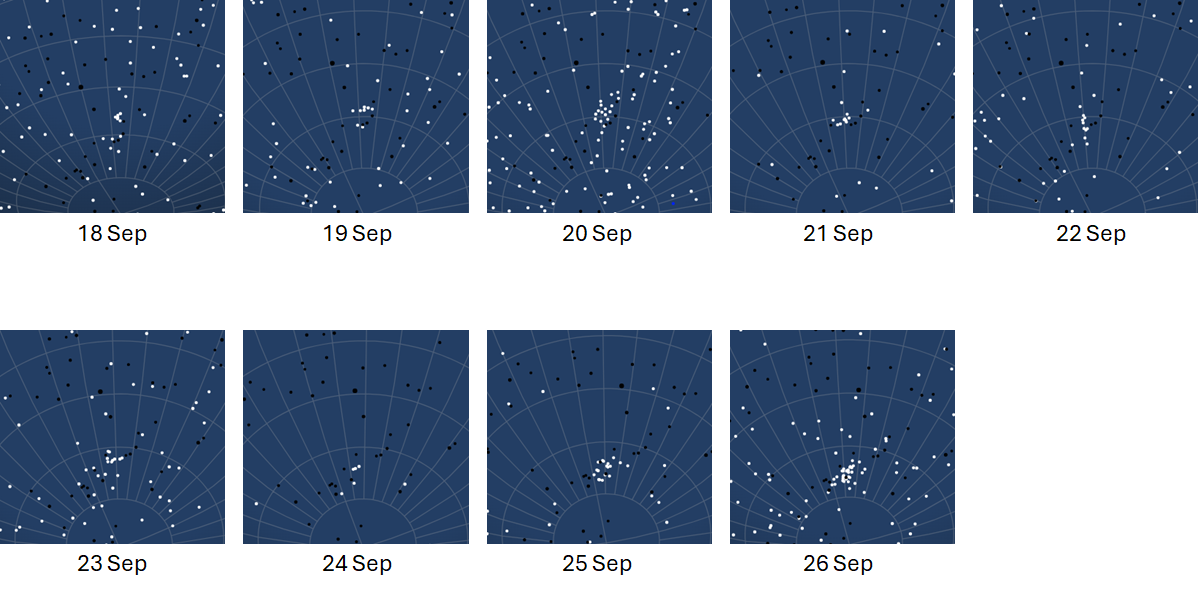
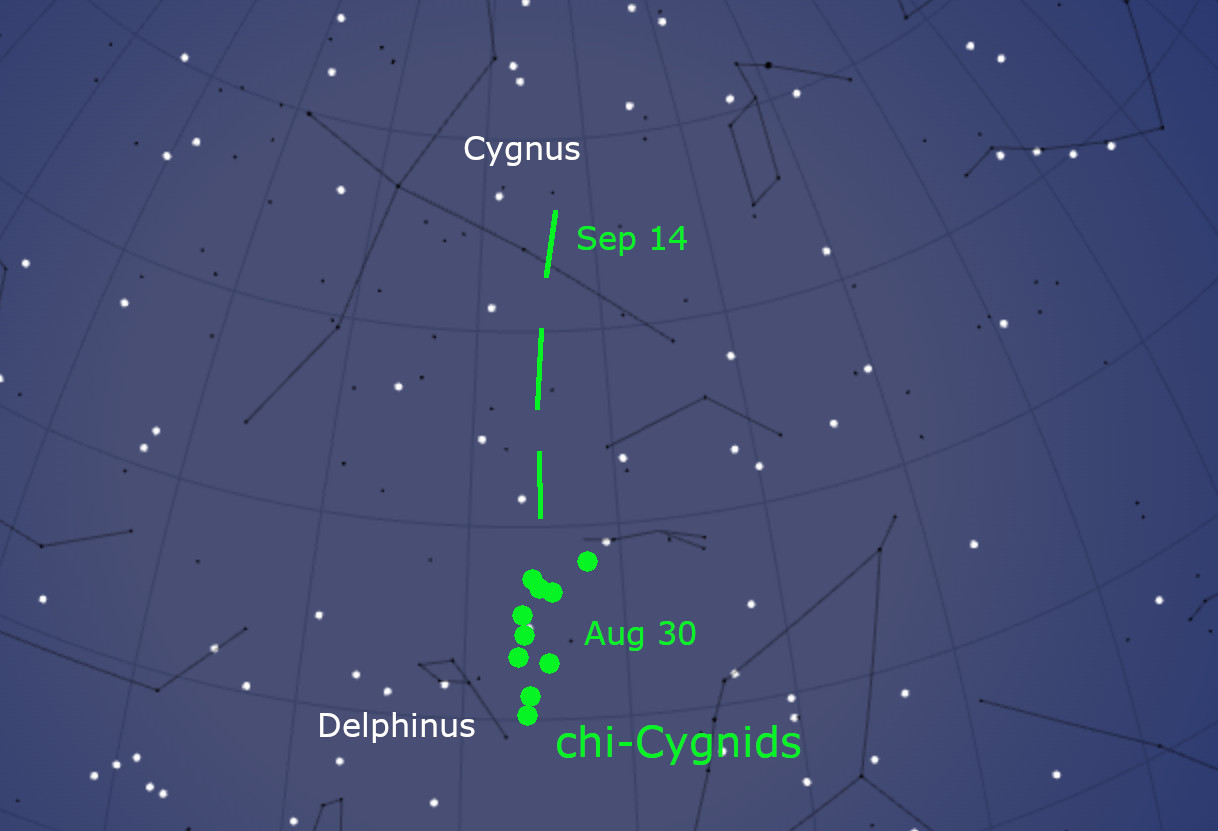
Observers during this year's Perseid meteor shower, especially the ones with dark and clear skies, may have noticed something unusual: slow meteors from the south adding to the usual Perseid display of fast meteors from the north-east. SETI Institute astronomer Peter Jenniskens reports that between August 10 and 15, slow meteors radiated from near the star nu Cap. The meteors were visible to the naked eye, but mostly faint. This nu-Capricornids meteor shower is new to astronomers and was detected by low-light video cameras all over the globe (http://cams.seti.org/FDL/ for dates of August 10-15, 2024). The new shower is caused by a yet-to-be identified comet or primitive asteroid that lost material in the recent past.
Report:http://www.cbat.eps.harvard.edu/iau/cbet/005400/CBET005434.txt
Electronic Telegram No. 5434
Central Bureau for Astronomical Telegrams
Prepared using the Tamkin Foundation Computer Network
NEW METEOR SHOWER WITH RADIANT IN CAPRICORNUS
P. Jenniskens, SETI Institute and NASA Ames Research Center, reports the detection of a newly recognized meteor shower with slow meteors from a radiant near nu Cap during this year's Perseid meteor shower season. The radiant was located just below that of the alpha Capricornid shower for dates of Aug. 10-15). This new shower was first detected in low-light video camera observations on 2024 Aug. 3, and last on 2024 Aug. 16, with activity spanning the solar longitude interval 131.3 to 143.5 degrees and centered at 139.05 deg (equinox J2000.0). Sixty-two new shower meteors were triangulated by CAMS New Zealand (coordinated by J. Baggaley, University of Canterbury; and J. Scott, University of Otago), 24 by CAMS Australia (H. Devillepoix, Curtin University; and D. Rollinson), 19 by CAMS BeNeLux (C. Johannink and M. Breukers), eleven by LO-CAMS in Arizona (N. Moskovitz, Lowell Observatory), six by CAMS Namibia (T. Hanke, E. Fahl, and R. van Wyk, HESS Collaboration), three by CAMS Chile (S. Heathcote, NOIRLAB and Cerro Tololo; and E. Jehin, University of Liege), three by the UAE Astronomical Camera Network (M. Odeh, International Astronomical Center), one by CAMS Arkansas (L. Juneau), and one by CAMS California (J. Albers, B. Grigsby, E. Egland, and T. Beck). The most prolific of these networks also participate in the Global Meteor Network. The triangulated meteors were mostly faint, ranging from absolute (from a distance of 100 km) visual magnitudes of -0.8 to +3.9, and centered on mag +2.0. The meteors radiated from a geocentric radiant centered at R.A. = 306.65 +/- 0.14 deg, Decl. = -11.38 +/- 0.09 deg (equinox J2000.0), with geocentric velocity 18.34 +/- 0.08 km/s (standard errors). The radiant drift was +0.40 deg/day in R.A. and +0.26 deg/day in Decl.; the corresponding sun-centered ecliptic coordinates are longitude 166.74 +/- 0.18 deg, latitude +7.62 +/- 0.07 deg. The orbital elements were centered at a = 2.94 +/- 0.03 AU, q = 0.749 +/- 0.002 AU, e = 0.745 +/- 0.003, i = 4.17 +/- 0.04 deg, Peri = 247.0 +/- 0.3 deg, and Node = 139.1 +/- 0.3 deg, while the longitude of perihelion was Pi = 26.4 +/- 1.2 deg. The orbital elements changed along the earth's path at a rate of +0.006 AU/day in q, +0.03 deg/day in i, and -0.89 deg/day in Peri. The episodic nature of the shower may be on account of recent comet activity or meteoroids being trapped in the 5:2 mean-motion resonance with Jupiter.
NOTE: These 'Central Bureau Electronic Telegrams' are sometimes
superseded by text appearing later in the printed IAU Circulars.
(C) Copyright 2024 CBAT
2024 August 20 (CBET 5434) Daniel W. E. Green
)