)

Thursday, Jan 08, 2026

Meteor Shower by SKY-Stock via Envato.
Electronic Telegram No. 5653
VOLANTID METEORS 2025-2026
P. Jenniskens, SETI Institute and NASA Ames Research Center; D. S. Lauretta, University of Arizona; J. Baggaley and J. Scott, Cameras for All-sky Meteor Surveillance (CAMS) low-light video survey, New Zealand; and H. A. R. Devillepoix and D. Rollinson, CAMS Australia, report that the Volantids meteor shower (IAU shower no. 758) was detected in the southern hemisphere during New Year's Eve 2025 (see map at website URL http://cams.seti.org/FDL/ for dates of 2025 Dec. 28-2026 Jan. 4). A total of 100 Volantid meteors were triangulated between solar longitudes 274 and 284 degrees, centered on a median solar longitude 279.82 +/- 0.11 degrees (equinox J2000.0). This episodic Jupiter- family-comet shower with geocentric radiant R.A. = 123 deg, Decl. = -72 deg and geocentric velocity 30 km/s around solar longitude 279 degress was previously detected around 2015 Dec. 31 and around 2020 Dec. 31. This year's return establishes a five-year periodicity, which suggests that these meteoroids are trapped in the 7:3 mean-motion resonance with Jupiter (period 5.08 years). The parent Jupiter family comet is not known, but likely has a semi-major axis near 2.96 AU, with approximate orbital elements q = 0.97 AU, e = 0.65, i = 51 deg, Peri. = 347 deg, Node = 99 deg, and longitude of perihelion close to 86 deg.
D. Vida, University of Western Ontario; D. Segon, Croatian Meteor Network; P. Roggemans, Mechelen, Belgium; J. Wood, Willetton, Australia; J. Scott, Aarhus University; and W. J. Cooke and A. Vriezelaar, NASA Meteoroid Environment Office, report an outburst of the kappa Volantid (KVO) meteor shower (IAU shower no. 787): 304 Volantid meteors were observed by the Global Meteor Network (GMN) low-light video cameras between 2025 Dec. 25 and 2026 Jan. 1 (cf. website URL https://globalmeteornetwork.org/data/). The shower was independently observed by cameras in five countries in the southern hemisphere (Australia, Brazil, Chile, New Zealand, and South Africa). The GMN did not observe any KVO meteors in 2024 when it had sufficient coverage in the southern hemisphere and the weather was clear. The shower had a median geocentric radiant at R.A. = 125.35 deg, Decl. = -71.98 deg (equinox J2000.0), within a wide circle having a standard deviation of +/- 1.3 deg. The radiant drift in R.A. was 0.19 deg on the sky per degree of solar longitude and -0.98 degrees in Decl., both with reference to the sun at longitude 279.5 deg. The median sun-centered ecliptic coordinates were L-L0 = 300.00 deg, beta = -76.53 deg. The geocentric velocity was 30.30 +/- 0.05 km/s. The orbital elements are characteristic of a Jupiter-family comet: q = 0.9731 +/- 0.0046 AU, e = 0.630 +/- 0.043, i = 50.9 +/- 1.5 deg, Peri. = 347.6 +/- 3.5 deg, Node = 98.7 +/- 1.5 deg (equinox J2000.0). All meteors appeared during in the solar- longitude interval 273.6-281.0 degrees, with a peak at roughly 279.5 degrees. A plot of co-added GMN radiant locations for the month of Dec. 2025 (cf. URL https://tinyurl.com/mrxncxc9) shows a concentration of radiants near the bottom right of the plot, which is the KVO shower. A parent-body search with a "Drummond D" criterion (cf. Drummond 2000, Icarus 146, 453) returned several potential candidates, of which the top three are as follows: D = 0.116 for 2017 YN_3, D = 0.127 for 2022 WC_12, and D = 0.140 for 2022 BJ_3. The original discovery of the shower reported by Pokorny et al. (2017, Icarus 290, 162), based on radar data, suggested minor planet 2011 AL_1 as the parent body, but that object was not even in the top-ten closest objects by orbit in the present analysis. Vida adds that the two Volatid showers noted in this CBET may need merging into a single shower.
NOTE: These 'Central Bureau Electronic Telegrams' are sometimes superseded by text appearing later in the printed IAU Circulars.
(C) Copyright 2026 CBAT 2026 January 7 (CBET 5653) Daniel W. E. Green







News
Related News
Jul 17, 2026
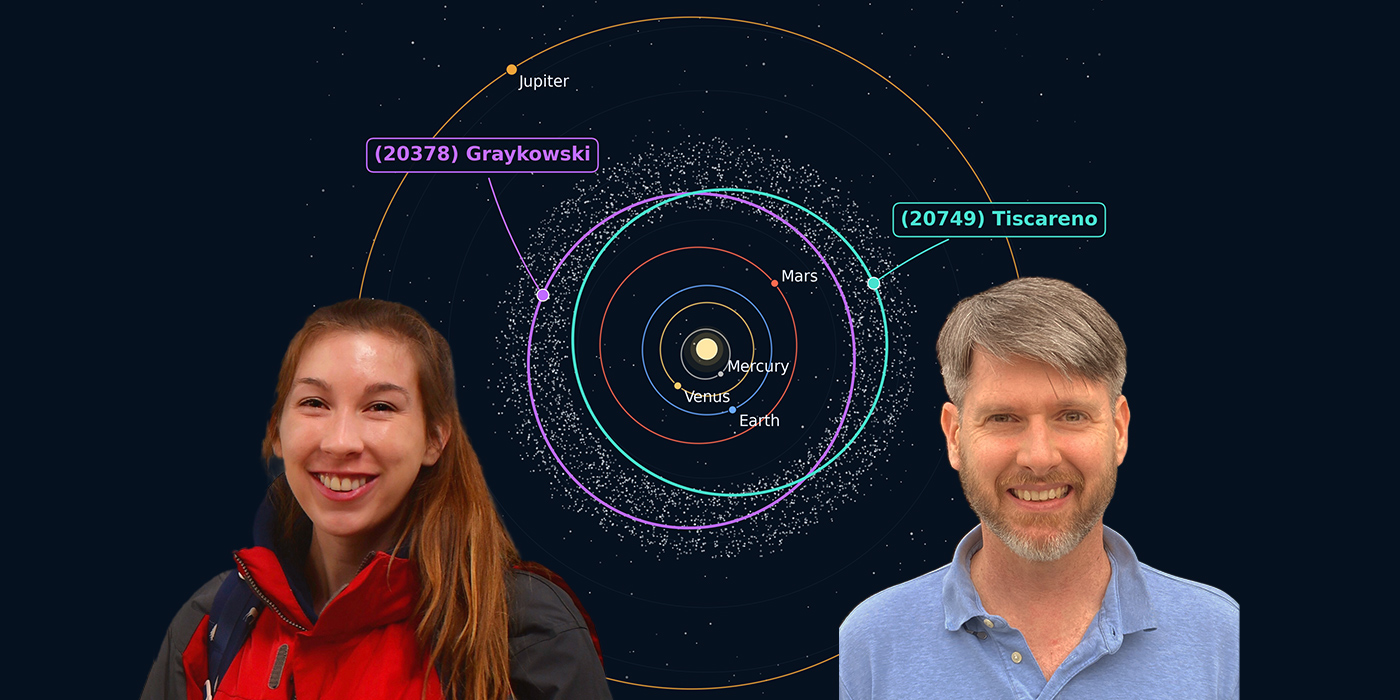
Two SETI Institute Scientists Honored with Asteroids Bearing Their Names
#Comets, Meteors, and Asteroids #Ariel Graykowski #Matthew Tiscareno #Planetary Astronomy #Solar System #Saturn
Jul 15, 2026
Alien World Chemistry Found Inside Meteorite That Struck New Jersey home
#Press Releases #Meteorites #Peter Jenniskens #JAMSTEC
Jul 10, 2026
A Remarkably Ancient Visitor: 3I/ATLAS
#3I/ATLAS #Comets, Meteors, and Asteroids #JWST
May 1, 2026
Asteroid Named in Honor of SETI Researcher and Communicator Seth Shostak
#Comets, Meteors, and Asteroids #Seth Shostak #SETI #Astronomy #Big Picture Science #Outreach #Andrew Fraknoi
Apr 23, 2026
SkyMapper Goes Live: Building a Real-Time, Global Network for Astronomy
SkyMapper functions as an observational infrastructure, a system that links instruments, users, and data streams. Its goal is ambitious: to continuously observe and map the entire sky. #Blog #SkyMapper #LaserSETI #SETI #Astronomy #Exoplanet Detection #Comets, Meteors, and Asteroids #Planetary Defense #Technosignatures #Franck Marchis #Lauren Sgro
Apr 3, 2026
SETI Institute In the News: March Roundup 2026
In March 2026, SETI Institute researchers contributed to a wide range of conversations about our solar system and the search for life beyond Earth. From explaining unusual features on Mars and studying meteor airbursts in Earth’s atmosphere to advancing new ways of detecting technosignatures, this work reflects how scientists are continually refining our understanding of both nearby and distant worlds. #SETI Institute in the News #SETI Institute #Community #Mars #Pascal Lee #Peter Jenniskens #Comets, Meteors, and Asteroids #Astronomy #Vishal Gajjar #SETI #AI and Machine Learning #Astrobiology #Nathalie Cabrol #Carl Sagan Center #Seth Shostak #Movie Reviews #Bill Diamond
Jul 17, 2026
#Comets, Meteors, and Asteroids
#Ariel Graykowski
#Matthew Tiscareno
#Planetary Astronomy
#Solar System
#Saturn
Jul 15, 2026
#Press Releases
#Meteorites
#Peter Jenniskens
#JAMSTEC
Alien World Chemistry Found Inside Meteorite That Struck New Jersey home
Jul 10, 2026
#3I/ATLAS
#Comets, Meteors, and Asteroids
#JWST
A Remarkably Ancient Visitor: 3I/ATLAS
May 1, 2026
#Comets, Meteors, and Asteroids
#Seth Shostak
#SETI
#Astronomy
#Big Picture Science
#Outreach
#Andrew Fraknoi
Asteroid Named in Honor of SETI Researcher and Communicator Seth Shostak
Apr 23, 2026
SkyMapper Goes Live: Building a Real-Time, Global Network for Astronomy
SkyMapper functions as an observational infrastructure, a system that links instruments, users, and data streams. Its goal is ambitious: to continuously observe and map the entire sky.
#Blog
#SkyMapper
#LaserSETI
#SETI
#Astronomy
#Exoplanet Detection
#Comets, Meteors, and Asteroids
#Planetary Defense
#Technosignatures
#Franck Marchis
#Lauren Sgro
Apr 3, 2026
SETI Institute In the News: March Roundup 2026
In March 2026, SETI Institute researchers contributed to a wide range of conversations about our solar system and the search for life beyond Earth. From explaining unusual features on Mars and studying meteor airbursts in Earth’s atmosphere to advancing new ways of detecting technosignatures, this work reflects how scientists are continually refining our understanding of both nearby and distant worlds.
#SETI Institute in the News
#SETI Institute
#Community
#Mars
#Pascal Lee
#Peter Jenniskens
#Comets, Meteors, and Asteroids
#Astronomy
#Vishal Gajjar
#SETI
#AI and Machine Learning
#Astrobiology
#Nathalie Cabrol
#Carl Sagan Center
#Seth Shostak
#Movie Reviews
#Bill Diamond
Research
Related Projects

SkyMapper • SETI • Citizen Science • Astronomy
SkyMapper: Expanding Access to Real-time Astronomy Through a Global Astronomical Network
SkyMapper and the SETI Institute are connecting educators, students and the public to live astronomical observations through a distributed astronomical network. #SkyMapper #SETI #Citizen Science #Astronomy
VPL
Virtual Planetary Laboratory
How can we best assess whether an exoplanet supports life? #VPL
Discovery and Futures Lab
Discovery and Futures Lab
What happens if life beyond Earth is discovered? The Discovery and Futures Lab at the SETI Institute fosters novel and anticipatory research at the intersection of science, society, our planet, and the search for life beyond Earth. #Discovery and Futures Lab
May 17, 2026
SkyMapper: Expanding Access to Real-time Astronomy Through a Global Astronomical Network
SkyMapper and the SETI Institute are connecting educators, students and the public to live astronomical observations through a distributed astronomical network.
#SkyMapper
#SETI
#Citizen Science
#Astronomy
May 5, 2026
Virtual Planetary Laboratory
How can we best assess whether an exoplanet supports life?
#VPL
Apr 16, 2026
Discovery and Futures Lab
What happens if life beyond Earth is discovered? The Discovery and Futures Lab at the SETI Institute fosters novel and anticipatory research at the intersection of science, society, our planet, and the search for life beyond Earth.
#Discovery and Futures Lab
Support Us
Support the
SETI Institute
Scientists are getting closer in their search for life beyond earth. But with limited federal funding for the search for extraterrestrial intelligence, supporters are the reason cutting-edge scientists can keep their eyes on the sky.
