






Wednesday, Sep 03, 2025

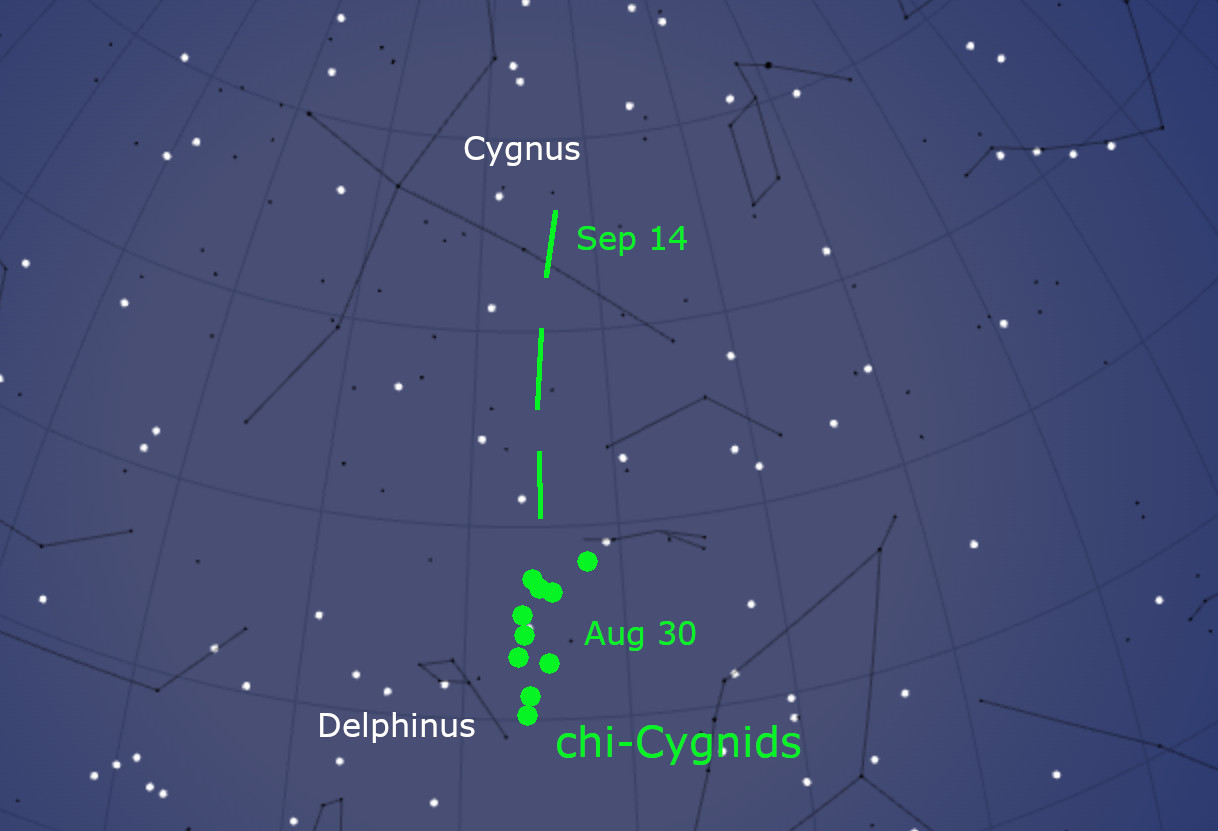
P. Jenniskens, SETI Institute and NASA Ames Research Center; and M. Breukers and C. Johannink, Cameras for Allsky Meteor Surveillance (CAMS), BeNeLux, report that the chi Cygnids meteor shower (IAU shower #757) was detected this past week (cf. map at website URL http://cams.seti.org/FDL/ for dates of 2025 Aug. 20-31). Based on past returns, the shower is expected to increase in activity gradually until a peak around Sept. 14, followed by a rapid decline (cf. Jenniskens 2023, Atlas of Earth's Meteor Showers, p. 83). This episodic shower was last seen in 2010, 2015, and 2020. The return in 2025 establishes a five-year periodicity, which suggests that these meteoroids are trapped in the 7:3 mean-motion resonance with Jupiter (period of 5.08 yr). The parent Jupiter-family comet is not known, but likely has a semi-major axis near 2.96 AU, q about 0.99 AU, e about 0.65, i about 23 degrees, Peri. about 194 degrees, Node about 185 degrees, and longitude of perihelion close to 21 degrees.

NOTE: These 'Central Bureau Electronic Telegrams' are sometimes superseded by text appearing later in the printed IAU Circulars.

(C) Copyright 2025 CBAT
2025 September 3 (CBET 5601) Daniel W. E. Green

News

Related News

Featured Image
May 1, 2026
Asteroid Named in Honor of SETI Researcher and Communicator Seth Shostak
#Comets, Meteors, and Asteroids #Seth Shostak #SETI #Astronomy #Big Picture Science #Outreach #Andrew Fraknoi
Featured Image
Apr 23, 2026
SkyMapper Goes Live: Building a Real-Time, Global Network for Astronomy
SkyMapper functions as an observational infrastructure, a system that links instruments, users, and data streams. Its goal is ambitious: to continuously observe and map the entire sky. #Blog #SkyMapper #LaserSETI #SETI #Astronomy #Exoplanet Detection #Comets, Meteors, and Asteroids #Planetary Defense #Technosignatures #Franck Marchis #Lauren Sgro
Featured Image
Apr 3, 2026
SETI Institute In the News: March Roundup 2026
In March 2026, SETI Institute researchers contributed to a wide range of conversations about our solar system and the search for life beyond Earth. From explaining unusual features on Mars and studying meteor airbursts in Earth’s atmosphere to advancing new ways of detecting technosignatures, this work reflects how scientists are continually refining our understanding of both nearby and distant worlds. #SETI Institute in the News #SETI Institute #Community #Mars #Pascal Lee #Peter Jenniskens #Comets, Meteors, and Asteroids #Astronomy #Vishal Gajjar #SETI #AI and Machine Learning #Astrobiology #Nathalie Cabrol #Carl Sagan Center #Seth Shostak #Movie Reviews #Bill Diamond
Featured Image
Mar 20, 2026
SETI Live: Unistellar + Citizen Science (Part 8)
#Blog #Unistellar #Citizen Science #Lauren Sgro #Franck Marchis #Astronomy #NASA Missions and Observatories #SETI Institute #Comets, Meteors, and Asteroids #Artemis II #3I/ATLAS
Featured Image
Jan 22, 2026
2025 in Citizen Science – The Biggest Year Yet!
#Unistellar #Astronomy #Exoplanets #3I/ATLAS #Comets, Meteors, and Asteroids #Planetary Defense #Community
Featured Image
Jan 13, 2026
What to Expect in Space Science 2026
#Blog #SETI Institute #SkyMapper #Moon #Comets, Meteors, and Asteroids #3I/ATLAS #Planetary Exploration
Research

Related Projects

Featured Image
SkyMapper • SETI • Citizen Science • Astronomy
SkyMapper: Expanding Access to Real-time Astronomy Through a Global Astronomical Network
SkyMapper and the SETI Institute are connecting educators, students and the public to live astronomical observations through a distributed astronomical network. #SkyMapper #SETI #Citizen Science #Astronomy
Featured Image
VPL
Virtual Planetary Laboratory
How can we best assess whether an exoplanet supports life? #VPL
Featured Image
Discovery and Futures Lab
What happens if life beyond Earth is discovered? The Discovery and Futures Lab at the SETI Institute fosters novel and anticipatory research at the intersection of science, society, our planet, and the search for life beyond Earth.  #Discovery and Futures Lab
Support Us

Support the
SETI Institute

Scientists are getting closer in their search for life beyond earth. But with limited federal funding for the search for extraterrestrial intelligence, supporters are the reason cutting-edge scientists can keep their eyes on the sky.