)

Wednesday, May 14, 2025

When we think about asteroids that could threaten Earth, we often imagine massive, city-sized rocks hurtling through space. But what if the real danger comes from much smaller, barely detectable ones?
In a new study using the James Webb Space Telescope, scientists have discovered a hidden population of tiny asteroids in our solar system. These objects might be a more significant threat than we ever realized.
In a recent SETI Live episode, Senior Planetary Astronomer Dr. Franck Marchis and the study's lead authors, Dr. Artem Y. Burdanov and Dr. Julien de Wit, discussed the role of minor asteroids and what they can reveal about potential threats to Earth.
The Search for the Smallest Asteroids
Burdanov, a research scientist at MIT, de Wit, an associate professor of Planetary Science at MIT, and twenty co-authors published a remarkable study that revealed the discovery of 138 tiny asteroids. Some are as small as 10 meters in diameter, hiding between Mars and Jupiter in the main asteroid belt. These were spotted using the James Webb Space Telescope (JWST) and an innovative technique called “shift and stack.”
What is Shift and Stack?
The shift and stack method, developed in the 1990s, has gained popularity with the advent of modern GPUs, making it much faster and more practical. This technique involves taking multiple images over time and then aligning these images based on where an asteroid should move. The asteroid then stands out while stars and other background objects blur away.
With this technique, JWST becomes not just a window into the deep universe but a powerful tool for planetary defense. This process makes it easier for scientists to detect faint, fast-moving asteroids.
Why Do Small Asteroids Matter?
Most space surveys have focused on large asteroids, particularly those over one kilometer in diameter. These are considered planet killers, and we’ve found about 95% of them. However, smaller asteroids, especially those 100 meters or less in size, can still cause significant damage. For example, the 2013 Chelyabinsk event involved a 20-meter asteroid that exploded in the atmosphere, injuring approximately 1,500 people.
By understanding these objects better, we can improve our ability to predict and protect against potential threats.
Why JWST?
The James Webb Space Telescope is the largest telescope ever launched into space, and one of its key strengths is its ability to observe in the infrared. This is important because small asteroids, which can be very faint in visible light, emit more strongly in infrared due to their heat. While most ground-based telescopes detect asteroids by the sunlight they reflect, JWST detects their thermal emission. This helps scientists to uncover asteroids that would otherwise remain hidden.
What JWST Tells Us?
JWST's infrared imaging allows scientists to detect asteroids and estimate their size, frequency, and population. This helps determine their orbits more precisely and provides insights into their origins and evolution. But beyond simply spotting asteroids, this study gave the first accurate count of how many small asteroids exist in the main belt, which had never been done before.
In the data, researchers found a sudden drop, or “kink,” in the number of asteroids around 100 meters, followed by an increase in smaller asteroids. This suggests that many small asteroids are likely fragments from past collisions between larger ones. While we know of around 2 million asteroids larger than one kilometer, there may be up to 10 billion larger than 10 meters in the main belt.
Knowing how many small asteroids exist is crucial to the field of planetary defense, as these smaller ones are more likely to leave the belt and become near-Earth Objects (NEOs). The team took a few steps to single these out from the crowd:
-
Asteroid Families:
Once the new asteroids were detected, researchers compared their positions to determine asteroid paths. Although those objects were outside JWST's field of view, their known orbital paths allowed scientists to link many new finds to known asteroid families formed by collisions.
-
NEOs (near-Earth Objects):
To distinguish near-Earth objects (NEOs) from main belt asteroids (MBAs), scientists looked at how fast and in what direction each object was moving. This motion, called a velocity vector, was compared to those of hundreds of known asteroids. If an object moved much faster than typical MBAs, it was marked as a possible NEO. Out of 140 objects detected, six had unusually high speeds, suggesting they are NEOs.
What’s Next: A 3D Look at the Asteroid Belt
The team has already secured a legacy-class archival program with JWST, intending to apply the same shift-and-stack method across all large datasets from other fields of view. This will allow researchers to study the asteroid belt population in 3D.
Asteroid families tend to cluster at specific latitudes. By shifting from one region to another, scientists expect to observe different size frequency distributions and trace the evolution of these families. The next six months of data analysis may reveal much more about how these populations change across space and time.
A New Era of Planetary Defense
By detecting and characterizing mini-asteroids, JWST provides scientists with:
- More accurate models of asteroid populations
- Deeper insights into how collisions have shaped the solar system
- Tools to identify potential threats long before they approach Earth
And this is only the beginning. Scientists are exploring combining the shift and stack method with AI to improve asteroid detection. The search will also expand using data from the Euclid space mission (a space telescope launched by the European Space Agency).
The upcoming NEO Surveyor mission is scheduled to launch in September 2027 and will help find many new near-Earth objects. JWST will play a key role in complementing that mission by observing objects while they are still far away and helping to determine their orbits.
Tiny Clues, Big Impacts
We often look to the stars for beauty and wonder, but space also holds dangers we must understand. JWST, already revolutionizing astronomy, is also helping us see the invisible threats lurking in the asteroid belt.
To learn more, check out the research paper, watch the video below, or find Tiny Asteroids, Big Threats: JWST Reveals a Hidden World of Mini Asteroids on our YouTube channel.







News
Related News
Jul 17, 2026
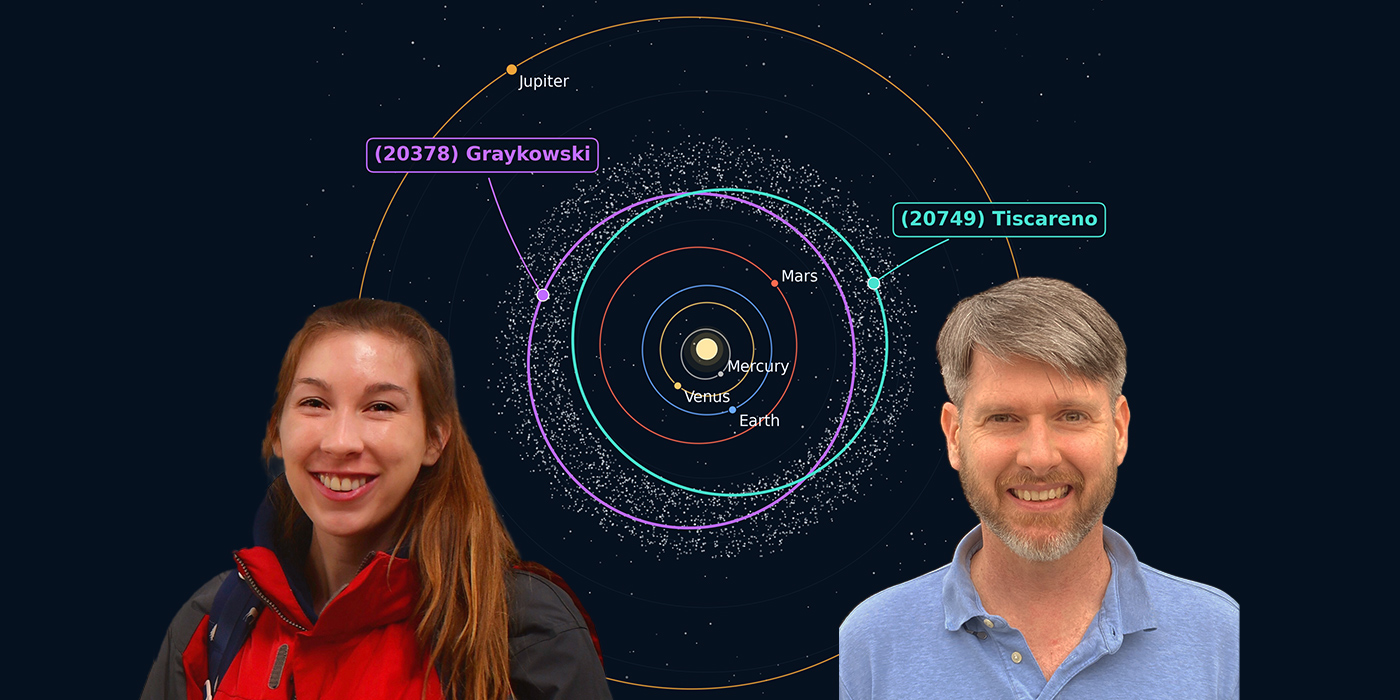
Two SETI Institute Scientists Honored with Asteroids Bearing Their Names
#Comets, Meteors, and Asteroids #Ariel Graykowski #Matthew Tiscareno #Planetary Astronomy #Solar System #Saturn
Jul 10, 2026
A Remarkably Ancient Visitor: 3I/ATLAS
#3I/ATLAS #Comets, Meteors, and Asteroids #JWST
Jun 26, 2026
What Juice Revealed About Interstellar Comet 3I/ATLAS
#Blog #3I/ATLAS #Franck Marchis #Juice
Jun 9, 2026
Disclosure Needs Data
#SkyMapper #Franck Marchis #SETI #citizen science
Jun 5, 2026
Beyond Disclosure Day: The Real-World Protocols
#Press Releases #SETI #Astronomy #Bill Diamond #SETI Institute
Jun 4, 2026
SETI Institute In the News: May Roundup 2026
#SETI Institute in the News #SETI Institute #Community #Solar System #Matija Ćuk #Neptune #SETI #Bill Diamond #UAPs #Drake Awards #Lori Marino #Matthew Tiscareno #Outreach #Exoplanets #Carl Sagan Center
Jul 17, 2026
#Comets, Meteors, and Asteroids
#Ariel Graykowski
#Matthew Tiscareno
#Planetary Astronomy
#Solar System
#Saturn
Jul 10, 2026
#3I/ATLAS
#Comets, Meteors, and Asteroids
#JWST
A Remarkably Ancient Visitor: 3I/ATLAS
Jun 26, 2026
#Blog
#3I/ATLAS
#Franck Marchis
#Juice
What Juice Revealed About Interstellar Comet 3I/ATLAS
Jun 9, 2026
#SkyMapper
#Franck Marchis
#SETI
#citizen science
Disclosure Needs Data
Jun 5, 2026
#Press Releases
#SETI
#Astronomy
#Bill Diamond
#SETI Institute
Beyond Disclosure Day: The Real-World Protocols
Jun 4, 2026
#SETI Institute in the News
#SETI Institute
#Community
#Solar System
#Matija Ćuk
#Neptune
#SETI
#Bill Diamond
#UAPs
#Drake Awards
#Lori Marino
#Matthew Tiscareno
#Outreach
#Exoplanets
#Carl Sagan Center
SETI Institute In the News: May Roundup 2026
Research
Related Projects

SkyMapper • SETI • Citizen Science • Astronomy
SkyMapper: Expanding Access to Real-time Astronomy Through a Global Astronomical Network
SkyMapper and the SETI Institute are connecting educators, students and the public to live astronomical observations through a distributed astronomical network. #SkyMapper #SETI #Citizen Science #Astronomy
VPL
Virtual Planetary Laboratory
How can we best assess whether an exoplanet supports life? #VPL
Discovery and Futures Lab
Discovery and Futures Lab
What happens if life beyond Earth is discovered? The Discovery and Futures Lab at the SETI Institute fosters novel and anticipatory research at the intersection of science, society, our planet, and the search for life beyond Earth. #Discovery and Futures Lab
May 17, 2026
SkyMapper: Expanding Access to Real-time Astronomy Through a Global Astronomical Network
SkyMapper and the SETI Institute are connecting educators, students and the public to live astronomical observations through a distributed astronomical network.
#SkyMapper
#SETI
#Citizen Science
#Astronomy
May 5, 2026
Virtual Planetary Laboratory
How can we best assess whether an exoplanet supports life?
#VPL
Apr 16, 2026
Discovery and Futures Lab
What happens if life beyond Earth is discovered? The Discovery and Futures Lab at the SETI Institute fosters novel and anticipatory research at the intersection of science, society, our planet, and the search for life beyond Earth.
#Discovery and Futures Lab
Support Us
Support the
SETI Institute
Scientists are getting closer in their search for life beyond earth. But with limited federal funding for the search for extraterrestrial intelligence, supporters are the reason cutting-edge scientists can keep their eyes on the sky.
