)

Tuesday, Dec 08, 2020
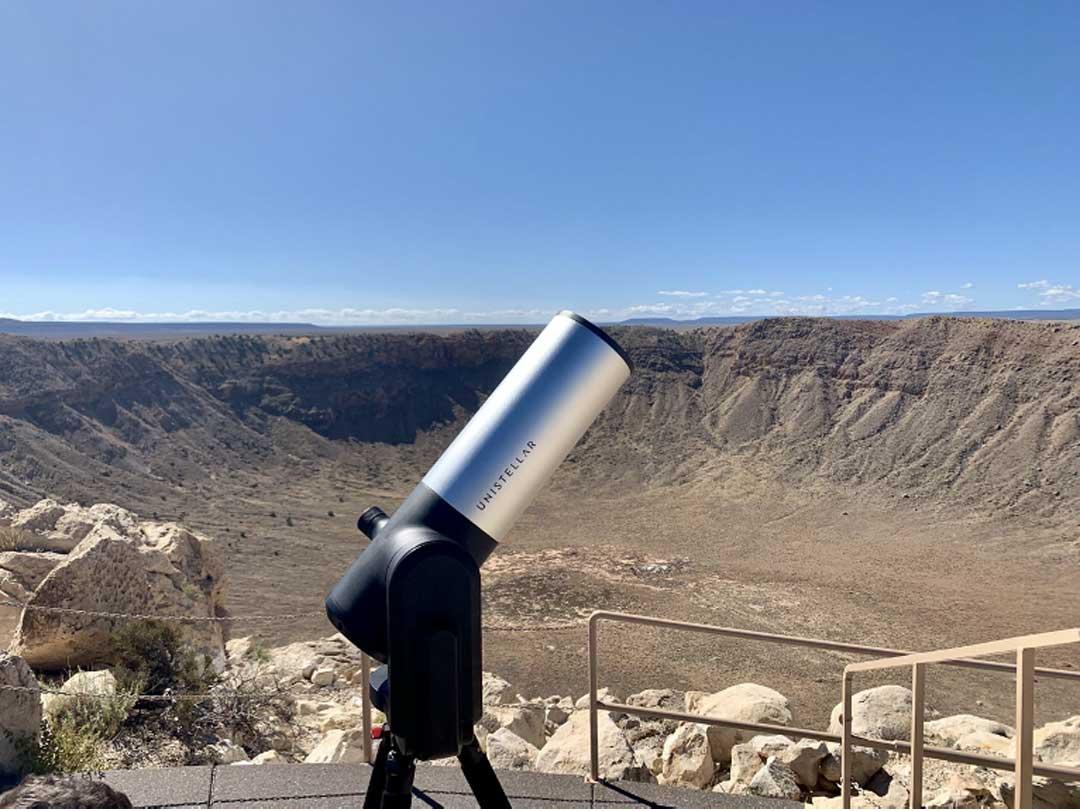
The Unistellar eVscope at Meteor Crater
Marseille, France and San Francisco, CA, December 9, 2020 –– The world’s first planetary defense team staffed by citizen astronomers has completed its first research mission: Detect and model a Near-Earth Asteroid, for only the 69th time in history. To honor the achievement, space-lovers from around the planet have a chance to give the asteroid a nickname.
Twenty-six backyard astronomers achieved a world-first by detecting and modeling a little-known Near-Earth Asteroid (NEA), 1999 AP10. Operating their Unistellar eVscopes from Austria, Cyprus, Finland, France, Switzerland, the United Kingdom and the United States of America, these citizen astronomers obtained decisive information about a potentially harmful solar system body.
“The Unistellar network of citizen astronomers accomplished something that professional astronomers have rarely done before. This proves the potential for meaningful Planetary Defense work to be conducted by everyday citizens who share a passion for space,” said Franck Marchis, senior astronomer at the SETI Institute and Chief Scientific Officer of Unistellar. “Continuous observations of Near-Earth Asteroids when they are close to Earth are critical to understand them and potentially mitigate their risk to our planet.”
This collaboration represents the world’s largest-ever citizen astronomy planetary defense research campaign, with 26 citizen astronomers located in 7 different countries successfully gathering valuable astronomical data. Researchers will present the results will be presented at the American Geophysical Union Fall Meeting.
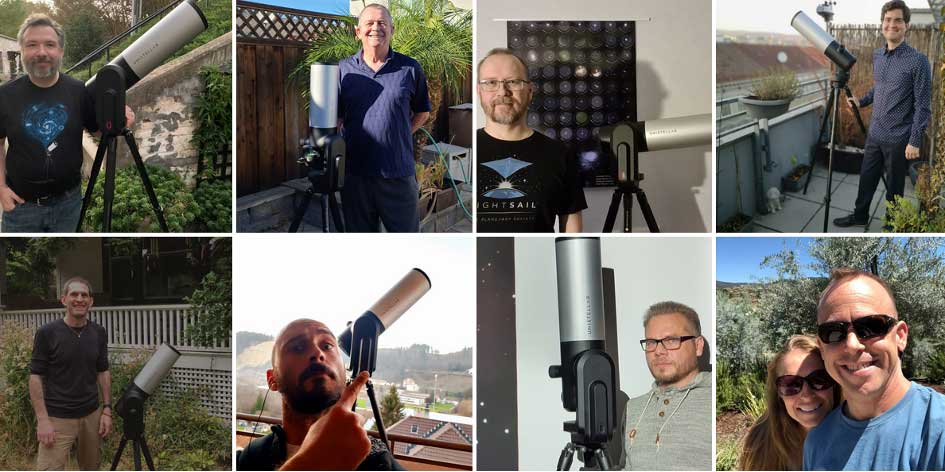
Citizen Astronomers from the Unistellar Network
Unistellar & SETI Institute Partner to Generate a Shape Model
Citizen astronomers observed 1999 AP10 in October and November of 2020 after being alerted by the SETI Institute team of researchers. The team used Unistellar eVscopes, a smart telescope that reveals the cosmos quickly and easily, to conduct the research. Thanks to a scientific partnership with the SETI Institute, citizen astronomers can contribute to cutting-edge research on exoplanet transits, asteroid occultations, comets, and much more with their eVscope.
This worldwide effort led to a better understanding of this still-mysterious body. Even though 1999 AP10 is one of 20,000 known Near-Earth Asteroids, only 1,250 have a size estimate and, among these, only 68 have a shape estimate. Thanks to the collected information, Joseph Durech, from Charles University in Prague, generated a shape model, making 1999 AP10 the 69th Near-Earth Asteroid to be shaped.
“Thanks to the Unistellar App and revolutionary eVscope, amateur astronomers and the science-curious can, for the first time, not only enjoy the wonders of deep-sky observations, but also participate in important and impactful science,” said Bill Diamond, CEO of the SETI Institute. “The ability to essentially network observations from individuals all over the world and contribute important knowledge and insights on NEOs for planetary defense is unparalleled in amateur astronomy. We are thrilled to be part of this transformative and important campaign” said Diamond.
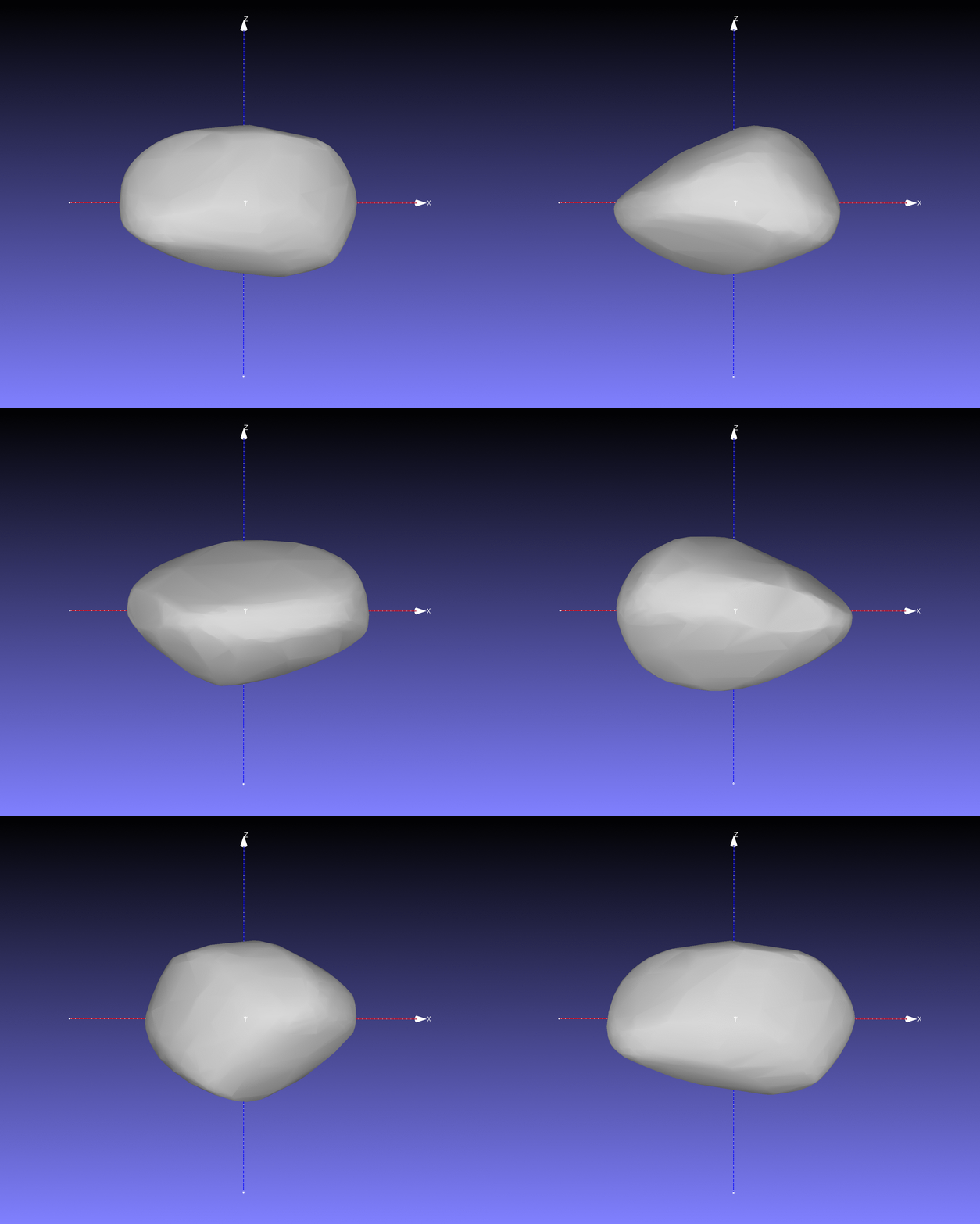
Asteroid's rotation. Animated gif credit: Josef Hanuš, Charles University.
Because Every Potential Threat to Life On Earth Needs a Good Name
NEA 1999 AP10 won’t be this close to the Earth again for another 11 years when Unistellar hopes to study it further but under a friendlier name. On Dec. 6, Unistellar launched a “Nickname the Asteroid” contest, giving space-lovers worldwide their chance to leave a small-but-cosmic scientific legacy.
“The Nickname the Asteroid contest is part of Citizen Astronomy Month, which celebrates the democratization of astronomy, with a special focus on allowing people to take part in the live adventure of astronomy,” said Laurent Marfisi, Chief Executive Officer at Unistellar. “While Unistellar’s advanced technology and partnership with the SETI Institute enables all eVscope users to contribute valuable astronomical research and participate in the process of scientific discovery, during Citizen Astronomy Month, we want to extend that participative philosophy to broader audiences and invite all space lovers to join and make their mark on science.”
The research was partially supported by the Carl Sagan Center Seed Funds CSC-SF19-01 funded with the James Kay bequest dedicated to improve the location, mapping, and understanding of Earth-crossing asteroids and comets.
About Unistellar
Unistellar is the start-up behind the eVscope, a powerful, simple-to-operate consumer telescope that brings the wonders of the universe to life in seconds - even in urban settings. Thanks to a partnership with the SETI Institute, this extremely powerful tool also allows its users to become citizen scientists and contribute to cutting-edge research on exoplanet transits, asteroid occultations, comets, and much more. The Unistellar eVscope received a CES Innovation Award in 2018 in the category Tech for a Better World and was nominated for a SXSW 2019 Innovation Award. Nearly 4,000 smart telescope users are now mobilized in Europe, Japan and North America, participating in an unprecedented observing experience.
Press release visuals: https://we.tl/t-MRIq7qnVqc
Unistellar media kit: https://we.tl/t-hXyIwQjjbI
About the SETI Institute
Founded in 1984, the SETI Institute is a non-profit, multi-disciplinary research and education organization whose mission is to lead humanity’s quest to understand the origins and prevalence of life and intelligence in the Universe and to share that knowledge with the world. Our research encompasses the physical and biological sciences and leverages expertise in data analytics, machine learning and advanced signal detection technologies. The SETI Institute is a distinguished research partner for industry, academia and government agencies, including NASA and NSF.
Contact information
For Unistellar:
Bospar Press Relations
Rebecca Shpektor
[email protected]
+1 508 654 5197
Ludovic Nachury, Head of Communication
[email protected]
+33 6 24 31 63 89
For SETI Institute:
Rebecca McDonald, Director of Communications
[email protected]
+1 650 960 4526







News
Related News
Jul 10, 2026
A Remarkably Ancient Visitor: 3I/ATLAS
#3I/ATLAS #Comets, Meteors, and Asteroids #JWST
Jun 26, 2026
What Juice Revealed About Interstellar Comet 3I/ATLAS
#Blog #3I/ATLAS #Franck Marchis #Juice
Jun 17, 2026
Community College Internship Program Celebrates Fourth Year of Student Research Achievement
#Community College Internship #Education #Lauren Sgro #Unistellar #Uma Gorti #Douglas Caldwell #Pamela Harman #Simon Steel
Jun 9, 2026
Disclosure Needs Data
#SkyMapper #Franck Marchis #SETI #citizen science
Jun 5, 2026
Beyond Disclosure Day: The Real-World Protocols
#Press Releases #SETI #Astronomy #Bill Diamond #SETI Institute
Jun 3, 2026
SETI Institute Looks for Signs of Technology in Interstellar Visitor 3I/ATLAS
Observations with the Allen Telescope Array set new limits on possible signals from extraterrestrial transmitters. #Press Releases #ATA #3I/ATLAS #Hat Creek Radio Observatory #Radio Astronomy #SETI
Jul 10, 2026
#3I/ATLAS
#Comets, Meteors, and Asteroids
#JWST
Jun 26, 2026
#Blog
#3I/ATLAS
#Franck Marchis
#Juice
What Juice Revealed About Interstellar Comet 3I/ATLAS
Jun 17, 2026
#Community College Internship
#Education
#Lauren Sgro
#Unistellar
#Uma Gorti
#Douglas Caldwell
#Pamela Harman
#Simon Steel
Community College Internship Program Celebrates Fourth Year of Student Research Achievement
Jun 9, 2026
#SkyMapper
#Franck Marchis
#SETI
#citizen science
Disclosure Needs Data
Jun 5, 2026
#Press Releases
#SETI
#Astronomy
#Bill Diamond
#SETI Institute
Beyond Disclosure Day: The Real-World Protocols
Jun 3, 2026
SETI Institute Looks for Signs of Technology in Interstellar Visitor 3I/ATLAS
Observations with the Allen Telescope Array set new limits on possible signals from extraterrestrial transmitters.
#Press Releases
#ATA
#3I/ATLAS
#Hat Creek Radio Observatory
#Radio Astronomy
#SETI
Research
Related Projects

SkyMapper • SETI • Citizen Science • Astronomy
SkyMapper: Expanding Access to Real-time Astronomy Through a Global Astronomical Network
SkyMapper and the SETI Institute are connecting educators, students and the public to live astronomical observations through a distributed astronomical network. #SkyMapper #SETI #Citizen Science #Astronomy
VPL
Virtual Planetary Laboratory
How can we best assess whether an exoplanet supports life? #VPL
Discovery and Futures Lab
Discovery and Futures Lab
What happens if life beyond Earth is discovered? The Discovery and Futures Lab at the SETI Institute fosters novel and anticipatory research at the intersection of science, society, our planet, and the search for life beyond Earth. #Discovery and Futures Lab
May 17, 2026
SkyMapper: Expanding Access to Real-time Astronomy Through a Global Astronomical Network
SkyMapper and the SETI Institute are connecting educators, students and the public to live astronomical observations through a distributed astronomical network.
#SkyMapper
#SETI
#Citizen Science
#Astronomy
May 5, 2026
Virtual Planetary Laboratory
How can we best assess whether an exoplanet supports life?
#VPL
Apr 16, 2026
Discovery and Futures Lab
What happens if life beyond Earth is discovered? The Discovery and Futures Lab at the SETI Institute fosters novel and anticipatory research at the intersection of science, society, our planet, and the search for life beyond Earth.
#Discovery and Futures Lab
Support Us
Support the
SETI Institute
Scientists are getting closer in their search for life beyond earth. But with limited federal funding for the search for extraterrestrial intelligence, supporters are the reason cutting-edge scientists can keep their eyes on the sky.
