February 5, 2024, Mountain View, CA – The official classification now aligns with what many suspected from merely looking at the images of the strange meteorites that fell near Berlin on January 21, 2024. They belong to a rare group called “aubrites”.
“They were devilishly difficult to find because, from a distance, they look like other rocks on Earth,” said SETI Institute meteor astronomer Dr. Peter Jenniskens. “Close up, not so much.”
Jenniskens traveled from San Francisco to Berlin to search the fields just south of the village of Ribbeck with Museum für Naturkunde (MfN) researcher Dr. Lutz Hecht, guiding a team of students and staff from the MfN, the Freie Universität Berlin, the Deutches zentrum für Luft und Raumfahrt, and the Technische Universität Berlin in the days following the fall.
“Even with superb directions by meteor astronomers Drs. Pavel Spurný, Jiří Borovička and Lukáš Shrbený of the Astronomical Institute of the Czech Academy of Sciences, who calculated how the strong winds blew the meteorites, and predicted that these could be rare enstatite-rich meteorites based on the light emitted by the fireball, our search team initially could not easily spot them on the ground,” said Jenniskens.
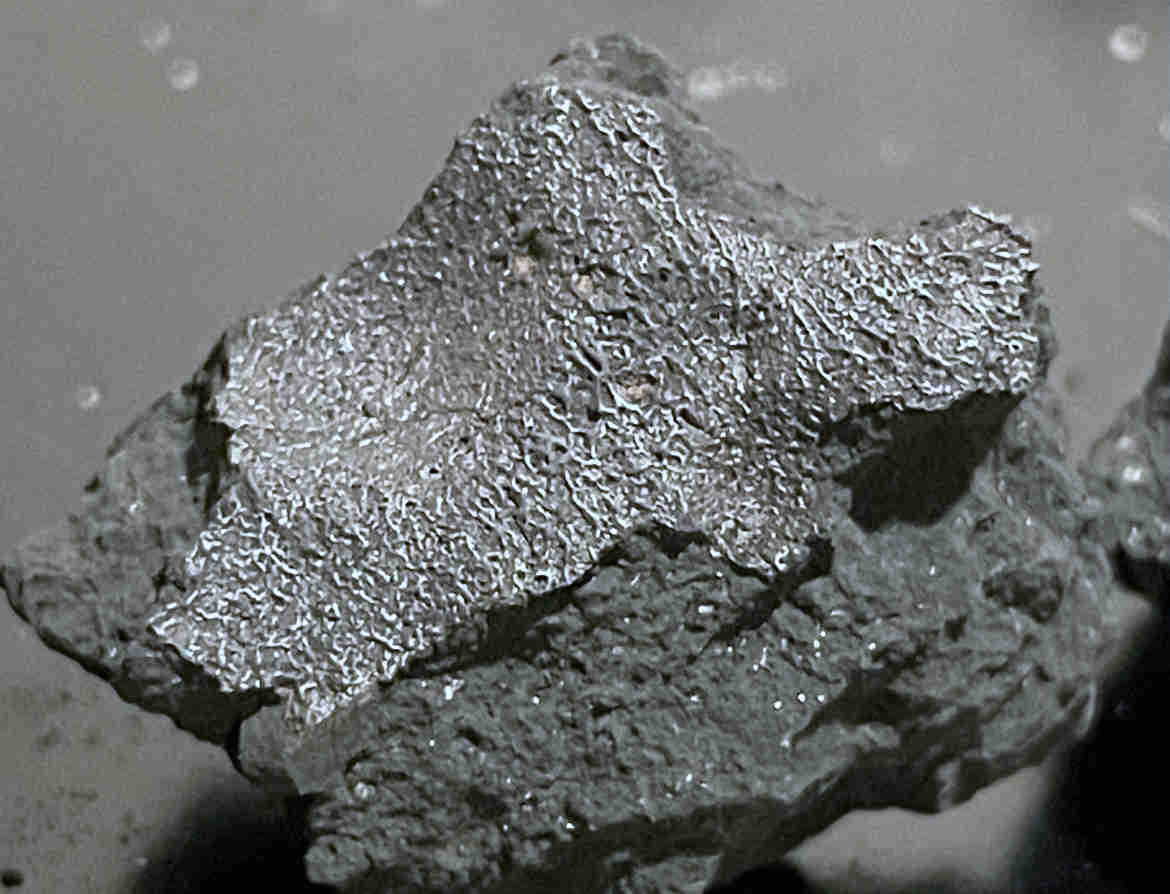
Unlike other meteorites which have a thin crust of black glass from atmospheric heat, these meteorites have a mostly translucent glass crust.
“We only spotted the meteorites after a Polish team of meteorite hunters had identified the first find and could show us what to look for,” said Jenniskens. “After that, our first finds were made quickly by Freie Universität students Dominik Dieter and Cara Weihe.”
The meteorites are fragments of the small asteroid 2024 BX1, first spotted with a telescope at Konkoly Observatory in Hungary by astronomer Dr. Krisztián Sárneczky, tracked and then predicted to impact Earth’s atmosphere by NASA’s Scout and ESA’s Meerkat Asteroid Guard impact hazard assessment systems, with Davide Farnocchia of JPL/Caltech providing frequent trajectory updates, and finally causing a bright fireball that was seen and filmed. This was Jenniskens’ fourth guided recovery of such a small asteroid impact, following a 2008 impact in Sudan, a 2018 impact in Botswana, and a 2023 impact in France.
Today, Jenniskens’ collaborators at the Museum für Naturkunde officially announced that the first examinations of one of these pieces with an electron beam microprobe prove the typical mineralogy and chemical composition of an achondrite of the aubrite type. This result was submitted to the International Nomenclature Commission of the Meteoritical Society on February 2, 2024, for examination and confirmation.
The name of the meteorite comes from the village of Aubrés in France, where a similar meteorite fell on September 14, 1836. The museum has a fragment of that in the collection.
“Based on this evidence, we were able to make a rough classification relatively quickly,” said Dr. Ansgar Greshake, scientific head of the museum's meteorite collection. “This underlines the immense importance of collections for research. So far, there is only material from eleven other observed falls of this type in meteorite collections worldwide.”
“Aubrites do not look like what people generally imagine meteorites to look like. Aubrites look more like a gray granite and consist mainly of the magnesium silicates enstatite and forsterite,” said Christopher Hamann from the Museum für Naturkunde, who was involved in the initial classification and took part in the search. “It contains hardly any iron and the glassy crust, which is usually a good way to recognize meteorites, looks completely different than that of most other meteorites. Aubrites are therefore difficult to detect in the field.”
About the SETI Institute
Founded in 1984, the SETI Institute is a non-profit, multi-disciplinary research and education organization whose mission is to lead humanity’s quest to understand the origins and prevalence of life and intelligence in the Universe and to share that knowledge with the world. Our research encompasses the physical and biological sciences and leverages expertise in data analytics, machine learning and advanced signal detection technologies. The SETI Institute is a distinguished research partner for industry, academia and government agencies, including NASA and NSF.
Contact information
Rebecca McDonald
Director of Communications
SETI Institute
[email protected]
DOWNLOAD FULL PRESS RELEASE
)