







Friday, Jul 09, 2021

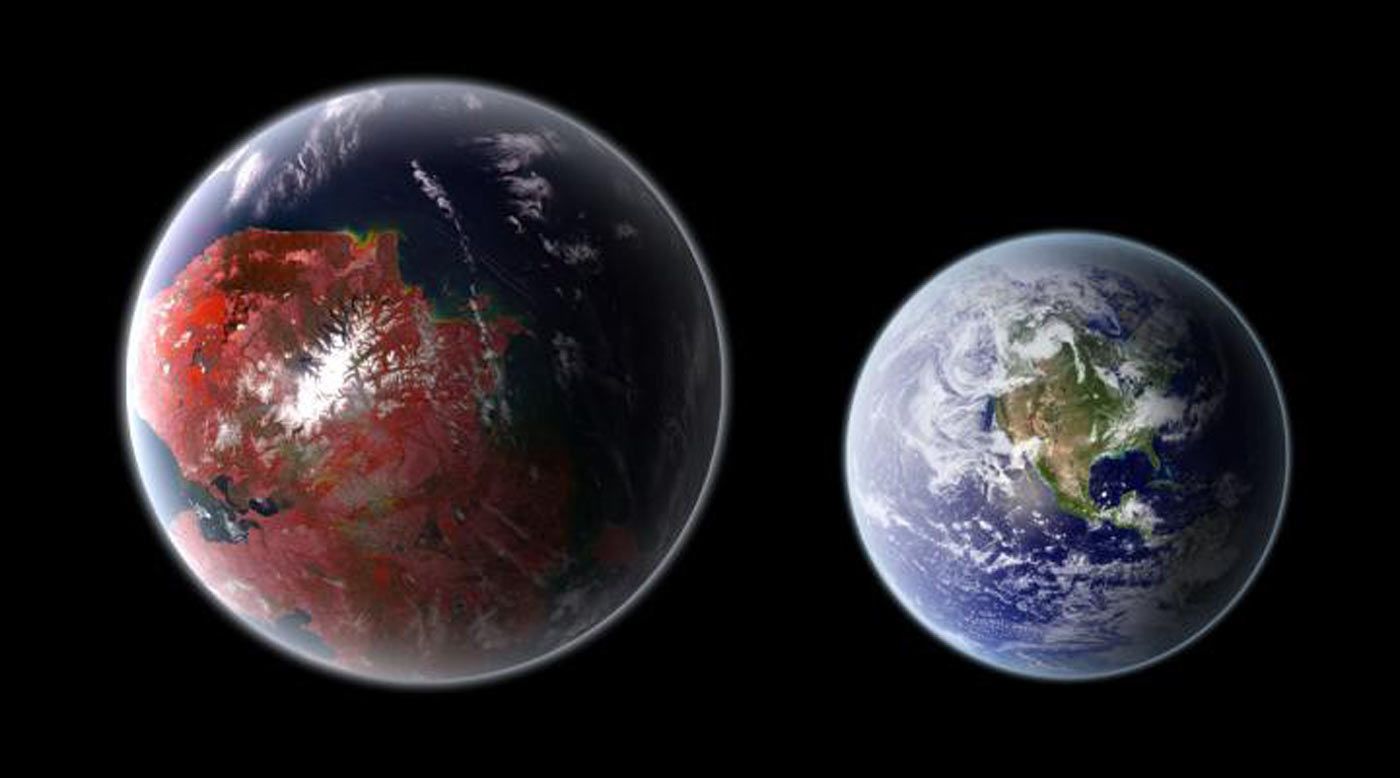
IMAGE: An artistic representation of the potentially habitable planet Kepler 422-b (left), compared with Earth (right). CREDIT: Ph03nix1986 / Wikimedia Commons.

Everything we study about our planet, our solar system, and even exoplanets seems to come back to one big question: Are we alone? It’s a huge question, really. Perseverance is looking for evidence that Mars had life. Phosphine was in the news last year because it could have been a biological marker for Venus. Europa Clipper is in the works, with teams meeting this week to discuss the instruments and science objectives, one of which is to look for molecular signs of life in the geysers. And Kepler, wonderful Kepler, its mission was not to hunt for exoplanets. No, its mission was to find Earth-like planets in the habitable zones of their stars.

Today, we have found over 4000 exoplanets. We still haven’t found that Earth 2.0 everyone is looking for, though. Sure, there are planets about the size of Earth. There are planets in the habitable zone. But the stars are too active, the planets too big, or some combination of the two. Nothing seems to fit just right. And it could be that finding that Earth-like planet may be even harder than we originally thought.

In a new study published in the Monthly Notices of the Royal Astronomical Society, scientists examined how much energy planets receive from their host stars and if there was enough energy available for biological life to process using oxygen-based photosynthesis. Some plants and animals here on Earth use the radiation from the Sun to turn carbon dioxide and water into fuel, but to have carbon dioxide, you need oxygen already in place. The results were not encouraging.

Per the press release: Planets around even cooler stars known as red dwarfs, which smolder at roughly a third of our Sun’s temperature, could not receive enough energy to even activate photosynthesis. Stars that are hotter than our Sun are much brighter, and emit up to ten times more radiation in the necessary range for effective photosynthesis than red dwarfs, however generally do not live long enough for complex life to evolve.

A lot of researchers were holding out hope that red dwarf stars, which are the most common type of star in the Milky Way, would be great places to harbor life. This new research actually narrows the exoplanet window we should be looking in. On the one hand, it’s a smaller window. On the other hand, we can focus the search a little better than we could before.

The FlyPol instrument, which was used to measure biosignatures from the air, aboard the helicopter. CREDIT: Courtesy of Lucas Patty.

Of course, once you get beyond the “where do we look for life” part of the question, the next piece is “how do we detect that life?”. In what I think is groundbreaking research, a team of scientists used a helicopter flying at 70 kilometers per hour at a distance of two kilometers above the ground to detect signatures of life here on Earth. And they found them. In fact, they were able to tell the difference between fields, forests, and urban areas.

First author Lucas Patty explains: When light is reflected by biological matter, a part of the light’s electromagnetic waves will travel in either clockwise or counterclockwise spirals. This phenomenon is called circular polarization and is caused by the biological matter’s homochirality. Similar spirals of light are not produced by abiotic non-living nature.

A note about the term homochirality: chirality is the property of handedness — left-handed or right-handed. We use this term in biology, and particularly in molecular biology, to describe the way molecules, like that of DNA, occur. Except, unlike hands, in molecules, the handedness is either left or right not paired. And that handedness, or chirality, can be used as a biosignature.

And this team found that signature from a moving helicopter. Now we can use their technology to engineer systems that could be on spacecraft, and first up, they’re working on adapting it for the International Space Station(ISS). I’m excited to follow where this research goes.

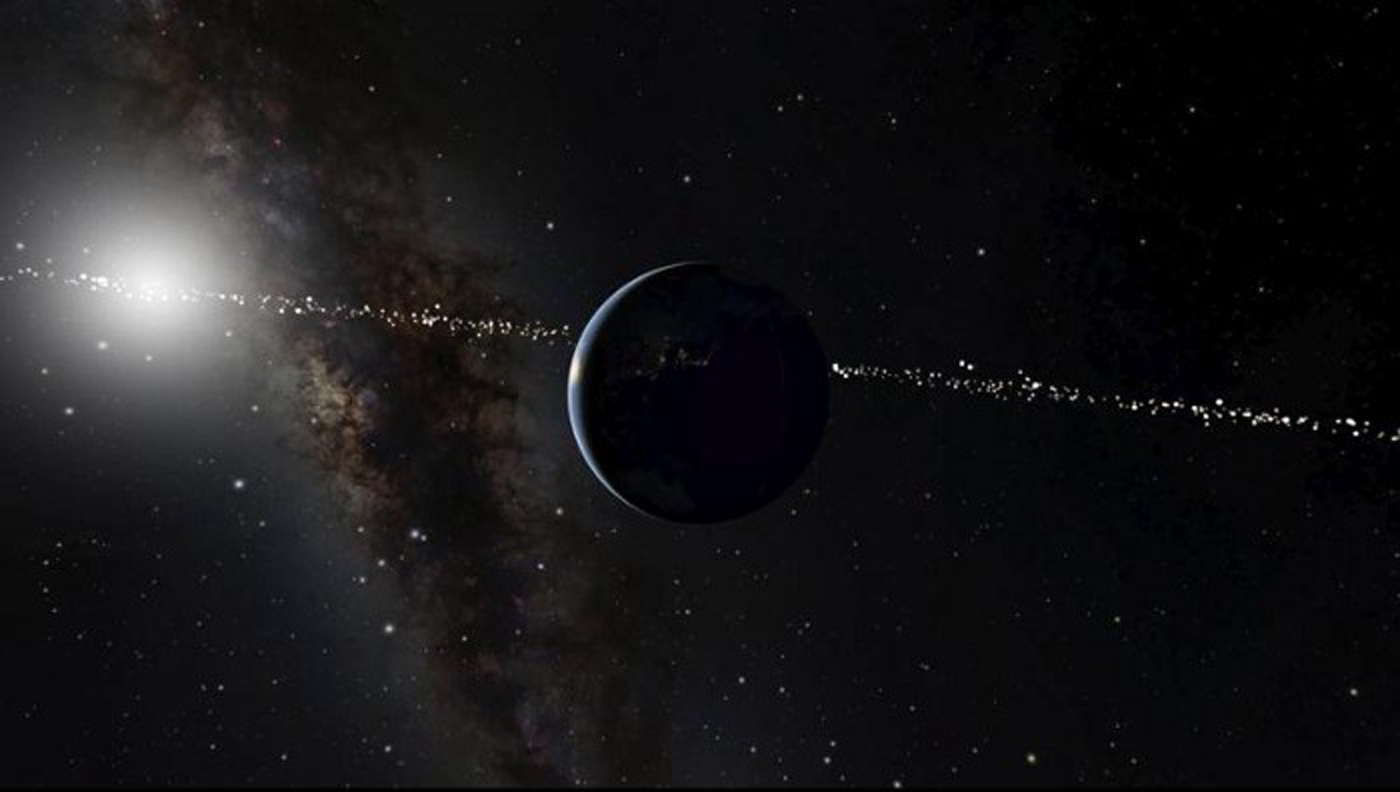
A view of the Earth and Sun from thousands of miles above our planet, with stars in position to see Earth transiting around the Sun brightened and the Milky Way visible on the left. CREDIT: Open Space/American Museum of Natural History.

One final story on detecting life. In new research published in Nature, scientists have released data on which star systems could detect life on Earth if they had intelligent species with the right technology. Within a distance of 326 light-years, there are over 2,000 star systems that have had just the right vantage point. And in the next 5,000 years, more than 300 star systems will be added to that list as everything orbits within the Milky Way.

The press release explains that the team “used positions and motions from the European Space Agency’s Gaia eDR3 catalog to determine which stars enter and exit the Earth Transit Zone — and for how long.” Within that catalog of systems are seven known to host exoplanets, and one of the ones that will get to that point — in about 1,600 years — is the Trappist-1 system.

Study co-author Jackie Faherty leaves us with this thought: One might imagine that worlds beyond Earth that have already detected us are making the same plans for our planet and solar system. This catalog is an intriguing thought experiment for which one of our neighbors might be able to find us.

Earth-like Conditions Rarer Than Previously Thought

Helicopter Used to Detect Life on Earth

  • University of Bern press release
  • “Biosignatures of the Earth I. Airborne spectropolarimetric detection of photosynthetic life,” C. H. L. Patty et al., to be published in Astronomy & Astrophysics (preprint on arxiv.org)

Over 2000 Nearby Star Systems Could Detect Earth

This article originally appeared on Medium, June 29, 2021.

News

Related News

Featured Image
Jun 3, 2026
SETI Institute Looks for Signs of Technology in Interstellar Visitor 3I/ATLAS
Observations with the Allen Telescope Array set new limits on possible signals from extraterrestrial transmitters. #Press Releases #ATA #3I/ATLAS #Hat Creek Radio Observatory #Radio Astronomy #SETI
Featured Image
Jun 1, 2026
SETI Institute Awards $1 Million in STRIDE Grants to Advance Astrobiology, Exoplanet Science, and Public Engagement
#Press Releases #STRIDE #Research #Carl Sagan Center #Spectroscopy #Solar System #SETI #Climate and Bioscience #Astronomy #Astrobiology #Exoplanets #Data Science #Education #Outreach #Hat Creek Radio Observatory #Unistellar #SkyMapper
Featured Image
May 28, 2026
Celebrating Frank Drake
#Frank Drake #SETI #Project Ozma #Drake Equation #SETI Institute
Featured Image
May 13, 2026
SETI Institute to Honor Dr. Matthew Tiscareno with 2026 Carl Sagan Center Director’s Award
The Drake Awards event will also recognize SETI Forward and SETI Institute REU student award recipients. #Press Releases #Drake Awards #Frank Drake #SETI #Awards #Planetary Astronomy #Astrobiology #SETI Forward #Education #Carl Sagan Center #Matthew Tiscareno #Nathalie Cabrol #REU
Featured Image
May 7, 2026
SETI Institute In the News: April Roundup 2026
#SETI Institute in the News #SETI Institute #Community #SETI #Discovery and Futures Lab #Lucian Walkowicz #Chelsea Haramia #NASA Missions and Observatories #Pascal Lee #Mars #Janice Bishop #Mark Showalter #JWST #Uranus #Bill Diamond #UAPs
Featured Image
May 1, 2026
Asteroid Named in Honor of SETI Researcher and Communicator Seth Shostak
#Comets, Meteors, and Asteroids #Seth Shostak #SETI #Astronomy #Big Picture Science #Outreach #Andrew Fraknoi
Research

Related Projects

Featured Image
SkyMapper • SETI • Citizen Science • Astronomy
SkyMapper: Expanding Access to Real-time Astronomy Through a Global Astronomical Network
SkyMapper and the SETI Institute are connecting educators, students and the public to live astronomical observations through a distributed astronomical network. #SkyMapper #SETI #Citizen Science #Astronomy
Featured Image
VPL
Virtual Planetary Laboratory
How can we best assess whether an exoplanet supports life? #VPL
Featured Image
Discovery and Futures Lab
What happens if life beyond Earth is discovered? The Discovery and Futures Lab at the SETI Institute fosters novel and anticipatory research at the intersection of science, society, our planet, and the search for life beyond Earth.  #Discovery and Futures Lab
Support Us

Support the
SETI Institute

Scientists are getting closer in their search for life beyond earth. But with limited federal funding for the search for extraterrestrial intelligence, supporters are the reason cutting-edge scientists can keep their eyes on the sky.