)

Wednesday, Aug 16, 2017
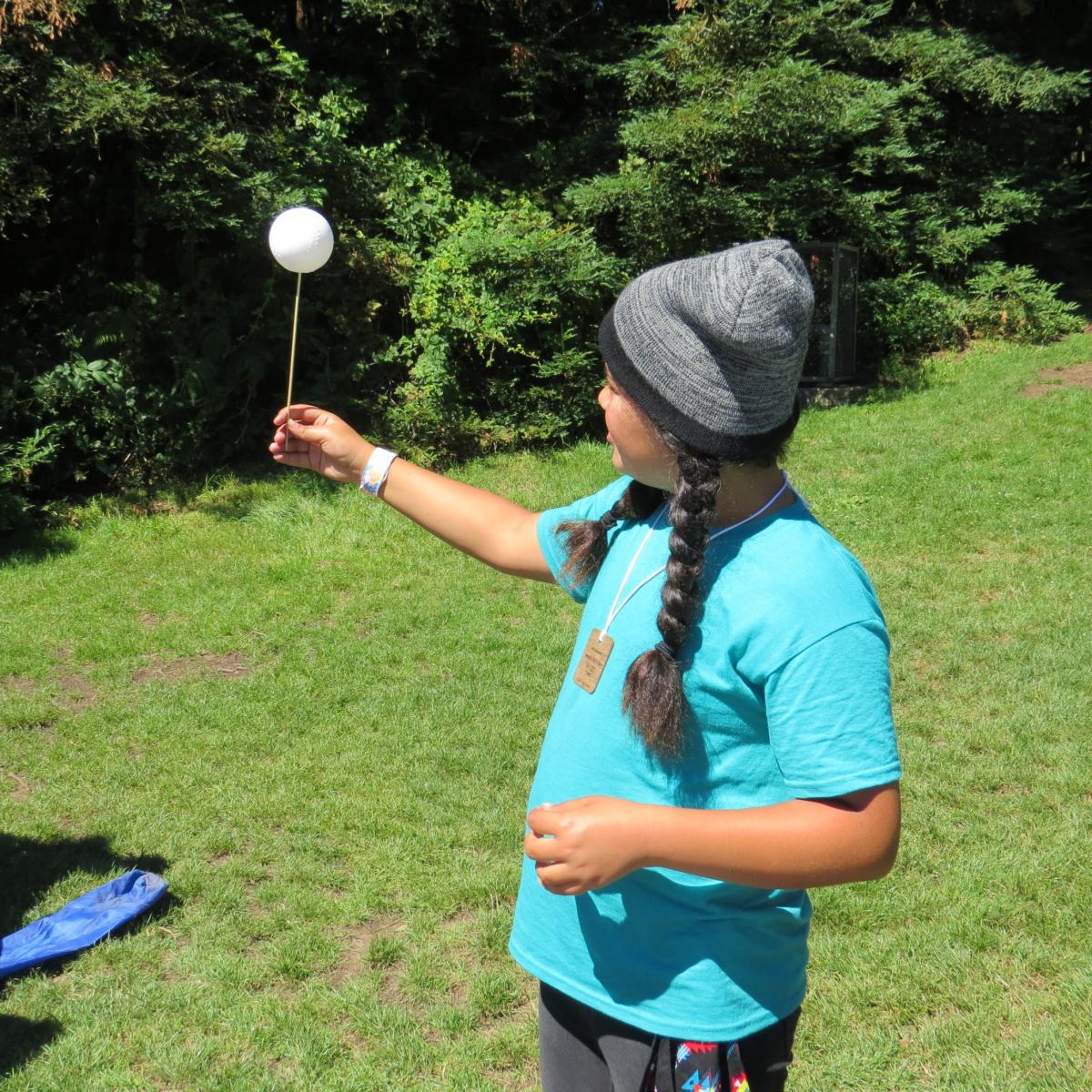
A scout tries to get a handle on the way sunlight falls on the Earth. Credit: Girl Scouts of Northern California.
On August 21, as the shadow of the moon races across the continental United States at more than 1,000 miles per hour, Girl Scouts of the USA – councils, volunteers and girls – will be poised to safely view the solar eclipse and engage in the interactive astronomy event of the decade.
The SETI Institute’s project, “Reaching for the Stars: NASA Science for Girl Scouts,” created activities and tools to prepare the Girl Scouts for the total solar eclipse.
We created ”Eclipse Boxes” featuring 14 activities for Girl Scouts of all ages, including chalk art, modeling magnetism, experimenting with light, scale modeling the solar system, and how eclipses work. Nine activities promote girls’ understanding of our place in the solar system, sun, Earth and moon. Five eclipse activities, resources and safe viewing instructions complete the guide. You can download a copy of the Eclipse Box Activity Guide here. To prepare for the eclipse, Girl Scouts also learned about the sun, Earth and moon at events and summer camps held by 90 Girl Scout councils across the nation.
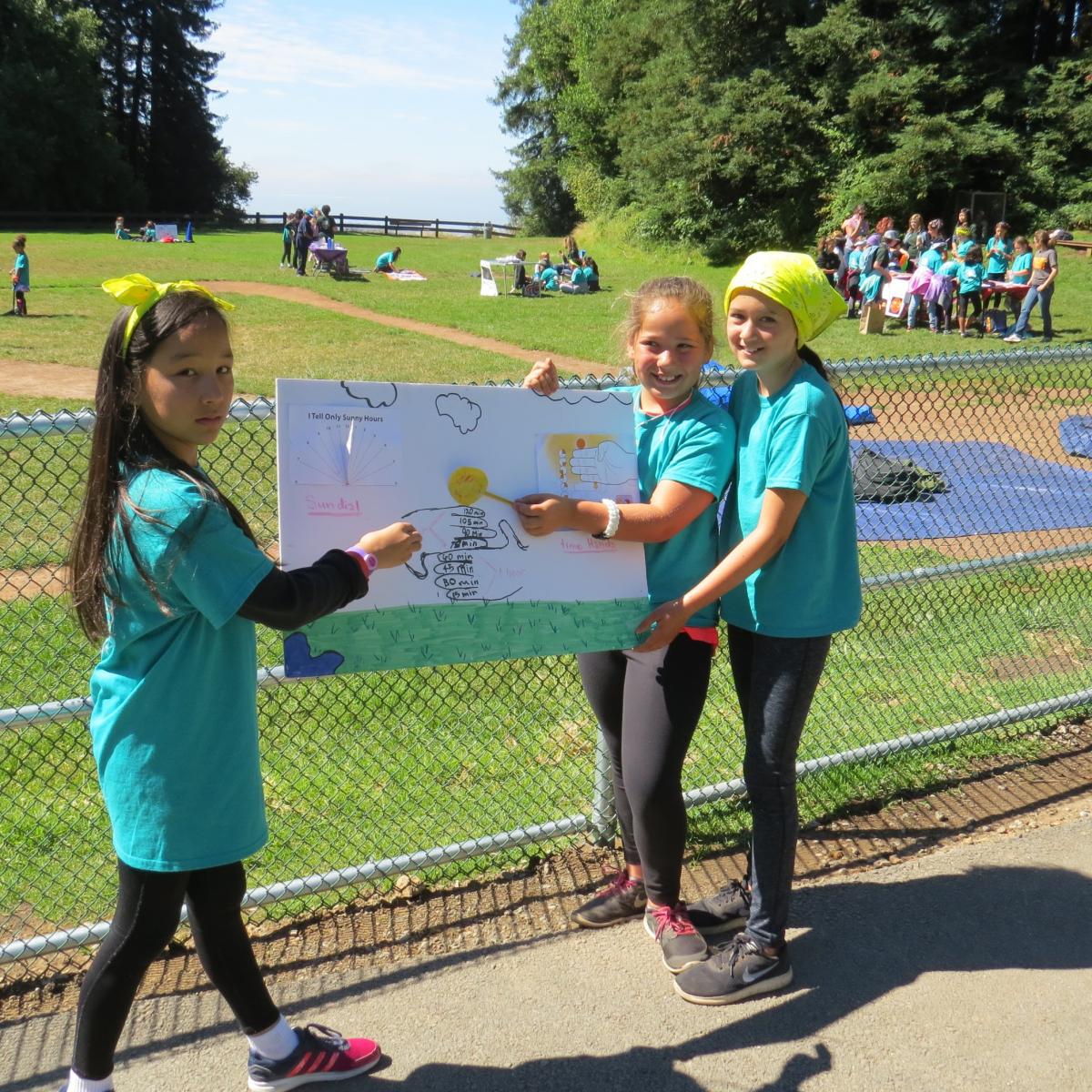
Three scouts show off what they've learned during final presentations. Credit: Girl Scouts of Northern California.
Many Girl Scouts are traveling to the centerline to observe the total eclipse, partially sponsored by our project. These once-in-a-lifetime trips are part of Girl Scouts of the USA’s Destinations summer travel programs, which offer inspiring travel adventures for older girls, grades 7 – 12.
Three eclipse Destinations will immerse girls in authentic STEM experiences. The three Girl Scout councils hosting Total Eclipse Destinations include
- Girl Scouts of Southern Illinois (Total Eclipse of the Heartland begins with planetarium and science center visits in St. Louis, and transits to Carbondale for the eclipse)
- Girl Scouts of the Missouri Heartland (The Great Eclipse Adventure features hands-on science activities led by Astronomy and Physics faculty and graduate students at University of Missouri, and girls will observe the eclipse near a Girl Scout camp)
- Girl Scouts of South Carolina – Mountains to Midlands (Eyes to the Sky: A Once in a Lifetime Destination visits a Challenger Center, a planetarium, and observatory, and culminates at a Girl Scout camp for eclipse viewing from a mountaintop)
Girl Scouts from across the nation are participating in these Eclipse Destinations as well as watching the total or partial eclipse. All science lovers can purchase safe-viewing eclipse glasses, an eclipse guidebook, an eclipse map, and an eclipse patch for the event at participating Girl Scout council stores.
“Reaching for the Stars: NASA Science for Girl Scouts” is helping Girl Scouts take space science to another level with subject matter experts at the SETI Institute, ARIES Scientific, Inc., Astronomical Society of the Pacific, Girl Scouts of Northern California and University of Arizona.
For more information about Girl Scouts and to join or volunteer, visit www.girlscouts.org/join.
Reaching for the Stars: NASA Science for Girl Scouts is led by subject matter experts at SETI Institute, ARIES Scientific, Inc., Astronomical Society of the Pacific, Girl Scouts of Northern California and University of Arizona. “Reaching for the Stars: NASA Science for Girl Scouts” is based upon work supported by Aerojet Rocketdyne Foundation and NASA Science under cooperative agreement No. NNX16AB90A. Any opinions, findings, and conclusions or recommendations expressed in this material are those of the author(s) and do not necessarily reflect the views of the National Aeronautics and Space Administration.







News
Related News
Jul 10, 2026
SETI Institute Achievements: Q1 2026 Activity Report
#Activity Reports #Carl Sagan Center #Outreach #Education #AIR #Community #Research
Jun 17, 2026
Community College Internship Program Celebrates Fourth Year of Student Research Achievement
#Community College Internship #Education #Lauren Sgro #Unistellar #Uma Gorti #Douglas Caldwell #Pamela Harman #Simon Steel
Jun 1, 2026
SETI Institute Awards $1 Million in STRIDE Grants to Advance Astrobiology, Exoplanet Science, and Public Engagement
#Press Releases #STRIDE #Research #Carl Sagan Center #Spectroscopy #Solar System #SETI #Climate and Bioscience #Astronomy #Astrobiology #Exoplanets #Data Science #Education #Outreach #Hat Creek Radio Observatory #Unistellar #SkyMapper
May 13, 2026
SETI Institute to Honor Dr. Matthew Tiscareno with 2026 Carl Sagan Center Director’s Award
The Drake Awards event will also recognize SETI Forward and SETI Institute REU student award recipients. #Press Releases #Drake Awards #Frank Drake #SETI #Awards #Planetary Astronomy #Astrobiology #SETI Forward #Education #Carl Sagan Center #Matthew Tiscareno #Nathalie Cabrol #REU
May 5, 2026
Atlanta Science Festival Exploration Expo and the Arecibo Message
#Community #SETI Institute #Outreach #Education #Lauren Sgro
Apr 15, 2026
2025 SETI Institute Activity Report
#Activity Reports #Carl Sagan Center #Outreach #Education #AIR #Community
Jul 10, 2026
#Activity Reports
#Carl Sagan Center
#Outreach
#Education
#AIR
#Community
#Research
Jun 17, 2026
#Community College Internship
#Education
#Lauren Sgro
#Unistellar
#Uma Gorti
#Douglas Caldwell
#Pamela Harman
#Simon Steel
Community College Internship Program Celebrates Fourth Year of Student Research Achievement
Jun 1, 2026
#Press Releases
#STRIDE
#Research
#Carl Sagan Center
#Spectroscopy
#Solar System
#SETI
#Climate and Bioscience
#Astronomy
#Astrobiology
#Exoplanets
#Data Science
#Education
#Outreach
#Hat Creek Radio Observatory
#Unistellar
#SkyMapper
SETI Institute Awards $1 Million in STRIDE Grants to Advance Astrobiology, Exoplanet Science, and Public Engagement
May 13, 2026
SETI Institute to Honor Dr. Matthew Tiscareno with 2026 Carl Sagan Center Director’s Award
The Drake Awards event will also recognize SETI Forward and SETI Institute REU student award recipients.
#Press Releases
#Drake Awards
#Frank Drake
#SETI
#Awards
#Planetary Astronomy
#Astrobiology
#SETI Forward
#Education
#Carl Sagan Center
#Matthew Tiscareno
#Nathalie Cabrol
#REU
May 5, 2026
#Community
#SETI Institute
#Outreach
#Education
#Lauren Sgro
Atlanta Science Festival Exploration Expo and the Arecibo Message
Apr 15, 2026
#Activity Reports
#Carl Sagan Center
#Outreach
#Education
#AIR
#Community
2025 SETI Institute Activity Report
Research
Related Projects

SkyMapper • SETI • Citizen Science • Astronomy
SkyMapper: Expanding Access to Real-time Astronomy Through a Global Astronomical Network
SkyMapper and the SETI Institute are connecting educators, students and the public to live astronomical observations through a distributed astronomical network. #SkyMapper #SETI #Citizen Science #Astronomy
VPL
Virtual Planetary Laboratory
How can we best assess whether an exoplanet supports life? #VPL
Discovery and Futures Lab
Discovery and Futures Lab
What happens if life beyond Earth is discovered? The Discovery and Futures Lab at the SETI Institute fosters novel and anticipatory research at the intersection of science, society, our planet, and the search for life beyond Earth. #Discovery and Futures Lab
May 17, 2026
SkyMapper: Expanding Access to Real-time Astronomy Through a Global Astronomical Network
SkyMapper and the SETI Institute are connecting educators, students and the public to live astronomical observations through a distributed astronomical network.
#SkyMapper
#SETI
#Citizen Science
#Astronomy
May 5, 2026
Virtual Planetary Laboratory
How can we best assess whether an exoplanet supports life?
#VPL
Apr 16, 2026
Discovery and Futures Lab
What happens if life beyond Earth is discovered? The Discovery and Futures Lab at the SETI Institute fosters novel and anticipatory research at the intersection of science, society, our planet, and the search for life beyond Earth.
#Discovery and Futures Lab
Support Us
Support the
SETI Institute
Scientists are getting closer in their search for life beyond earth. But with limited federal funding for the search for extraterrestrial intelligence, supporters are the reason cutting-edge scientists can keep their eyes on the sky.
