)

Friday, Apr 01, 2022
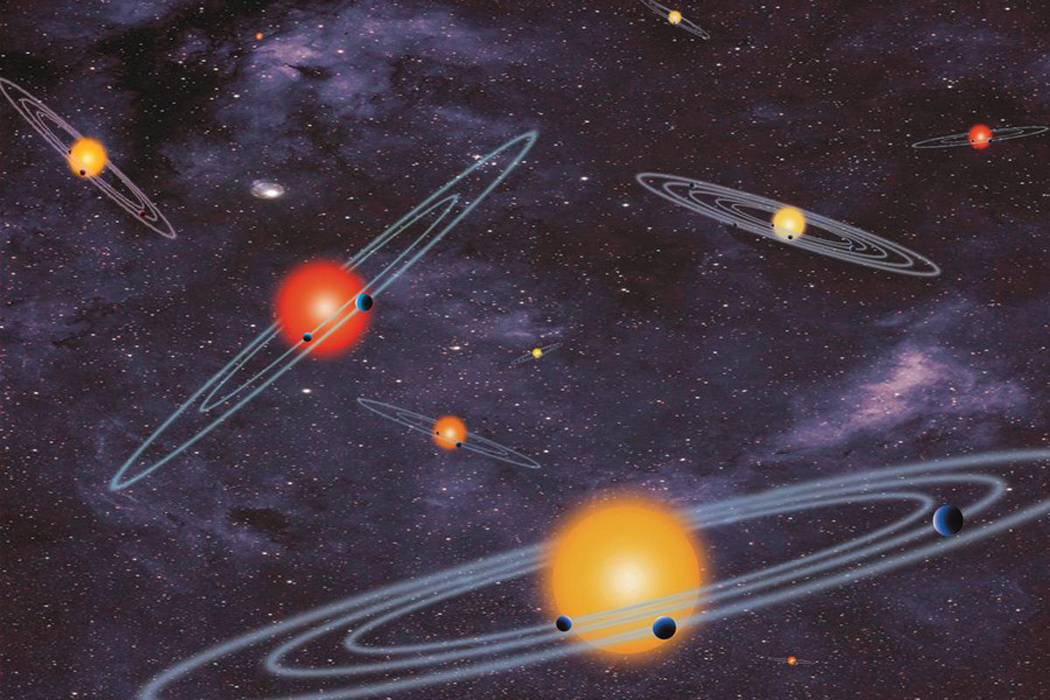
IMAGE: Among thousands of known exoplanets, MIT astronomers have flagged three that are actually stars. Pictured is an artist’s interpretation of stars and planets. CREDIT: NASA
A new study published in The Astronomical Journal reports that three and maybe even four objects originally classified as exoplanets in Kepler data are actually small stars. Oops.
The research team behind this paper used updated measurement techniques and discovered that Kepler-854b, Kepler-840b, and Kepler-699b are about two to four times the size of Jupiter. This makes them too big to be planets, at least so far as we have been able to confirm when it comes to exoplanets. First author and graduate student Prajwal Niraula explains: Most exoplanets are Jupiter-sized or much smaller. Twice [the size of] Jupiter is already suspicious. Larger than that cannot be a planet, which is what we found.
That’s where that possible fourth star-not-planet comes in. Kepler-747b is only about 1.8 times the size of Jupiter, which sets it right on the cusp of being too big to be an exoplanet. However, a more detailed look at the object finds that it is relatively distant from its star, so it doesn’t get enough light to be that big a planet. But there are some other confirmed exoplanets that size, so it’s not completely outside the realm of possibility.
Oddly enough, the work that led to this result wasn’t even about confirming exoplanets. The goal was to find signs of tidal distortion in extrasolar systems. Nirula goes on to explain: If you have two objects close to each other, the gravitational pull of one will cause the other to be egg-shaped, or ellipsoidal, which gives you an idea of how massive the companion is. So you could determine whether it’s a star-star or star-planet system, just based on that tidal pull.
So what led to the new measurements? One of my favorite missions is the European Space Agency’s Gaia observatory, which precisely measures and maps a whole lot of data about stars in our galaxy. With all of these improved measurements and a second look at various light curves from Kepler, the objects causing a dip in certain stars’ light curves turned out to be larger than previously calculated.
And some of them, we now know, are too big to be planets.
But this doesn’t mean that Kepler’s measurements were completely wrong everywhere and all the time. Co-author Avi Shporer notes: This is a tiny correction. It comes from the better understanding of stars, which is only improving all the time. So, the chances of a star’s radius being so incorrect are much smaller. These misclassifications are not going to happen many times more.
Mostly it means that we’ll have to wait a tiny bit longer to break that 5,000 confirmed exoplanet mark. But we’ll get there.
More Information
MIT press release
“Revisiting Kepler Transiting Systems: Unvetting Planets and Constraining Relationships among Harmonics in Phase Curves,” Prajwal Niraula, Avi Shporer, Ian Wong, and Julien de Wit, 2022 March 15, The Astronomical Journal
This story was written for the Daily Space podcast/YouTube series. Want more news from myself, Dr. Pamela Gay, and Erik Madaus? Check out DailySpace.org.
This article was originally published by Beth Johnson on medium.com.







News
Related News

Jun 4, 2026
SETI Institute In the News: May Roundup 2026
#SETI Institute in the News #SETI Institute #Community #Solar System #Matija Ćuk #Neptune #SETI #Bill Diamond #UAPs #Drake Awards #Lori Marino #Matthew Tiscareno #Outreach #Exoplanets #Carl Sagan Center
Jun 1, 2026
SETI Institute Awards $1 Million in STRIDE Grants to Advance Astrobiology, Exoplanet Science, and Public Engagement
#Press Releases #STRIDE #Research #Carl Sagan Center #Spectroscopy #Solar System #SETI #Climate and Bioscience #Astronomy #Astrobiology #Exoplanets #Data Science #Education #Outreach #Hat Creek Radio Observatory #Unistellar #SkyMapper
Mar 30, 2026
We Finally Have a Shortlist for Finding Life Beyond Earth
#SETI #Astronomy #Exoplanets #NASA Missions and Observatories #JWST #Technosignatures #Franck Marchis
Jan 22, 2026
2025 in Citizen Science – The Biggest Year Yet!
#Unistellar #Astronomy #Exoplanets #3I/ATLAS #Comets, Meteors, and Asteroids #Planetary Defense #Community
Oct 1, 2025
Wolf 1130C: Phosphine, Evidence, and an Exercise in Scientific Restraint
Commentary on A.J. Burgasser et al., "Observation of undepleted phosphine in the atmosphere of a low-temperature brown dwarf." #JWST #Astrobiology #Exoplanets #SETI #Nathalie Cabrol
Sep 19, 2025
Worlds of Fire: What Molten Exoplanets Teach Us About Planet Formation
#Blog #Exoplanets
Jun 4, 2026
#SETI Institute in the News
#SETI Institute
#Community
#Solar System
#Matija Ćuk
#Neptune
#SETI
#Bill Diamond
#UAPs
#Drake Awards
#Lori Marino
#Matthew Tiscareno
#Outreach
#Exoplanets
#Carl Sagan Center
Jun 1, 2026
#Press Releases
#STRIDE
#Research
#Carl Sagan Center
#Spectroscopy
#Solar System
#SETI
#Climate and Bioscience
#Astronomy
#Astrobiology
#Exoplanets
#Data Science
#Education
#Outreach
#Hat Creek Radio Observatory
#Unistellar
#SkyMapper
SETI Institute Awards $1 Million in STRIDE Grants to Advance Astrobiology, Exoplanet Science, and Public Engagement
Mar 30, 2026
#SETI
#Astronomy
#Exoplanets
#NASA Missions and Observatories
#JWST
#Technosignatures
#Franck Marchis
We Finally Have a Shortlist for Finding Life Beyond Earth
Jan 22, 2026
#Unistellar
#Astronomy
#Exoplanets
#3I/ATLAS
#Comets, Meteors, and Asteroids
#Planetary Defense
#Community
2025 in Citizen Science – The Biggest Year Yet!
Oct 1, 2025
Wolf 1130C: Phosphine, Evidence, and an Exercise in Scientific Restraint
Commentary on A.J. Burgasser et al., "Observation of undepleted phosphine in the atmosphere of a low-temperature brown dwarf."
#JWST
#Astrobiology
#Exoplanets
#SETI
#Nathalie Cabrol
Sep 19, 2025
#Blog
#Exoplanets
Worlds of Fire: What Molten Exoplanets Teach Us About Planet Formation
Research
Related Projects

SkyMapper • SETI • Citizen Science • Astronomy
SkyMapper: Expanding Access to Real-time Astronomy Through a Global Astronomical Network
SkyMapper and the SETI Institute are connecting educators, students and the public to live astronomical observations through a distributed astronomical network. #SkyMapper #SETI #Citizen Science #Astronomy
VPL
Virtual Planetary Laboratory
How can we best assess whether an exoplanet supports life? #VPL
Discovery and Futures Lab
Discovery and Futures Lab
What happens if life beyond Earth is discovered? The Discovery and Futures Lab at the SETI Institute fosters novel and anticipatory research at the intersection of science, society, our planet, and the search for life beyond Earth. #Discovery and Futures Lab
May 17, 2026
SkyMapper: Expanding Access to Real-time Astronomy Through a Global Astronomical Network
SkyMapper and the SETI Institute are connecting educators, students and the public to live astronomical observations through a distributed astronomical network.
#SkyMapper
#SETI
#Citizen Science
#Astronomy
May 5, 2026
Virtual Planetary Laboratory
How can we best assess whether an exoplanet supports life?
#VPL
Apr 16, 2026
Discovery and Futures Lab
What happens if life beyond Earth is discovered? The Discovery and Futures Lab at the SETI Institute fosters novel and anticipatory research at the intersection of science, society, our planet, and the search for life beyond Earth.
#Discovery and Futures Lab
Support Us
Support the
SETI Institute
Scientists are getting closer in their search for life beyond earth. But with limited federal funding for the search for extraterrestrial intelligence, supporters are the reason cutting-edge scientists can keep their eyes on the sky.
