)

Monday, Jul 15, 2024
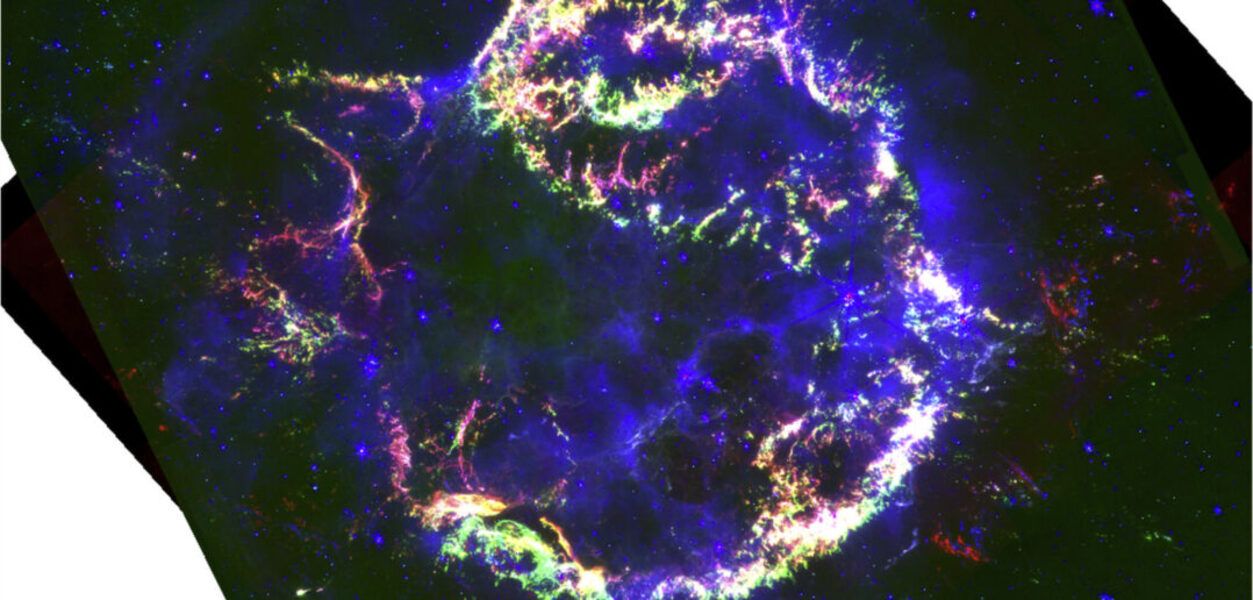
July 15, 2024, Mountain View, CA - The SETI Institute announced the latest findings from the James Webb Space Telescope (JWST) of the supernova remnant, Cassiopeia A (Cas A). These observations of the youngest known core collapse supernova in the Milky Way provide insights into the conditions that lead to the formation and destruction of molecules and dust within supernova ejecta. The study’s findings change our understanding of dust formation in the early universe in the galaxies detected by JWST 300 million years after the Big Bang. Researchers consider supernovae, such as those that formed Cas A, vital sources of the dust seen in distant, high-redshift galaxies. These new insights challenge beliefs that dust primarily originated from intermediate-mass stars on the asymptotic giant branch (AGB) in present-day galaxies.
“It is remarkable to see how bright the carbon monoxide emission detected in JWST NIR imaging and spectroscopy, showing a few tens of sinusoidal patterns of CO fundamental rovibrational lines,” said Dr. Jeonghee Rho, senior research scientist at the SETI Institute who led this research. “The patterns look like they were artificially generated.”
Key findings include:
- Molecular CO Formation: The data shows more CO gas in the outer layers than argon gas, which means CO molecules are forming again after the reverse shock. This data is important for understanding how cooling and dust formation happen after a supernova explosion. The images indicate CO molecules are reformed behind the shock and may have protected the dust in the ejecta.
- Detailed Spectroscopy: The NIRSpec-IFU spectra of two significant areas in Cas A show differences in how elements were formed. Both regions have strong CO gas signals and show various ionized elements like argon, silicon, calcium, and magnesium. The fundamental CO lines are a few tens of sinusoidal patterns of CO fundamental rovibrational lines with a continuum-like underneath due to the high velocity of the CO molecules.
- Temperature Insights: The research shows that the temperature is about 1080 K, based on the CO gas emissions. This helps us understand how dust, molecules, and highly ionized gas interact in supernovae. However, the authors also find vibrational lines in high rotational (J=90) lines, which features appear between 4.3-4.4 microns. These lines indicate the presence of hotter (4800 K) temperature component, implying CO formation and reformation at the same time. CO from such high rotational levels is first seen in Cas A with the new JWST spectroscopy.
- Supernovae such as Cas A, located 11,000 light years away, are explosions that occur when a high mass star comes to the end of its life about 350 years ago. Called a core collapse supernova, the star’s interior collapses inwards due to gravity once the nuclear fuel that powered the star is depleted. The rebound of this collapse blows the star’s outer shell into space in an explosion that can outshine an entire galaxy.
“To see such hot CO in a young supernova remnant is truly remarkable and indicates that CO formation is still happening hundreds of years after the explosion,” said Chris Ashall, Assistant Professor at Virginia Tech. “Combining such impressive data sets with earlier JWST observations of supernovae will allow us to understand the pathway to molecules and dust formation in a way not previously possible.”
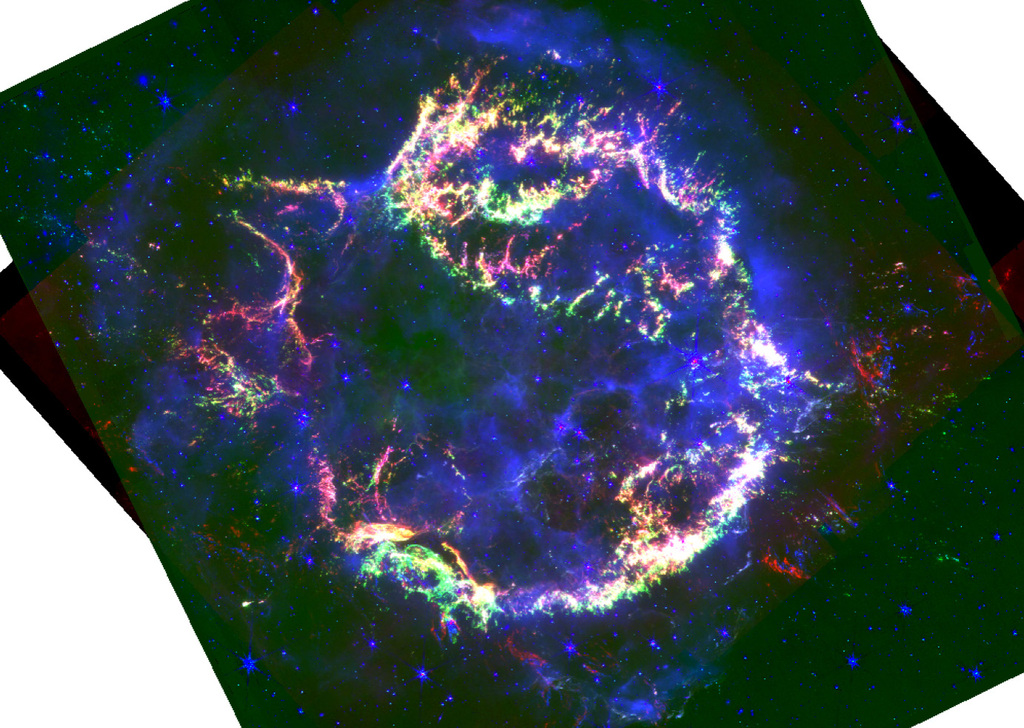
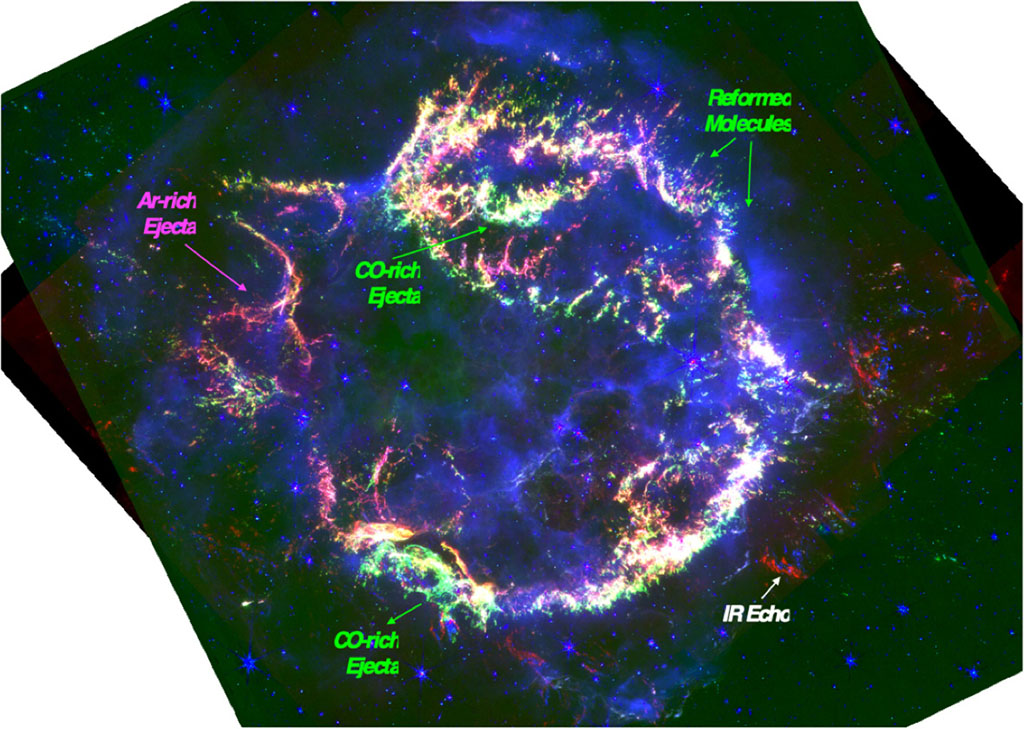

JWST three-color images of Cassiopeia A, contrasting Carbon Monoxide (CO in green) and Argon ejecta (in red) and synchrotron emission (in blue). The images show that there is more CO gas in the outer layers than argon gas, which means CO molecules are forming again after the reverse shock.
Groundbreaking Images and Spectroscopy
The observations utilized JWST’s Near Infrared Camera Instrument (NIRCam) and the Mid Infrared Instrument (MIRI), along with detailed Near-Infrared Spectrograph (NIRSpec)-Integral Field Units (IFU) spectroscopy. The team mapped the intricate structures of synchrotron radiation (light emitted when charged particles, like electrons, are sped up into high speeds in strong magnetic fields), argon-rich ejecta, and carbon monoxide (CO) molecules within Cas A. The images show very detailed and intricate patterns of shells, holes and filaments, highlighting how powerful JWST is.
Seong Hyun Park, a graduate student at Seoul National University in South Korea, performed modeling of the CO properties together with Rho.
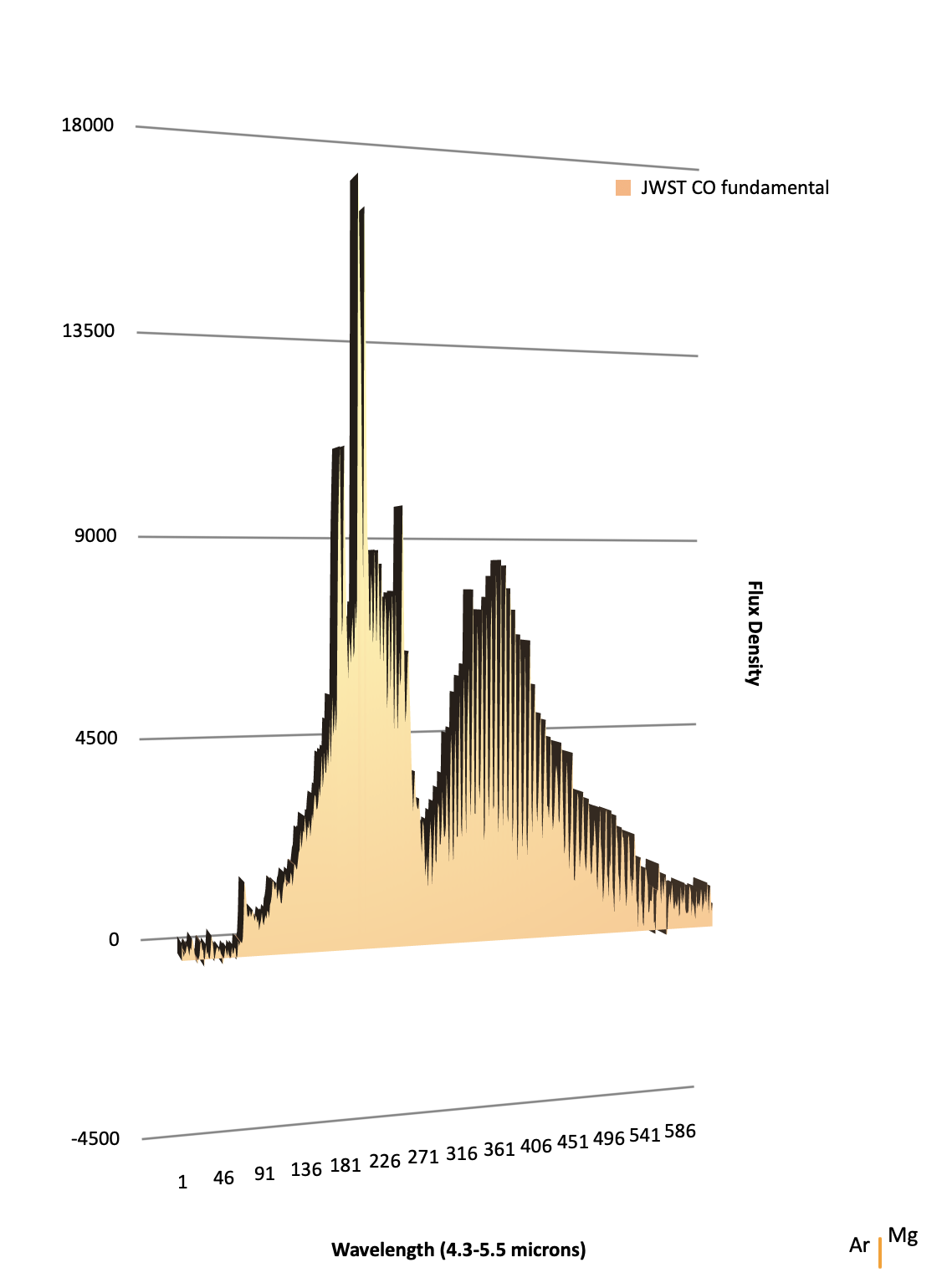
Near-infrared spectra (NIRSpec) of the northern and southern shells of Cas A. CO fundamental band shows unique shapes of CO, with a few tens of sinusoidal patterns of rovibrational lines with pseudo- continuum underneath (the two spike lines are Magnesium and Argon).
The illustrated images and spectroscopy were generated by the lead author, Dr. Jeonghee Rho with Mr. Sang Bum Ko (a student at Seoul National University).
The new observations highlight supernova remnants’ complex and competing molecular formation and destruction processes. While not directly leading to dust formation, CO molecules are critical indicators of the cooling and chemical processes that eventually lead to dust condensation.
While this study offers new perspectives, the debate continues regarding the extent to which supernovae contribute to dust formation in the early universe. Researchers will continue exploring these phenomena with future observations and research to unravel the mysteries of cosmic dust and molecular formation.
The findings are published this week in the Astrophysical Journal as a Letter.
JWST three-color image of synchrotron, CO, and Ar emission has been featured as a cover image in NOVA at: Featured Image: A New Portrait of Cassiopeia A
This article is available in Korean here
About the SETI Institute
Founded in 1984, the SETI Institute is a non-profit, multi-disciplinary research and education organization whose mission is to lead humanity’s quest to understand the origins and prevalence of life and intelligence in the Universe and to share that knowledge with the world. Our research encompasses the physical and biological sciences and leverages expertise in data analytics, machine learning and advanced signal detection technologies. The SETI Institute is a distinguished research partner for industry, academia and government agencies, including NASA and NSF.
Jeonghee Rho dedicates this work to a colleague and friend, Dr. Tom Jarrett, who recently disappeared from the earth. Dr. Jarrett and Dr. Rho first discovered the presence of CO in Cas A from 2.3-micron imaging using the Palomar telescope, and the bright fundamental CO is now detected using the JWST. Happy memories of spending time at Caltech and many observing runs to Palomar and Australia will last forever. Rest in peace, Friend, and see you in Heaven.
Contact information
Rebecca McDonald
Director of Communications
SETI Institute
[email protected]







News
Related News
Jun 5, 2026
Beyond Disclosure Day: The Real-World Protocols
#Press Releases #SETI #Astronomy #Bill Diamond #SETI Institute
Jun 3, 2026
SETI Institute Looks for Signs of Technology in Interstellar Visitor 3I/ATLAS
Observations with the Allen Telescope Array set new limits on possible signals from extraterrestrial transmitters. #Press Releases #ATA #3I/ATLAS #Hat Creek Radio Observatory #Radio Astronomy #SETI
Jun 1, 2026
SETI Institute Awards $1 Million in STRIDE Grants to Advance Astrobiology, Exoplanet Science, and Public Engagement
#Press Releases #STRIDE #Research #Carl Sagan Center #Spectroscopy #Solar System #SETI #Climate and Bioscience #Astronomy #Astrobiology #Exoplanets #Data Science #Education #Outreach #Hat Creek Radio Observatory #Unistellar #SkyMapper
May 13, 2026
SETI Institute to Honor Dr. Matthew Tiscareno with 2026 Carl Sagan Center Director’s Award
The Drake Awards event will also recognize SETI Forward and SETI Institute REU student award recipients. #Press Releases #Drake Awards #Frank Drake #SETI #Awards #Planetary Astronomy #Astrobiology #SETI Forward #Education #Carl Sagan Center #Matthew Tiscareno #Nathalie Cabrol #REU
May 7, 2026
SETI Institute In the News: April Roundup 2026
#SETI Institute in the News #SETI Institute #Community #SETI #Discovery and Futures Lab #Lucian Walkowicz #Chelsea Haramia #NASA Missions and Observatories #Pascal Lee #Mars #Janice Bishop #Mark Showalter #JWST #Uranus #Bill Diamond #UAPs
May 1, 2026
Asteroid Named in Honor of SETI Researcher and Communicator Seth Shostak
#Comets, Meteors, and Asteroids #Seth Shostak #SETI #Astronomy #Big Picture Science #Outreach #Andrew Fraknoi
Jun 5, 2026
#Press Releases
#SETI
#Astronomy
#Bill Diamond
#SETI Institute
Jun 3, 2026
SETI Institute Looks for Signs of Technology in Interstellar Visitor 3I/ATLAS
Observations with the Allen Telescope Array set new limits on possible signals from extraterrestrial transmitters.
#Press Releases
#ATA
#3I/ATLAS
#Hat Creek Radio Observatory
#Radio Astronomy
#SETI
Jun 1, 2026
#Press Releases
#STRIDE
#Research
#Carl Sagan Center
#Spectroscopy
#Solar System
#SETI
#Climate and Bioscience
#Astronomy
#Astrobiology
#Exoplanets
#Data Science
#Education
#Outreach
#Hat Creek Radio Observatory
#Unistellar
#SkyMapper
SETI Institute Awards $1 Million in STRIDE Grants to Advance Astrobiology, Exoplanet Science, and Public Engagement
May 13, 2026
SETI Institute to Honor Dr. Matthew Tiscareno with 2026 Carl Sagan Center Director’s Award
The Drake Awards event will also recognize SETI Forward and SETI Institute REU student award recipients.
#Press Releases
#Drake Awards
#Frank Drake
#SETI
#Awards
#Planetary Astronomy
#Astrobiology
#SETI Forward
#Education
#Carl Sagan Center
#Matthew Tiscareno
#Nathalie Cabrol
#REU
May 7, 2026
#SETI Institute in the News
#SETI Institute
#Community
#SETI
#Discovery and Futures Lab
#Lucian Walkowicz
#Chelsea Haramia
#NASA Missions and Observatories
#Pascal Lee
#Mars
#Janice Bishop
#Mark Showalter
#JWST
#Uranus
#Bill Diamond
#UAPs
SETI Institute In the News: April Roundup 2026
May 1, 2026
#Comets, Meteors, and Asteroids
#Seth Shostak
#SETI
#Astronomy
#Big Picture Science
#Outreach
#Andrew Fraknoi
Asteroid Named in Honor of SETI Researcher and Communicator Seth Shostak
Research
Related Projects

SkyMapper • SETI • Citizen Science • Astronomy
SkyMapper: Expanding Access to Real-time Astronomy Through a Global Astronomical Network
SkyMapper and the SETI Institute are connecting educators, students and the public to live astronomical observations through a distributed astronomical network. #SkyMapper #SETI #Citizen Science #Astronomy
VPL
Virtual Planetary Laboratory
How can we best assess whether an exoplanet supports life? #VPL
Discovery and Futures Lab
Discovery and Futures Lab
What happens if life beyond Earth is discovered? The Discovery and Futures Lab at the SETI Institute fosters novel and anticipatory research at the intersection of science, society, our planet, and the search for life beyond Earth. #Discovery and Futures Lab
May 17, 2026
SkyMapper: Expanding Access to Real-time Astronomy Through a Global Astronomical Network
SkyMapper and the SETI Institute are connecting educators, students and the public to live astronomical observations through a distributed astronomical network.
#SkyMapper
#SETI
#Citizen Science
#Astronomy
May 5, 2026
Virtual Planetary Laboratory
How can we best assess whether an exoplanet supports life?
#VPL
Apr 16, 2026
Discovery and Futures Lab
What happens if life beyond Earth is discovered? The Discovery and Futures Lab at the SETI Institute fosters novel and anticipatory research at the intersection of science, society, our planet, and the search for life beyond Earth.
#Discovery and Futures Lab
Support Us
Support the
SETI Institute
Scientists are getting closer in their search for life beyond earth. But with limited federal funding for the search for extraterrestrial intelligence, supporters are the reason cutting-edge scientists can keep their eyes on the sky.
