Thursday, Mar 21, 2024
This meteoroid broke up by thermal stresses just before entering Earth's atmosphere, creating a cluster of meteors over Norway on October 30, 2022, recorded by Allsky7 station AMS119 operated by Gaustabanen and Steinar Midtskogen of the Norway Meteor Network. Video courtesy of Mike Hankey, American Meteor Society. See video here.

March 21, 2024, Mountain View, CA -- The dust of comets fills the space between the planets, collectively called the zodiacal cloud. Still, severe breakdown has reduced that dust in size so much that it now scatters sunlight efficiently, causing the faint glow in the night sky known as the "zodiacal light."

It was long thought that high-speed collisions pulverized the comet ejecta, but now a 45-member team of researchers reports, in a paper published online in the journal Icarus this week, that heat is to blame.

“Comets eject most debris as large sand-grain to pebble-sized particles, called meteoroids, that move in meteoroid streams and cause the visible meteors in our meteor showers,” says Dr. Peter Jenniskens, meteor astronomer at the SETI Institute. “In contrast, the zodiacal cloud is mostly composed of particles the size of tobacco smoke that even radars have difficulty detecting as meteors.”

Why do pebbles pulverize after they leave the comet?

“Meteor showers show us this loss of pebbles over time, because older showers tend to contain fewer bright meteors than young showers,” said Jenniskens. “We set out to investigate what is responsible.”

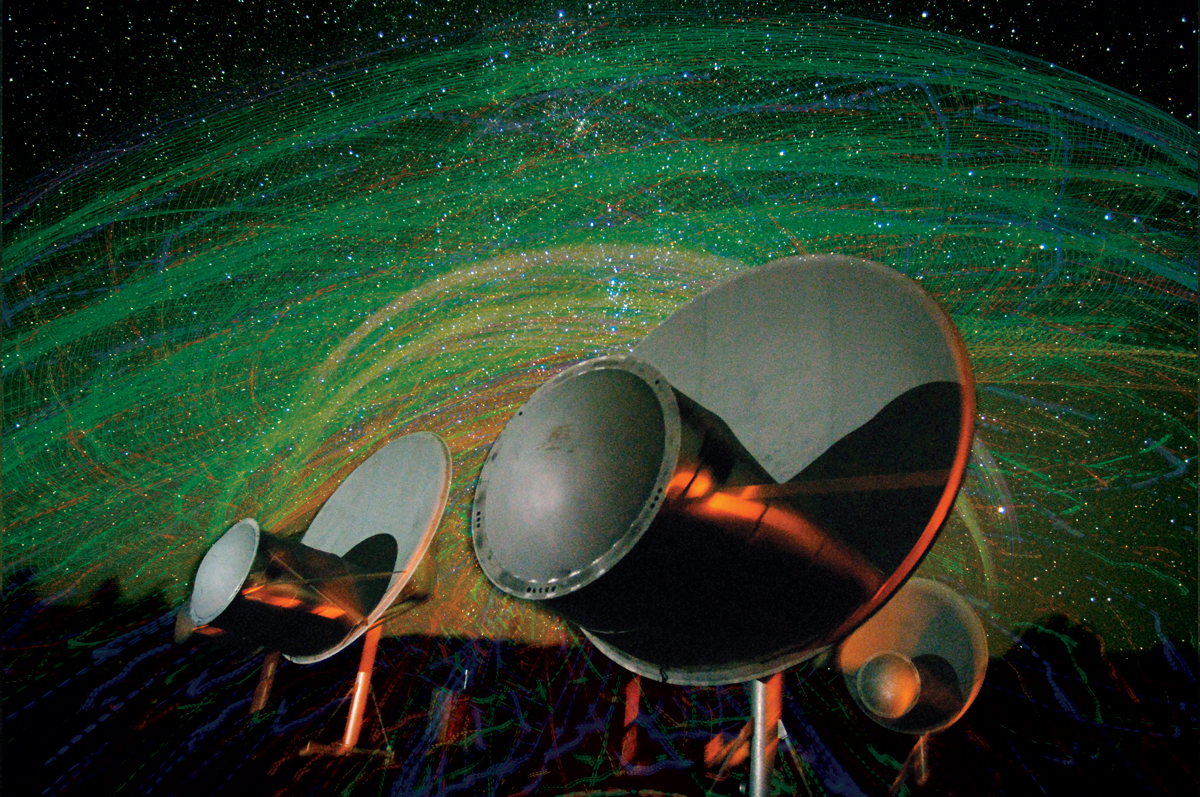
Jenniskens leads a NASA-sponsored global network called “CAMS” that monitors the night sky for meteors with low-light video security cameras. Most co-authors on the paper are the researchers and citizen scientists who built and operate the 15 CAMS camera networks in ten countries.

“We developed software that detects meteors in videos recorded from different locations and then triangulates their trajectory in the atmosphere,” said detection specialist Peter S. Gural. “Meteors arriving from the same direction each day belong to a meteor shower.”

Nightly maps showing from what direction those meteors arrive at Earth are at the website: https://meteorshowers.seti.org. After 13 years of observations, the combined maps were recently published as a book, “Atlas of Earth’s Meteor Showers”, an encyclopedia of information on each known meteor shower.

“As part of this work, we determined the age of meteor showers from how much they had dispersed,” says Stuart Pilorz of the SETI Institute, “and then examined how rapidly they were losing their large meteoroids compared to the smaller ones.”  

To investigate what is responsible, the team examined of how close those streams came to the Sun. If collisions were to blame, then the pebbles were expected to be destroyed faster directly proportionally to their proximity to the Sun.

“Because there is more comet dust closer to the Sun, we had expected collisions there would pulverize the pebbles that much faster,” says Jenniskens. “Instead, we found that the pebbles survived better than expected.” 

The research team concluded that, instead, the pebbles are destroyed proportional to the peak temperature they reach along their orbit. Thermal stresses are likely to blame for breaking up the large meteoroids near Earth, and all the way to the orbit of Mercury, while deep inside the orbit of Mercury the particles are heated so much that they fall apart from losing material.

“Here at Earth, we sometimes see that process in action when in a short time of say 10 seconds we detect ten or twenty meteors in part of the sky, a meteor cluster, the result of a meteoroid having fallen apart by thermal stresses just before entering Earth’s atmosphere,” says Jenniskens.

Manuscript online at: https://authors.elsevier.com/sd/article/S0019-1035(24)00093-9

Same meteor cluster from a different perspective. Video courtesy of Steinar Midtskogen and Mike Hankey. See video here.

About the SETI Institute
Founded in 1984, the SETI Institute is a non-profit, multi-disciplinary research and education organization whose mission is to lead humanity’s quest to understand the origins and prevalence of life and intelligence in the Universe and to share that knowledge with the world. Our research encompasses the physical and biological sciences and leverages expertise in data analytics, machine learning and advanced signal detection technologies. The SETI Institute is a distinguished research partner for industry, academia and government agencies, including NASA and NSF.

Contact information
Rebecca McDonald
Director of Communications
SETI Institute
[email protected]

DOWNLOAD FULL PRESS RELEASE

News

Related News

Featured Image
Jun 5, 2026
Beyond Disclosure Day: The Real-World Protocols
#Press Releases #SETI #Astronomy #Bill Diamond #SETI Institute
Featured Image
Jun 3, 2026
SETI Institute Looks for Signs of Technology in Interstellar Visitor 3I/ATLAS
Observations with the Allen Telescope Array set new limits on possible signals from extraterrestrial transmitters. #Press Releases #ATA #3I/ATLAS #Hat Creek Radio Observatory #Radio Astronomy #SETI
Featured Image
Jun 1, 2026
SETI Institute Awards $1 Million in STRIDE Grants to Advance Astrobiology, Exoplanet Science, and Public Engagement
#Press Releases #STRIDE #Research #Carl Sagan Center #Spectroscopy #Solar System #SETI #Climate and Bioscience #Astronomy #Astrobiology #Exoplanets #Data Science #Education #Outreach #Hat Creek Radio Observatory #Unistellar #SkyMapper
Featured Image
May 13, 2026
SETI Institute to Honor Dr. Matthew Tiscareno with 2026 Carl Sagan Center Director’s Award
The Drake Awards event will also recognize SETI Forward and SETI Institute REU student award recipients. #Press Releases #Drake Awards #Frank Drake #SETI #Awards #Planetary Astronomy #Astrobiology #SETI Forward #Education #Carl Sagan Center #Matthew Tiscareno #Nathalie Cabrol #REU
Featured Image
May 1, 2026
Asteroid Named in Honor of SETI Researcher and Communicator Seth Shostak
#Comets, Meteors, and Asteroids #Seth Shostak #SETI #Astronomy #Big Picture Science #Outreach #Andrew Fraknoi
Featured Image
Apr 23, 2026
SkyMapper Goes Live: Building a Real-Time, Global Network for Astronomy
SkyMapper functions as an observational infrastructure, a system that links instruments, users, and data streams. Its goal is ambitious: to continuously observe and map the entire sky. #Blog #SkyMapper #LaserSETI #SETI #Astronomy #Exoplanet Detection #Comets, Meteors, and Asteroids #Planetary Defense #Technosignatures #Franck Marchis #Lauren Sgro
Research

Related Projects

Featured Image
SkyMapper • SETI • Citizen Science • Astronomy
SkyMapper: Expanding Access to Real-time Astronomy Through a Global Astronomical Network
SkyMapper and the SETI Institute are connecting educators, students and the public to live astronomical observations through a distributed astronomical network. #SkyMapper #SETI #Citizen Science #Astronomy
Featured Image
VPL
Virtual Planetary Laboratory
How can we best assess whether an exoplanet supports life? #VPL
Featured Image
Discovery and Futures Lab
What happens if life beyond Earth is discovered? The Discovery and Futures Lab at the SETI Institute fosters novel and anticipatory research at the intersection of science, society, our planet, and the search for life beyond Earth.  #Discovery and Futures Lab
Support Us

Support the
SETI Institute

Scientists are getting closer in their search for life beyond earth. But with limited federal funding for the search for extraterrestrial intelligence, supporters are the reason cutting-edge scientists can keep their eyes on the sky.