)

Friday, Mar 06, 2026
At a Glance
|
The search for extraterrestrial life depends on more than telescopes and data analysis. It requires conceptual tools capable of redefining life, intelligence, and communication beyond Earth-centered assumptions.
In a recent SETI Live conversation, SETI Institute Artist-in-Residence (AIR) Director Bettina Forget spoke with Cosmic Consciousness residency artists daniela brill estrada, Bart Kuipers, and Julie-Michèle Morin about Exoplanetary Poetry, an art–science collaboration that asks whether molecules themselves might function as a universal language.
The project begins with a simple premise: chemistry operates everywhere in the universe. While biological systems may vary dramatically, planetary atmospheres are governed by physical and chemical laws shared across cosmic environments. If life emerges from chemistry, then chemistry may also be the most fundamental bridge between species.
From Physics to Planetary Life
daniela brill estrada traces the conceptual roots of the project to her earlier work in conversation with physicists at CERN. There, she encountered a strict materialist perspective: hydrogen atoms are identical, regardless of whether they participate in living or nonliving systems. Questions about life, she was told, belong to biology.
That boundary proved unsatisfying. Could matter itself encode the difference between living and nonliving organizations?
The work of physicist and astrobiologist Dr. Sarah Walker provided a framework. Walker’s assembly theory proposes that life can be characterized by the complexity of molecular combinations, structures assembled in ways that exceed what random chemistry alone would produce. In this model, life is not defined by specific molecules but by the depth of combinatorial history embedded in matter.
For the artists, this theory offers both scientific grounding and aesthetic inspiration. A planet’s geochemistry may cross a threshold into biochemistry. The planet “makes” life by assembling matter into increasingly complex forms.
Exoplanetary Poetry asks what it would mean to treat those chemical possibilities as the beginning of language.
Training an Alien Co-Author
To simulate nonhuman intelligence, the team trained an artificial intelligence system on two intertwined datasets:
- Atmospheric chemistry data from observed exoplanets
- Human poetry and scientific texts, including astrobiology research
The AI, affectionately named “Jupy”, does not replace the artists. Bart Kuipers, whose background spans computer science and creative writing, emphasizes that the system is intentionally imperfect. Its unexpected turns of phrase, contextual misalignments, and linguistic “errors” are generative rather than corrective.
This imperfection matters. Poetry, Kuipers argues, occupies a different register than technological efficiency. Rather than producing optimized output, the AI serves as a collaborator that disrupts habitual thinking. The resulting text is co-authored, shaped through iterative dialogue between human and machine.
Notably, none of the artists is native to English. Writing in a non-primary language introduces productive instability. The text carries traces of estrangement, an appropriate condition when imagining alien worlds.
From Language Back to Chemistry
The most distinctive feature of the project is its closed loop: poetry derived from chemistry is translated back into chemistry.
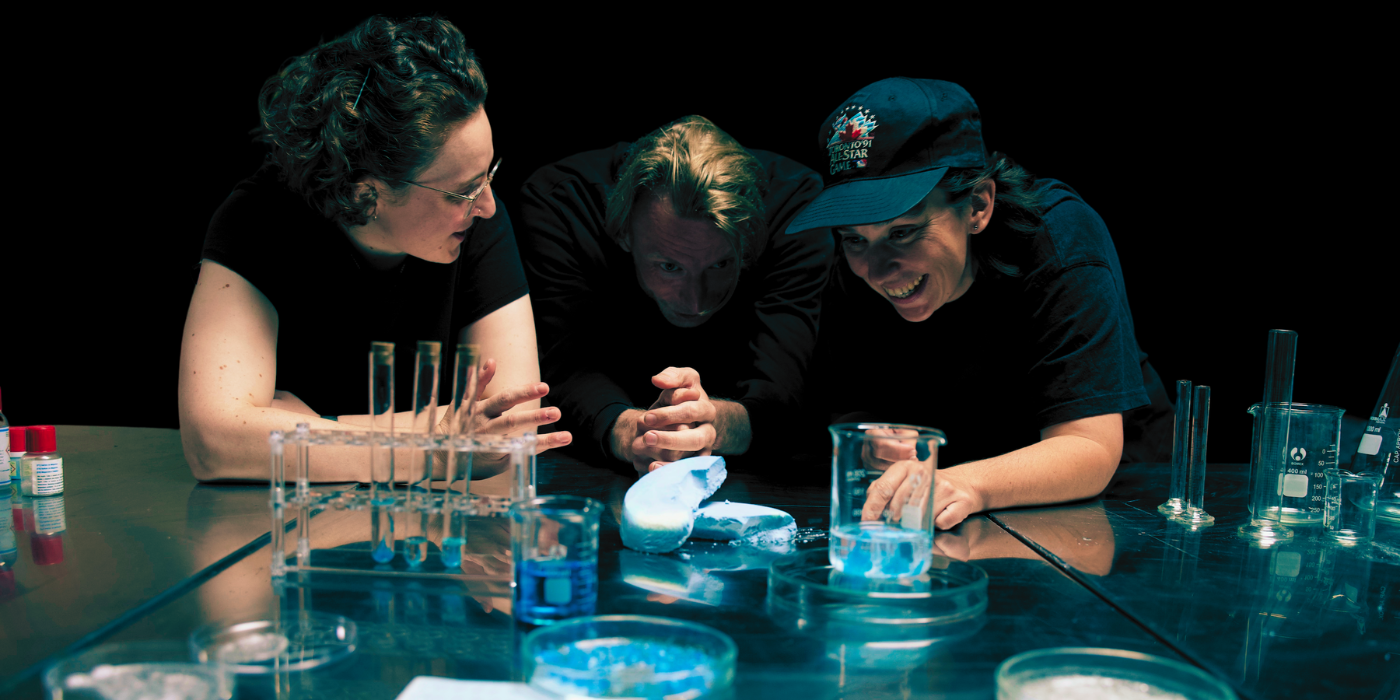
During their residency at Cultivamos Cultura in Portugal, the artists transformed a DIY bio-art laboratory into a working chemistry space. There, they stage chemical phenomena such as oxidation reactions, observing changes in color, texture, timing, and transformation.
These reactions become performative expressions of poetic structure.
Rather than treating poetry as symbolic language alone, the team treats it as action. If extraterrestrial organisms perceive through unfamiliar sensory modalities—sensitivity to pH changes, for example—then communication must extend beyond written words.
A chemical process may function as a message.
Julie-Michèle Morin, whose research bridges dramaturgy and robotics, frames this as a redefinition of performance. Traditionally, the stage privileges human presence. In Exoplanetary Poetry, nonhuman processes occupy that space. Attention shifts from human speech to molecular transformation.
This shift carries ethical implications. By staging machines, chemical systems, and nonhuman agents without anthropomorphic projection, the project cultivates attentiveness to other forms of existence. Responsibility, care, and solidarity extend beyond human-centered narratives.
Poetry Beyond Symbolism
Why poetry rather than direct signal transmission?
Kuipers suggests that poetry communicates across multiple registers simultaneously. It conveys emotion, ambiguity, rhythm, and silence—dimensions that exceed literal statements. If humanity attempts communication with alien intelligence, it may require more than declarative messages. It may require structures that can be sensed rather than decoded.
The artists describe their method as iterative:
- Conduct chemical experiments
- Write observational notes
- Generate AI-assisted poetry
- Research planetary chemistry
- Stage reactions as embodied text
The loop remains dynamic. Chemistry informs language, language reshapes experimentation, and performance reframes interpretation.
At the molecular level, dramatic processes unfold continuously. Reaction rates mirror poetic rhythm. Delays and phase transitions echo meter and pause. What appears as fluid in a beaker becomes a structured transformation when viewed closely.
Listening to chemistry becomes an act of translation.
Expanding the SETI Framework
SETI Institute’s Artists-in-Residence program exists to expand how scientific inquiry is imagined and experienced. The search for life beyond Earth requires both technical precision and conceptual elasticity.
Exoplanetary Poetry does not replace traditional methods such as radio astronomy or biosignature detection (chemical indicators of life). Instead, it broadens the framework for considering communication. If life elsewhere assembles matter in unfamiliar ways, then humanity must cultivate new interpretive tools.
The project proposes that the first “conversation” in the universe may have occurred not in language but in chemistry. Molecular interaction preceded speech. In that sense, chemistry is not metaphorical language; it is literal exchange.
By beginning and ending with matter, Exoplanetary Poetry closes the communicative circle.
As performances evolve and experiments continue, the project invites audiences to reconsider what intelligence might look like and how it might feel.
Watch the full SETI Live conversation here. Learn more about the SETI Institute Artists-in-Residence program at seti.org/air.







News
Related News
Jul 24, 2026
A New Way to Search for Alien Civilizations
#Blog #Lauren Sgro
Jul 22, 2026
The SETI Institute is now accepting submissions for the Wow! Literary Award for Emerging Writers
The annual Wow! Literary Award for emerging writers and poets (formerly Cosmic Chronicles Literary Prize) is a contest for emerging writers of all ages whose work explores questions of interspecies communication, intelligence and consciousness in the universe. #AIR #Cosmic Chronicles #Wow! Literary Award #Bettina Forget #Gregory Betts
Jul 22, 2026
SETI AIR Newsletter - July 2026
#AIR #SETI AIR Newsletter #Bettina Forget #Xin Liu #Jonathon Keats #Richelle Ellis #Linda O'Keefe
Jul 21, 2026
Celebrating 25 Years of Exoplanet Astrobiology: Welcoming the Virtual Planetary Laboratory to its New Home at the SETI Institute
#VPL #Astrobiology #SETI Institute #Victoria Meadows #Andrew Lincowski #Eric Wolf #Nicholas Wogan #Kimberly Bott #Hannah Dawson
Jul 17, 2026
How Clouds Hide Alien Worlds—and How Astronomers See Through Them
#Blog #Moiya McTier
Jul 10, 2026
SETI Institute Achievements: Q1 2026 Activity Report
#Activity Reports #Carl Sagan Center #Outreach #Education #AIR #Community #Research
Jul 24, 2026
#Blog
#Lauren Sgro
Jul 22, 2026
The SETI Institute is now accepting submissions for the Wow! Literary Award for Emerging Writers
The annual Wow! Literary Award for emerging writers and poets (formerly Cosmic Chronicles Literary Prize) is a contest for emerging writers of all ages whose work explores questions of interspecies communication, intelligence and consciousness in the universe.
#AIR
#Cosmic Chronicles
#Wow! Literary Award
#Bettina Forget
#Gregory Betts
Jul 22, 2026
#AIR
#SETI AIR Newsletter
#Bettina Forget
#Xin Liu
#Jonathon Keats
#Richelle Ellis
#Linda O'Keefe
SETI AIR Newsletter - July 2026
Jul 21, 2026
#VPL
#Astrobiology
#SETI Institute
#Victoria Meadows
#Andrew Lincowski
#Eric Wolf
#Nicholas Wogan
#Kimberly Bott
#Hannah Dawson
Celebrating 25 Years of Exoplanet Astrobiology: Welcoming the Virtual Planetary Laboratory to its New Home at the SETI Institute
Jul 17, 2026
#Blog
#Moiya McTier
How Clouds Hide Alien Worlds—and How Astronomers See Through Them
Jul 10, 2026
#Activity Reports
#Carl Sagan Center
#Outreach
#Education
#AIR
#Community
#Research
SETI Institute Achievements: Q1 2026 Activity Report
Research
Related Projects

SkyMapper • SETI • Citizen Science • Astronomy
SkyMapper: Expanding Access to Real-time Astronomy Through a Global Astronomical Network
SkyMapper and the SETI Institute are connecting educators, students and the public to live astronomical observations through a distributed astronomical network. #SkyMapper #SETI #Citizen Science #Astronomy
VPL
Virtual Planetary Laboratory
How can we best assess whether an exoplanet supports life? #VPL
Discovery and Futures Lab
Discovery and Futures Lab
What happens if life beyond Earth is discovered? The Discovery and Futures Lab at the SETI Institute fosters novel and anticipatory research at the intersection of science, society, our planet, and the search for life beyond Earth. #Discovery and Futures Lab
May 17, 2026
SkyMapper: Expanding Access to Real-time Astronomy Through a Global Astronomical Network
SkyMapper and the SETI Institute are connecting educators, students and the public to live astronomical observations through a distributed astronomical network.
#SkyMapper
#SETI
#Citizen Science
#Astronomy
May 5, 2026
Virtual Planetary Laboratory
How can we best assess whether an exoplanet supports life?
#VPL
Apr 16, 2026
Discovery and Futures Lab
What happens if life beyond Earth is discovered? The Discovery and Futures Lab at the SETI Institute fosters novel and anticipatory research at the intersection of science, society, our planet, and the search for life beyond Earth.
#Discovery and Futures Lab
Support Us
Support the
SETI Institute
Scientists are getting closer in their search for life beyond earth. But with limited federal funding for the search for extraterrestrial intelligence, supporters are the reason cutting-edge scientists can keep their eyes on the sky.
