)

Thursday, Jan 06, 2022
By Seth Shostak, Senior Astronomer
It’s been a well-worn gag for years among astronomers: The James Webb Space Telescope is scheduled to launch later this year. And always will be.
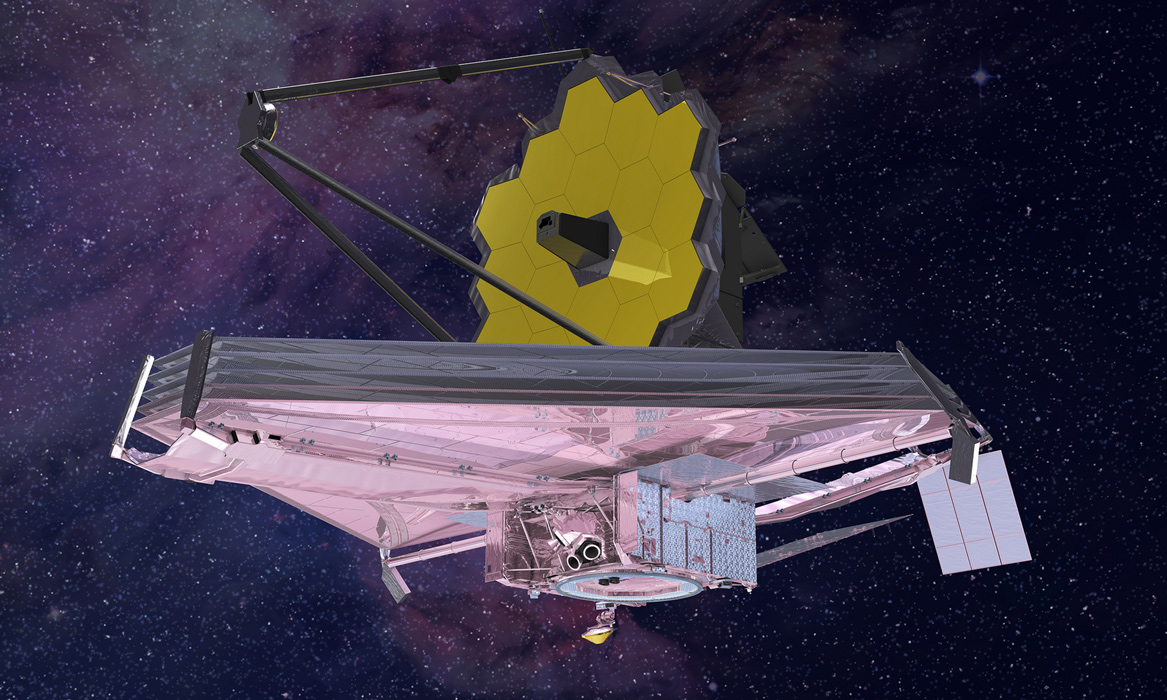
Well, that joke is less potent now. Early on Christmas morning, this imposing instrument, with its signature gold-plated mirror, was successfully launched from French Guiana.
Assuming all continues to go well, the JWST will arrive at its designated parking space, about a million miles behind the Earth (as seen from the Sun), near the end of January.
Why exile the telescope to this reclusive site? Because James Webb needs to chill out to work. If it set up shop any closer to Earth, reflected sunlight would slightly warm the telescope, blinding its view. Its operating temperature is 377 degrees colder than the windblown peak of Mt. Everest.
Unlike Hubble, this newest addition to astronomy’s bestiary surveys the sky at infrared wavelengths, similar to night vision cameras. It can see things thanks to the warmth that any object has. That includes asteroids, planets orbiting other stars, and the faint, dull-red glow of galaxies billions of light-years distant.
This last talent will allow James Webb to examine the universe’s childhood, soon after the Big Bang. It’s a time machine with a dial that goes back more than 13 billion years. With this ability, James Webb can tackle one of the most fundamental questions in science, namely how did the universe become what we observe today?
But there’s something else just as enticing on the wish list of this new instrument: Finding life beyond Earth.
Obviously, there’s no hope of seeing animals, plants, or Klingons at the several light-years’ distance of even the nearest other star system. But what James Webb can do is snap photos of exoplanets – worlds that orbit other suns. Since 1995, astronomers have discovered more than four thousand exoplanets. But only a handful of these have been photographed. The overwhelming majority have been found by measuring the subtle effects they have on their host stars; either shaking them slightly or periodically blocking some of their light.
James Webb promises to do better: To make pictures of medium-size exoplanets. Worlds that are two to three times the diameter of Earth. The images would be disappointing to shutterbugs; the planet would only appear as a one-pixel dot. But astronomers have had nearly two centuries of experience teasing good information out of bad photos. They could pass the light from that dot through a high-tech prism, spreading it out into a rainbow, or spectrum. The detailed structure of that spectrum will tell them what’s in the planet’s atmosphere.
For example, if you look at the spectrum of Mars, you’ll find telltale indicators of carbon dioxide. The same for Venus. Not too exciting. But if you were an alien studying Earth, you’d find more than just CO2. You’d see oxygen – the accumulated exhaust gas from billions of years of photosynthesis. That would probably get you tenure at Klingon U., because it would be strong evidence that Earth has life.
Discovering oxygen or a few other so-called “biomarkers” in a planet’s atmosphere is a powerful way to sense biology at great distance. Our alien astronomer might have gone beyond gaining tenure and won a Klingon Nobel Prize if he had the extraordinary luck to examine our terrestrial spectrum in the late 1980s. That’s because there was something else in our air besides the oxygen, carbon dioxide, nitrogen and other humdrum gases that have enveloped Earth for billions of years. Chlorofluorocarbons – CFCs – were also in the mix. They were added to our atmosphere beginning in the 1930s by air conditioners, refrigerators and even hair spray. Those gases eventually caused a problem for us – the shrinking of the ozone hole above Antarctica. Sensible policies have allowed us to tamp down this anthropogenic gas. But for a half century the presence of CFCs would have fingered Earth as a world with technically competent inhabitants for anyone studying it from afar.
Turning this situation around, some scientists have wondered if James Webb could spot such artificially produced gases in the atmosphere of an exoplanet, and thereby conclude that it hosted intelligent life. Despite the seductive nature of this idea, it wouldn’t be easy to do because we’d need to be incredibly lucky to find anything in an exoplanet’s atmosphere that came and went in fifty years’ time. That would be like buying a winning lottery ticket: The potential payoff is huge, but the odds are long.
Even discovering photosynthetic plants by sensing their oxygen output would disappoint Trekkies. After all, wielding a ten-billion-dollar telescope to find alien pond scum might not be satisfying. But that underestimates how much humanity’s world view would change by uncovering even microscopic life on a distant planet.
That’s because today we know of only a single instance of biology in the entire universe. Life beyond Earth is a nice idea and has been for a long time. But once James Webb starts its reconnaissance of the heavens, that idea could become the stuff of textbooks: A proven fact.







News
Related News

Jun 29, 2026
Humanity's Plan for First Contact: Who Speaks for Earth?
#Blog #Lauren Sgro #Lucian Walkowicz #Chelsea Haramia #SETI #SETI Institute
Jun 9, 2026
Disclosure Needs Data
#SkyMapper #Franck Marchis #SETI #citizen science
Jun 8, 2026
The Sounds of Intelligence: A Conversation with 2026 Drake Award Recipient Lori Marino
#Blog #Drake Awards #Lori Marino #SETI
Jun 5, 2026
Beyond Disclosure Day: The Real-World Protocols
#Press Releases #SETI #Astronomy #Bill Diamond #SETI Institute
Jun 4, 2026
SETI Institute In the News: May Roundup 2026
#SETI Institute in the News #SETI Institute #Community #Solar System #Matija Ćuk #Neptune #SETI #Bill Diamond #UAPs #Drake Awards #Lori Marino #Matthew Tiscareno #Outreach #Exoplanets #Carl Sagan Center
Jun 3, 2026
SETI Institute Looks for Signs of Technology in Interstellar Visitor 3I/ATLAS
Observations with the Allen Telescope Array set new limits on possible signals from extraterrestrial transmitters. #Press Releases #ATA #3I/ATLAS #Hat Creek Radio Observatory #Radio Astronomy #SETI
Jun 29, 2026
#Blog
#Lauren Sgro
#Lucian Walkowicz
#Chelsea Haramia
#SETI
#SETI Institute
Jun 9, 2026
#SkyMapper
#Franck Marchis
#SETI
#citizen science
Disclosure Needs Data
Jun 8, 2026
#Blog
#Drake Awards
#Lori Marino
#SETI
The Sounds of Intelligence: A Conversation with 2026 Drake Award Recipient Lori Marino
Jun 5, 2026
#Press Releases
#SETI
#Astronomy
#Bill Diamond
#SETI Institute
Beyond Disclosure Day: The Real-World Protocols
Jun 4, 2026
#SETI Institute in the News
#SETI Institute
#Community
#Solar System
#Matija Ćuk
#Neptune
#SETI
#Bill Diamond
#UAPs
#Drake Awards
#Lori Marino
#Matthew Tiscareno
#Outreach
#Exoplanets
#Carl Sagan Center
SETI Institute In the News: May Roundup 2026
Jun 3, 2026
SETI Institute Looks for Signs of Technology in Interstellar Visitor 3I/ATLAS
Observations with the Allen Telescope Array set new limits on possible signals from extraterrestrial transmitters.
#Press Releases
#ATA
#3I/ATLAS
#Hat Creek Radio Observatory
#Radio Astronomy
#SETI
Research
Related Projects

SkyMapper • SETI • Citizen Science • Astronomy
SkyMapper: Expanding Access to Real-time Astronomy Through a Global Astronomical Network
SkyMapper and the SETI Institute are connecting educators, students and the public to live astronomical observations through a distributed astronomical network. #SkyMapper #SETI #Citizen Science #Astronomy
VPL
Virtual Planetary Laboratory
How can we best assess whether an exoplanet supports life? #VPL
Discovery and Futures Lab
Discovery and Futures Lab
What happens if life beyond Earth is discovered? The Discovery and Futures Lab at the SETI Institute fosters novel and anticipatory research at the intersection of science, society, our planet, and the search for life beyond Earth. #Discovery and Futures Lab
May 17, 2026
SkyMapper: Expanding Access to Real-time Astronomy Through a Global Astronomical Network
SkyMapper and the SETI Institute are connecting educators, students and the public to live astronomical observations through a distributed astronomical network.
#SkyMapper
#SETI
#Citizen Science
#Astronomy
May 5, 2026
Virtual Planetary Laboratory
How can we best assess whether an exoplanet supports life?
#VPL
Apr 16, 2026
Discovery and Futures Lab
What happens if life beyond Earth is discovered? The Discovery and Futures Lab at the SETI Institute fosters novel and anticipatory research at the intersection of science, society, our planet, and the search for life beyond Earth.
#Discovery and Futures Lab
Support Us
Support the
SETI Institute
Scientists are getting closer in their search for life beyond earth. But with limited federal funding for the search for extraterrestrial intelligence, supporters are the reason cutting-edge scientists can keep their eyes on the sky.
