)

Monday, Aug 04, 2025

Aram Chaos. Image Credit: NASA/JPL-Caltech/University of Arizona.
August 5, 2025, Mountain View, CA – New research published in Nature Communications identifies an iron sulfate on Mars that may represent a brand-new mineral. Sulfur is common on Mars and combines with other elements to form minerals, especially sulfates. While most sulfates are highly soluble and readily dissolve on Earth during rainfall, on the dry surface of Mars these minerals can survive for billions of years and preserve important clues on the planet’s early history. Each mineral has a unique crystal structure and properties, including the common minerals gypsum and hematite. Scientists rely on data collected by Mars orbiters to identify minerals on the surface and obtain information about former martian environments that would have enabled the formation of these minerals. For nearly 20 years, researchers have been puzzled by unusual, layered iron sulfates with a unique spectral signature. Now, a study led by Dr. Janice Bishop, senior research scientist at the SETI Institute and NASA’s Ames Research Center in California’s Silicon Valley, has identified and characterized an uncommon ferric hydroxysulfate phase by combining laboratory experiments with Mars orbital observations. The discovery adds new insight into how heat, water, and chemical reactions shape the martian surface.
“We investigated two sulfate-bearing sites near the vast Valles Marineris canyon system that included mysterious spectral bands seen from orbital data, as well as layered sulfates and intriguing geology,” said Bishop.
The study included a region called Aram Chaos, located northeast of Valles Marineris where ancient water drained away toward lower regions in the north, and also the plateau above Juventae Chasma, a 5-km-deep canyon located just north of Valles Marineris (Figure 1).

Figure 1. Mars Orbiter Laser Altimeter (MOLA) map of Valles Marineris region with higher elevations in red and lower elevations in yellow, green and then blue tones.
Juventae Plateau (above Juventae Chasma):
Near the cliffs of Valles Marineris, this area holds clues to Mars's wetter past. There are signs of ancient water channels across the landscape, but scientists found sulfates in just one small, low-lying spot, likely left behind when pools of sulfate-rich water slowly dried up, forming hydrated ferrous sulfates. These minerals, including ferric hydroxysulfate, appear as thin meter-thick layers occurring both above and beneath basaltic materials (Figure 2), suggesting they were heated from lava or ash after formation.
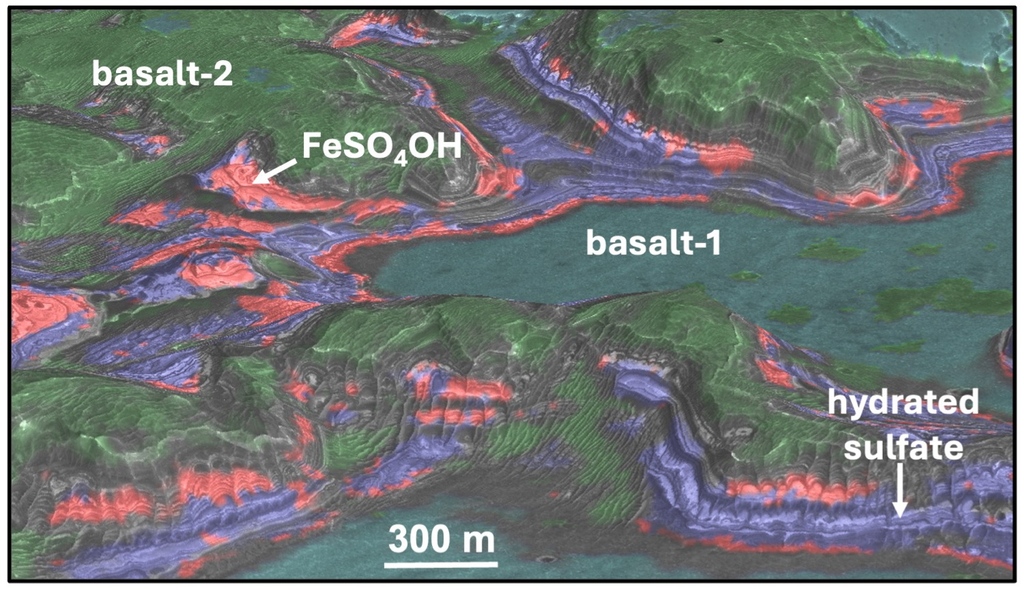
Figure 2. A view of the plateau above Juventae Chasma with compositional units from the Compact Reconnaissance Imaging Spectrometer for Mars (CRISM) instrument showing a lower basalt unit in cyan (basalt-1), polyhydrated sulfates in blue, the ferric hydroxysulfate phase in red, and a different basalt unit on top (basalt-2) in medium green over a High Resolution Imaging Science Experiment (HiRISE) DTM (5x vertical exaggeration).
“Investigation of the morphologies and stratigraphies of these four compositional units allowed us to determine the age and formation relationships among the different units,” said Dr. Catherine Weitz, a co-author on the study and Senior Scientist at the Planetary Science Institute.
Aram Chaos:
Researchers have observed sulfate minerals throughout the Valles Marineris region, including in the rugged landscapes known as chaotic terrains—areas they believe were carved and shaped by powerful floods in the past. As water gradually dried up, it left behind layered deposits of iron and magnesium sulfates, subtle but powerful clues that Mars was once much wetter. In one chaos terrain that formed within a former impact crater, the upper layers contain polyhydrated sulfates, while monohydrated and ferric hydroxysulfate layers lie beneath (Figure 3).
Each of these three sulfates has distinct spectral signatures that can be identified from orbit using the CRISM instrument (Figure 4). While the stratigraphy of these three sulfates was initially puzzling, lab tests showed that heating polyhydrated sulfates to 50°C produces monohydrated forms, and heating above 100°C produces ferric hydroxysulfate, supporting the idea that geothermal heat caused the minerals to transform. Monohydrated and polyhydrated sulfates occur across broad regions (green and blue in Figure 4, respectively), while ferric hydroxysulfate is limited to only a few small regions (red in Figure 4). The warmest geothermal sources likely sat beneath the sites where ferric hydroxysulfate appears today, although more may lie buried under monohydrated sulfates.

Figure 3. Views of Aram Chaos region. a) Mars Express High Resolution Stereo Camera (HRSC) image with compositional units from CRISM marking polyhydrated sulfates (PHS) in blue, monohydrated sulfates (MHS) in green, and ferric hydroxysulfate in red (N is towards the right). b) HiRISE view of region in yellow box where all three sulfate types are in close proximity (north is up).
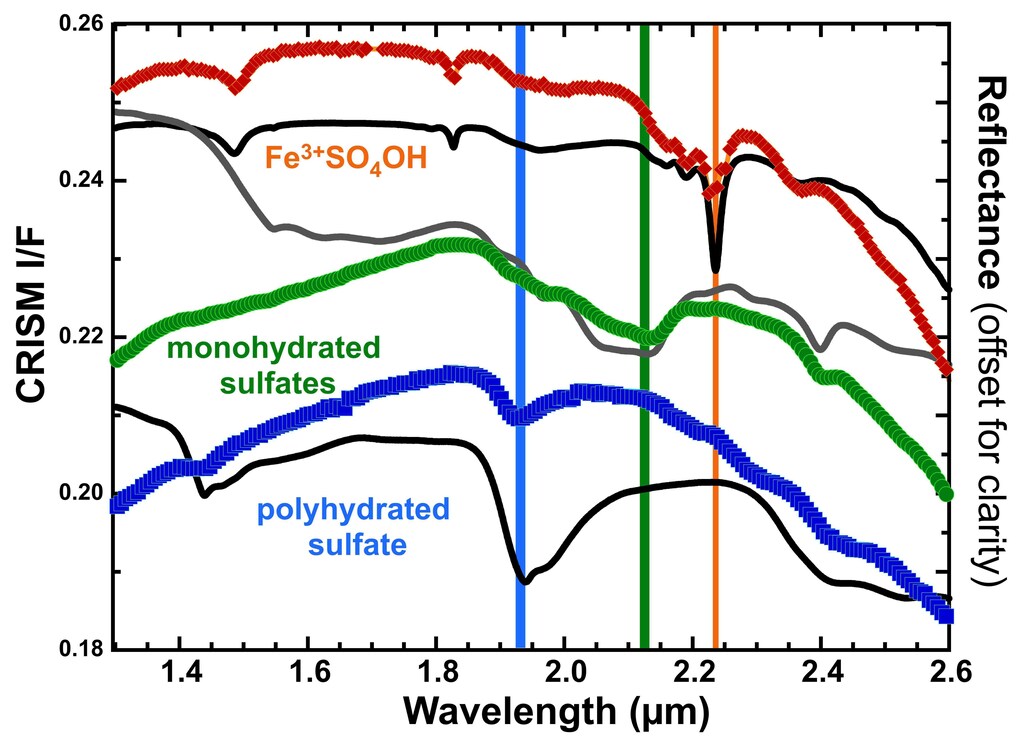
Figure 4. Spectra of the polyhydrated sulfates (blue squares), monohydrated sulfates (green circles), and ferric hydroxysulfate (red diamonds) measured by the CRISM instrument at Aram Chaos and compared to laboratory spectra (dark lines). Note the sharp narrow band at 2.236 µm in the ferric hydroxysulfate spectrum.
Researchers at the SETI Institute and NASA Ames conducted lab experiments to determine how these sulfates transformed—from rozenite (Fe²⁺SO₄·4H₂O) with four water molecules per unit cell, to szomolnokite (Fe²⁺SO₄·H₂O) with one, and finally to ferric hydroxysulfate, which contains OH instead of H₂O in its structure.
“Our experiments suggest that this ferric hydroxysulfate only forms when hydrated ferrous sulfates are heated in the presence of oxygen,” said postdoctoral researcher Dr. Johannes Meusburger at NASA Ames. “While the changes in the atomic structure are very small, this reaction drastically alters the way these minerals absorb infrared light, which allowed identification of this new mineral on Mars using CRISM (Figure 4).”
The reaction requires oxygen gas and produces water (Equation 1). Today, Mars has a thin atmosphere mostly consisting of CO2, but still has enough oxygen for this reaction to proceed and for oxidation of other forms of iron as well.
Equation 1: 4 Fe2+SO4·H2O + O2 4 Fe3+SO4OH + 2H2O
“The material formed in these lab experiments is likely a new mineral due to its unique crystal structure and thermal stability,” said Bishop. “However, scientists must also find it on Earth to officially recognize it as a new mineral.”
Interestingly, this new ferric hydroxysulfate appears structurally similar to szomolnokite, a monohydrated ferrous sulfate mineral, but ferric hydroxysulfate forms more easily from rozenite, a tetrahydrated mineral.
This transformation from hydrated ferrous sulfates to ferric hydroxysulfate only happens at temperatures above 100°C, much hotter than what Mars usually experiences at the surface. The sulfates at Aram Chaos and Juventae, including the ferric hydroxysulfate, likely formed more recently than the terrain in which they occur, possibly during the Amazonian period (<3 billion years ago).
This study reveals that heat from both volcanic activity at the Juventae Plateau and geothermal energy below Aram Chaos can transform common hydrated sulfates into ferric hydroxysulfate. The findings suggest parts of Mars have been chemically and thermally active more recently than scientists once believed—offering new insight into the planet's dynamic surface and its potential to have supported life.
The paper, Characterization of Ferric Hydroxysulfate on Mars and Implications of the Geochemical Environment Supporting its Formation, is published in Nature Communications here.
About the SETI Institute
Founded in 1984, the SETI Institute is a non-profit, multi-disciplinary research and education organization whose mission is to lead humanity’s quest to understand the origins and prevalence of life and intelligence in the universe and share that knowledge with the world. Our research encompasses the physical and biological sciences and leverages data analytics, machine learning, and advanced signal detection technologies. The SETI Institute is a distinguished research partner for industry, academia, and government agencies, including NASA and the National Science Foundation.







News
Related News

Jun 5, 2026
Beyond Disclosure Day: The Real-World Protocols
#Press Releases #SETI #Astronomy #Bill Diamond #SETI Institute
Jun 3, 2026
SETI Institute Looks for Signs of Technology in Interstellar Visitor 3I/ATLAS
Observations with the Allen Telescope Array set new limits on possible signals from extraterrestrial transmitters. #Press Releases #ATA #3I/ATLAS #Hat Creek Radio Observatory #Radio Astronomy #SETI
Jun 1, 2026
SETI Institute Awards $1 Million in STRIDE Grants to Advance Astrobiology, Exoplanet Science, and Public Engagement
#Press Releases #STRIDE #Research #Carl Sagan Center #Spectroscopy #Solar System #SETI #Climate and Bioscience #Astronomy #Astrobiology #Exoplanets #Data Science #Education #Outreach #Hat Creek Radio Observatory #Unistellar #SkyMapper
May 13, 2026
SETI Institute to Honor Dr. Matthew Tiscareno with 2026 Carl Sagan Center Director’s Award
The Drake Awards event will also recognize SETI Forward and SETI Institute REU student award recipients. #Press Releases #Drake Awards #Frank Drake #SETI #Awards #Planetary Astronomy #Astrobiology #SETI Forward #Education #Carl Sagan Center #Matthew Tiscareno #Nathalie Cabrol #REU
May 7, 2026
SETI Institute In the News: April Roundup 2026
#SETI Institute in the News #SETI Institute #Community #SETI #Discovery and Futures Lab #Lucian Walkowicz #Chelsea Haramia #NASA Missions and Observatories #Pascal Lee #Mars #Janice Bishop #Mark Showalter #JWST #Uranus #Bill Diamond #UAPs
May 4, 2026
SETI Institute Announces Nominees for the Speculative Life BioArt Residency
Six international artists shortlisted for a new residency at the intersection of art, astrobiology, and biotechnology #AIR #SETI Institute #Speculative Life #Astrobiology #Danielle Siembieda #Nathalie Cabrol
Jun 5, 2026
#Press Releases
#SETI
#Astronomy
#Bill Diamond
#SETI Institute
Jun 3, 2026
SETI Institute Looks for Signs of Technology in Interstellar Visitor 3I/ATLAS
Observations with the Allen Telescope Array set new limits on possible signals from extraterrestrial transmitters.
#Press Releases
#ATA
#3I/ATLAS
#Hat Creek Radio Observatory
#Radio Astronomy
#SETI
Jun 1, 2026
#Press Releases
#STRIDE
#Research
#Carl Sagan Center
#Spectroscopy
#Solar System
#SETI
#Climate and Bioscience
#Astronomy
#Astrobiology
#Exoplanets
#Data Science
#Education
#Outreach
#Hat Creek Radio Observatory
#Unistellar
#SkyMapper
SETI Institute Awards $1 Million in STRIDE Grants to Advance Astrobiology, Exoplanet Science, and Public Engagement
May 13, 2026
SETI Institute to Honor Dr. Matthew Tiscareno with 2026 Carl Sagan Center Director’s Award
The Drake Awards event will also recognize SETI Forward and SETI Institute REU student award recipients.
#Press Releases
#Drake Awards
#Frank Drake
#SETI
#Awards
#Planetary Astronomy
#Astrobiology
#SETI Forward
#Education
#Carl Sagan Center
#Matthew Tiscareno
#Nathalie Cabrol
#REU
May 7, 2026
#SETI Institute in the News
#SETI Institute
#Community
#SETI
#Discovery and Futures Lab
#Lucian Walkowicz
#Chelsea Haramia
#NASA Missions and Observatories
#Pascal Lee
#Mars
#Janice Bishop
#Mark Showalter
#JWST
#Uranus
#Bill Diamond
#UAPs
SETI Institute In the News: April Roundup 2026
May 4, 2026
SETI Institute Announces Nominees for the Speculative Life BioArt Residency
Six international artists shortlisted for a new residency at the intersection of art, astrobiology, and biotechnology
#AIR
#SETI Institute
#Speculative Life
#Astrobiology
#Danielle Siembieda
#Nathalie Cabrol
Research
Related Projects

SkyMapper • SETI • Citizen Science • Astronomy
SkyMapper: Expanding Access to Real-time Astronomy Through a Global Astronomical Network
SkyMapper and the SETI Institute are connecting educators, students and the public to live astronomical observations through a distributed astronomical network. #SkyMapper #SETI #Citizen Science #Astronomy
VPL
Virtual Planetary Laboratory
How can we best assess whether an exoplanet supports life? #VPL
Discovery and Futures Lab
Discovery and Futures Lab
What happens if life beyond Earth is discovered? The Discovery and Futures Lab at the SETI Institute fosters novel and anticipatory research at the intersection of science, society, our planet, and the search for life beyond Earth. #Discovery and Futures Lab
May 17, 2026
SkyMapper: Expanding Access to Real-time Astronomy Through a Global Astronomical Network
SkyMapper and the SETI Institute are connecting educators, students and the public to live astronomical observations through a distributed astronomical network.
#SkyMapper
#SETI
#Citizen Science
#Astronomy
May 5, 2026
Virtual Planetary Laboratory
How can we best assess whether an exoplanet supports life?
#VPL
Apr 16, 2026
Discovery and Futures Lab
What happens if life beyond Earth is discovered? The Discovery and Futures Lab at the SETI Institute fosters novel and anticipatory research at the intersection of science, society, our planet, and the search for life beyond Earth.
#Discovery and Futures Lab
Support Us
Support the
SETI Institute
Scientists are getting closer in their search for life beyond earth. But with limited federal funding for the search for extraterrestrial intelligence, supporters are the reason cutting-edge scientists can keep their eyes on the sky.
